

HCPCS Code L0472: Hyperextension TLSO billing guide
HCPCS code L0472: Official descriptor and device definition HCPCS code L0472 des...

Last Updated: Nov 5, 2026
G8080 was the CCSD code for small bowel capsule endoscopy, including interpretation and evaluation. CCSD Bulletin 196 inactivated it, with a recommended adoption date of 8 August 2024.
For capsule endoscopy since then, bill G8087, Capsule endoscopy of GI system. The same bulletin added it and retired the upper GI (G8081) and colon (G8086) capsule codes. Check each insurer's switch-over date before resubmitting an older claim.
Let Pabau's smart automation suggest the right codes, reduce claim denials, and keep your practice compliant—effortlessly.
Automate repetitive tasks and focus on what matters most—your patients.
Reduce coding errors and ensure compliance with the latest regulations.
Clean claims, fewer denials, and faster reimbursements.
Powerful insights and reporting to help your practice thrive.
HIPAA compliant SOC 2 certified GDPR-compliant Trusted by 4,000+ clinics worldwide

CCSD code G8080, small bowel capsule endoscopy including interpretation and evaluation, is inactivated and should not appear on new private claims.
CCSD Bulletin 196 inactivated G8080 with a recommended adoption date of 8 August 2024, alongside the upper GI (G8081) and colon (G8086) capsule codes.
The same bulletin added G8087, Capsule endoscopy of GI system, which is the current CCSD code for billing capsule endoscopy.
Prior authorisation, a documented indication, failed prior investigations and a dated consultant report still decide whether a capsule endoscopy claim gets paid.
Pabau, our practice management platform, supports CCSD code entry and Healthcode claims, so practices can swap G8080 for G8087 before the next claim goes out.
CCSD code G8080 was the Clinical Coding and Schedule Development (CCSD) code for small bowel capsule endoscopy, including interpretation and evaluation. It is no longer an active code.
The CCSD Working Group inactivated G8080 in CCSD Bulletin 196, dated 13 June 2024. The bulletin gives a recommended adoption date of 8 August 2024, and says the changes may be implemented before then.
The same bulletin inactivated the two sibling capsule codes: G8081 for upper GI capsule endoscopy and G8086 for colon capsule endoscopy. It also added one new code, G8087, Capsule endoscopy of GI system.
The CCSD schedule is maintained by the CCSD Group, a joint body representing UK medical associations and private insurers. CCSD codes are alphanumeric: one letter followed by four digits. The letter denotes the body system, and G8080 sits in Chapter 10, Endoscopic gastrointestinal tract. Neighbouring endoscopy procedures are listed in our searchable CCSD library.
No. G8080 is listed under Inactivation in CCSD Bulletin 196, so it should not be used for capsule endoscopy performed after the change was adopted.
The bulletin sets a recommended adoption date rather than a fixed cut-off. For episodes dated around August 2024, check which code each insurer accepted at the time.
For capsule endoscopy carried out today, a claim carrying G8080 is likely to come back as an invalid code. Update the code in your fee schedule and service list before the next claim goes out.
Bill G8087, Capsule endoscopy of GI system, for capsule endoscopy. The bulletin that inactivated G8080 added G8087 at the same time, with the same recommended adoption date.
The G8087 narrative names the GI system as a whole, not one segment of it. In practice, that single code takes the place of the three regional capsule codes the bulletin retired, as the diagram shows.
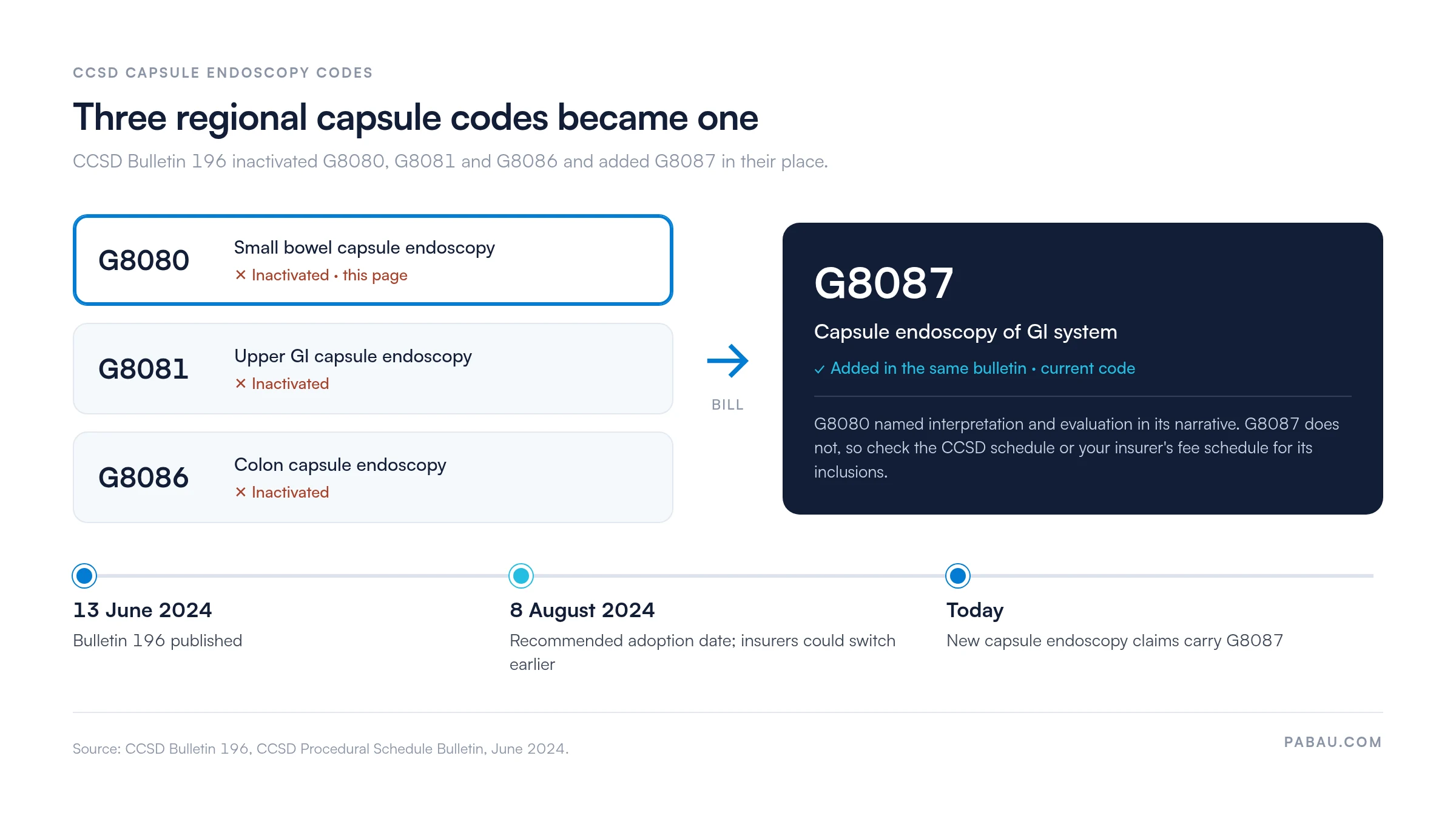
Unlike G8080, the G8087 narrative does not say whether interpretation and evaluation are included. Check the current CCSD schedule or your insurer’s fee schedule for its inclusions and fee before you apply the old bundling rules.
Four CCSD codes cover capsule endoscopy, and three of them are now inactive. The table below sets out how each one relates to G8080. US practices bill the same test under CPT 91110, which never appears on a UK private claim.
Capsule endoscopy uses a swallowable wireless camera capsule to image the gut. Each step below feeds both the clinical record and the documentation a billing team needs.
Private medical insurers require documented medical necessity before they pay for capsule endoscopy. Accepted indications generally follow British Society of Gastroenterology (BSG) guidance on its appropriate use.
Payers typically expect evidence that conventional investigations came first and did not find the source. Missing evidence is a common cause of denial, so record prior investigations in the referral letter and procedure notes.
The G8080 narrative bundled the capsule study with its interpretation and evaluation. The table shows what the narrative settles and what it leaves to the CCSD principles. That boundary still matters when you review or appeal claims raised under the old code.
Refer to the CCSD Technical Guide for the general coding rules, and check how G8087 is described in the current schedule. Individual insurer fee schedules may add further restrictions.
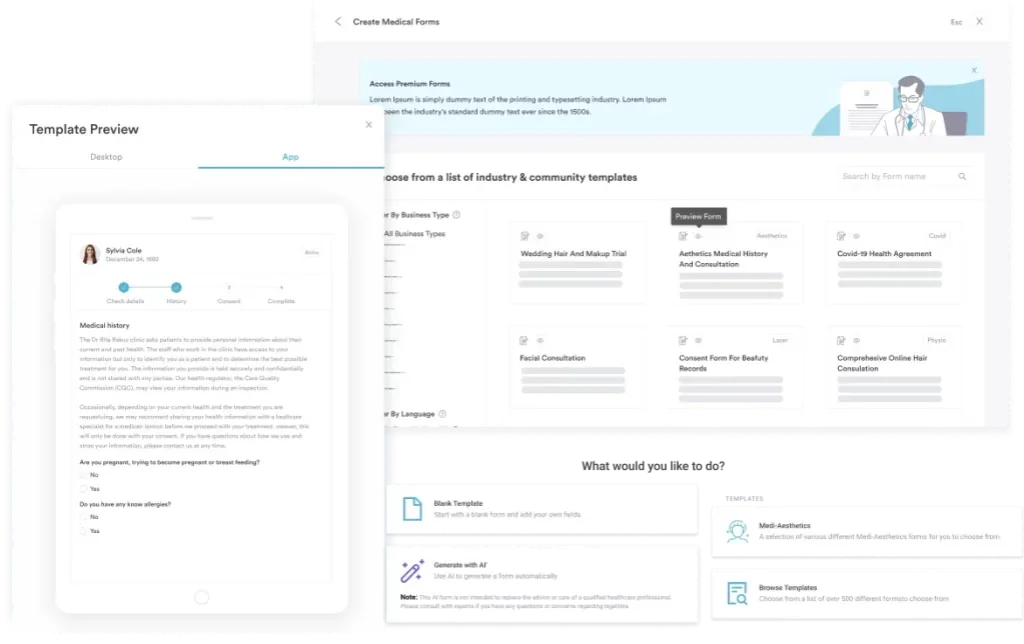
A complete procedure record is the strongest defence against denial. Each element below should appear in the clinical notes before the claim is submitted. Practices using digital clinical forms can build these fields into one capsule endoscopy template, so none is missed at the point of care.
Search your fee schedule and saved service codes for G8080 before your next capsule endoscopy claim. Then flag any claim missing the prior investigation history or a dated report, two common causes of first-pass denials.
Most UK private medical insurers require prior authorisation before they pay for capsule endoscopy. The authorisation reference must appear on the claim form. Claims without it may be rejected, so confirm each insurer’s process.
Make sure the authorisation request names G8087, not G8080, so the reference matches the code on the claim.
Requirements vary by insurer and policy year, so confirm the current position with each payer before scheduling. Major PMI providers known to apply pre-authorisation to specialist investigations like this include Bupa, AXA Health, Vitality Health and Aviva Health. Practices billing several insurers benefit from one standard way of tracking authorisation references.
The typical prior authorisation process follows these steps:
Capsule endoscopy denials follow predictable patterns. Most are preventable with a structured pre-submission check.
Capsule retention occurs when the device does not pass through the gut within the expected timeframe, most often because of an unsuspected stricture. Published studies report retention in roughly 1 to 2 percent of small bowel studies.
Rates are higher in patients with known or suspected Crohn’s disease. Retention does not invalidate the capsule endoscopy claim, because the consultant still reviewed the images captured before the capsule stopped.
Handle the retention event like this:
A code change like this one is easiest to absorb when CCSD codes and insurer claims live in one system. Pabau handles CCSD code entry and submits claims to UK private medical insurers through Healthcode.
Billing teams update the capsule endoscopy service to G8087 once, then log each prior authorisation reference against the patient’s episode. Pabau’s claims management software pulls the details already on the patient record into the claim, then tracks it through Healthcode.
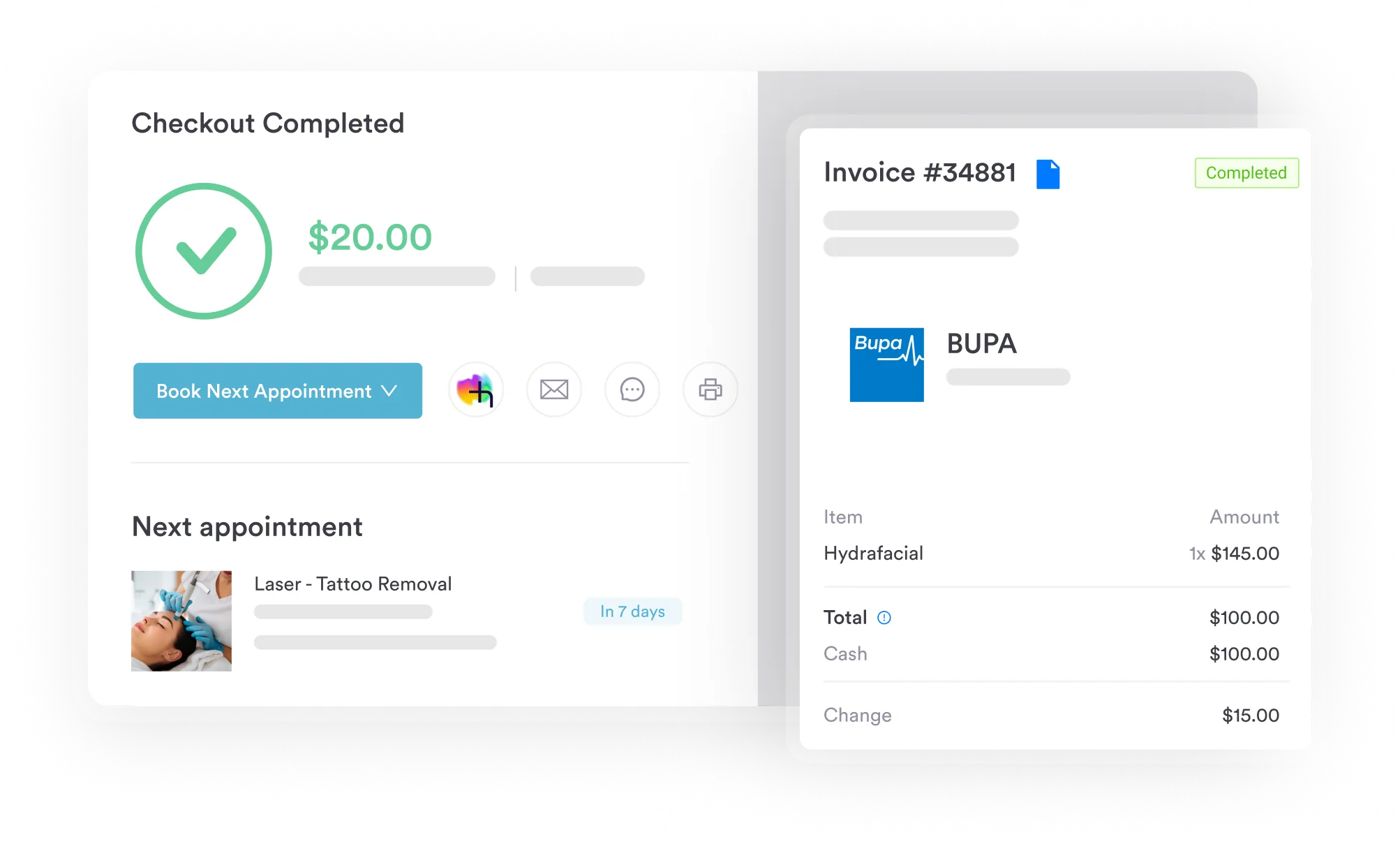
For gastroenterology practices running several capsule studies a week, the gain is in the pre-submission workflow. Each claim can be checked against the documentation checklist, with the authorisation reference and consultant GMC number confirmed in one place.
The same workflow covers Bupa CCSD codes and the other major UK PMI providers. Patient records sit alongside billing, so procedure reports and insurer letters stay against the same patient episode.
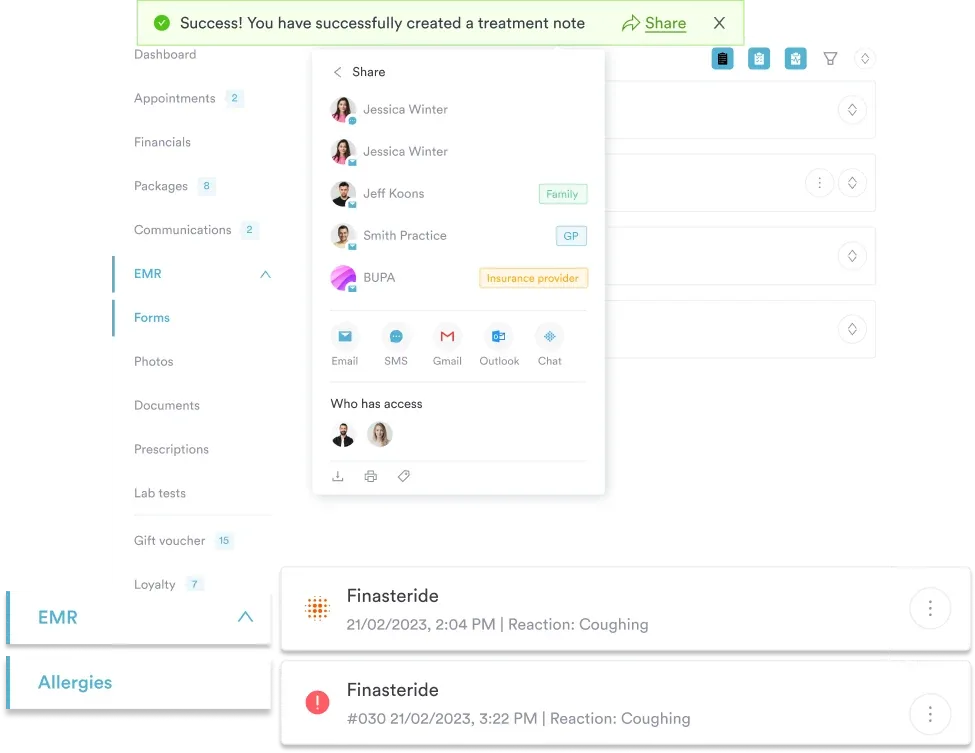

Pabau helps gastroenterology and private practice teams track CCSD codes, record authorisation references, and submit clean claims to UK private medical insurers without chasing paperwork.

G8080 is a retired code, and the fix is simple once you know it. CCSD Bulletin 196 inactivated it with a recommended adoption date of 8 August 2024, and G8087 is now the code for capsule endoscopy.
The bigger risk is an old code sitting quietly in a fee schedule or saved service list. Update it once, then keep authorisation references, indications and dated reports complete on every claim. To see how Pabau handles CCSD code workflows and private insurer claims, book a demo.

Billing other CCSD codes for private insurers? Bupa CCSD codes and billing guide covers the Bupa procedure code schedule and submission requirements.
Billing capsule endoscopy for US patients? CPT code 91110: Capsule endoscopy billing explains the US code, rates and documentation rules.
Coding a lower GI scope instead? CCSD code H2510: Rigid sigmoidoscopy covers rigid sigmoidoscopy with proctoscopy and biopsy.
Want to reduce claim rejection rates across your practice? Claims management software shows how Pabau builds claims from the patient record and tracks them.
No. CCSD Bulletin 196, dated 13 June 2024, lists G8080 under Inactivation with a recommended adoption date of 8 August 2024. Do not use it on claims for current capsule endoscopy.
The same bulletin added G8087, Capsule endoscopy of GI system. It also inactivated the upper GI (G8081) and colon (G8086) capsule codes, so G8087 is the code to bill for capsule endoscopy now.
G8080 covered small bowel capsule endoscopy, including interpretation and evaluation. The capsule study and the consultant’s written report were billed under that one code, with no separate code for reading the images.
The G8087 narrative, Capsule endoscopy of GI system, does not say. Check the current CCSD schedule or your insurer’s fee schedule before you bill the report separately or assume it is bundled.
Most UK private medical insurers require prior authorisation before they pay for capsule endoscopy. Request it under G8087 and put the reference on the claim form. Policies vary by insurer and policy year, so confirm first.
Common reasons are an inactive code such as G8080, a missing authorisation reference and thin indication notes. An undated report, unjustified same-day bundling with a colonoscopy and late submission also trigger denials.



