CPT Code 98981: RTM Treatment Management Billing Guide
CPT code 98981: Definition and official descriptor CPT code 98981 is an add-on c...

Last Updated: Nov 9, 2026
C3960 is the CCSD code for excision of pterygium. It covers surgical removal of a pterygium from the conjunctiva and cornea, whatever technique the surgeon uses.
The code sits in Chapter 4 (Eye and orbital contents) of the CCSD Schedule of Procedures, used by UK private medical insurers. CCSD publishes no fees, so each insurer sets its own rate and expects pre-authorization before surgery.
Let Pabau's smart automation suggest the right codes, reduce claim denials, and keep your practice compliant—effortlessly.
Automate repetitive tasks and focus on what matters most—your patients.
Reduce coding errors and ensure compliance with the latest regulations.
Clean claims, fewer denials, and faster reimbursements.
Powerful insights and reporting to help your practice thrive.
HIPAA compliant SOC 2 certified GDPR-compliant Trusted by 4,000+ clinics worldwide

CCSD code C3960 is the UK private-sector code for excision of pterygium, in Chapter 4 (Eye and orbital contents) of the CCSD schedule.
CCSD publishes codes and narratives but no fees, so insurers such as Bupa and AXA Health each price C3960 from their own schedules.
The excision technique does not change the code, but a graft or adjuvant radiotherapy line needs clearing with the insurer before you invoice it.
UK practices use WHO ICD-10, where pterygium is H11.0 with no laterality. ICD-10-CM splits it by eye: H11.001, H11.002, H11.003 and H11.009.
UK insurers expect pre-authorization before planned pterygium surgery, and the authorization number belongs on the C3960 invoice.
CCSD code C3960 is the code for excision of pterygium in the CCSD Schedule of Procedures.
The Clinical Coding & Schedule Development (CCSD) Group maintains that schedule for UK private healthcare. Insurers such as Bupa, AXA Health, Freedom Health and National Friendly use it to identify procedures on invoices.
The official CCSD descriptor for C3960 is Excision of pterygium. It applies when an ophthalmologist surgically removes a pterygium from the conjunctiva and corneal surface. The descriptor names no technique, so bare sclera excision and graft-based repair share the same code.
The code sits in Chapter 4 of the procedural schedule, Eye and orbital contents, where every code begins with a C prefix. Insurer fee schedules, such as National Friendly’s, class C3960 as a Minor complexity procedure. Our CCSD code guides cover other procedures in the schedule in the same format.
CCSD publishes no fees. Its Technical Guide leaves complexity bands and reimbursement to each funder. The amount you invoice therefore comes from the patient’s insurer, never from the CCSD schedule itself.
A pterygium is a benign, fibrovascular growth of conjunctival tissue that spreads onto the cornea from the nasal or temporal limbus. Surgery is indicated when it threatens the visual axis, causes chronic irritation that conservative treatment has not settled, or grows quickly. Clearance before refractive surgery is another common reason for referral.
The main surgical approaches include:
Anesthesia is usually topical or local, often a sub-Tenon block, for primary cases. General anesthesia is reserved for anxious patients or complex bilateral surgery. Most cases run as day surgery.
CCSD aims for a single code to describe the whole procedure in most cases. It also lists unacceptable combinations against each code, which are pairs that should not appear on the same invoice. The Technical Guide treats those lists as guidelines, and each insurer decides what it pays.
The table below shows how the common parts of a pterygium operation relate to C3960. Where a line says to check with the insurer, confirm it before surgery rather than after a query.
Several Chapter 4 codes cover other conjunctival procedures. Choosing one of them for a pterygium, or adding one without checking, is a common source of queries. The descriptors below match our guide to C3950 and published insurer schedules.
The CCSD Schedule itself needs a login to search, so confirm descriptors there or in the insurer’s schedule before invoicing. For how the schedule is organized and how Bupa applies it, see our UK CCSD guide.
CCSD updates its schedule on a regular publication cycle and recommends adopting changes within two months. Check C3960 and any second code against the schedule in force on the date of surgery.
Where an insurer or your billing system asks for a diagnosis, UK practices use the WHO edition of ICD-10. In that edition, pterygium is a single code, H11.0, with no laterality. Record the operated eye in the notes and on the pre-authorization, because the code will not carry it.
Software built on ICD-10-CM, the US edition, uses a more detailed set. There, H11.00 (unspecified pterygium of eye) is a parent code and not billable. The table lists the codes that are.
Use the most specific code the notes support. If the diagnosis, the operation note and the authorization name different eyes, expect the insurer to query the invoice.
Pterygium excision is usually a day procedure under topical or local anesthesia. Each part of the episode is invoiced by the person or facility that provided it, and C3960 covers the surgeon’s procedure only.
UK private medical insurers expect the patient to obtain pre-authorization before planned surgery. Bupa, AXA Health, Aviva and Vitality all ask members to contact them before treatment. An invoice without an authorization number is likely to be queried or rejected.
Requirements differ by insurer and policy. When the insurer asks the surgeon for supporting details, the request typically covers:
Most policies exclude cosmetic treatment, so record the functional reason for surgery. Confirm the authorization number in writing and keep it in the patient file. Quote it on the invoice with the consultant’s details and the date of surgery.
The diagram below traces the operated eye and the authorization number through the four documents an insurer may compare.
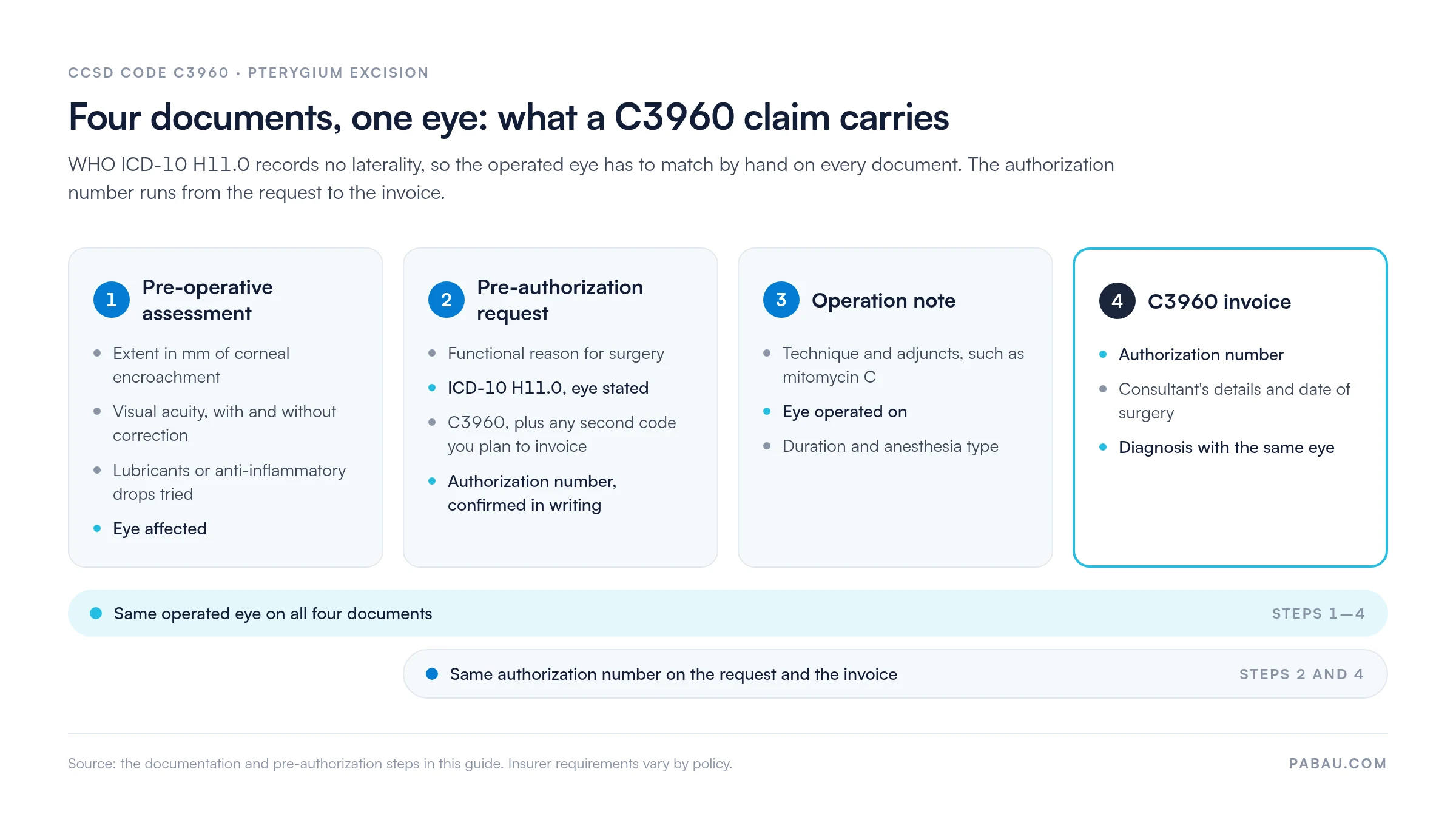
A complete clinical record supports a payable C3960 invoice. Insurers may request notes when they review eye surgery claims, especially where a graft line or both eyes appear. The pre-operative assessment and the operation note must together support each line.
Key documentation elements include:
In Pabau, the practice software we build, clinical records keep operation notes and pre-operative assessments in the patient file. Digital clinical forms can capture pterygium extent and technique in the same fields for every patient.
Queries and rejections on C3960 usually trace back to a few recurring causes. Most are preventable before the invoice goes out.
C3960 still applies to recurrent pterygium, because its descriptor does not separate primary from recurrent surgery. Recurrent cases are harder, though. The scleral bed may be scarred, tissue planes are disrupted and the risk of further recurrence is higher.
In WHO ICD-10, recurrent pterygium still codes to H11.0. ICD-10-CM has its own recurrent codes, H11.061 to H11.063 and H11.069. When requesting authorization for a recurrent case, include:
Mitomycin C is used more often in recurrent cases. Whether it can appear as a separate line depends on the insurer, so get written confirmation first. If the revision needs a further code, such as a graft, check its descriptor and unacceptable combinations in the current CCSD schedule.
For a recurrent pterygium, send the original operation note with the new request. Insurers can then see the first surgery, the documented recurrence and the reason for the revision technique in one package.
Many ophthalmology practices still keep authorization numbers in emails or spreadsheets and retype them onto each invoice. One missed number sends the claim back, and the team loses days reworking it.
Pabau’s claims management stores each insurer pre-authorization as a case. Attach the case when you book the surgery, and the authorization code follows the appointment through to the claim. A claim with no case attached is flagged before it goes out.
UK claims go out through Healthcode and Bupa, and the insurers you can reach come from Healthcode’s own payer list. Insurers outside Healthcode can still be invoiced as third parties. The claims dashboard tracks each claim from Pending to Paid, so an overdue C3960 invoice shows up without a manual chase.

Pabau stores each insurer pre-authorization as a case and sends private medical insurance claims through Healthcode, so C3960 invoices leave the practice complete.

Choosing C3960 is the easy part of a pterygium claim. Claims stall on what surrounds the code. The usual culprits are a missing authorization number, an eye recorded differently across documents, or a bundled graft line.
Settle bundling and bilateral questions with the insurer when you book the surgery. That extra call takes minutes, while a queried invoice can take weeks to resolve.
Book a demo to see how Pabau links pre-authorizations to claims for UK private ophthalmology practices.

Need a broader CCSD reference? Our UK CCSD guide explains how the schedule is organized and how Bupa applies CCSD codes.
Giving radiotherapy after a pterygium excision? CCSD code C3950 covers radiotherapy to conjunctival lesion and when to ask the insurer before invoicing it.
Looking to reduce claim rework across your practice? Pabau’s claims management links pre-authorizations to claims and tracks each one from Pending to Paid.
Coding the same operation for a US payer? CPT code 65426 covers excision of pterygium with a graft under the US code set.
CCSD code C3960 covers excision of pterygium, the surgical removal of conjunctival tissue growing onto the cornea. It applies whatever technique the surgeon uses. A graft or adjuvant treatment line needs checking against the insurer’s rules before you invoice it.
In the WHO ICD-10 used in the UK, pterygium is H11.0, with no laterality. ICD-10-CM splits it by eye: H11.001 is the right eye, H11.002 the left, H11.003 both eyes and H11.009 an unspecified eye. H11.00 itself is a parent code.
C3960 covers the excision whatever technique closes the wound. Whether a separate graft code is paid depends on C3960’s unacceptable combinations and the insurer’s bundling rules. Confirm with the insurer before invoicing both.
Yes. UK private medical insurers such as Bupa and AXA Health expect pre-authorization before planned surgery. Quote the authorization number on the invoice, because a claim without one is likely to be queried or rejected.
Yes. C3960 applies to recurrent pterygium as well as primary cases, since its descriptor does not separate them. Send the original operation note, evidence of recurrence and the reason for any graft or mitomycin C with the authorization request.
No. CCSD publishes codes and descriptors, not fees. Each insurer sets its own rate and complexity band, so check the patient’s insurer schedule, such as Bupa’s code search tool, before invoicing.