CPT code 93503: Swan-Ganz catheter billing and modifiers
CPT code 93503: Official descriptor and procedure overview In the AMA CPT code s...

Last Updated: Oct 23, 2026
C0213 is the CCSD code for excision of lesion of orbit – lateral orbitomy. It covers removing an orbital lesion after the surgeon temporarily takes down the lateral orbital wall to reach the space behind the eye.
UK private medical insurers such as Bupa, AXA Health, Aviva and Vitality use the code. It sits in Chapter 4 (Eye and orbital contents), section 4.1 Globe and orbit, with a Major complexity rating. An anterior approach without bone removal bills as C0212.
Let Pabau's smart automation suggest the right codes, reduce claim denials, and keep your practice compliant—effortlessly.
Automate repetitive tasks and focus on what matters most—your patients.
Reduce coding errors and ensure compliance with the latest regulations.
Clean claims, fewer denials, and faster reimbursements.
Powerful insights and reporting to help your practice thrive.
HIPAA compliant SOC 2 certified GDPR-compliant Trusted by 4,000+ clinics worldwide

CCSD code C0213 covers excision of an orbital lesion through a lateral orbitotomy, where the surgeon takes down the lateral orbital wall to reach it.
An anterior approach without bone removal bills as C0212 instead, and the CCSD Technical Guide treats C0212 and C0213 as an impossible pairing.
Each UK private insurer sets its own fee for C0213. Freedom Health’s January 2026 schedule rates it Major and pays the specialist £550.
Most UK insurers expect pre-authorization for orbital surgery, so confirm the route with the patient’s insurer and record the reference before the procedure.
Pabau, the practice software we build, records pre-authorization references and submits and tracks insurer claims through Healthcode.
The table below gives a quick-reference summary of the code, its official descriptor and its billing context in UK private medical insurance. The descriptor comes verbatim from the CCSD Technical Guide.
“Orbitomy” is the schedule’s own spelling, although some insurer schedules print “orbitotomy”. Use the CCSD wording on claims and correspondence, and browse our other CCSD code guides for the rest of the schedule.
A lateral orbitotomy is a surgical procedure in which the surgeon temporarily removes part of the lateral orbital wall to reach the retrobulbar space. The wall is formed by the zygomatic bone and the greater wing of the sphenoid. The approach gives direct reach to lesions in the posterior and lateral orbit that an anterior route cannot reach safely.
The classic technique is often called the Krönlein orbitotomy, after the surgeon who described it in the late 19th century. In current oculoplastic practice the steps follow a consistent sequence:
Surgeons choose the lateral approach when the lesion sits behind the globe or involves the lacrimal gland fossa. It also suits lesions where an anterior route would risk the optic nerve. The approach decides the code. C0213 applies only when the surgeon takes down the lateral wall, and an anterior approach without bone removal bills as C0212.
C0213 fits when the surgical plan needs lateral orbital wall access to excise a discrete lesion. UK insurers expect a WHO ICD-10 diagnosis code alongside the CCSD procedure code. These are four-character codes, shorter than the US ICD-10-CM codes many online lookups return. The table below maps common indications to codes in the WHO ICD-10 browser.
Removing a retained foreign body from the orbit is not a C0213 indication, because the schedule gives it its own code, C0640. A tumor that needs the entire orbital contents removed moves to C0110 instead. For malignant indications, check how the patient’s policy handles cancer treatment. Many UK policies fund it under a separate cancer benefit, with its own limits and authorization route.
A superficial lesion at the inner or outer corner of the eye sits outside the orbit, and bills under CCSD code C1110 instead. Where the surgeon excises the lesion from the eyelid itself, the claim is CCSD code C1210.
Selecting the correct CCSD orbital code depends on the surgical approach and intent, not on the diagnosis alone. The table below sets C0213 against its neighbors in section 4.1, with complexity ratings from Freedom Health’s January 2026 schedule of fees. Billing the wrong approach code for the same lesion is a coding error and can lead to an insurer query or audit.
The operative report decides code selection. If the note describes a lateral wall osteotomy to reach and excise a discrete mass, C0213 is correct.
If it describes bone removal to reduce intraorbital pressure in Graves orbitopathy, C0630 applies, even when the surgeon also accessed the lateral wall.
If it describes removal of the eyeball itself with an orbital implant placed in the same operation, the claim is C0122.
If the surgeon opens the orbit and removes no lesion, the claim moves to C0650 as a sole procedure. The guide below runs through those checks in order.
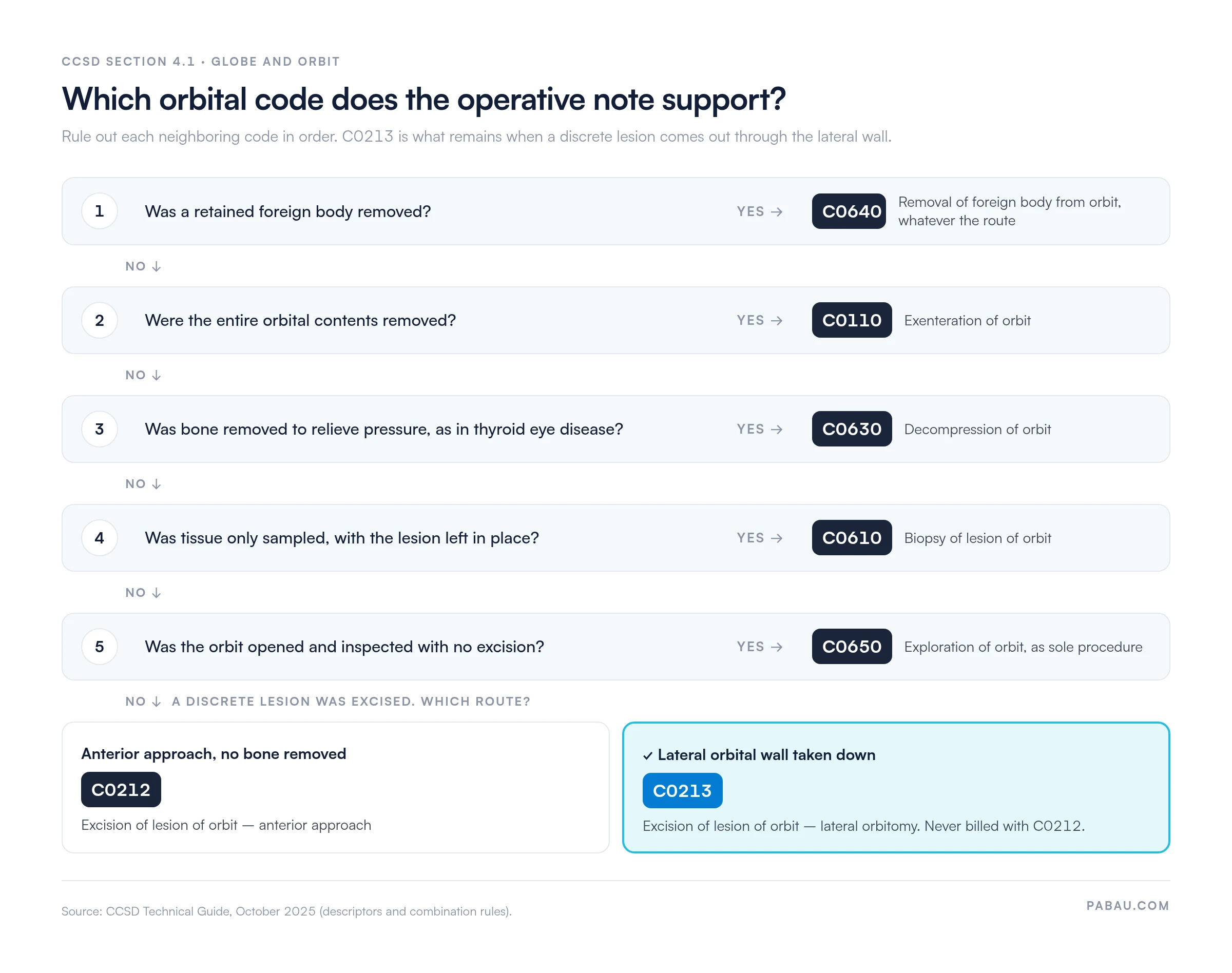
A complete operative report is the most important document behind a C0213 claim. Insurers’ clinical reviewers use it to check that the coded procedure matches the one performed. The operative note for a lateral orbitotomy must contain these elements:
Keep the supporting documents on file or ready to send on request. They include the histopathology report, the CT or MRI reports, the pre-authorization reference and the anesthetic record. Digital operative forms that capture these points at the time of surgery keep the record complete when the insurer reviews it weeks later.
Most UK private medical insurers expect pre-authorization before elective orbital surgery, including lateral orbitotomy. The patient usually calls their insurer for an authorization number, and the consultant’s team supplies the CCSD code and diagnosis. An insurer can reject a claim with no authorization reference before anyone reviews its clinical content.
Each insurer runs its own route, so check the patient’s policy before booking the operating room:
The clinical information insurers typically ask for on a C0213 request includes:
Record the authorization number in the patient file before the procedure. Insurers do not guarantee retrospective authorization for emergency surgery, so check the policy terms rather than relying on it.
Send the full clinical picture with the first pre-authorization request: the diagnosis code, the imaging report and the consultant’s summary. A request the insurer has to come back on can push past the surgery date and force a rebooking.
There is no single national tariff for C0213. Each UK insurer publishes its own fee schedule against CCSD codes and pays a recognized consultant up to that figure. Our guide to Bupa CCSD codes shows how one insurer applies the schedule. Freedom Health’s January 2026 schedule of fees rates C0213 Major, paying £550 to the specialist and £285 to the anesthetist.
Other insurers set different figures, so check the patient’s own insurer before quoting. Where a consultant’s fee is above the insurer’s schedule, the patient may face a shortfall. Tell them before the procedure, in writing. Keeping each insurer’s details in one system produces cleaner insurer claims, with fewer errors to correct after submission.
C0213 claims tend to fail for the same handful of reasons across UK insurers. Most rejections are preventable before the claim is sent. The list below covers the main triggers and the fix for each.
Start with the reason the insurer gives on its remittance or rejection notice. Most C0213 rejections come down to a missing reference or document, and those resolve with a corrected resubmission.
The ombudsman hears complaints from the policyholder, who generally has six months from the insurer’s final response to refer it. A consultant’s own fee dispute with an insurer stays within that insurer’s provider process.
Lateral orbitotomy is a low-volume procedure in most oculoplastic practices, so the billing team rarely builds a routine for it. A missing authorization reference or an incomplete note then goes unnoticed until the insurer rejects the claim.
Pabau keeps the operative note, imaging, histology and authorization reference on one patient file. Its claims management tool records the pre-authorization reference against the patient, submits the claim to Healthcode and tracks it through to payment.
The surgeon and coder still choose the code, and Pabau holds the paperwork that supports it. When the insurer asks for the operative note or the histology report, your billing team answers from the same record.

Keep operative notes, histology reports and pre-authorization references on one patient record. Then submit and track each insurer claim through Healthcode.

C0213 gets paid when the record proves the surgeon took down the lateral wall to remove a discrete lesion. Put the approach, the bone work, the side and the histology request in the operative note, and the choice against C0212 or C0630 defends itself.
The work sits before surgery. Authorization, the insurer’s fee and the patient’s shortfall all need settling before the surgery date. Each one settled removes a reason for the claim to come back.
Billing orbital surgery to UK private insurers? Book a demo to see Pabau keep the operative note, authorization reference and Healthcode claim on one patient record.

Draining the orbit instead? CCSD code C0620 sets out fees and documentation for drainage of orbit.
Need the wider schedule? CCSD code guides walk through other procedures in Chapter 4 and beyond.
CCSD code C0213 covers excision of a lesion of the orbit through a lateral orbitotomy. The surgeon temporarily removes the lateral orbital wall to reach and remove a mass, tumor or cyst behind the eye. UK private medical insurers use the code. An anterior approach without bone removal bills as C0212 instead.
Most UK private insurers, including Bupa, AXA Health, Aviva and Vitality, expect pre-authorization for elective orbital surgery. The patient usually obtains an authorization number from their insurer before the procedure. Without it, the insurer can reject the claim. Retrospective authorization for emergency surgery is not guaranteed, so check the policy terms.
Each insurer sets its own fee against the CCSD code. Freedom Health’s January 2026 schedule rates C0213 Major and pays £550 to the specialist and £285 to the anesthetist. Other insurers publish different figures, so check the patient’s own insurer before quoting a fee.
UK insurers use WHO ICD-10, so common pairings are D31.6 for a benign orbital neoplasm and C69.6 for a malignant one. A benign lacrimal gland tumor takes D31.5, and a cavernous hemangioma takes D18.0. C79.8 covers a secondary malignant lesion, and H05.1 covers granuloma of orbit. A retained foreign body is not a C0213 case, because it bills under C0640.
Lateral orbitotomy (C0213) removes a discrete lesion through a lateral approach, so the intent is excising a mass. Orbital decompression (C0630) removes orbital wall bone to reduce pressure, typically in thyroid eye disease. The operative note decides the code. Bone removed to reach a tumor points to C0213, and bone removed to decompress the orbit points to C0630.
The note must state that the lateral approach was used and describe the lateral wall osteotomy. It should record the side, the lesion’s location and characteristics, the excision technique and the specimen sent for histopathology. It also documents hemostasis and closure. Insurers query a note most often when it leaves out the approach or the histology request.
No. The surgeon invoices C0213 against the insurer’s specialist fee. The anesthetist bills separately, under the same CCSD code, against the insurer’s anesthetist fee. The insurer assesses the two fees independently, so never add anesthetic costs to the surgeon’s invoice.
First, ask the insurer to review the decision, with any missing document attached. If the patient is still unhappy, they can make a formal complaint to the insurer. After the insurer’s final response, or eight weeks without one, they can refer it to the Financial Ombudsman Service free of charge.