CPT code 93503: Swan-Ganz catheter billing and modifiers
CPT code 93503: Official descriptor and procedure overview In the AMA CPT code s...

Last Updated: Oct 23, 2026
C0110 is the CCSD code for exenteration of orbit. It covers surgical removal of the entire contents of the bony orbit: the globe, extraocular muscles, orbital fat and periorbita, with or without the eyelids.
The code sits in section 4.1 (Globe and orbit) of Chapter 4 and carries a Major complexity rating. Removal of the globe or its contents alone is billed as C0120, or C0122 with an implant.
Let Pabau's smart automation suggest the right codes, reduce claim denials, and keep your practice compliant—effortlessly.
Automate repetitive tasks and focus on what matters most—your patients.
Reduce coding errors and ensure compliance with the latest regulations.
Clean claims, fewer denials, and faster reimbursements.
Powerful insights and reporting to help your practice thrive.
HIPAA compliant SOC 2 certified GDPR-compliant Trusted by 4,000+ clinics worldwide

CCSD code C0110 covers exenteration of the orbit, which removes the whole orbital contents. Enucleation and evisceration bill under C0120 instead.
Most UK insurers typically require pre-authorisation before orbital exenteration, so confirm the requirement with each insurer and record the reference number.
The operative note must document the exact structures removed, laterality, surgical intent and extent of resection to support the claim.
Pabau, the practice software we build, records pre-authorisation reference numbers and submits and tracks claims through Healthcode.
CCSD code C0110 is the CCSD (Clinical Coding and Schedule Development) code for exenteration of the orbit. It covers removal of the entire contents of the bony orbit. Oculoplastic and orbital surgeons bill it to UK private medical insurers such as Bupa, AXA Health, Vitality and Aviva.
C0110 sits in Chapter 4 (Eye and orbital contents), section 4.1 Globe and orbit, and published insurer schedules rate it Major complexity. The Clinical Coding and Schedule Development Group maintains the schedule used across UK private medical insurance. NHS activity uses OPCS-4 instead, so private claims pair a CCSD procedure code with an ICD-10 diagnosis code.
Code choice matters here because the neighbouring globe codes cover far less tissue. Our CCSD code guides explain the other procedures in Chapter 4 and beyond.
Oculoplastic surgeons, orbital surgeons and ophthalmologists with specialist orbital training perform and bill C0110. Surgeons rarely bill it, because they reserve complete orbital exenteration for cases where the eye and surrounding structures cannot be preserved. A code that billing teams meet only occasionally is easy to get wrong.
Orbital exenteration removes the entire contents of the bony orbit. That scope distinguishes it from every other orbital procedure in the CCSD schedule and governs when C0110 applies.
The structures removed depend on the variant performed:
The surgeon performs the procedure under general anaesthesia. They clear the orbit from the orbital rim inward, strip the periorbita from the bony walls and divide the orbital apex structures. Teams often plan reconstruction at the same operative encounter, and its separate coding question appears below.
The operative note must describe which variant was performed and which structures were included in the resection. A note that records only “orbital exenteration performed” without its anatomical scope will not support the claim. Insurers reviewing a C0110 claim look for the structures removed, named one by one.
Surgeons turn to orbital exenteration when malignant disease involves the orbital contents in a way that globe-preserving surgery, radiotherapy or chemotherapy cannot control alone. It is not a first-line intervention. Surgeons consider it when other treatment has failed or is not feasible, and the clinical record must show that reasoning.
Indications that typically support a C0110 claim include:
The ICD-10 diagnosis code on the claim varies with the indication. For malignant orbital tumours, codes from the C69 range (malignant neoplasm of eye and adnexa) commonly pair with C0110. For invasive eyelid malignancy, C44 codes apply. Check the exact code against the current NHS ICD-10 release, because version updates can change fourth- and fifth-character extensions.
A histopathology report confirming the diagnosis is a standard supporting document for malignancy-based C0110 claims. Insurers treat it as evidence of medical necessity, and its absence is a common reason for a query. Where the surgeon performs exenteration for infection, microbiological culture results play the same role.
These three procedures are the most often confused in orbital surgery coding. Exenteration has its own code, C0110, while enucleation and evisceration share C0120. Claiming C0110 for a globe-only procedure overstates the work, and billing C0120 after a full exenteration understates it. Either error invites an insurer query or audit.
The governing rule is simple. If the surgeon retains the scleral shell, the procedure is evisceration. If they remove the globe but leave the orbital fat and muscles largely intact, it is enucleation. Both bill under C0120, or C0122 when an orbital implant goes in at the same sitting. Only when the surgeon clears the complete orbital contents does C0110 apply, as the decision steps below show.
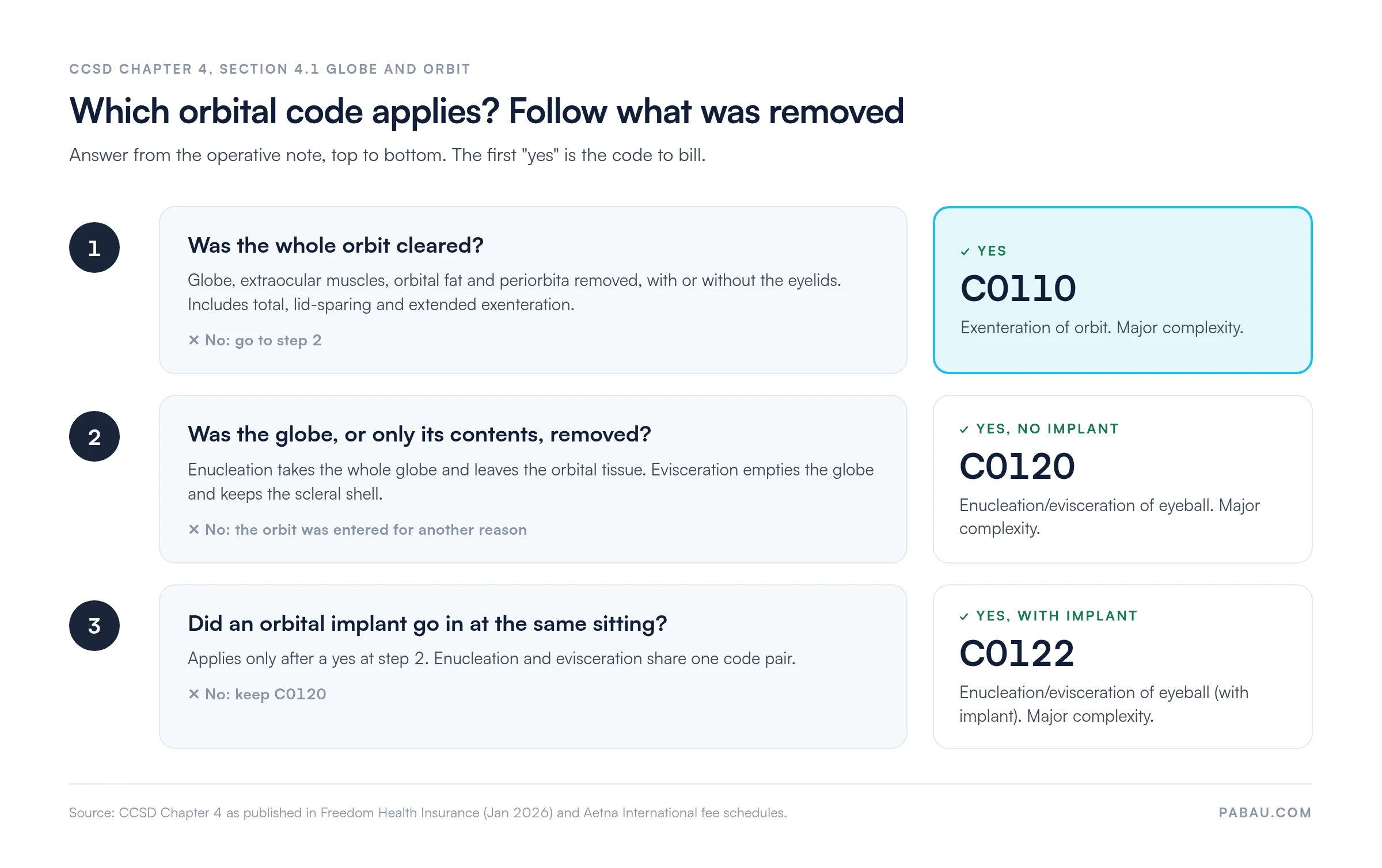
Check the current edition of the CCSD schedule before submitting, because codes and descriptors can change between editions.
C0110 sits in section 4.1, Globe and orbit, of Chapter 4. Several neighbouring codes cover procedures performed in the same operative setting or on the same patients. Knowing where each one stops prevents upcoding and bundling errors.
The one pairing the schedule rules out outright is C0110 with C0650, exploration of orbit as a sole procedure. For the other rows, confirm the position against the edition in use at the time of service, because the schedule is updated periodically.
When the globe and orbital contents survive the operation, C0110 is the wrong code. Targeted removal of a discrete orbital mass through a lateral orbitotomy bills as C0213. Decompression of the orbit, which enlarges the socket without clearing its contents, bills as C0630 instead.
The operative note is the foundational document for every C0110 claim. Exenteration is rare and costly per case, so insurers tend to read the note closely. A complete note makes a documentation query much less likely.
A structured operative-note template, with a field for each element below, stops a surgeon signing off a note that leaves one out.
The operative note must include:
Attach the histopathology or culture report to the claim file, or reference its specimen number in the operative note. Some insurers require pathology confirmation as a condition of payment.
Check your C0110 operative note template against the six elements above before submission. A note that names the procedure but omits laterality or the structures removed is likely to draw a request for more information, which delays payment.
Most insurers typically require pre-authorisation for orbital exenteration, so confirm the requirement with each insurer before surgery. Insurers can reject a C0110 claim without a pre-authorisation reference before anyone reviews its clinical content.
Pre-authorisation routes by insurer (check current policy directly before submitting, as rules change):
The clinical evidence insurers typically request for C0110 authorisation includes:
Record the authorisation reference number before the procedure takes place. Retrospective authorisation is not guaranteed, so check each insurer’s policy terms rather than relying on it.
CCSD does not use CPT-style modifiers, so C0110 carries no laterality modifier. The operative note records which orbit was treated. Bilateral exenteration is extremely rare. If it happens, confirm the bilateral and multiple-procedure rule with each insurer and the CCSD schedule notes before billing.
Insurers handle billing variations through their own tariff and schedule rules. The key bundling questions for C0110 are:
Reconstruction after orbital exenteration is a separate coding question from the exenteration itself. Three factors decide it: timing (same encounter or staged), technique (skin grafting, free flap, prosthetic fitting) and insurer policy.
The schedule carries its own socket reconstruction codes, C0512 to C0514, in the same Globe and orbit section. Whether an insurer pays one alongside C0110 at the same anaesthetic encounter varies. Confirm the bundling position with each insurer in writing before the procedure, because verbal guidance does not bind a claim.
Staged reconstruction happens at separate encounters, typically weeks to months later, once the socket has healed. Each staged encounter is a distinct claim with its own reconstruction code and the matching ICD-10 aftercare or complication code. It needs its own prior authorisation if the insurer requires one for surgical reconstruction.
Ocular prosthesis fitting is not a surgical procedure and sits outside the reconstruction codes. Ask the insurer how it funds the prosthesis before the patient is referred for fitting.
C0110 claims tend to fail for a handful of predictable reasons. The six below each have a straightforward prevention step.
Orbital surgery teams often hold the operative note, the pathology report and the pre-authorisation number in three different places. When the insurer queries a C0110 claim, someone has to chase each one down.
Pabau keeps those records on one patient file. Its claims management tool records the pre-authorisation reference number against the patient and submits the claim to Healthcode, then tracks it through to payment.
Coding and bundling decisions stay with the surgeon and coder. What changes is the paperwork around them. When the insurer asks for the operative note or histopathology, your billing team answers from the same record instead of waiting on the surgeon.
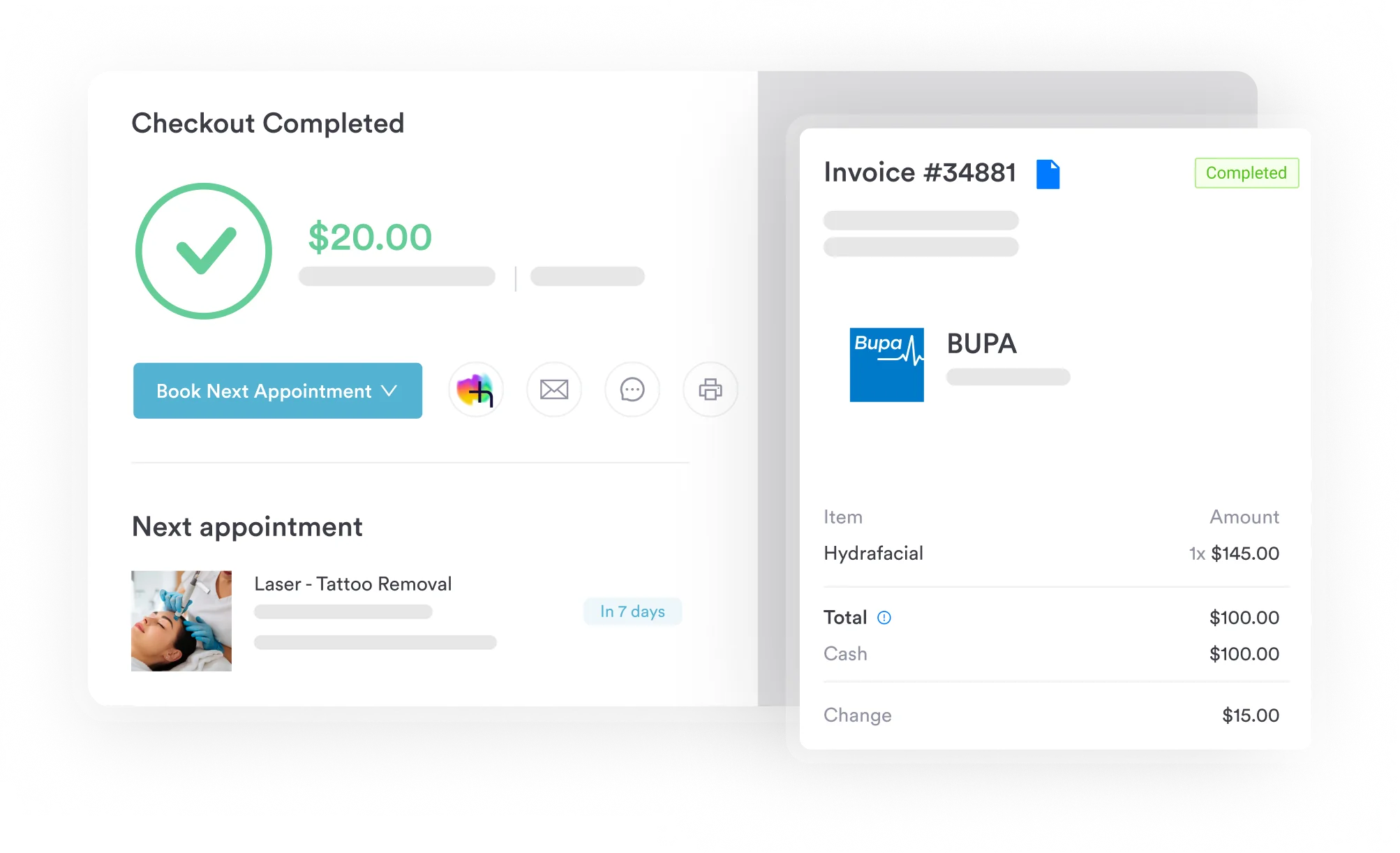

Keep operative notes, pathology reports and pre-authorisation numbers on one patient record. Then submit and track each claim through Healthcode.

C0110 pays only when the record proves the surgeon cleared the whole orbit. Put the variant, the side and each structure removed into the operative note, and the choice between C0110 and C0120 defends itself.
The trade-off is effort before surgery. Pre-authorisation, the pathology report and a written bundling answer from the insurer all take time up front. Each one removes a reason for the claim to come back as a query.
Billing orbital surgery privately? Book a demo to see Pabau keep the operative note, pre-authorisation reference and Healthcode claim on one patient record.

Need the neighbouring orbital code? CCSD code C0650 explains exploration of orbit as a sole procedure, the one code the schedule bars alongside C0110.
Billing a globe removal with an implant? CCSD code C0122 covers enucleation or evisceration of the eyeball when an orbital implant goes in.
Draining the orbit rather than clearing it? CCSD code C0620 sets out fees and documentation for drainage of orbit.
Need a reference for all Bupa CCSD codes? Bupa CCSD procedure codes covers the Bupa schedule with billing context for UK private practice.
Want to see how claims move from procedure to payment? Claims management software explains how Pabau records, submits and tracks claims through Healthcode.
CCSD code C0110 covers exenteration of the orbit. That is the surgical removal of the entire orbital contents, including the globe, extraocular muscles, orbital fat and periorbita, with or without the eyelids. It is used in UK private medical insurance billing and applies only when the whole orbit is cleared, not for enucleation or globe-preserving orbital procedures.
The operative note must include laterality, the exenteration variant and every structure removed. It also records the surgical intent (curative, palliative or debridement), the extent of resection and the reconstruction plan. Attach a histopathology or culture report confirming the indication to the claim file. Missing any of these elements is a frequent reason for a query.
Immediate reconstruction at the same operative encounter may or may not be separately billable, depending on the insurer. Staged reconstruction at a later encounter is billed with a socket reconstruction code such as C0512, C0513 or C0514. It needs its own prior authorisation where required. Confirm the bundling position with each insurer before submitting reconstruction codes alongside C0110.
Six reasons recur. The claim has no pre-authorisation reference, or it carries the wrong code, such as C0120 instead of C0110. The operative note may not name the structures removed, or the pathology report is missing. The side may differ between the pre-authorisation and the claim. Finally, a bundled procedure may be billed separately. This guide gives a prevention step for each.