Newborn feeding schedule: How much and how often by week
A newborn feeding schedule is a framework for how often and how much a baby eats...

3
Last Updated: Oct 13, 2026

Leaving the NHS for private practice is an 11-step process covering your contract, pension, indemnity, CQC registration, tax, systems, and patients.
The largest hidden cost is pension funding, because the NHS pays 23.7% of your pensionable pay into the scheme on your behalf.
Keeping one NHS session or a bank contract keeps you an active member, so your banked benefits still grow at CPI plus 1.5%.
Partial retirement lets you draw 20% to 100% of your pension while still working, if you cut your pensionable pay by 10%.
Practice management software like Pabau replaces the paper referrals, spreadsheets, and separate booking tools that new private practices typically piece together at the start.
Doctors and nurses across the NHS are asking the same question: whether it is time to go private.
Long hours, relentless admin, and the guilt of rushing patients through in ten minutes all feed burnout.
Going private is the usual answer. It also hands you the pension, the indemnity, the regulator, and the tax return to sort out yourself.
The route out takes 11 steps, from handing in your notice to seeing your first private patient. Your NHS pension is the step that decides whether the numbers work, so this guide puts figures on it.
NHS workload has grown significantly as resources have contracted. Three pressures come up consistently:
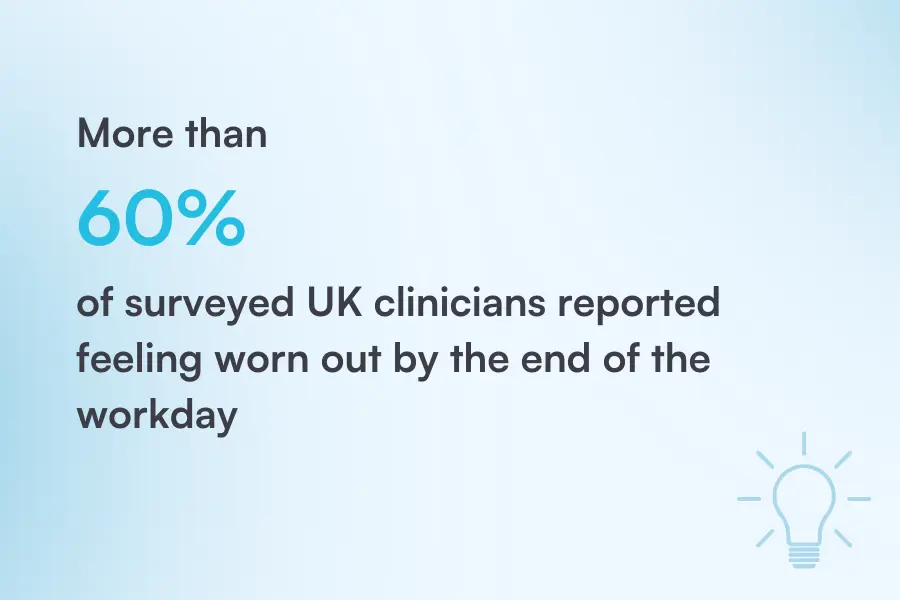
In the same study, 23% of doctors said they were considering a career switch. Burnout is pushing doctors to cut hours or leave clinical work entirely.
Patients are frustrated too. Waiting weeks for an appointment has pushed plenty of them to pay for faster access instead.
That shift in patient behavior is what makes private practice commercially viable, as it offers more control over schedule and higher earnings per session than most NHS roles allow.
Going private trades guaranteed pension accrual and job security for control of your own schedule. You gain higher earnings per session, and you take on every piece of admin and business risk.
The move changes seven things at once. Understand the benefits of private practice before you commit.
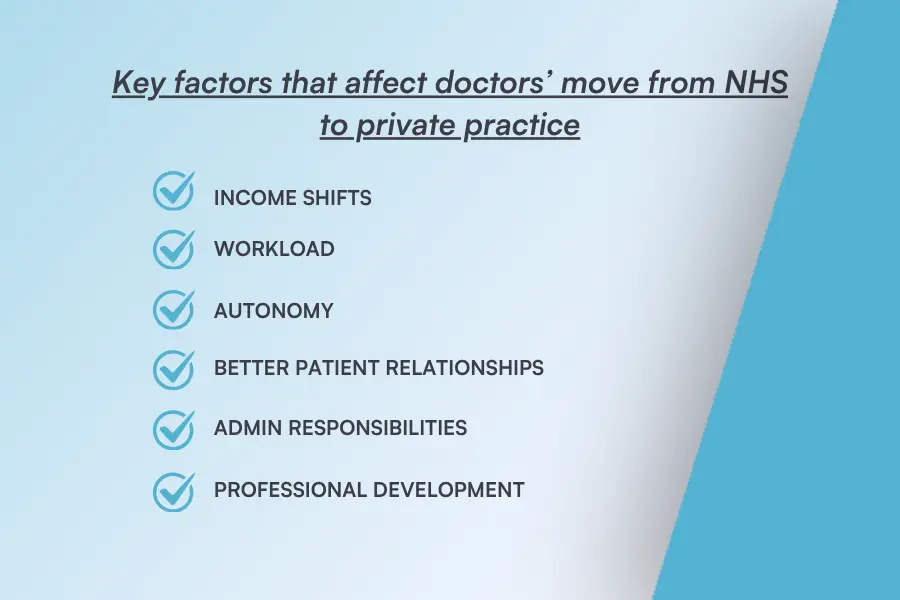
Two of those changes carry costs that are easy to underestimate. The first is timing, because a new list takes months to fill, and fees land after treatment rather than on payday.
The second is non-clinical time. You see fewer patients in a day, then spend the evening on invoices, letters, marketing, and compliance paperwork.
Autonomy is the payoff. You choose which treatments you offer, how long an appointment runs, and how your practice operates day to day.
The trade is more freedom and better pay per session. Against that, every part of the practice is now yours to run.
The choice comes down to available capital, your appetite for risk, and how much administrative control you want. Three routes are open to you:
If you want independence and have the capital, start your own practice. If you prefer a lower-risk entry, join an established setup first and negotiate a stake later.
A generalist practice sells access and continuity. A specialist practice sells one procedure or condition, and that difference decides where your patients come from.
Generalist work means longer appointments, same-week availability, and a broad list of self-pay patients who found you locally. Marketing has to work harder, because you are competing on convenience.
A specialist practice runs on referrals instead. Other GPs and consultants send you the cases they can’t take on, and insurers recognize you for a defined set of procedures.
That changes what you build first. A generalist practice needs a booking page and local visibility. A specialist practice needs a referral list, and a way to track where each referral came from.
Recognition by the main private medical insurers matters more to a specialist, because their fee schedules will set much of your income. Check those schedules before you commit to a niche.
Handing in your notice is only the first move. Here are the 11 steps, in the order they usually need doing.
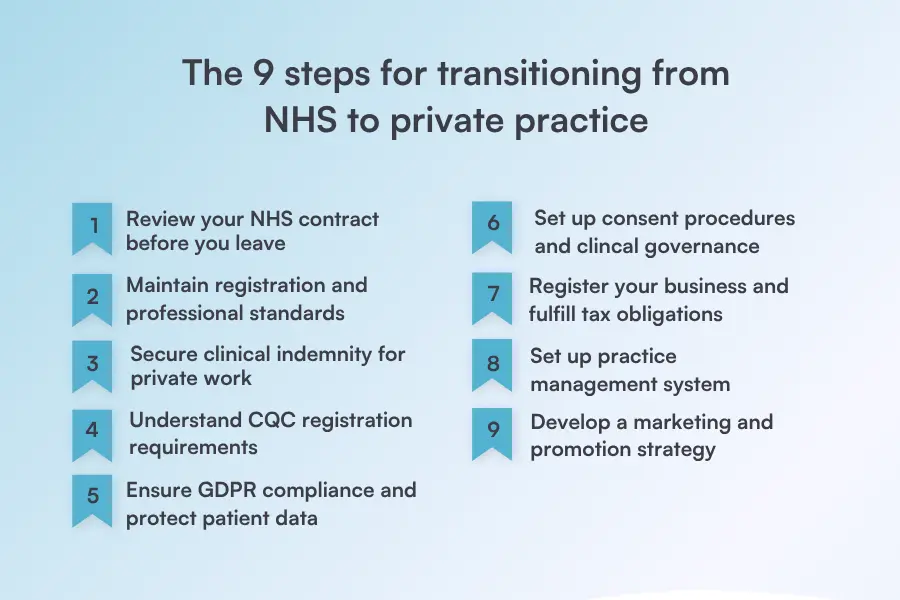
Your business plan starts with one number. Work out how many paid appointments a week you need to replace your NHS take-home pay.
Everything else hangs off that figure. It decides your premises, your staffing, and how quickly you can afford to leave.
A phased plan also keeps your pension accruing while you test demand. Treat the income targets below as a planning model, then swap in your own figures.
Dig out your NHS contract before you tell anyone. It sets your notice period and the rules on secondary employment, which together decide how soon private work can start.
Keep the two roles cleanly separate. Never use NHS staff, equipment, patient lists, or your NHS email address for private purposes.
Breaching secondary employment clauses can trigger disciplinary proceedings and, in serious cases, referral to the GMC.
You don’t lose your NHS pension when you leave, but it stops growing at the same rate. Benefits you have already earned stay yours and still rise with inflation each April.
What you give up is the employer funding and the extra growth that come with active membership. Two figures explain the size of it.
In the 2015 Scheme you build 1/54 of each year’s pensionable pay as a pension for life. On top of that, your employer pays 23.7% of your pensionable pay into the scheme.
A third figure is equally important. While you are an active member, everything you have already banked grows at CPI plus 1.5% a year. Once you stop contributing, it grows at CPI alone.
The £70,000 is an illustration, so run the same sums on your own pensionable pay. On these figures, leaving hands you back the £8,750 you were paying in, and costs you £16,590 of employer funding.
That is the number your private fees have to beat, on top of replacing your salary. Three levers let you keep some of it:
One old rule no longer applies. The 16-hour limit on your first month back after retirement was removed permanently on 1 April 2023. Members with 1995 Section benefits can now return and build new benefits too.
If you hold 1995 or 2008 Section benefits, watch the five-year clock. A break of five years or more in pensionable service breaks the final salary link.
Those benefits are then worked out on the pay you earned before the break, not on anything you earn later. A five-year gap can therefore reduce your eventual pension by more than the contributions you missed during the break.
Pension rules change, and your own position depends on which section you are in. Confirm it with NHS Pensions or an independent financial adviser before you resign.
Leaving the NHS doesn’t mean leaving the rules behind. Patients expect the same standards of professionalism and safety whether they pay or not.
You still need current registration with your regulator, and you still have to complete appraisal and revalidation. That means the General Medical Council (GMC) for doctors.
Your appraisal and revalidation currently run through your NHS employer. Identify a new responsible officer before you leave, so your revalidation isn’t delayed by a change of designated body.
Your NHS indemnity doesn’t follow you. Private work needs its own professional indemnity, arranged before you see your first fee-paying patient.
In English general practice, NHS work has been covered by the Clinical Negligence Scheme for General Practice (CNSGP) since 1 April 2019. Privately funded work sits outside CNSGP entirely.
The Medical Defence Union (MDU), the Medical Protection Society (MPS), and MDDUS all write cover for private practice. A policy normally includes:
None of the three publish a price list, so you will be quoted individually. Five things move the figure.
Budget for income protection in the same conversation. Once you are self-employed there is no NHS sick pay sitting behind you.
In England, private practices must understand the CQC’s role, then register with it before treating patients. The CQC checks that your intended services meet its safety, quality, and governance standards.
Start early. Getting CQC registered is not quick. The CQC aims to send its decision ten weeks after it validates your application, and that clock only starts once the paperwork is complete.
If your practice is based in Scotland, Wales, or Northern Ireland, a different regulator handles registration:
Their requirements differ in the detail, but the core principles are the same. Work through a CQC inspection checklist early, so registration and your first inspection ask for the same evidence.
In private practice you are personally responsible for GDPR compliance, not your employer. That starts with registering as a data controller with the Information Commissioner’s Office (ICO) and paying the annual data protection fee.
From there, four things need writing down and following:
Clinical photos need particular care. Images taken on a personal phone sit outside your records and outside your control. That’s a potential GDPR violation, avoidable with the right system.
Private consent is more than a signature. Patients need to complete their medical forms before the appointment and genuinely understand the treatment, the outcome, the risks, and the alternatives.
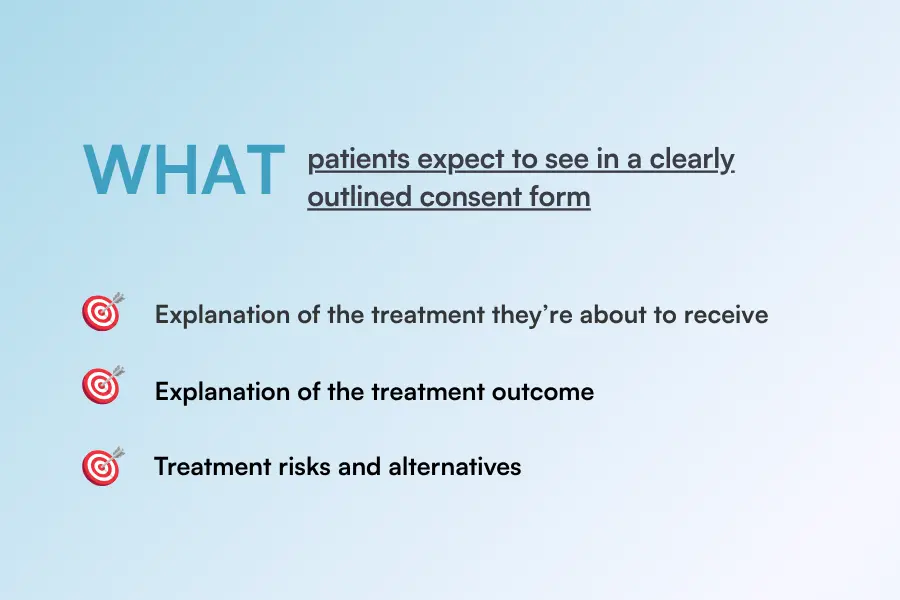
That means jargon-free conversations, checking what the patient expects, and writing it all down. Digital consent forms cut the risk of a missing signature or an unrecorded discussion.
Clinical governance sits underneath all of it. At a minimum you need three things documented:
These are the same standards regulators look for. They also demonstrate to patients that your practice operates to the same standards as any regulated provider.
Once you go private you are running a business as well as a medical practice. Three decisions come first.
VAT is worth taking advice on. Care provided by a registered health professional is normally VAT exempt where the purpose is to protect, maintain, or restore health.
Purely cosmetic work is standard-rated instead. A practice that mixes medical and cosmetic services can therefore cross the VAT threshold on part of its income, so get the split right early.
In the NHS the system was chosen for you. In private practice you choose it, and that choice shows up in how your evenings look six months in.
On paper and spreadsheets, one follow-up appointment means checking four places. The diary, the patient’s folder, the invoice pad, and the email thread the referral arrived in.
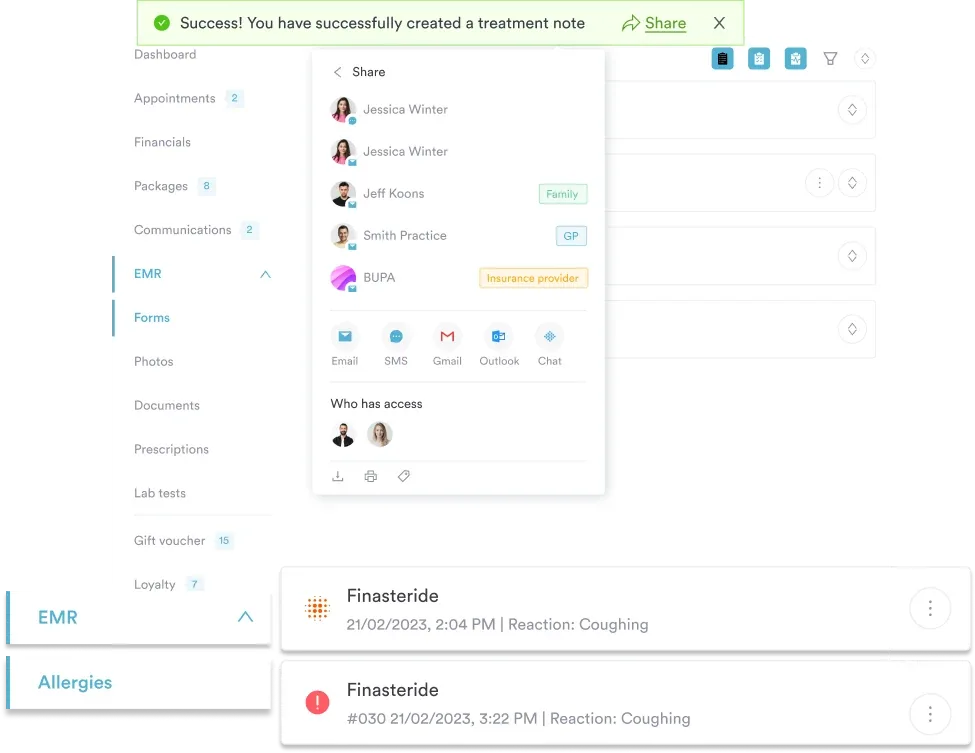
A practice EHR pulls those into a single patient timeline. A referral attaches to the patient, the appointment, the treatment note, and the invoice, so nothing gets copied across by hand.
What you need depends on your specialty. A GP list runs on letters, prescriptions, and lab results, while a physical therapy practice runs on treatment plans and block bookings. A private psychology list adds structured assessments such as the MMPI-2, which need to file into the same record.
When you compare a practice EHR against a booking tool, look for six things.
Practice management software like Pabau is built around that single record. Its features for GP practices include letter templates, centralized prescriptions, and lab results through The Doctors Laboratory.
A generic CRM looks like a cheap starting point. Juvea Medical replaced theirs with Pabau, after finding it lacked the clinical workflows a practice depends on.
Your first private patients will come from people who already know your name, not from advertising. So start with referrals rather than a campaign.
Tell former colleagues, local GPs, and consultants exactly what you now treat and how to send someone to you. A one-page referral form and a direct email address beat a contact form nobody trusts.
Then track it. If you can’t see which GP or insurer sent each patient, you can’t tell which relationship is worth your time. A structured referral program makes that visible.
Self-pay patients find you a different way, which is where the digital work earns its place. That means a professional website and a Google Business Profile, so you appear in local searches.
Referrals remain the most reliable patient acquisition channel in private practice. Partnering with local gyms, wellness centers, or community groups puts you in front of the patients you want.
In your first private month the admin looks manageable. One diary, a handful of patients, a few invoices.
By month six it isn’t. Bookings arrive by phone, email, and web form, consent forms need chasing, invoices need reconciling against insurer payments, and referrals need acknowledging.
Pabau keeps bookings, records, consent forms, invoicing, and referral tracking in one place. Its GP practice system adds prescriptions and connects everything through one patient timeline.
Forms arrive completed before the appointment, reminders go out without anyone typing them, and your invoices reconcile without a second spreadsheet.
Pricing scales with locations and users, and every subscription includes every feature. A solo practice starts on the same system it will still be running at three sites.

Pabau brings booking, patient records, consent forms, invoicing, and referral tracking together, so a new private practice runs without a patchwork of separate tools. Structured onboarding gets you set up before your first patient arrives.

The decision to leave is rarely the hard part. The sequencing is what people wish they had handled differently.
Settle the pension question before you resign, not after. One retained session costs you very little and protects the CPI plus 1.5% uplift on everything you have already earned.
Then build the business in the right order. Register with your regulator, get indemnity in place, and put one system under the bookings, records, and money before the volume arrives.
Do that and the transition becomes a sequence of manageable steps rather than a single risk. Book a demo to see how Pabau handles bookings, records, billing, and referral tracking for a new private practice.

Building your clinical exam routine? Head and neck assessment guide walks through the data-dense exam so findings do not get missed.
Running a structured headache exam? Headache physical exam guide walks through the exam in order, so signs like papilledema are not missed.
Running a GP list privately? 6 best GP clinic tools compares what each one covers beyond a diary.
Meeting HIPAA requirements at your practice? HIPAA compliance checklist covers what primary care practices need to safeguard and share patient data properly.
Testing for meningeal irritation? Kernig sign test covers bedside technique, common pitfalls, and why its sensitivity is only 5 percent.
No. Everything you have already earned stays yours and rises with CPI each April. What you lose is the extra 1.5% a year that active members get, plus the 23.7% employer contribution.
Yes, and it is the lowest-risk way to start. Check your contract’s secondary employment rules, declare the private work in writing, and keep NHS staff, equipment, and patient lists out of it.
There is no published rate card, because the MDU, MPS, and MDDUS quote each member individually. Your specialty, the procedures you perform, your private earnings, and your claims history all move the figure.
Yes, if you carry out a regulated activity in England, and it has to be in place before you treat anyone. Practices in Scotland, Wales, and Northern Ireland register with HIS, HIW, and RQIA instead.
Yes. Staying an active member keeps your whole 2015 Scheme record growing at CPI plus 1.5% a year, rather than CPI alone. A bank contract counts, unless you opt out of the scheme for it.