

ICD-10 Code S53.013D: Anterior subluxation of unspecified radial head
ICD-10 Code S53.013D: Quick reference summary Use the table below as your first ...

Last Updated: Nov 6, 2026
Billable Code Specific Code
S98.011D is the billable ICD-10-CM code for complete traumatic amputation of right foot at ankle level, subsequent encounter. It applies to follow-up visits after active treatment ends, such as wound care, prosthetic fitting, and rehabilitation.
A common error is switching the 7th character back to A at a wound care visit or prosthetic fitting, which can draw payer scrutiny. Assignment turns on the encounter type, right-side laterality, and Z89.441 reported as an additional code.
Let Pabau's smart automation suggest the right codes, reduce claim denials, and keep your practice compliant—effortlessly.
Automate repetitive tasks and focus on what matters most—your patients.
Reduce coding errors and ensure compliance with the latest regulations.
Clean claims, fewer denials, and faster reimbursements.
Powerful insights and reporting to help your practice thrive.
HIPAA compliant SOC 2 certified GDPR-compliant Trusted by 4,000+ clinics worldwide

S98.011D codes a complete traumatic amputation of the right foot at the ankle joint, at a subsequent encounter only.
The 7th character D means active treatment has ended. Use A while the injury is actively treated and S for a late effect.
Report Z89.441 (acquired absence of right ankle) as an additional code at follow-up visits, because leaving it off can trigger denials.
Claim validation in Pabau, our practice management and billing platform, catches missing or invalid details before you submit an S98.011D claim.
ICD-10 code S98.011D describes a complete traumatic amputation of the right foot at the ankle level, reported at a subsequent encounter. The medical record has to support all four parts of the code.
In ICD-10-CM, “at ankle level” means disarticulation at the ankle joint itself. A below-knee (trans-tibial) amputation sits higher, because it cuts through the tibia and fibula above the ankle. A transmetatarsal amputation sits lower and removes only part of the forefoot.
A note that says “foot amputation” without the level risks a less accurate code from elsewhere in the S98 family.
The code covers crush injuries, avulsions, and guillotine-type lacerations that sever the foot completely. A planned surgical amputation is reported with ICD-10-PCS (inpatient) or CPT (outpatient), with the condition that required it as the diagnosis. S98.011D applies only when an external traumatic event caused the amputation.
The 7th character D signals that active treatment of the injury has ended and the patient is receiving routine care during healing or recovery. Per CMS ICD-10-CM guidelines, a subsequent encounter covers follow-up wound care, prosthetic fitting, stump rehabilitation, and physical therapy visits. It applies to any encounter where the injury is healing rather than being actively treated.
A frequent error is keeping A on the claim after active treatment ends. Once the patient leaves definitive care and moves to follow-up, each healing-care visit takes the D character. Under ICD-10-CM Official Guidelines Section I.C.19.a, an A on a wound care visit three weeks after the injury misstates the encounter. Payers can flag that at audit.
Several providers can treat the same injury at once, and the 7th character reflects each provider’s purpose at that encounter. A trauma surgeon still performing wound revisions codes the A character. An outpatient physical therapist seeing the same patient that week for rehabilitation codes D for the same injury. The 7th character belongs to the encounter, not the injury date.
The S98 category covers traumatic amputations of the ankle and foot. S98.011D sits in subcategory S98.01, complete traumatic amputation of foot at ankle level. Its 6th character sets laterality and its 7th character sets the encounter type.
Query the provider for the side before falling back on an unspecified code. Those codes are for records where the side was never documented, and payers increasingly question them.
Payers check S98.011D claims against five documentation points. A claim missing any one of them can draw a denial or a request for more records.
Before billing S98.011D, run a quick documentation checklist. Confirm the traumatic cause, the right foot, the ankle level, the follow-up purpose of the visit, and the external cause code. A claim that clears all five points leaves the payer far fewer documentation grounds for a denial.
Follow-up visits after a traumatic foot amputation fall into a predictable set of services. The codes below are commonly paired with S98.011D in outpatient and wound care settings. Pabau’s claims management software includes claim validation that catches missing or invalid details before you submit.
Report Z89.441 (acquired absence of right ankle) alongside S98.011D at follow-up encounters. Z89.441 records the patient’s anatomical status after the amputation, while S98.011D describes care for the traumatic injury. Following the ICD-10-CM Official Guidelines on sequencing, list the injury code first and Z89.441 as an additional code. Leaving Z89.441 off the claim can trigger denials.
Payer rules for traumatic amputation follow-up vary. Leaving Z89.441 off a follow-up claim can trigger denials, and some payers ask for the external cause code on institutional claims. Medicaid rules differ by state, so check the state’s billing manual first.
Workers’ compensation carriers usually ask for the most documentation. Expect to supply a detailed mechanism-of-injury narrative, employer and incident report details, and the state’s own forms.
Commercial payers increasingly require prior authorization around prosthetic fitting. When an S98.011D claim comes with an HCPCS L-code for the device, many plans want the device itself authorized, not only the evaluation. The provider’s notes must establish medical necessity with the functional baseline, rehabilitation goals, and the patient’s ability to benefit.
Without that documentation, the prosthetic claim may be denied even when the S98.011D diagnosis is correct.
Check these five denial patterns first when an S98.011D claim comes back. Each one has a corrective action for the resubmission.
Pabau’s integration with the Claim.MD clearinghouse brings ERAs back into your billing workflow so billing teams can see each denial’s CARC code. A repeating pattern then shows up across claims, instead of each rejection being handled on its own.
Our guide to medical billing denial codes explains each adjustment reason code in detail. Tracking CARCs across several S98.011D claims shows whether the problem sits with coding, provider documentation, or a payer rule your workflow needs to absorb.
Each quarter, audit the S98.011 claims billed with an A in the 7th position. Flag each one whose note describes wound care, prosthetic fitting, or rehabilitation instead of active treatment. Those claims most likely needed D, and correcting them early keeps the pattern from repeating.
The three 7th characters for this code describe three clinical situations. Coders often read them as a timeline running from A to D to S, in that order. The choice depends on what this provider is doing at this encounter, however much time has passed since the injury.
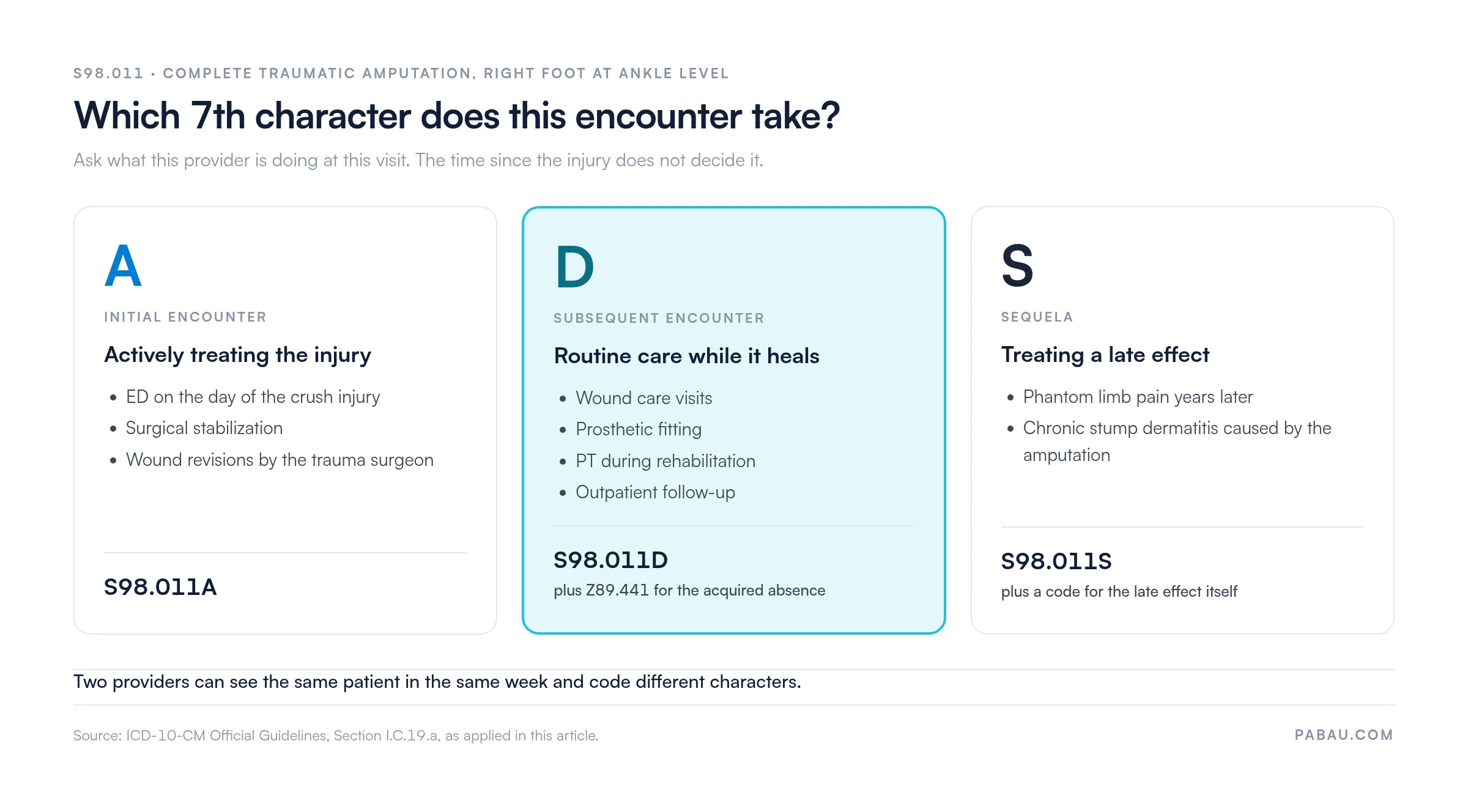
S98.011A: Reserved for encounters where active treatment is being given. That covers the emergency department on the day of injury and the operating room for initial surgery. It also covers any visit where the provider makes treatment decisions about the acute injury. The test is one question. Is this provider actively treating the injury right now?
S98.011D: Applies once active treatment has ended and the patient is receiving routine care for healing. Wound care visits, prosthetic evaluations, physical therapy during rehabilitation, and outpatient follow-up appointments all qualify. Routine visits after the amputation belong here.
S98.011S: Used when a new condition arises as a direct late effect of the traumatic amputation. Sequela coding takes two codes. The code for the late effect itself, such as phantom limb pain or chronic stump dermatitis, is sequenced first. S98.011S follows it to name the injury that caused it.
Do not use S for a routine healing follow-up, which stays on D.
The encounter type, the side, and the Z code usually start in the provider’s note. A biller then reads that note days later and builds the claim by hand. That is where a follow-up visit picks up the A from the patient’s first visit.
Pabau keeps the clinical note and the claim in one system. Its claim validation catches missing or invalid details before you submit. When ERAs come back through Claim.MD, each denial’s CARC code lands in the same billing workflow, so you can correct and resubmit without switching tools.
The result is less time rebuilding claims from notes, and a shorter path from a denial to a corrected S98.011D claim.

Pabau’s claim validation catches missing or invalid details before you submit, and denied claims come back into the same billing workflow. Book a demo to see how it handles amputation follow-up coding.

S98.011D pays when the claim tells the same story as the note. Most denials for this code trace back to the 7th character, the side, or a missing Z89.441. Each of those is settled in the provider’s documentation before a coder ever opens the chart.
So the fix starts upstream. Ask providers to name the side, the ankle level, and the purpose of the visit in every follow-up note, and audit A-coded follow-ups each quarter. For working the denials that still come back, our guide to denial management in healthcare covers the full process.
Book a demo to see how Pabau catches missing claim details before your amputation follow-up claims reach the payer.

Need a plain-English walkthrough of the claims submission process? What is medical billing explains how diagnosis codes flow from documentation to claim to payment.
Seeing recurring CARC denials across multiple codes? Claim.MD clearinghouse overview covers how electronic claims validation catches errors before submission.
Want to understand 837 file structure for institutional claims? 837 file guide explains how diagnosis codes including S98.011D are structured in the EDI transaction.
ICD-10 code S98.011D is the billable diagnosis code for a complete traumatic amputation of the right foot at the ankle level, subsequent encounter. It encodes complete separation, right laterality, the ankle-joint level, and a follow-up visit after active treatment has ended.
S98.011A is for encounters where the traumatic amputation is being actively treated, typically in the emergency department, surgery, or acute inpatient care. S98.011D is for follow-up encounters once active treatment has ended, covering wound care, prosthetic fitting, rehabilitation, and routine healing visits. Using A after the active-treatment phase is a coding error that payers can flag.
No. S98.011D is specific to the right foot. Left foot complete traumatic amputation at ankle level, subsequent encounter, uses S98.012D. The 6th character position encodes laterality: 1 = right, 2 = left, 9 = unspecified. Never use S98.011D for a left foot injury.
Z89.441 (acquired absence of right ankle) is the companion code. Following the ICD-10-CM Official Guidelines, sequence S98.011D first as the injury diagnosis, then Z89.441 as an additional code for the patient’s current anatomical status. Leaving Z89.441 off can trigger denials on S98.011D claims.
The most common pairings are wound debridement (97597, 97598), E/M (99213, 99214), and physical therapy evaluation codes (97161, 97162) during rehabilitation. Prosthetic device HCPCS L-codes, such as L5050 for an ankle-level Symes prosthesis, are billed by the prosthetist, not the physician. Procedure-to-diagnosis pairing should be validated against the specific payer’s LCD before submission.
The usual causes are a wrong 7th character (A at a follow-up visit) and a missing external cause code when the payer requires one. Unspecified laterality, a missing or misordered Z89.441, and a CPT code that reflects active surgical management round out the list. The denial section above gives the fix for each.



