

ICD-10 code S61.201A: Open wound of left index finger without nail damage
ICD-10 code S61.201A covers a left index finger wound of unstated type ICD-10 co...

Last Updated: Oct 16, 2026
Billable Code Specific Code
S42.211P is the billable ICD-10-CM code for unspecified displaced fracture of surgical neck of right humerus, subsequent encounter for fracture with malunion.
Let Pabau's smart automation suggest the right codes, reduce claim denials, and keep your practice compliant—effortlessly.
Automate repetitive tasks and focus on what matters most—your patients.
Reduce coding errors and ensure compliance with the latest regulations.
Clean claims, fewer denials, and faster reimbursements.
Powerful insights and reporting to help your practice thrive.
HIPAA compliant SOC 2 certified GDPR-compliant Trusted by 4,000+ clinics worldwide

S42.211P describes an unspecified displaced fracture of the surgical neck of the right humerus at a subsequent encounter where malunion has occurred.
The 7th character ‘P’ is mandatory for billing. The parent code S42.211 without a 7th character is non-billable and will cause claim rejection.
Malunion (P) and nonunion (K) are not interchangeable. S42.211K applies when the fracture fails to unite. S42.211P applies when it heals in a misaligned position.
Surgical fixation (ORIF) doesn’t change the code: a right proximal humerus fracture that heals misaligned after surgery is still coded S42.211P, based on healing status rather than treatment method.
Pabau’s claims management software helps orthopedic and sports medicine practices catch 7th-character errors before submission, reducing rework on fracture aftercare claims.
ICD-10 code S42.211P is the billable code for a right proximal humerus fracture — an unspecified displaced fracture of the surgical neck of the right humerus — at a subsequent encounter where the fracture has resulted in malunion.
It belongs to the S42.2 category (fracture of upper end of humerus) within ICD-10-CM Chapter 19 (Injury, Poisoning, and Certain Other Consequences of External Causes).
Claims submitted with a date of service on or after October 1, 2015 require the use of ICD-10-CM codes. CMS mandates a valid 7th character for all fracture codes in this category, making S42.211P the correct full code when malunion is the documented complication at a follow-up visit.
Coders working in sports medicine practices and orthopedic practices encounter this code most frequently during post-operative and non-operative fracture aftercare.
The surgical neck of the humerus sits just below the greater and lesser tuberosities, proximal to the humeral shaft. Fractures at this anatomical site are among the most common proximal humerus injuries, particularly in older adults after low-energy falls.
Malunion occurs when the bone heals in a position that deviates from anatomical alignment, potentially limiting shoulder range of motion and function.
The parent code S42.211 is non-billable without a 7th character. Per ICD-10-CM coding conventions, all fracture codes under S42 require a 7th character to indicate the encounter type and healing status. The seven valid extensions for S42.211 are:
| Code | 7th Character | Description | Billable |
|---|---|---|---|
| S42.211A | A | Initial encounter for closed fracture | Yes |
| S42.211B | B | Initial encounter for open fracture | Yes |
| S42.211D | D | Subsequent encounter for fracture with routine healing | Yes |
| S42.211G | G | Subsequent encounter for fracture with delayed healing | Yes |
| S42.211K | K | Subsequent encounter for fracture with nonunion | Yes |
| S42.211P | P | Subsequent encounter for fracture with malunion | Yes |
| S42.211S | S | Sequela | Yes |
The 7th character must match the clinical documentation at the time of the encounter. Assigning D (routine healing) when the treating clinician has documented malunion is a coding error that may trigger a payer audit. Coders should verify the physician’s assessment note before selecting between D, G, K, P, or S.
The seventh character rule does not extend to every bone diagnosis. M85.2 for hyperostosis of the skull is terminal, so no site digit or seventh character is added.
The distinction between malunion and nonunion is clinical, not administrative. Getting it wrong results in an incorrect diagnosis code on the claim.
Coding S42.211K when the chart documents malunion will likely pass claim edits but misrepresents the clinical picture. Payers may later use this to deny related surgical correction claims that are consistent with malunion treatment but not with nonunion protocols. Accurate selection protects reimbursement continuity for the full episode of care.
Review the imaging report and attending physician’s assessment note together before assigning S42.211P. The phrase ‘malunion’ must appear explicitly in the documentation. Inferring it from imaging alone, without a physician’s clinical judgment documented in the record, may not satisfy payer audits under ICD-10-CM guidelines.
Clinics tracking fracture and sprain recovery in Jane often start comparing Jane App alternatives as caseloads grow.
Understanding where ICD-10 Code S42.211P sits within the code hierarchy helps coders select the most specific appropriate code and avoid upcoding or undercoding errors. The hierarchy from broad to specific:
For left-sided fractures with malunion, the correct code is S42.212P. For unspecified laterality, S42.219P applies, though laterality should always be specified when documented.
Don’t confuse S42.211P with a fracture of the humeral shaft, which sits lower on the bone and falls under a separate code range (S42.3-) rather than the upper-end S42.2 category covered here. Anatomical neck and articular head fractures also belong to S42.2, under S42.29. A nondisplaced right-sided one with delayed healing is coded as ICD-10 code S42.294G.
Three documentation elements are essential before assigning S42.211P:
If the note never confirms a side, code the displaced surgical neck malunion as S42.213P instead.
Practices using digital intake and assessment forms can build laterality and encounter-type fields directly into structured documentation, reducing the need for coders to hunt through unstructured notes for these coding-critical details.
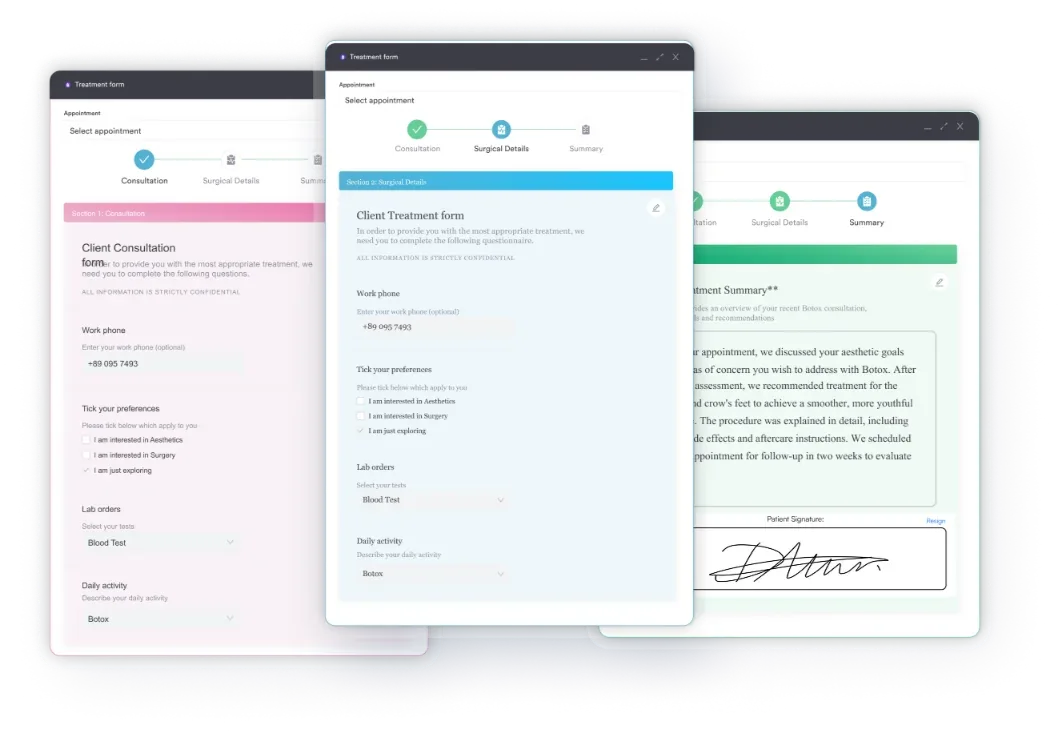

Pabau’s claims management tools help orthopedic and sports medicine teams validate diagnosis codes, catch 7th-character errors, and submit cleaner claims. See how it works for your practice.

S42.211P is included in the eligible patient population for CMS QPP MIPS Quality Measure 221 (Functional Status Change for Shoulder Patients). This measure tracks patient-reported functional outcomes for shoulder conditions using validated tools, typically the American Shoulder and Elbow Surgeons (ASES) score or the Oxford Shoulder Score.
For practices eligible for MIPS reporting, patients seen with S42.211P as a diagnosis code during the measurement period may qualify as denominator-eligible cases. Correctly assigning S42.211P (rather than a non-specific follow-up code) ensures these encounters are captured in the measure’s denominator, which matters for both reporting completeness and performance score calculations.
If your practice reports MIPS Measure 221, tag S42.211P encounters in your scheduling system so functional outcome assessments are triggered automatically at each visit. Waiting until year-end to collect outcome data from malunion patients is a common audit exposure point. Missing documentation in the numerator will lower your performance score.
Surgical fixation doesn’t change which 7th character applies. Whether the surgical neck fracture was treated with open reduction internal fixation (ORIF) or managed non-operatively, S42.211P still depends on the healing status documented at the follow-up encounter, not the treatment method.
A patient who had ORIF and returns with imaging showing the fracture healed in a non-anatomic position is coded S42.211P in exactly the same way as a patient managed with a sling. The operative history belongs in the clinical note, not in the code selection.
When a post-ORIF visit note reads ‘fracture healed, plate intact, patient reports stiffness,’ that’s malunion coding territory (S42.211P) if the alignment is off, not a hardware complication. Reserve T84 codes for documented plate or screw problems, and code them alongside S42.211P rather than in place of it.
If the same visit also addresses a hardware-related problem, such as loosening, breakage, or infection around the plate or screws, that’s a separate complication captured under the T84 series (complications of internal orthopedic prosthetic devices). Code it in addition to S42.211P, not instead of it.
Coders should verify the note doesn’t blur “malunion” with “hardware failure,” since the two trigger different code sets and reflect different clinical problems.
A consistent coding workflow reduces the likelihood of 7th-character errors on fracture aftercare claims. The following sequence applies to encounters where S42.211P may be the correct code:
The CDC/NCHS ICD-10-CM web tool provides the official code descriptions and hierarchy for the current fiscal year, which is useful when verifying a code before submission or when training new coders. The AAPC Codify ICD-10-CM lookup also offers crosswalk data and payer policy notes that can supplement the official code set during claim preparation.
For practices managing compliance management workflows across multiple providers, building a standard coding reference card for the S42.2xx malunion and nonunion codes reduces variability between coders and provides a defensible audit trail.
Fracture aftercare coding errors concentrate around two failure points: incorrect 7th character assignment and laterality mismatches. S42.211P eliminates both risks when the documentation clearly supports a subsequent encounter for malunion of a displaced fracture at the surgical neck of the right humerus.
The clinical distinction between malunion and nonunion shapes the reimbursement logic for everything that follows in the episode of care, from imaging to surgical correction.
Practices with structured physiotherapy clinic compliance frameworks already understand that consistent documentation at the point of care is the only reliable protection against downstream coding disputes. Pabau’s claims management software helps orthopedic and sports medicine teams build that consistency into the pre-submission workflow. To see how it works for your practice, book a demo. Coding sits in the middle of the revenue cycle, between registration and payment posting. Patients who claim reimbursement themselves need an itemized receipt, which is what a superbill template sets out.

Billing for removal of infected mesh material? CPT code 11008 for mesh removal explains the add-on billing rules for removing prosthetic mesh from the abdominal wall.
Need the ICD-10 code for autism spectrum? ICD-10 code for autistic disorder covers the correct F84.0 code, related autism spectrum codes, and documentation tips for accurate billing.
Coding debridement for an open fracture wound? CPT code 11011 debridement guide matches documented tissue depth to the correct code in this three-code series.
ICD-10 code S42.211P is a billable diagnosis code for an unspecified displaced fracture of the surgical neck of the right humerus at a subsequent encounter where the fracture has healed in a misaligned position (malunion).
The 7th character P designates a subsequent encounter for fracture with malunion — the fracture has healed in an anatomically abnormal position. It is distinct from D (routine healing), G (delayed healing), K (nonunion), and S (sequela).
Yes. S42.211P is fully billable. The parent code S42.211 without a 7th character is non-billable and will cause claim rejection.
Use S42.211P when the fracture has healed in a misaligned position. Use S42.211K when the fracture has failed to heal at all. The treating physician’s documentation must distinguish between the two clearly, since they require different clinical management pathways.
Adjacent codes include S42.211K (nonunion, right), S42.212P (malunion, left), S42.211G (delayed healing, right), and S42.211D (routine healing, right). The S42.22–S42.29 subcategories cover other proximal humerus fracture sites including the greater and lesser tuberosities.
Subsequent fracture encounters use 7th characters D (routine healing), G (delayed healing), K (nonunion), P (malunion), or S (sequela). This logic applies across most Chapter 19 fracture categories, not only S42.211.
Malunion fracture coding uses the 7th character P across most ICD-10-CM fracture categories. For a right proximal humerus fracture specifically, that’s S42.211P (right side) or S42.212P (left side).
No. Open reduction internal fixation (ORIF) is a treatment method, not a coding factor. S42.211P still applies once malunion is documented at a subsequent encounter, regardless of whether the fracture was managed surgically or non-operatively. Hardware complications, if documented separately, are coded under the T84 series instead.



