

ICD-10 code S61.201A: Open wound of left index finger without nail damage
ICD-10 code S61.201A covers a left index finger wound of unstated type ICD-10 co...

Last Updated: Oct 16, 2026
Billable Code Specific Code
M72.4 is the billable ICD-10-CM code for pseudosarcomatous fibromatosis.
The code sits in the M72 fibroblastic disorders category and is valid for HIPAA-covered transactions effective October 1, 2025. Documentation often uses the synonym "nodular fasciitis" without naming the fibromatosis descriptor. Coders also confuse M72.4 with the plantar variant coded at M72.2. Selection turns on the physician's documented site and histological characterization.
Let Pabau's smart automation suggest the right codes, reduce claim denials, and keep your practice compliant—effortlessly.
Automate repetitive tasks and focus on what matters most—your patients.
Reduce coding errors and ensure compliance with the latest regulations.
Clean claims, fewer denials, and faster reimbursements.
Powerful insights and reporting to help your practice thrive.
HIPAA compliant SOC 2 certified GDPR-compliant Trusted by 4,000+ clinics worldwide

ICD-10 code M72.4 describes pseudosarcomatous fibromatosis, a benign soft tissue lesion that mimics sarcoma on imaging.
Nodular fasciitis is an accepted synonym under M72.4, so documentation using that term maps correctly to this code.
M72.4 is a billable, HIPAA-valid code effective FY2026 (October 1, 2025), covered by Medicare and Medicaid.
Practice management software like Pabau pairs with Claim.MD to validate ICD-10 submissions against thousands of US payers.
ICD-10 code M72.4 is a valid, specific, billable diagnosis code in the ICD-10-CM classification system. It represents pseudosarcomatous fibromatosis and is accepted on all HIPAA-covered claim transactions. The CDC/NCHS ICD-10-CM web tool confirms M72.4 as effective from October 1, 2025 for fiscal year 2026.
Pseudosarcomatous fibromatosis is a benign, rapidly growing fibroblastic proliferation of soft tissue that can mimic a malignant sarcoma on both clinical examination and imaging. Despite the alarming name, the lesion is non-cancerous. It arises most often in subcutaneous or intramuscular connective tissue, and it grows quickly. That speed is why the lesion is usually biopsied to rule out malignancy before a code is assigned.
Clinically, the condition affects adults of any age and has no strong sex predilection. Lesions typically appear on the trunk, the upper extremity, or the head and neck region.
The physician’s note must document histological confirmation to support M72.4 over a neoplasm code. Where surgery has not happened yet, strong clinical suspicion from imaging and presentation can stand in. Coders should not assign M72.4 from radiology alone when the pathology report contradicts a fibromatosis classification.
Local recurrence after excision also has coding implications. A recurrence is not a new diagnosis and does not take a different code. The note should still state “recurrent pseudosarcomatous fibromatosis” so auditors can tell it apart from a first presentation.
Several clinical terms map to ICD-10 code M72.4. Coders need to recognize all of them, because physician documentation varies widely. A missed synonym is the fastest route to an unbillable claim.
Of these, nodular fasciitis causes the most confusion. It is a widely used clinical term, and some coders search “nodular fasciitis ICD-10” without realizing it maps straight to M72.4.
When the pathology report reads “nodular fasciitis,” M72.4 is the correct code, not a neoplasm code from the D49 range. Verify any alternate descriptor against the AAPC Codify ICD-10-CM lookup before you submit.
Knowing where M72.4 sits in the classification helps coders navigate the chapter structure and pick the most specific code for each encounter. The hierarchy runs from chapter level down to M72.4:
M72.4 is a terminal, billable code with no further subcategory. The WHO ICD-10 browser confirms the international classification structure, while the CMS tabular list governs the US-specific rules that apply at M72.4. Coders working across the M70-M79 block can browse the neighboring categories in our ICD-10-CM code library.
M72.4 shares its parent category with several other fibroblastic disorder codes. Selecting the wrong sibling code is a common denial trigger. The table below shows every M72 subcode alongside its descriptor and the key differentiator from M72.4.
The most consequential distinction for practices billing surgical procedures is M72.4 against M72.2. Plantar fascial fibromatosis (M72.2) is a far more common presentation. Coders sometimes default to it when the note describes a foot or lower extremity lesion. If the pathology is pseudosarcomatous, M72.4 applies regardless of anatomical site.
Run a query on your denied claims from the past 12 months, filtered by M72 category codes. If M72.9 or M72.8 turns up alongside surgical excision CPT codes, the physician note probably never carried the specific pathology language. Query the ordering physician for that language, then recode to M72.4 where the report supports it.
M72.4 pairs with procedure codes for excision, biopsy, and imaging when the practice bills for pseudosarcomatous fibromatosis management. The table below lists CPT codes commonly submitted alongside M72.4. These are typical pairings based on clinical workflow, not guaranteed reimbursement combinations. Verify coverage with each payer’s local coverage determination (LCD) before submitting.
Cross-referencing ICD-10 and CPT codes in one system removes the manual step of confirming a pairing before submission. A superbill that pre-populates M72.4 alongside the excision code also removes a common transcription error at the billing desk.
M72.4 is covered by Medicare and Medicaid, per the AAPC code page. Coverage does not mean automatic reimbursement. Payers apply medical necessity criteria tied to local coverage determinations (LCDs).
For a benign soft tissue lesion like pseudosarcomatous fibromatosis, prior authorization for surgical excision is common. The documentation must show why watchful waiting was not the right management before an excision claim will clear.
Building the pre-authorization step into the workflow before the procedure date, rather than after it, is what keeps M72.4 claims moving. Submitting an excision claim without prior authorization for a non-urgent benign lesion is a predictable denial pattern. Payer rules govern here, not the billable status of the diagnosis code.
Practices submitting M72.4 claims through Pabau can route them via the Claim.MD clearinghouse integration. It validates codes against thousands of US payers and runs real-time eligibility checks.
Remittance files come back in the ERA 835 format, so the payment loop closes without manual reconciliation. The integration handles CMS-1500 and 837P formats, and it flags payer-specific rejections before adjudication.
The physician note decides whether an M72.4 claim survives review. This section covers what the note must contain, the errors that most reliably trigger denials, and the situations where M72.4 does not apply.
Denial management patterns for soft tissue codes show that the most recoverable denials in this category come from a missing pathology report. Attach it at first submission rather than during an appeal. A quarterly audit of M72-category claims will surface weak documentation before a payer does.
Coders meet these rules in reverse, starting from a note rather than a code list. The routing below maps each documented finding onto the code it supports.
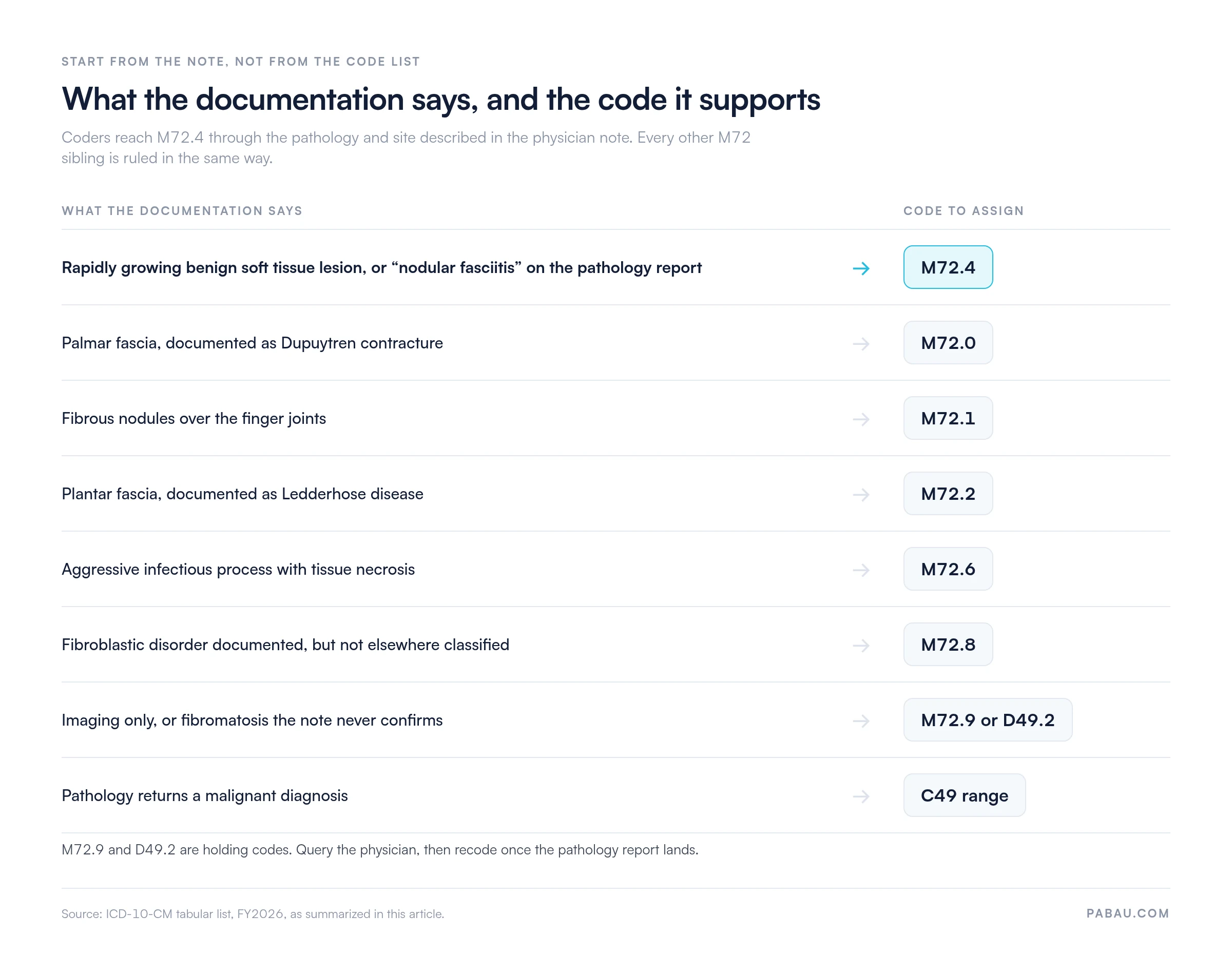
Specificity is what protects the money here. An M72.9 on a claim that the pathology report could have supported at M72.4 invites review, and the excision is the expensive line. At the point of billing, claims software for practices catches that mismatch before the claim leaves the building.
A coding mismatch usually surfaces after the remittance comes back. The denial arrives weeks later. Someone has to dig the pathology report out again, and the appeal costs more staff time than the original claim did.
Practice management software like Pabau moves that check to the front of the process. Diagnosis and procedure codes sit on the same patient record as the treatment note. The M72.4 pairing is assembled where the clinical detail already lives, and payer-specific rules can flag an M72-category claim that carries no pathology attachment.
From there the claim goes out through the Claim.MD clearinghouse integration, which checks eligibility and validates the code set before submission. Rejections surface ahead of the payer’s adjudication cycle rather than after it. Your team fixes the M72.4 line once, not twice.


Pabau pairs with Claim.MD to validate ICD-10 codes, run eligibility checks, and route claims to thousands of US payers. Build the documentation workflow that prevents denials instead of appealing them.

Pseudosarcomatous fibromatosis is a benign lesion with a name that reads like a cancer diagnosis. That tension is what makes M72.4 easy to get wrong. The code itself is straightforward once the pathology report is in hand.
So the work sits upstream of the coder. Ask the ordering physician for site and histology in the note itself. Attach the pathology report at first submission, and the specificity argument never has to be made twice.
That habit is worth more than any single code correction. Book a demo to see how Pabau pairs M72.4 with the right procedure code and gets the claim out clean.

Need a structured framework for ICD-10 claim denials? Denial codes in medical billing covers the most common CARC denial reasons and how to appeal them systematically.
Want to understand how clearinghouse validation works? Medical claims clearinghouse guide explains how 837P files are scrubbed, validated, and transmitted to payers.
Exploring how to reduce coding errors across your practice? Superbill best practices outlines how structured superbill templates reduce mismatched diagnosis and procedure code pairings at source.
ICD-10 code M72.4 is used to report pseudosarcomatous fibromatosis, a benign proliferative soft tissue lesion that includes nodular fasciitis as an accepted synonym. It is assigned when the clinical or pathology documentation confirms a fibromatosis diagnosis rather than a malignant soft tissue neoplasm.
Yes, M72.4 is a billable, specific ICD-10-CM diagnosis code valid for HIPAA-covered claim transactions. It has been effective since October 1, 2025 for fiscal year 2026. The code carries no excludes notes that would prevent its use as a standalone diagnosis on most claim types.
Yes, for ICD-10-CM coding purposes nodular fasciitis maps directly to M72.4 (Pseudosarcomatous fibromatosis). The AAPC and the ICD-10-CM index both list nodular fasciitis as an included synonym. When the pathology report reads “nodular fasciitis,” M72.4 is the correct code, not a separate entry.
M72.2 is plantar fascial fibromatosis (Ledderhose disease), a site-specific code for fibromatosis of the plantar fascia. M72.4 is pseudosarcomatous fibromatosis, which may appear at any site and is characterized by rapid growth that mimics sarcoma. The key differentiator is the histological and clinical picture, not the anatomical location alone.
Medicare covers M72.4 as a diagnosis, but reimbursement for associated procedures depends on medical necessity under the applicable local coverage determination (LCD). For excision of a benign soft tissue lesion, documentation of rapid growth, functional impairment, or diagnostic uncertainty is typically required. Confirm the specific LCD with your Medicare Administrative Contractor before submitting.
The M72 fibroblastic disorders category runs from M72.0 to M72.9. It includes M72.0 (palmar fascial fibromatosis / Dupuytren), M72.1 (knuckle pads), M72.2 (plantar fascial fibromatosis / Ledderhose) and M72.4 (pseudosarcomatous fibromatosis). The remaining codes are M72.6 (necrotizing fasciitis), M72.8 (other fibroblastic disorders) and M72.9 (fibroblastic disorder, unspecified).



