ICD-10 Code S82.242H: Displaced spiral tibial shaft fracture, delayed healing
ICD-10 Code S82.242H: Definition and code details ICD-10 Code S82.242H designate...

Last Updated: Oct 15, 2026
Billable Code Specific Code
V29.008S is the billable ICD-10-CM code for other motorcycle driver injured in collision with unspecified motor vehicles in nontraffic accident, sequela. It's an external cause code, so it's always listed on claims after the code for the late-effect condition being treated.
The code sits in Chapter 20, External causes of morbidity (V00-Y99). Its parent, V29.008, can't be billed without a 7th character. Use S only once the acute injury has resolved. A covers the initial encounter, and D covers active treatment.
Let Pabau's smart automation suggest the right codes, reduce claim denials, and keep your practice compliant—effortlessly.
Automate repetitive tasks and focus on what matters most—your patients.
Reduce coding errors and ensure compliance with the latest regulations.
Clean claims, fewer denials, and faster reimbursements.
Powerful insights and reporting to help your practice thrive.
HIPAA compliant SOC 2 certified GDPR-compliant Trusted by 4,000+ clinics worldwide

V29.008S is a billable ICD-10-CM code for a motorcycle driver hurt in a nontraffic collision with an unspecified motor vehicle. It applies when the visit treats a late effect.
The 7th character S (sequela) applies only after the acute injury phase has ended. Use A for the first encounter and D during active treatment.
V29.008S is an external cause code, so it can never be the principal or first-listed diagnosis. The sequela condition, such as chronic pain or fracture malunion, goes first.
Most V29.008S denials trace back to three errors. They are the wrong 7th character, a missing principal diagnosis, or a note that doesn’t link the condition to the crash.
Claims management software like Pabau checks required claim details before submission and tracks each claim’s status, so sequela rejections surface early.
ICD-10 code V29.008S identifies a motorcycle driver hurt in a nontraffic collision with an unspecified motor vehicle. It applies when the visit treats a late effect of that injury. It’s a billable, 7-character external cause code, and it’s always listed after the sequela condition it explains.
The table below summarizes the lookup details coders check before submitting a claim.
The descriptor has five distinct elements. Each one must be supported by the medical record before you can assign this code.
All five elements must align with the physician’s documentation. If any element cannot be confirmed from the record, a more appropriate code should be selected. For reference, CMS publishes the annual ICD-10-CM update files including the full tabular list and coding guidelines.
A patient hurt inside a bus, with the other vehicle still unidentified, is coded under V79 instead. V79.60XS covers a bus occupant’s sequela after a collision on a public road, unlike this nontraffic code. It applies when the record names neither the occupant’s role nor the other vehicle type.
The 7th character “S” designates sequela. That is a condition caused directly by a prior injury, which appears or persists after the acute phase has ended. Per ICD-10-CM Official Guidelines Section I.C.19.a, “sequela” replaces the older term “late effect” used in ICD-9-CM. The three episode-of-care characters for injury codes are compared below.
The most common coder error is using “A” for a follow-up visit that should be “D.” Another is using “D” for a late-effects visit that should be “S.” If the physician’s note says “chronic sequela of prior motorcycle accident,” the 7th character must be S.
Selecting the wrong variant is the fastest path to a denial. The timeline below shows where each character falls in the patient’s care, and how the S claim is ordered.
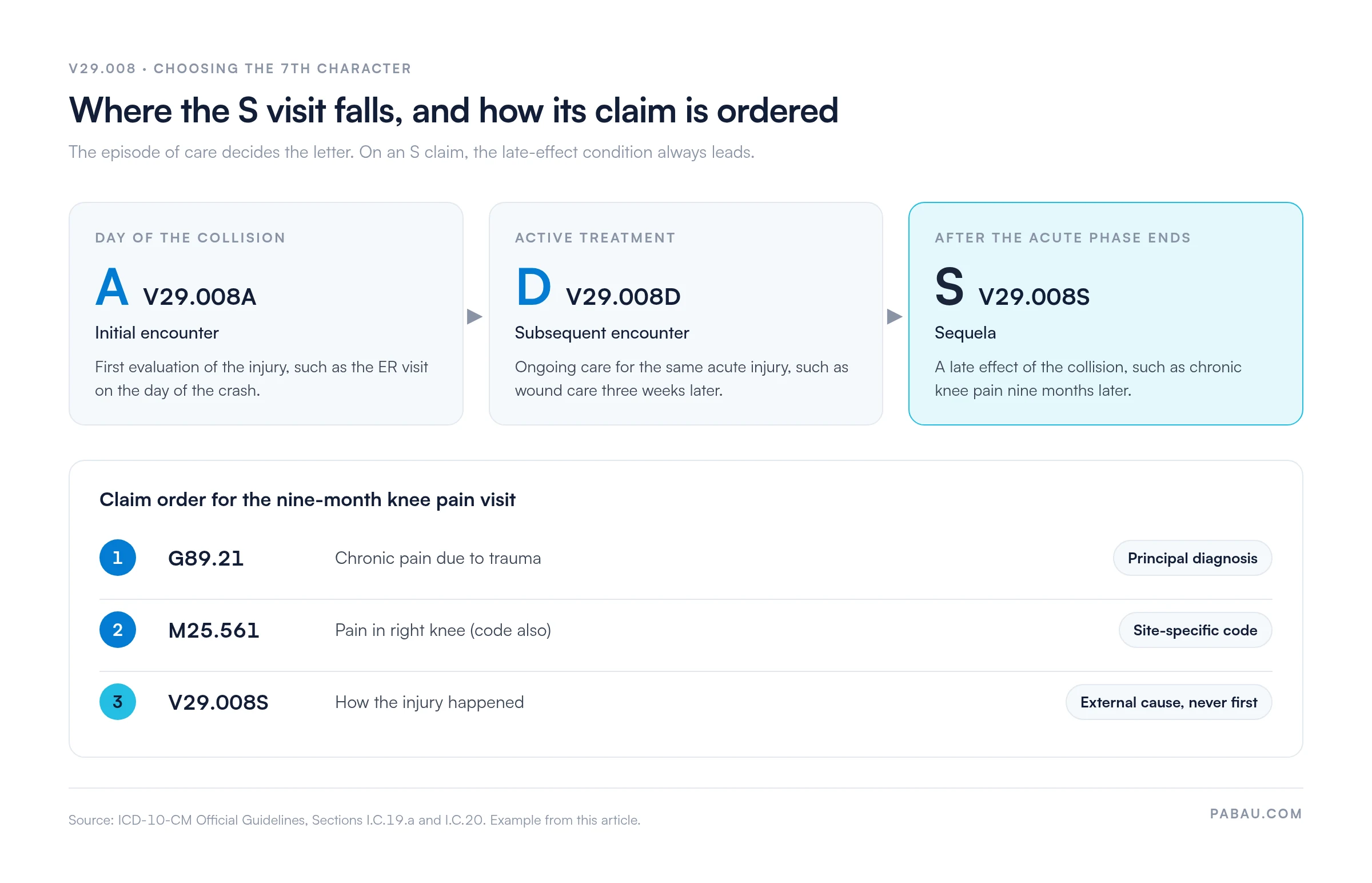
Use the comparison table to confirm the assignment before submitting.
Understanding the parent-child structure helps coders spot more specific alternatives when documentation permits. V29.008S sits at the deepest level of a six-level hierarchy, from chapter down to billable code.
V29.008 is itself the unspecified-vehicle code. When the record names the other vehicle, code from its own category instead:
If the physician’s record doesn’t identify the vehicle, V29.008S is the appropriate choice. If instead the chart names a nonmotor vehicle, such as a ridden animal, and omits the rider’s role, the nontraffic sequela code is V26.29XS.
Each injured person in a collision carries their own external cause code, often from a different block. A heavy truck driver struck by a motorcycle in traffic is coded V62.5XXA at the first encounter.
The V29 category carries several instructional notes that affect how and when V29.008S can be used alongside other codes. Skipping them leads to conflicting or incomplete code sets on the claim.
External cause codes like V29.008S follow the coding sequence in ICD-10-CM Official Guidelines Section I.C.20.a. They are supplementary codes and can never be the first-listed or principal diagnosis. Treating V29.008S as a standalone code is one of the top reasons sequela claims are denied.
Run a pre-submission check on every V29.008S claim. Confirm the sequela condition code is listed first and the 7th character matches the episode of care. Then check that the physician’s note explicitly connects the condition to the original accident.
V29.008S cannot stand alone. Payers require a qualifying sequela condition as the primary code. The table below shows the most commonly paired principal diagnoses, drawn from typical clinical presentations following motorcycle collisions. When post-traumatic anxiety is the condition being treated, its mental health code leads the claim.
Always verify the specific principal code against the current ICD-10-CM tabular list using the CDC/NCHS ICD-10-CM web tool for the date of service. Codes in the examples above are illustrative; site specificity and laterality extensions may apply.
Payer policies on external cause codes vary widely, from optional on traditional Medicare to near-mandatory on workers’ compensation. Knowing which applies decides whether V29.008S is needed on the claim at all. Automated claims management that checks required details before each submission cuts down on rework.
Confirm the requirement with each payer’s current billing manual. Policies may change annually, and relying on outdated guidance is a common source of preventable denials. Submitting a clean claim for a sequela encounter starts with checking that payer’s policy.
Sequela claims involving external cause codes have a distinct denial pattern. Most rejections stem from a small set of avoidable coding errors. Start by checking which of these errors shows up most often in your practice’s remittance data. A guide to decoding denial codes helps map each claim adjustment reason code (CARC) back to its root cause.
Clearinghouse validation before submission catches format errors, like a missing 7th character, before they reach the payer. That one step removes the most mechanical of these denials.
Several codes within V29 look nearly identical to V29.008S. The table below distinguishes the most commonly confused ones.
Clinical scenario: A 38-year-old male presents 9 months after a motorcycle collision with an unknown vehicle. The original acute injuries resolved, but he now has chronic knee pain that his orthopedist has documented as a direct result of the original accident. The visit is for management of that chronic pain.
Payment on sequela claims like this one depends on the physician’s note carrying all four documentation elements above. When the note is vague, query before coding rather than assuming the sequela relationship. For crosswalk lookups and diagnosis validation, the WHO ICD-10 browser provides the international classification framework from which ICD-10-CM derives its structure.
Without integrated claims tools, a sequela claim gets built by hand. Someone copies the codes from the note, re-keys the patient’s insurer, and checks the claim status on the clearinghouse portal days later.
Practice management software like Pabau raises the invoice to the patient’s linked insurer from the visit itself. In the US, it submits through Claim.MD, runs eligibility checks, and posts ERA remittances into the same Claims dashboard.
Before each claim goes out, Pabau runs background validation on required details like membership numbers and authorization codes. Every claim then shows a live status, from pending to paid or error. A rejected V29.008S claim surfaces the same day, while the physician’s note is still fresh enough to query.

Pabau submits claims through Claim.MD, validates required details before each one goes out, and tracks every claim’s status in one dashboard. See how it handles injury follow-up billing.

V29.008S is a narrow code, and that is its value. It tells the payer the crash happened off a public road, with an unidentified vehicle, and that today’s visit treats what the injury left behind.
Before assigning it, confirm three facts from the note. The acute phase is over, the physician links the condition to the collision, and the other vehicle is unknown. If any one is missing, query the physician first. A delayed claim costs less than a denied one.
Want every sequela claim checked before it reaches the payer? Book a demo to see how Pabau handles injury follow-up claims from invoice to payment.

Need to understand how clearinghouse validation catches code errors? Medical claims clearinghouse guide explains how electronic validation works before claims reach payers.
Want a reference on clean claim requirements for injury encounters? Superbill documentation guide covers what must appear on an injury claim to pass payer edits.
Looking for guidance on insurance eligibility before filing sequela claims? Insurance eligibility verification outlines real-time verification workflows that reduce sequela claim rejections.
ICD-10 code V29.008S is the billable ICD-10-CM code for a motorcycle driver hurt in a nontraffic collision with an unspecified motor vehicle. It’s used when the current visit treats a sequela, or late effect, of that accident. The code sits in Chapter 20 (External causes of morbidity) and can’t be the principal diagnosis. It’s always paired with a code for the sequela condition being treated.
Yes, V29.008S is a billable ICD-10-CM code valid for claims submission. Its parent, V29.008, isn’t billable without a 7th character, and adding “S” completes it. Always verify validity for the date of service, as ICD-10-CM codes update every October 1.
The 7th character sets the episode of care. V29.008A (initial encounter) covers the first evaluation of the acute injury. V29.008D (subsequent encounter) covers ongoing active treatment of that injury. V29.008S (sequela) covers a chronic or residual condition from the collision, after the acute phase has resolved. Applying the wrong character is one of the most common denial triggers for motorcycle injury claims.
No. Per ICD-10-CM Official Guidelines Section I.C.20.a, external cause codes like V29.008S can never be the principal or first-listed diagnosis. A code for the sequela condition goes first, such as chronic pain (G89.21), fracture malunion, or PTSD (F43.10). V29.008S follows as a supplementary external cause code.
The medical record needs four elements. The physician must explicitly link the current condition to the prior motorcycle collision. The note must also show the acute phase has resolved, give the date of the original accident, and confirm the other vehicle was unknown. Coders can’t assume the sequela relationship, so an unclear note calls for a physician query.
Workers’ compensation and auto liability or PIP payers almost always require external cause codes. Most state Medicaid programs require them for trauma-related claims. Commercial insurers often require them for accident-related encounters to support subrogation. Medicare doesn’t mandate them, but many Medicare Administrative Contractors recommend them. Check each payer’s current billing manual, as policies change annually.