

ICD-10 code S61.201A: Open wound of left index finger without nail damage
ICD-10 code S61.201A covers a left index finger wound of unstated type ICD-10 co...

Last Updated: Oct 16, 2026
Billable Code Specific Code
V93.52XS is the billable ICD-10-CM code for explosion on board fishing boat, sequela. It records that a patient's current condition is a late effect of a past onboard blast, such as an engine or fuel-system explosion.
The code sits in category V93, other injury due to accident on board watercraft, without accident to watercraft. It is always a secondary code. The residual condition, such as blast-related hearing loss or a head injury sequela, is sequenced first.
Let Pabau's smart automation suggest the right codes, reduce claim denials, and keep your practice compliant—effortlessly.
Automate repetitive tasks and focus on what matters most—your patients.
Reduce coding errors and ensure compliance with the latest regulations.
Clean claims, fewer denials, and faster reimbursements.
Powerful insights and reporting to help your practice thrive.
HIPAA compliant SOC 2 certified GDPR-compliant Trusted by 4,000+ clinics worldwide

V93.52XS describes the sequela of an explosion on board a fishing boat and is valid for FY2026 billing.
The seventh character S means the patient has a residual condition from a past fishing-boat explosion, not an active acute injury.
Code the residual condition first. V93.52XS is always a secondary external cause code, never the principal diagnosis.
Missing the companion residual code or assigning encounter character A on a sequela visit are the two leading denial triggers for this code.
ICD-10 code V93.52XS is a specific, billable ICD-10-CM external cause code covering the sequela of an explosion on board a fishing boat. It belongs to category V93 within the broader V90-V94 watercraft accident block. The full official descriptor is Explosion on board fishing boat, sequela. It is always a secondary code, listed after the residual condition that brought the patient in.
Sequela coding applies when the current visit treats a condition caused by a past injury, rather than the injury itself. Per ICD-10-CM Official Guidelines Section I.C.19.a (CMS), the seventh character “S” identifies the sequela phase and carries no time restriction. A patient can present with blast-related hearing loss two years after the fishing-boat explosion. The code still applies, provided the record documents the causal link. This differs from initial encounter (“A”) and subsequent encounter (“D”), which describe different phases of treating the original acute injury.
The three seventh-character options for the V93.52X code family serve distinct clinical purposes, and picking the wrong one is a common technical denial. The same A, D, and S framework applies across Chapter 20 external cause codes. That means you can look up ICD-10-CM codes for other injury mechanisms and apply the same logic.
Use V93.52XA when the patient is receiving initial treatment for the acute fishing-boat blast. Use V93.52XD for ongoing treatment of that same acute injury. Use V93.52XS once the acute injury has resolved and the visit addresses a residual condition that traces back to the explosion.
The practical documentation trigger for “S” is the wording of the provider note. It should call the current condition a “late effect of,” “result of,” or “sequela of” a prior fishing-boat explosion. Without that statement, the payer has no clinical basis to accept the sequela code over an initial encounter code. The usual result is a medical necessity denial.
V93.52XS covers the sequela of any explosion occurring on board a fishing vessel, whether commercial or recreational. “On board” is the key qualifier. A crew member struck by blast debris while standing on the deck is covered. Someone already overboard when the explosion happened is not covered by this code.
A crew member who jumps from a burning fishing boat and then drowns gets a V90 code instead. The late-effect visit for that patient is coded V90.22XS.
Blast injuries from onboard explosions can produce a range of late-effect conditions, many of which persist or emerge well after initial treatment ends. Common sequela diagnoses reported alongside V93.52XS include:
External cause codes in the V93 category work as supplementary descriptors. They explain how and where the injury happened, but they never stand alone as the reason for the encounter. The residual condition code (the injury sequela) must lead on the claim.
V93.52 sits within a hierarchical structure of watercraft explosion codes. Selecting the most specific child code is required. V93.52 covers fishing boats, so don’t default to V93.50 “unspecified watercraft” when the vessel type is documented. The V93 category also covers onboard fires, so a follow-up burn visit on a merchant vessel uses ICD-10 code V93.00XD.
Craft type drives code selection across the rest of V93, not only the explosion subcategory. A subsequent-encounter visit for other injury on board a nonpowered inflatable craft takes V93.86XD.
V93.52XS never appears on a claim alone. The residual condition code leads, and place-of-occurrence or activity codes round out the claim. The table below lists the companion codes coders most often pair with ICD-10 code V93.52XS. It includes the traumatic brain injury sequela codes common in blast cases.
Audit every V93.52XS claim for a sequela companion code before submission. A claim with only V93.52XS and no leading residual-condition code will be denied for missing principal diagnosis. Build a claim edit rule flagging any external cause code appearing in the first diagnosis position.
The medical record must do three things to support V93.52XS on a sequela claim. It must link the current condition to the fishing-boat explosion, date the original incident, and confirm the visit treats a late effect.
Vague language fails payer review. Phrases like “history of explosion injury” without connecting that history to the current condition are insufficient. The record should state something like: “Patient presents with sensorineural hearing loss, a direct sequela of the April 2023 explosion aboard his fishing vessel.” That one line covers the causal link and the incident date.
The diagram below puts the coding order, the three note requirements, and the main denial triggers side by side.
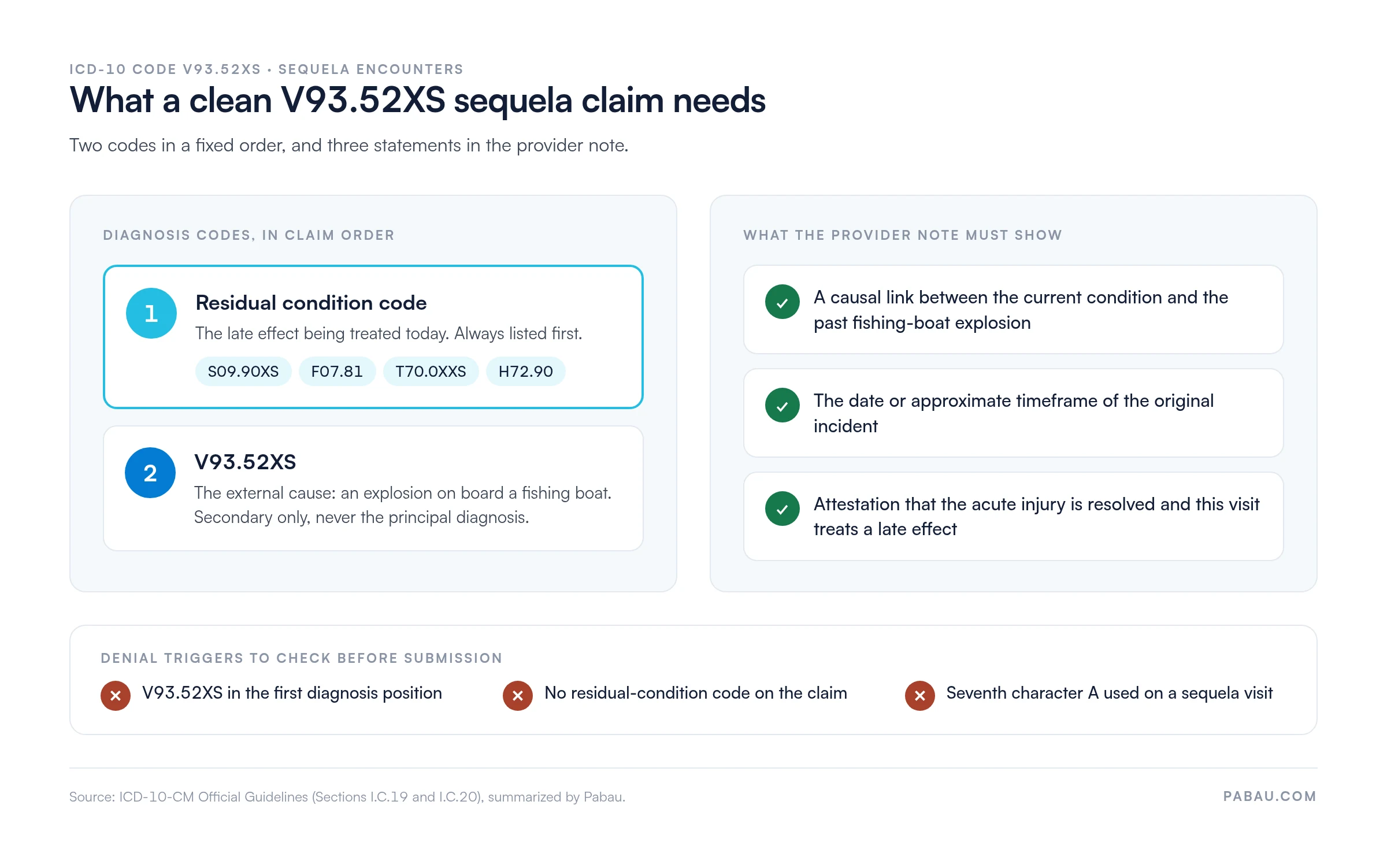
Structured documentation templates help ensure completeness on every sequela visit. A clean claim for a sequela visit starts in the provider note, not in the billing department.
Commercial fishing crew injuries in the United States often fall under the Jones Act (Merchant Marine Act of 1920) rather than standard state workers’ compensation. That determination is fact-specific, and Jones Act eligibility involves legal analysis beyond the coder’s role.
What coders need to know is that the payer type affects prior authorization requirements and claim routing. Maritime injury billing workflows differ materially from standard group health billing.
ICD-10 code V93.52XS is accepted as a secondary external cause code by Medicare and most commercial payers when accompanied by a valid principal diagnosis. Medicaid acceptance varies by state.
For Jones Act claims routed through maritime insurers, the payer may require a pre-determination letter for late-effect treatment. That applies most to high-cost sequela like traumatic brain injury rehabilitation or cochlear implantation. Read the electronic remittance advice closely on these claims, because it shows whether a denial came from a payer-specific sequela policy or a coding error.
Keeping maritime sequela claims apart from standard health plan claims is easier with error-flagging claims software.
Five denial patterns account for most rejected claims involving ICD-10 code V93.52XS. Each has a straightforward prevention step if caught before submission. Billing teams can build claim edits at the clearinghouse level to catch several of these errors automatically. Those edits sit alongside the denial prevention rules the practice already runs for other codes.
Without a pre-submission check, a sequencing error on a V93.52XS claim usually surfaces only when the denial comes back. By then, the claim needs correcting, resubmitting, and chasing, weeks after the visit.
Practice management software like Pabau keeps insurer details on the patient record and sends US claims to Claim.MD without leaving the system. Real-time eligibility checks confirm coverage before the visit, which helps when a maritime insurer or Jones Act carrier is paying.
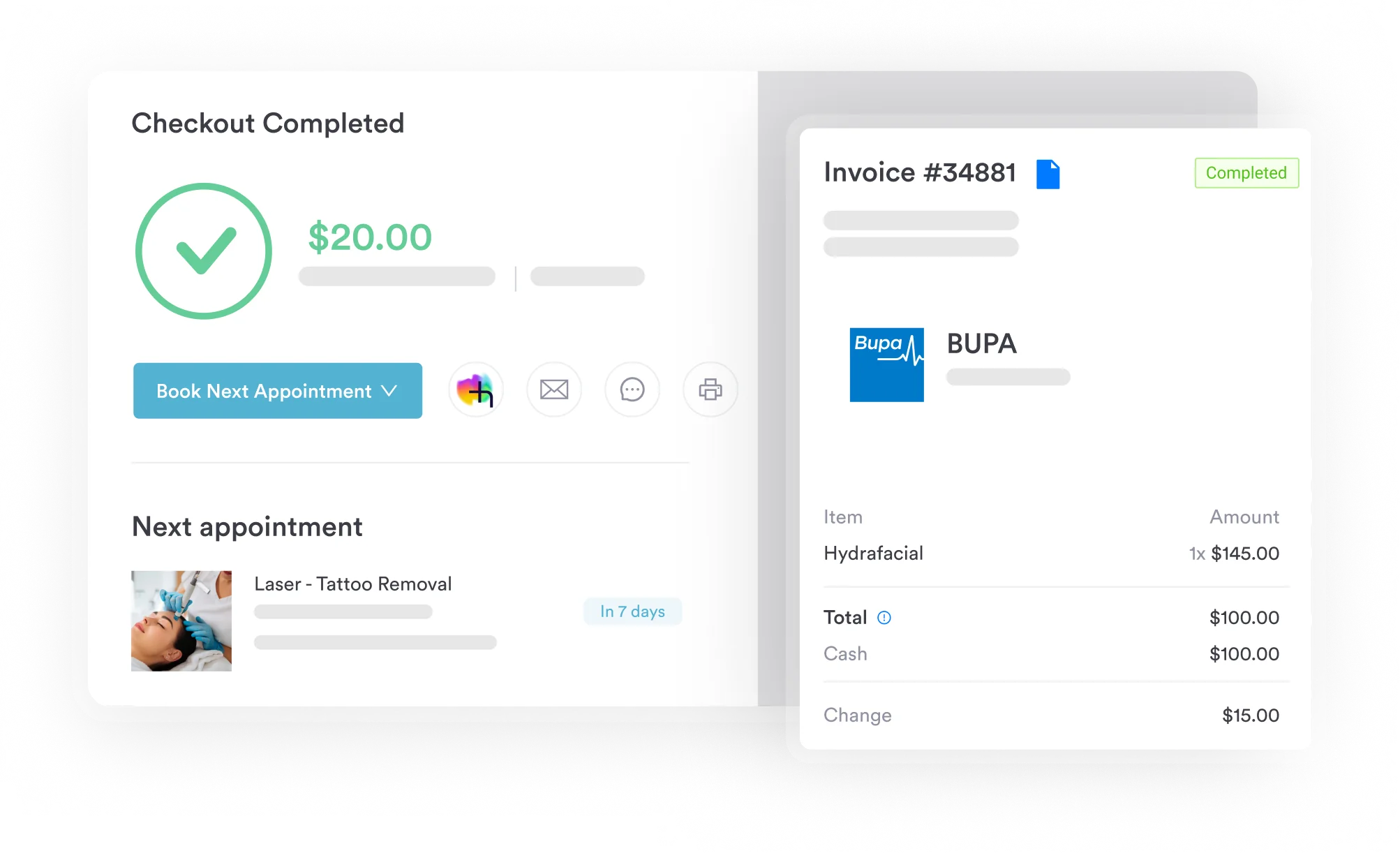
Every claim then sits in one Claims dashboard with a live status of pending, submitted, processing, paid, or error. Your team sees a rejected sequela claim as soon as it lands, fixes the code order, and resubmits from the same screen.

Pabau’s claims management tools help billing teams submit and track external cause code claims, check eligibility before the visit, and catch missing details before submission. See how it works for your practice.

A V93.52XS claim holds up when two checks happen before submission. The residual condition code leads the claim, and the provider note ties that condition to the original fishing-boat explosion.
Building both checks into intake and coding takes a few minutes per sequela visit. Skipping them costs a resubmission cycle, and with a maritime insurer it can also mean chasing a pre-determination letter after the fact.
Book a demo to see how Pabau helps your billing team submit and track sequela claims without leaving the patient record.

Need a reference for denial codes on sequela claims? Denial codes in medical billing covers the CARC and RARC codes payers use when rejecting external cause code claims.
Want to understand how your clearinghouse handles ICD-10 sequela codes? How Claim.MD clearinghouse works explains the electronic submission and validation process for diagnosis code claims.
Looking to improve your revenue cycle around late-effect claims? What is revenue cycle management walks through the end-to-end billing process where sequela coding fits.
Building a denial prevention routine? Denial management in healthcare shows how to track, appeal, and prevent recurring claim denials.
Keeping sequela records audit-ready? Medical billing compliance covers the record retention and coding rules payers audit against.
ICD-10 code V93.52XS is the billable ICD-10-CM code for the sequela of an explosion on board a fishing boat. It means the patient’s current condition is a late effect of a past onboard blast, not an active acute injury. It belongs to the V93 external cause category and is valid for FY2026 claims.
V93.52XA applies to the initial encounter for the acute explosion injury itself. V93.52XS applies when the acute injury is resolved and the current visit is for a residual condition caused by that past explosion. Using XA on a sequela visit is a leading denial trigger for this code family.
No. External cause codes in the V93 category are always secondary diagnoses per ICD-10-CM Official Guidelines Section I.C.20. The residual condition code (for example, T70.0XXS for otitic barotrauma sequela or S09.90XS for head injury sequela) must be sequenced first as the principal diagnosis.
ICD-10-CM Official Guidelines place no time limit on sequela coding. A patient can present with blast-induced hearing loss two years after the fishing-boat explosion, and V93.52XS remains the correct external cause code. The medical record must document the causal link between the current condition and the original incident.
Common companion codes include S09.90XS (head injury sequela), F07.81 (post-concussion syndrome), T70.0XXS (otitic barotrauma sequela), and H91.23 (bilateral hearing loss). Activity and status codes Y93.89 and Y99.0 also appear. The residual condition code always comes first, and V93.52XS is always secondary.
The medical record must state the link between the current condition and the prior fishing-boat explosion. It must also give the date or approximate timeframe of the original incident. The provider must attest that the acute injury is resolved and this visit is for a late effect. Vague phrases like “history of explosion” without a causal link won’t pass payer review.



