ICD-10 code S61.201A: Open wound of left index finger without nail damage
ICD-10 code S61.201A covers a left index finger wound of unstated type ICD-10 co...

Last Updated: Oct 16, 2026
Billable Code Specific Code
T45.626S is the billable ICD-10-CM code for underdosing of hemostatic drugs, sequela. It applies when a patient took less of a hemostatic drug, such as tranexamic acid, than prescribed and now has a residual condition.
Use it only once the acute underdosing episode has resolved. The code for the residual condition goes first on the claim, with T45.626S sequenced after it.
Let Pabau's smart automation suggest the right codes, reduce claim denials, and keep your practice compliant—effortlessly.
Automate repetitive tasks and focus on what matters most—your patients.
Reduce coding errors and ensure compliance with the latest regulations.
Clean claims, fewer denials, and faster reimbursements.
Powerful insights and reporting to help your practice thrive.
HIPAA compliant SOC 2 certified GDPR-compliant Trusted by 4,000+ clinics worldwide

T45.626S is a billable ICD-10-CM code for sequela of hemostatic drug underdosing, valid for FY 2025 reporting.
List the sequela condition code first, with T45.626S sequenced after it and never as the primary diagnosis.
Seventh character S applies only after the acute underdosing episode is fully resolved, distinguishing it from A (initial) and D (subsequent) encounters.
Claims management software like Pabau flags sequencing errors before submission, which cuts T45.626S denials at the clearinghouse.
ICD-10 code T45.626S is the billable code for a sequela of hemostatic drug underdosing. It covers the residual condition left after a patient took less of a clotting drug than prescribed and the acute episode resolved.
The code sits in the T45.6 block, which covers drugs affecting fibrinolysis. That block belongs to Chapter 19 of the ICD-10-CM tabular list (S00-T88), for injury, poisoning and certain other consequences of external causes. The Centers for Medicare and Medicaid Services (CMS) and the National Center for Health Statistics (NCHS) maintain ICD-10-CM jointly.
The ICD-10-CM Official Guidelines for Coding and Reporting (Section I.C.19) define underdosing. It occurs when a patient takes less of a medication than the prescriber or manufacturer directed. It is coded separately from an adverse effect or a poisoning, and each of the three follows its own billing rules.
Hemostatic drugs are agents that promote clotting or reduce bleeding. The T45.6 category captures drugs primarily affecting fibrinolysis and coagulation. Common agents coded under this block include tranexamic acid and aminocaproic acid (Amicar). Say a patient consistently takes less than the prescribed dose of one of these agents. If they later present with a sequela condition after the acute underdosing episode has resolved, T45.626S applies.
T45.626S stays the same whatever the reason for underdosing, but the medical record still needs that reason. Noncompliance, cost barriers, a prescriber change or a deliberate dose reduction all belong in the note, because they support the code assignment.
Seventh character S indicates a sequela. The ICD-10-CM Official Guidelines define a sequela as the late effect of an injury or condition once its acute phase has ended. On this code, the sequela is the residual condition left behind after the underdosing episode. Use S only after the acute encounter for underdosing is closed.
Three seventh characters apply to T45.626: A for initial encounter, D for subsequent encounter, and S for sequela. Confusing them is one of the most common coding errors on this parent code. The AAPC’s ICD-10-CM code reference consistently flags seventh-character misuse as a top denial driver for T-code claims.
The seventh character tracks the phase of care for the underdosing episode, whatever the patient’s overall visit count. A patient seen twice during an active episode gets A on the first visit and D on the second. S applies only once the acute issue has resolved and a residual condition persists.
A practical test: Ask whether the acute underdosing episode is still being actively treated. If yes, use A or D. If the episode is closed and what remains is a late-effect condition, S applies.
All three classifications share the T45.62 hemostatic drug subcategory, but each has its own codes, coding rules and documentation. Misclassifying an adverse effect as underdosing, or the reverse, is a compliance risk.
The ICD-10-CM Official Guidelines (Section I.C.19) are explicit: Underdosing requires evidence the patient took less than prescribed. An adverse effect requires confirmation that the drug was correctly administered. Coders who conflate these categories create compliance exposure that can trigger payer audits.
The diagram below runs both decisions in order: The dose question comes first, then the phase of care.
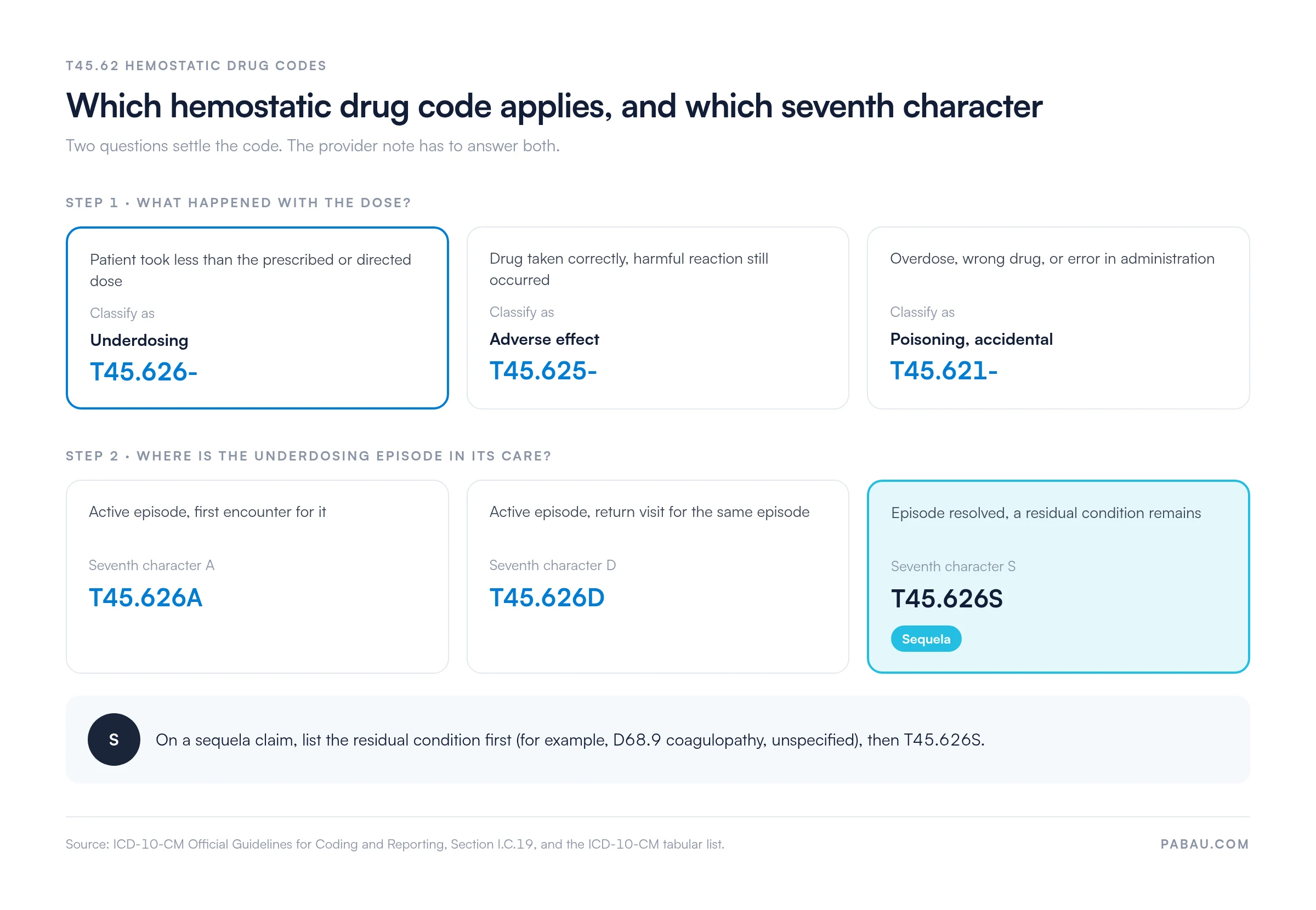
ICD-10-CM sequela coding convention requires the code for the sequela condition to be listed before T45.626S on the claim. On its own, T45.626S explains why the sequela developed, but it doesn’t describe what’s being treated at this encounter. The claim needs both codes.
Common sequela conditions reported ahead of T45.626S include coagulopathy, persistent hematoma, abnormal bleeding episodes and complications of altered coagulation. Look up the right residual condition code in the ICD-10-CM tabular list before submission to avoid incomplete-claim denials. Also confirm the patient’s insurance eligibility is current, since some payers restrict coverage when T45.626S is the only diagnosis code.
A superbill that captures all active diagnoses in the correct sequence prevents incomplete-code denials on T45.626S claims.
Payers and auditors look for five documented elements before they accept T45.626S. A claim missing any one of them is exposed to denial.
On sequela T-codes, medical billing compliance depends on a provider note that states the underdosing outright. “Patient appears to have taken less medication” doesn’t meet that standard. “Patient reports taking half the prescribed dose of tranexamic acid for three weeks due to cost” does.
Checking the record against this list before submission is what makes each T45.626S claim a clean claim. It also cuts the time coders spend working denials after the fact.
Most T45.626S denials fall into a small number of identifiable patterns. Knowing them lets billing teams build checks before submission instead of working appeals afterward.
The table below lists the five that come up on this code. When one does reach the payer, the reference on medical billing denial codes explains the reason code that comes back.
Before submitting any T45.626S claim, run a two-step check. Confirm the sequela condition code is in the primary position, then verify the provider note states the underdosing episode is resolved. Both checks take under a minute and prevent the two denial types this code sees most often.
Seeing where T45.626S sits in the T45 hierarchy makes it easier to spot when a neighboring code applies instead. T45 covers poisoning, adverse effects, and underdosing of primarily systemic agents. The CDC/NCHS ICD-10-CM web tool provides a navigable tabular view of the full T45 hierarchy.
After submission, electronic remittance advice (ERA) returns denial reason codes faster than a paper explanation of benefits (EOB). On T45.626S, that means a sequencing or seventh-character error can be corrected and resubmitted sooner.
Without a check before submission, a T45.626S error usually surfaces as a denial. A coder then reworks the claim by hand and waits on the resubmission.
Practice management software like Pabau moves that check ahead of submission. Its claims software for practices reviews diagnosis sequencing and seventh-character accuracy, so a missing sequela condition code gets flagged before the claim goes out.
Practices that route claims through Pabau’s Claim.MD clearinghouse integration get a second layer of checks. The integration validates ICD-10-CM codes against CMS code sets and flags incorrect encounter characters. Fewer T45.626S claims come back for manual rework, and your billing team spends less time on appeals.

Pabau’s claims management software checks diagnosis code sequencing and seventh-character accuracy before submission. T45.626S errors get caught before the claim reaches the payer.

T45.626S rarely gets denied because of the code itself. Denials come from the claim around it: The order of the codes, the seventh character and the wording of the provider note.
So put the check where the error starts. Before a T45.626S claim leaves the practice, confirm the residual condition code comes first and the note says the episode has resolved. A provider query costs minutes, while a denied sequela claim costs a resubmission and a delayed payment.
Book a demo to see how Pabau checks diagnosis sequencing before your T45.626S claims reach a payer.

Need a practical overview of how denials connect to billing workflows? Denial management strategies in healthcare walks through the upstream fixes that reduce rejection rates across code types.
Looking for a clearinghouse that validates ICD-10-CM codes in real time? Medical claims clearinghouse guide explains how clearinghouse validation works and what to look for in a US clearinghouse partner.
Want to understand how remittance data helps track denial patterns? Electronic remittance advice explained covers how ERA data surfaces CARC denial codes and accelerates posting.
Listing diagnoses in the right order on every encounter? What is a superbill? explains what goes on a superbill and how it feeds the claim.
Worried about audit exposure on T-code claims? Medical billing compliance: The laws and violations walks through the rules and includes a downloadable checklist.
ICD-10 code T45.626S is the billable diagnosis code for underdosing of hemostatic drugs, sequela. The patient presents with a residual condition that developed after an underdosing episode whose acute phase has fully resolved. Hemostatic drugs in this context include agents such as tranexamic acid and aminocaproic acid.
Yes, T45.626S is a billable, specific ICD-10-CM diagnosis code valid for claim submission. The seventh character S makes it reportable, whereas the parent code T45.626 (without a seventh character) is not billable on its own. Confirm current-year validity against the CMS ICD-10-CM update file for the relevant fiscal year.
T45.626A is for the initial encounter during an active hemostatic drug underdosing episode. T45.626D is for a subsequent encounter while the same episode continues. T45.626S applies only after the acute episode has fully resolved and the patient presents with a sequela condition. The seventh character reflects the phase of care, not the visit count.
Use the sequela seventh character S when the original injury or condition is fully resolved. The current encounter must be for a residual (late-effect) condition caused by that original episode. For T45.626S specifically, the provider must document that the underdosing episode is no longer active and identify the specific sequela condition being treated.
Underdosing occurs when the patient takes less than the prescribed dose. An adverse effect occurs when a harmful reaction develops even though the drug was taken correctly as directed. The distinction decides which T45.62x code applies. An adverse effect involves no patient deviation from the prescription, while underdosing needs explicit documentation that a subtherapeutic dose was taken.
No. Payers generally do not accept T45.626S as a primary or sole diagnosis. Under ICD-10-CM sequela coding convention, the code for the residual condition being treated goes in the primary position. T45.626S is sequenced after it to identify the cause. Submitting T45.626S alone or in the primary slot is the most common denial pattern for this code.
The sequela condition code (such as D68.9 for coagulopathy, unspecified) is required in the primary position. Some payers and AHA Coding Clinic guidance also recommend a code for the reason for underdosing when the provider note documents it. For noncompliance, use a billable child code such as Z91.190 (financial hardship) or Z91.198 (other reason).