ICD-10 Code S82.242H: Displaced spiral tibial shaft fracture, delayed healing
ICD-10 Code S82.242H: Definition and code details ICD-10 Code S82.242H designate...

Last Updated: Oct 15, 2026
Billable Code Specific Code
V69.9XXA is the billable ICD-10-CM code for occupant (driver) (passenger) of heavy transport vehicle injured in unspecified traffic accident, initial encounter. It applies when the record confirms a traffic accident involving a heavy transport vehicle occupant but doesn't document what kind of traffic accident it was.
The code sits in the V60-V69 block for heavy transport vehicle occupants. It's an external cause code, so it's always reported after the injury diagnosis and never as the principal diagnosis. Subsequent encounters take V69.9XXD, and sequela take V69.9XXS.
Let Pabau's smart automation suggest the right codes, reduce claim denials, and keep your practice compliant—effortlessly.
Automate repetitive tasks and focus on what matters most—your patients.
Reduce coding errors and ensure compliance with the latest regulations.
Clean claims, fewer denials, and faster reimbursements.
Powerful insights and reporting to help your practice thrive.
HIPAA compliant SOC 2 certified GDPR-compliant Trusted by 4,000+ clinics worldwide

V69.9XXA is a billable ICD-10-CM external cause code, valid for FY2025 and FY2026. It covers any occupant of a heavy transport vehicle injured in an unspecified traffic accident.
The code needs a documented traffic accident. An unspecified nontraffic accident codes to V69.3XXA instead.
The seventh character A marks the initial encounter, D a subsequent encounter, and S a sequela. Picking the wrong one is the leading cause of claim rejection for this code.
V69.9XXA is always a secondary code. It’s sequenced after the principal injury diagnosis, such as a fracture, traumatic brain injury (TBI), or laceration.
Claims management software like Pabau helps practices submit complete code sets, track denial patterns, and resubmit corrected claims with updated seventh characters.
ICD-10 code V69.9XXA describes an occupant of a heavy transport vehicle who was injured in an unspecified traffic accident during an initial encounter. The official descriptor is: Occupant of heavy transport vehicle injured in unspecified traffic accident, initial encounter. It’s a specific, billable code, valid for diagnosis submission under ICD-10-CM according to the CMS ICD-10-CM annual code files.
The code hierarchy runs from the broad external cause chapter (V00-Y99) through the transport block (V60-V69) to category V69. It then narrows to subcategory V69.9 for unspecified traffic accidents. The placeholder X fills positions five and six because V69.9 has no further subdivision, and the A in position seven marks the initial encounter.
V69.9XXA applies to any heavy transport vehicle occupant injured in a traffic accident. It’s the code to use when the record doesn’t say what kind of traffic accident it was. The traffic status itself must be documented. An unspecified nontraffic accident codes to V69.3XXA instead. Both drivers and passengers qualify under the occupant designation.
Heavy transport vehicles under ICD-10-CM include the following vehicle classes. Per the AAPC ICD-10-CM code reference, the block definition covers commercial and non-commercial large-vehicle operation:
“Unspecified traffic accident” means the record confirms a traffic accident but doesn’t support a more granular V69 subcategory. If the record names the accident type, a more specific V69 code applies. Use V69.9XXA only when that detail can’t be established, and query the provider first if a quick question would settle it.
V69.9XXA inherits the exclusion notes that apply at the V69 category level and the V60-V69 block level. Coders must review all three tiers before selecting this code.
Excludes1 notes are absolute. When an Excludes1 condition is present, you can’t report V69.9XXA alongside it. Excludes2 notes mean the two conditions are distinct enough to coexist. Report both when the clinical scenario supports it and the documentation is complete. The distinction matters at audit, where misapplied Excludes1 notes are a frequent finding.
V69.9XXA uses the initial-encounter extension A, the most critical of the three valid seventh characters for this code. Selecting the wrong extension is the single most avoidable cause of claim rejection for heavy transport vehicle accident codes.
The move from A to D follows the clinical picture, not the calendar. A patient seen at three follow-up appointments while still under active surgical management keeps the A extension on each encounter. The switch to D happens when treatment shifts to routine recovery.
The same A-to-D logic applies across the whole external cause chapter. A railway vehicle occupant, for example, is reported with V81.0XXA at the initial visit and V81.0XXD at follow-up. Whichever character applies, the injury code carries the same one and always sits first, as the code sets below show.
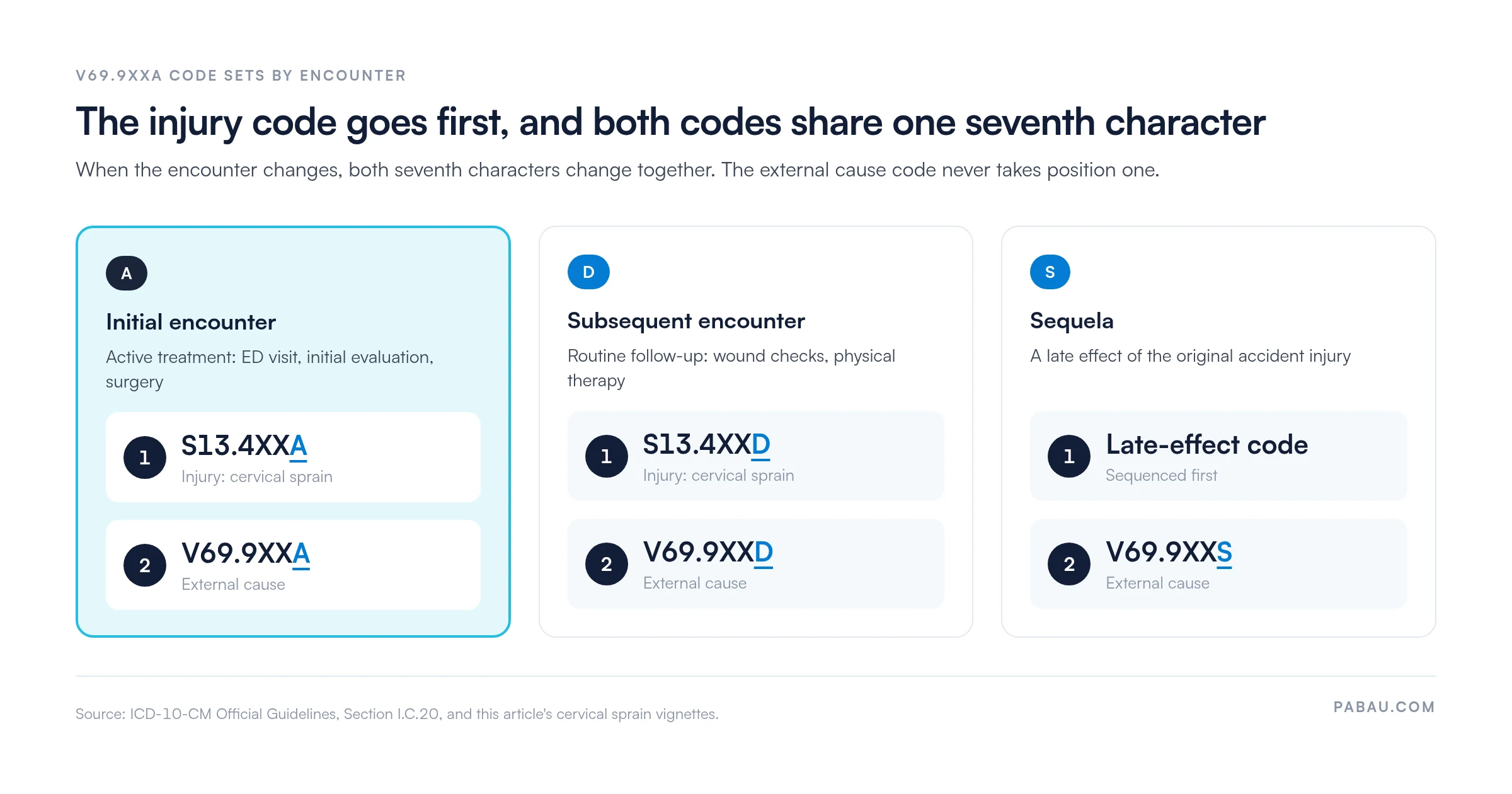
V69.9XXA is the least specific traffic code in the V69 category. Review the more granular siblings first. V69.9XXA applies only when the documentation supports none of them, and the traffic status is still confirmed.
The more specific code sometimes sits outside V69. A heavy transport vehicle driver injured in a traffic collision with a two- or three-wheeled motor vehicle takes V62.5XXA instead.
Verify the traffic vs. nontraffic distinction against the full V69 code tree in the official ICD-10-CM tabular list. That distinction directly affects payer liability determinations in auto-accident cases.
V69.9XXA is an external cause code and can never serve as a principal diagnosis. Section I.C.20 of the ICD-10-CM Official Guidelines for Coding and Reporting covers this. Every external cause code is reported as an additional code, after the injury or condition being treated.
Take a truck driver who reaches the ED with a closed fracture of the upper end of the left tibia. The record confirms a traffic accident but not its type. The correct code set follows this order:
The same rule holds for a TBI. The TBI code leads, and the external cause code follows. Submitting V69.9XXA without a lead injury code will trigger a front-end edit at most clearinghouses.
Run a pre-submission check on every motor vehicle accident (MVA) claim. Confirm that an injury diagnosis, not V69.9XXA, occupies the first diagnosis slot. Many practice management systems let you set claim scrubbing rules that flag an external cause code in position one. Set that rule before your next billing cycle.
The minimum documentation needed to support V69.9XXA and defend the claim at audit includes four elements. Missing any one of them can trigger a request for medical records or a denial for medical necessity. Transport codes also attract closer payer review, because auto insurance brings third-party liability into the claim.
Providers should review their intake process for MVA patients. Standardized triage questions that capture vehicle type, occupant position, and accident location reduce coding ambiguity from the first encounter onward.
External cause codes including V69.9XXA are required by many state Medicaid programs and encouraged by Medicare for injury claims, but commercial payer requirements vary. Check each payer’s policy before assuming optional status means the code can be omitted.
Auto-accident claims present a specific wrinkle. Many commercial insurers route MVA claims to their subrogation or liability departments when external cause codes signal a motor vehicle accident. Submitting V69.9XXA can trigger a request for accident details before payment is released. That request is a routine step, and it doesn’t count as a denial.
When a medical claims clearinghouse processes a V69.9XXA claim, its front-end validation checks for three elements:
A clean claim passes all three. If a payer rejects any element after adjudication, the electronic remittance advice (ERA) carries claim adjustment reason codes (CARCs). Those give coders the specific denial reason instead of a generic rejection notice.
Denials on V69.9XXA cluster around five specific errors. Each is fixable at the front end with the right documentation and coding checks in place. Practices with a structured denial management workflow catch these before submission rather than after rejection.
Tracking denial patterns across MVA claims? A denial codes reference matches each CARC on the ERA to the coding error behind it.
These two clinical vignettes show how V69.9XXA fits into a complete code set. Both follow the correct sequencing hierarchy and use the full seven-character code.
Note that both the injury code and the external cause code carry the same seventh character on each encounter. When the injury transitions from A to D, the external cause code does too. Mismatching seventh characters across codes in the same claim set is an audit risk. Using claims management software that validates seventh-character consistency across a claim’s full code set reduces this risk before submission.
V69.9XXA carries no descriptor changes in either the FY2025 or FY2026 ICD-10-CM update cycles. The code is active and valid for submission in both fiscal years. The CDC/NCHS ICD-10-CM web tool confirms the code’s current status. It also shows whether the annual update added, deleted, or revised any adjacent V69 code in a way that changes code selection.
If you bill injury-related encounters, confirm code status each October when the new fiscal year takes effect. The CMS annual update files are the authoritative source. Coders who rely on third-party databases should check those databases have been refreshed against the official October 1 release.
Bookmark the CDC/NCHS ICD-10-CM web tool and check it each October 1 when the new fiscal year activates. For V60-V69 transport codes specifically, also review any CMS transmittals issued mid-year that affect external cause code reporting requirements for Medicare and Medicaid claims.
Without a claims system, an injury claim passes through several hands. The coder picks the codes, someone else keys them into the claim, and the clearinghouse flags errors days later. By then, each fix means a corrected claim and a longer wait for payment.
With practice management software like Pabau, the encounter note, the code set, and the claim sit in one record. You can set claim scrubbing rules that flag an external cause code in position one before the claim leaves the practice. Pabau also integrates with the Claim.MD clearinghouse for real-time eligibility checks and 837P claim submission, including multi-code injury encounters.
When a payer does reject a claim, you can track the denial reason across MVA encounters and resubmit with the corrected seventh character. Fewer claims sit in rework, and injury visits get paid sooner.

Pabau’s built-in claims management tools help practices submit complete code sets, track denial reasons across payers, and resubmit corrected claims with updated ICD-10 codes. It all happens in one system.

V69.9XXA is the right code only when the record confirms a traffic accident and leaves its type undocumented. If the notes can settle the accident type, or show the accident happened off a public road, a sibling code fits better. A short provider query before coding costs less than a rejected claim.
Where V69.9XXA does apply, sequencing and the seventh character decide whether the claim pays the first time. Lead with the injury code, give both codes the same seventh character, and send the full seven-character code on every claim.
Book a demo to see how Pabau catches sequencing and seventh-character errors on injury claims before they reach the payer.

Tracking denials across injury claims? Denial management in healthcare explains how to build a denial workflow that catches external cause code errors before they reach the payer.
Need to understand the clearinghouse process for MVA claims? Claim.MD clearinghouse overview covers how 837P claims are validated and routed for injury encounters.
Working on post-accident rehabilitation billing? What is revenue cycle management walks through how injury encounter billing fits into the broader RCM framework.
Reading adjustment codes on a rejected claim? Electronic remittance advice explains how to read the ERA a payer returns after adjudication.
Preparing for a coding audit? Medical billing compliance covers the rules and checks that keep a practice’s claims defensible.
ICD-10 code V69.9XXA is the billable external cause code for a heavy transport vehicle occupant injured in an unspecified traffic accident. It covers the initial encounter. The code doesn’t describe the injury itself. It describes the external circumstances of the injury event, and it’s always sequenced after the principal injury diagnosis.
Yes, V69.9XXA is a specific, billable ICD-10-CM code valid for submission in FY2025 and FY2026. The abbreviated forms V69.9 and V69.9XX aren’t billable. Payers and clearinghouses accept only the complete seven-character version, V69.9XXA.
The three codes differ only in the seventh character, which identifies the encounter type. V69.9XXA is used for initial encounters where the patient is receiving active treatment. V69.9XXD applies to subsequent encounters during routine follow-up care after the injury has been assessed. V69.9XXS is used when the visit is for a late effect or sequela that developed as a direct result of the original accident injury.
No. ICD-10-CM Official Guidelines Section I.C.20 prohibit external cause codes from being listed as a principal or first-listed diagnosis. V69.9XXA must always follow an injury code such as a fracture, sprain, or traumatic brain injury code in the diagnosis sequence.
Use V69.9XXA only when the record confirms a traffic accident but can’t support a more specific traffic code. If the record documents a traffic collision with a motor vehicle, use V69.4-V69.6 with the right occupant role. A nontraffic accident takes V69.0-V69.2, or V69.3XXA when its type is unspecified. V69.9XXA is never a default for documentation nobody obtained.
V69.9XXA carries no descriptor or guideline changes in the FY2026 ICD-10-CM update. The code is active, and the FY2026 cycle added no V69 subcategories that would alter code selection.