ICD-10 Code Y76.0: Diagnostic obstetric and gynecological devices
ICD-10 Code Y76.0: Definition and billable status ICD-10 Code Y76.0 is a valid, ...

Last Updated: Oct 23, 2026
Billable Code Specific Code
M30.8 is the billable ICD-10-CM code for other conditions related to polyarteritis nodosa.
Let Pabau's smart automation suggest the right codes, reduce claim denials, and keep your practice compliant—effortlessly.
Automate repetitive tasks and focus on what matters most—your patients.
Reduce coding errors and ensure compliance with the latest regulations.
Clean claims, fewer denials, and faster reimbursements.
Powerful insights and reporting to help your practice thrive.
HIPAA compliant SOC 2 certified GDPR-compliant Trusted by 4,000+ clinics worldwide

ICD-10 code M30.8 describes other conditions related to polyarteritis nodosa, including polyangiitis overlap syndrome, and is a billable/specific code valid for reimbursement in 2026.
M30.8 sits within the M30-M36 block (Systemic connective tissue disorders) under Chapter 13; the parent code M30 is non-billable, making M30.8 the required level of specificity.
Accurate documentation must distinguish M30.8 from adjacent codes like M30.0 (polyarteritis nodosa) and M31.x (other necrotizing vasculopathies) to avoid claim denials.
Pabau’s claims management software helps rheumatology and internal medicine teams submit M30.8 correctly and track coding accuracy across patient encounters.
The primary condition captured under this code is polyangiitis overlap syndrome, a rare inflammatory vascular condition where features of polyarteritis nodosa overlap with other vasculitic processes. Rheumatologists and internal medicine physicians will encounter this code when documenting patients who present with necrotizing vasculitis features that span diagnostic categories.
Polyarteritis nodosa itself is a systemic necrotizing vasculitis affecting medium-sized vessels. M30.8 captures the clinical scenarios where features of this disease family are present but the picture extends beyond classical polyarteritis nodosa into overlapping territory. Per the WHO ICD-10 browser, this code belongs to the broader international classification framework governing systemic connective tissue conditions.
M30.8 sits within a clear hierarchical structure. Understanding the hierarchy is essential before assigning this code in a clinical encounter.
The parent category M30 is non-billable. Payers require a code at the specificity level of M30.8 (or another M30 subcategory) before processing a claim. Assigning M30 alone will result in rejection. Coders working on ICD-10 coding for systemic conditions across specialties will recognize this pattern: non-billable parent, billable child.
The complete M30 family contains five billable subcodes. Knowing all five helps coders choose the correct one at the time of documentation review.
The most common coding error with M30.8 is conflating it with M31-range codes for other necrotizing vasculopathies. Coders and clinicians at integrative medicine practices treating autoimmune and inflammatory conditions need to understand how these codes differ in scope. Systemic inflammation without a vasculitic component is coded separately under M04.9, so ruling that out early avoids downstream sequencing errors.
The distinction between M30.8 and M31.8 is clinically meaningful. M30.8 remains within the polyarteritis nodosa family; M31.8 covers necrotizing vasculopathies in a separate category. Misassigning between these two codes can affect MS-DRG mapping and downstream reimbursement.
The AAPC Codify ICD-10-CM lookup tool allows coders to cross-reference both code families side by side before finalizing assignment. The same hierarchical logic applies throughout Chapter 13, including to the unspecified variant.
Before assigning M30.8, review the patient’s rheumatology notes for explicit documentation of polyangiitis overlap syndrome or a clearly stated PAN-related condition. If the records support M30.0 (classical polyarteritis nodosa) without overlap features, use M30.0 instead. Ambiguous or incomplete documentation is the primary trigger for code-level audits on vasculitis diagnoses.
Clinics managing athletic injuries often pair these codes with outcome tracking in software for sports medicine.
Accurate assignment of ICD-10 code M30.8 depends on what the physician documents, not just what they intend to communicate. Coders cannot infer a diagnosis; the clinical record must support it explicitly. Practices that invest in compliance documentation workflows see fewer code-level query cycles with payers.

The CMS ICD-10 codes page provides the official ICD-10-CM Official Guidelines for Coding and Reporting, which govern documentation standards for all Chapter 13 codes including M30.8. These guidelines are updated annually; coders should verify they are referencing the current fiscal year’s edition.
Structured patient record management systems that prompt clinicians with diagnosis-specific documentation fields reduce the back-and-forth between coders and providers. For a vasculitis diagnosis like M30.8, those fields should capture vessel involvement, overlap syndrome features, and the source of diagnostic confirmation. Teams standardizing these fields across encounters often turn to clinical documentation software that prompts for them automatically. Secondary payers often allow a shorter window than the primary, so the filing deadline differs by claim.
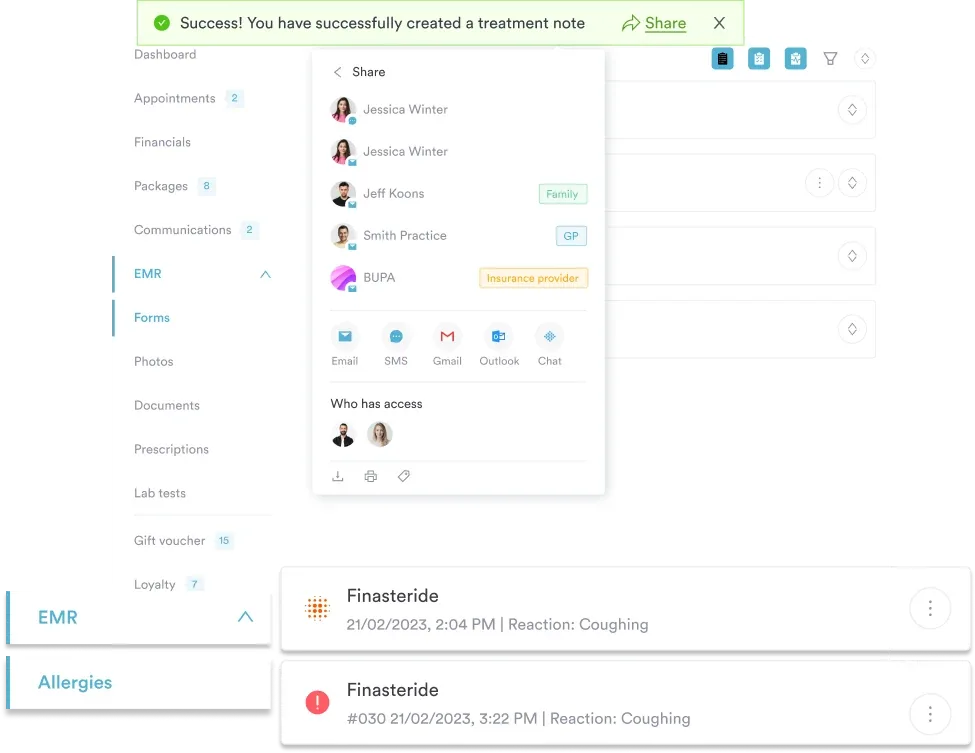

Pabau’s claims management software helps internal medicine and rheumatology teams code accurately, track M30.8 and related vasculitis diagnoses, and submit cleaner claims from day one.

M30.8 is a valid primary or secondary diagnosis code, depending on the clinical context of the encounter. For functional medicine practices and rheumatology groups billing for autoimmune disease management visits, understanding how this code interacts with payer policies prevents avoidable denials.
Coders should also confirm the accompanying evaluation and management level. Coders new to the specialty can review the fundamentals of medical billing before working with complex diagnosis families like this one.
When the polyarteritis nodosa-related condition is the chief reason for the encounter, M30.8 may serve as the principal diagnosis. When a patient presents for a complication such as N19 or G59 and the underlying vasculitis is contextual, M30.8 is coded as a secondary diagnosis behind the complication code.
Per CDC/NCHS ICD-10-CM guidance, the principal diagnosis is the condition established after study to be chiefly responsible for the admission or encounter. Coders must apply this standard consistently and not default to sequencing the vasculitis code first when a complication drives the visit.
Practices transitioning legacy records or working with older encounter data may need the ICD-9-CM equivalent. The approximate crosswalk for M30.8 is ICD-9-CM code 446.20 (Hypersensitivity angiitis, unspecified) and related codes in the 446.x range.
These crosswalks are approximate rather than direct one-to-one mappings. Always verify against the official GEM (General Equivalence Mapping) files maintained by CMS before applying to active claims.
Practices using claims management software can flag outdated ICD-9 references in legacy data automatically, reducing the risk of submitting crosswalk-based codes where a current ICD-10-CM code is required.

Run an annual audit of your rheumatology diagnosis code library. ICD-10-CM codes for systemic connective tissue disorders are updated each October. M30.8 has been stable across recent fiscal years, but adjacent codes in the M31 range have seen definitional changes. Verify against the current CMS tabular list before the new fiscal year begins.
Vasculitis diagnoses like M30.8 present documentation challenges because the clinical picture evolves. A patient initially coded with M30.0 (classical polyarteritis nodosa) may develop overlap features over time, requiring a coding update to M30.8. Practices need a structured approach to rheumatology practice management that accommodates these diagnostic shifts without creating duplicate or conflicting encounter records.
The same query discipline applies to pediatric rheumatology diagnoses like M08.1, where documentation specificity determines the correct code level.
M30.8 is a straightforward but easily misapplied code. The distinction between classical polyarteritis nodosa (M30.0) and “other conditions related to polyarteritis nodosa” (M30.8) hinges entirely on what the physician documents. When overlap syndrome features are present and recorded, M30.8 is the correct assignment. When the diagnosis is unambiguous classical PAN, M30.0 applies.
Pabau’s practice management software helps rheumatology and internal medicine teams maintain structured encounter records, link diagnosis codes to the correct documentation, and reduce claim rejections tied to under-specified vasculitis coding. To see how Pabau handles diagnostic code workflows in your practice, book a demo.

Coding a palate anomaly outside the cleft codes? Palate malformation coding guide explains when Q38.5 applies instead of the standard cleft palate codes.
Coding a different congenital GI anomaly? Congenital rectal atresia coding guide covers Q42.0, the code for absence of the rectum with fistula.
Coding a congenital female genital anomaly instead? Imperforate hymen coding guide explains when Q52.3 applies and why denials for this diagnosis happen.
ICD-10 code M30.8 is a billable ICD-10-CM diagnosis code for “Other conditions related to polyarteritis nodosa,” including polyangiitis overlap syndrome. It is valid for use in FY 2026 and can be assigned for reimbursement purposes when a patient’s condition falls within the polyarteritis nodosa family but does not meet a more specific M30 subcode.
Yes, M30.8 is a billable and specific ICD-10-CM code. The parent code M30 is non-billable, so payers require assignment at the M30.8 level (or another M30 subcategory) before processing a claim.
M30.0 is assigned for classical polyarteritis nodosa with a clear, unambiguous diagnosis. M30.8 applies when the patient has conditions related to polyarteritis nodosa that include overlap features or do not fit the classical presentation, such as polyangiitis overlap syndrome.
The physician’s notes must explicitly document a vasculitic condition in the polyarteritis nodosa family with overlap or “other” features. Biopsy results, imaging, or specialist rheumatology opinion should be referenced, and the responsible clinician must be identified in the encounter record. Coders cannot infer M30.8 from vague or incomplete documentation.
Yes. When a patient presents for a complication of their underlying vasculitis (such as renal involvement or peripheral neuropathy), the complication code takes the principal position and M30.8 is listed as a secondary diagnosis to provide clinical context for the encounter.
The ICD-10-CM code for classical polyarteritis nodosa is M30.0. Use M30.0 when the diagnosis is unambiguous PAN without overlap features, and use M30.8 when the record documents conditions related to polyarteritis nodosa, such as polyangiitis overlap syndrome, that do not meet a more specific M30 subcode.
Eosinophilic granulomatosis with polyangiitis (EGPA), historically called Churg-Strauss syndrome, is coded as M30.1 (polyarteritis with lung involvement). It is a separate billable code from M30.8 and requires documented pulmonary involvement.