ICD-10 code S61.201A: Open wound of left index finger without nail damage
ICD-10 code S61.201A covers a left index finger wound of unstated type ICD-10 co...

Last Updated: Oct 16, 2026
Billable Code Specific Code
L84 is the billable ICD-10-CM code for corns and callosities.
Let Pabau's smart automation suggest the right codes, reduce claim denials, and keep your practice compliant—effortlessly.
Automate repetitive tasks and focus on what matters most—your patients.
Reduce coding errors and ensure compliance with the latest regulations.
Clean claims, fewer denials, and faster reimbursements.
Powerful insights and reporting to help your practice thrive.
HIPAA compliant SOC 2 certified GDPR-compliant Trusted by 4,000+ clinics worldwide

ICD-10 Code L84 is the single billable ICD-10-CM code for corns and callosities, covering all types including plantar callus, heel callus, and clavus (corn).
L84 has no subcodes for laterality: right foot, left foot, and bilateral presentations all use the same L84 code with no additional digit.
Medicare typically excludes routine foot care like corn and callus removal unless comorbidities such as diabetes or peripheral vascular disease are documented.
Pabau’s claims management software helps podiatry and dermatology practices pair L84 with the correct CPT codes and capture the documentation needed to support reimbursement.
According to the CDC/NCHS ICD-10-CM coding tool, L84 is classified under Chapter L00-L99 (Diseases of the skin and subcutaneous tissue), within the block L80-L99 (Other disorders of the skin and subcutaneous tissue). The official clinical definition describes localized hyperplasia of the horny layer of the epidermis due to pressure or friction. In plain terms: skin thickening caused by repeated mechanical stress, whether from ill-fitting footwear, occupational pressure, or bony prominences.
L84 applies to two distinct but related conditions that practitioners frequently document together. Understanding the clinical difference matters because payers may look for specific language in notes.
Both conditions use the same L84 code. The ICD-10-CM classification structure does not differentiate by lesion type, laterality, or anatomical subsite for this code. L84 is a single terminal code with no subcodes. Practices using dermatology EMR software that auto-populates laterality fields should confirm those fields don’t create non-existent subcodes like L84.0 or L84.1, which do not exist in the 2026 ICD-10-CM tabular list.
Before billing, confirm these reference details are correctly entered in your practice management system.
Choosing the wrong CPT code against L84 is where most practices lose reimbursement. The three primary procedure codes for corn and callus treatment are straightforward in principle but require accurate lesion counting at the time of service.
Count and document each lesion separately in the procedure note. Billing 11057 when only two lesions were treated is a common audit trigger. According to the CMS ICD-10 codes guidance, claims with a date of service on or after October 1, 2015 require ICD-10-CM codes, making L84 the mandatory diagnosis code for all current corn and callus billing. The ICD-10 diagnostic code crosswalk also applies here: when transitioning older charts, ICD-9 code 700 maps directly to L84 via the CMS General Equivalence Mappings.
Practices using skin clinic software with integrated billing should configure the default diagnosis code for corn/callus procedure templates to L84 and link the CPT codes based on their standard lesion count ranges.
Document each hyperkeratotic lesion individually in your procedure note before selecting a CPT code. Count lesions on all affected sites, including interdigital spaces, as they are easy to miss during a busy clinic session. A clear count in the note protects against audit risk when billing 11056 or 11057.
Practices treating cosmetic and medical skin concerns side by side often chart in an aesthetic EMR.
Medicare coverage for corn and callus treatment is one of the most misunderstood areas in podiatry billing. Routine foot care, which includes nail trimming and callus removal performed on otherwise healthy feet, is generally excluded from Medicare coverage. L84 can support a covered claim only when the documentation establishes medical necessity, typically through comorbidities that create systemic risk.
When a patient has diabetes mellitus, peripheral vascular disease, or another condition that creates elevated foot care risk, the corn or callus treatment may be covered. The comorbidity code must appear in the claim alongside L84, properly sequenced as the underlying condition.
Reviewing condition-specific ICD-10 codes for co-occurring diagnoses helps ensure secondary codes are accurate and sequenced correctly. Severe systemic conditions that compromise skin integrity and wound healing. Payers expect the chart note to contain explicit language tying the foot condition to the systemic risk, not simply a listed comorbidity in the problem list.
A compliant L84 encounter note should include the following elements to withstand payer review. Claims management software that flags incomplete fields before submission reduces the likelihood of a denial on first pass.
On a Medicare routine foot care claim, L84 and the correct CPT code are not enough on their own. When coverage rests on a systemic condition, the CMS Billing and Coding article for foot care (A56232) requires a Q7, Q8, or Q9 modifier that reflects the documented class findings. Miss the modifier and the claim is denied even when the diagnosis is correct.
The class findings themselves are defined by CMS: Class A is a nontraumatic amputation of the foot or an integral skeletal portion of it; Class B covers absent posterior tibial pulse, absent dorsalis pedis pulse, and advanced trophic changes (nail changes, skin texture or color changes, decreased hair growth); Class C covers claudication, temperature changes, edema, paresthesia, and burning. The corresponding systemic diagnosis, the class findings, and the Q modifier must all appear together for the service to be considered for payment. A retroactive authorization is rarely granted, so the check belongs before the appointment.
Q modifiers establish medical necessity, but they do not identify the site treated. Pair them with the anatomic modifiers Medicare expects: LT or RT for the left or right foot, and the toe (T) modifiers (T1-T9, TA) when the procedure is toe-specific. For most Medicare Administrative Contractors, routine foot care tied to a systemic condition is covered no more than once every 60 days, so confirm the frequency limit and covered diagnosis list in your regional LCD and the current version of CMS Article A56232 before you submit.
L84 is not an isolated code. Several adjacent diagnoses frequently appear in the same podiatry or dermatology encounter, and coding them correctly alongside L84 affects both claim accuracy and sequencing. In dermatology encounters, thickened skin also has to be distinguished from inflammatory footwear reactions such as ICD-10 Code L25.3 (Unspecified contact dermatitis due to chemicals), which is coded separately when a chemical exposure is documented.
When a callus has progressed to open ulceration, L84 is no longer the correct primary code. Switch to the appropriate L89- pressure ulcer code or L97- non-pressure chronic ulcer code based on wound characteristics and anatomical site. Using standardized skin assessment tools in your workflow helps practitioners distinguish callosity from early-stage ulceration at the point of care.
Verify current code validity using the AAPC Codify ICD-10-CM lookup before billing. It reflects the current fiscal year tabular list – which spans every chapter, from skin diagnoses like L84 through external-cause codes such as assault by unspecified means (Y09) and an electric bicycle collision (V24.21XD) – and flags any codes that have been retired or modified.
Never use L84 when the lesion has broken down into an open wound or ulcer. The moment skin integrity is compromised, the claim requires a wound/ulcer code from the L89 or L97 range. Billing L84 against an ulcer treatment is a coding error that auditors flag frequently in podiatry charts.
Legacy billing systems and retrospective chart reviews occasionally require the ICD-9-CM equivalent. L84 maps directly to ICD-9-CM code 700 (Corns and callosities) via the CMS General Equivalence Mappings. This is a one-to-one crosswalk with no ambiguity.
For practices reviewing historical claims or conducting coding audits. The transition to ICD-10-CM became mandatory for all HIPAA-covered entities for dates of service on or after October 1, 2015. Any claim submitted with ICD-9 codes after that date is rejected at the payer level.
L84 is grouped within the MS-DRG system (v43.0). For outpatient podiatry and dermatology practices, DRG grouping is rarely the primary billing concern as L84 is predominantly billed in outpatient and office settings. However, hospital-based dermatology departments and outpatient hospital clinics may encounter DRG implications when L84 appears alongside other diagnoses in an inpatient record.
Commercial payers vary significantly in their coverage policies for L84-coded claims. Some cover corn and callus treatment without requiring documented comorbidities; others mirror Medicare’s medical necessity requirements. Check the payer’s current local coverage determination (LCD) before assuming a claim will process. Using digital patient intake forms that capture comorbidity history at check-in gives the treating clinician the information needed to code correctly before the encounter begins, not after a denial arrives.
Practitioners and coders working with L84 regularly encounter a short list of predictable mistakes. Knowing them in advance saves significant time on rework. A quick coding reference for CPT, ICD-10, and HCPCS ranges catches many of these mistakes before they reach the claim.
Some third-party coding tools and AI-generated content incorrectly list L84.0 (right foot) and L84.1 (left foot) as valid subcodes. These do not exist in the 2026 official ICD-10-CM tabular list. L84 is the complete code. Submitting L84.0 or L84.1 on a claim will result in an immediate rejection because the code is invalid. Always verify against the official CDC/NCHS ICD-10-CM web tool when uncertain about code structure.
Billing L84 alone on a Medicare claim for a patient without documented systemic risk will not produce a covered claim. The note must justify that the corn or callus represents more than a cosmetic or comfort concern. Document symptoms such as altered gait, pressure ulcer risk, pain limiting daily activity, or the inability of the patient to safely self-treat due to systemic disease. Capturing this information through standardized encounter templates reduces the likelihood of missing these fields under time pressure.
Selecting CPT 11057 (more than 4 lesions) when the note documents only two locations is a discrepancy that Recovery Audit Contractor (RAC) reviews detect quickly. The lesion count in the procedure note must match the CPT code selected. Some practices default to the highest CPT code in the 11055-11057 range to maximize reimbursement, which creates audit exposure without corresponding documentation. Using patient record management systems with structured procedure templates helps enforce accurate lesion counting at the point of care.
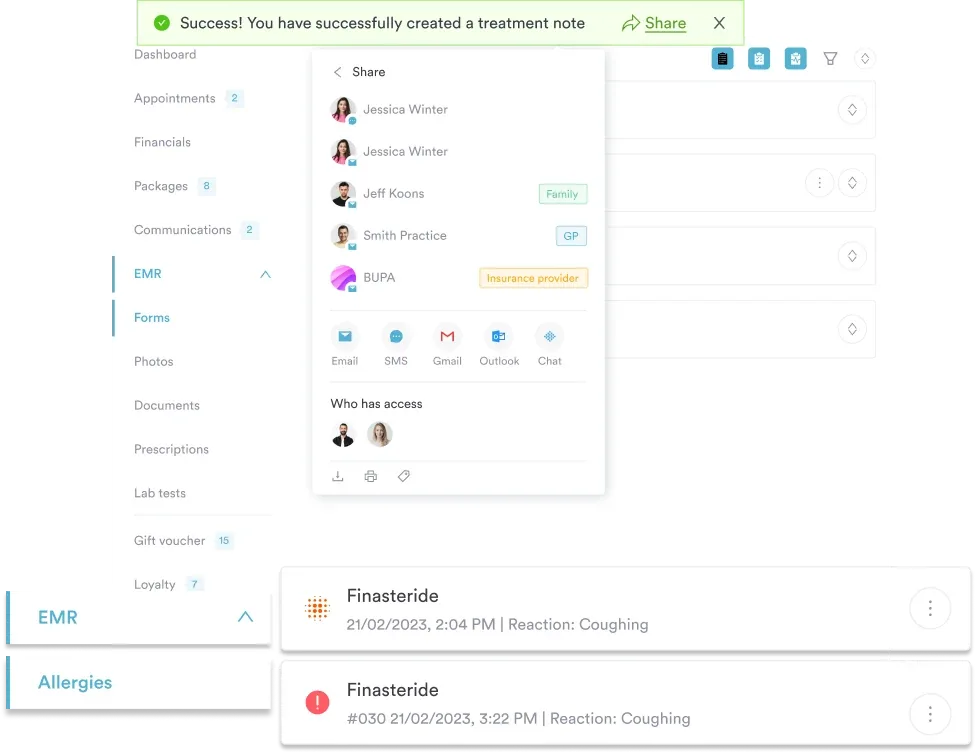

Pabau’s integrated claims management tools help skin and podiatry practices pair L84 with the correct CPT codes, capture comorbidity documentation, and reduce denial rates on first submission.

Corn and callus claims fail most often for two reasons: missing comorbidity documentation and CPT-to-lesion-count mismatches. ICD-10 Code L84 is a single, billable code covering all corn and callosity presentations, but the claim around it requires a compliant encounter note to survive payer review.
Pabau’s claims management software helps podiatry and dermatology practices build the documentation habits that support L84 billing, from structured procedure templates that enforce lesion counting to pre-submission claim checks that flag missing comorbidity codes. To see how Pabau handles the documentation workflow, book a demo.

Tempted to default to the unspecified back pain code? Dorsalgia, Unspecified billing reference covers why the most commonly coded musculoskeletal diagnosis is also one of the most miscoded.
Documenting a muscle inflammation without a named type? Myositis, unspecified explains when this code applies within the M60 category.
Coding calcium deposits in muscle tissue? Calcification and ossification of muscle covers when imaging confirms the finding but the muscle and cause go unnamed.
ICD-10 Code L84 is the billable ICD-10-CM diagnosis code for corns and callosities, covering all forms of localized skin thickening caused by pressure or friction, including plantar callus, heel callus, and clavus (corn). It falls under Chapter L00-L99 (Diseases of the skin and subcutaneous tissue) and has no subcodes for laterality or lesion type.
Yes, L84 is a billable and specific ICD-10-CM code. It can be used to indicate a diagnosis for reimbursement purposes on claims with a date of service on or after October 1, 2015. Whether the claim is actually covered depends on payer policy and the medical necessity documented in the encounter note.
Both conditions use the same code, L84. Clinically, a corn (clavus) is a concentrated lesion with a hard central core, while a callosity is a diffuse area of thickened skin without a discrete core. ICD-10-CM does not distinguish between them for coding purposes, but clinical notes should specify the lesion type for audit defense purposes.
CPT codes 11055 (single lesion), 11056 (2-4 lesions), and 11057 (more than 4 lesions) are the primary procedure codes billed with L84 for corn and callus paring or cutting. The correct CPT code depends on the number of distinct lesions documented and treated during the encounter.
The ICD-9-CM equivalent of L84 is code 700 (Corns and callosities). This is a direct one-to-one crosswalk per the CMS General Equivalence Mappings. ICD-9 codes are no longer accepted for claims with a date of service on or after October 1, 2015.