ICD-10 code S61.201A: Open wound of left index finger without nail damage
ICD-10 code S61.201A covers a left index finger wound of unstated type ICD-10 co...

Last Updated: Oct 16, 2026
Billable Code Specific Code
L42 is the billable ICD-10-CM code for pityriasis rosea.
Let Pabau's smart automation suggest the right codes, reduce claim denials, and keep your practice compliant—effortlessly.
Automate repetitive tasks and focus on what matters most—your patients.
Reduce coding errors and ensure compliance with the latest regulations.
Clean claims, fewer denials, and faster reimbursements.
Powerful insights and reporting to help your practice thrive.
HIPAA compliant SOC 2 certified GDPR-compliant Trusted by 4,000+ clinics worldwide

ICD-10 code L42 is the billable, terminal diagnostic code for pityriasis rosea, a self-limiting papulosquamous skin disorder of unknown origin.
L42 falls under the L40-L45 Papulosquamous disorders block in Chapter 12 (L00-L99) of ICD-10-CM and has no subcodes.
Synonyms include pityriasis rosea and pityriasis rosea-like drug eruption; accurate differential diagnosis from L40 (psoriasis) and L43 (lichen planus) is critical to avoid claim errors.
Pabau’s claims management software helps dermatology and general practice teams submit L42 encounters accurately and reduce coding-related denials.
Pityriasis rosea is a mild, self-limiting exanthem that typically resolves within six to ten weeks.
ICD-10 code L42 is the billable, specific ICD-10-CM diagnosis code for pityriasis rosea, effective for dates of service on or after October 1, 2015. The 2026 ICD-10-CM edition (valid from October 1, 2025) confirms L42 remains current with no revisions. It is a terminal code, meaning there are no subcategories or child codes beneath it.
Clinically, pityriasis rosea is a mild exanthematous inflammation of unknown etiology. It presents as salmon-colored maculopapular lesions, typically distributed across the trunk in a “Christmas tree” pattern following skin cleavage lines. A herald patch, an isolated oval plaque appearing one to two weeks before the generalized eruption, is the condition’s most recognizable early feature.
| Code detail | Value |
|---|---|
| ICD-10-CM code | L42 |
| Full description | Pityriasis rosea |
| Code type | Billable / specific (terminal code, no subcodes) |
| Chapter | Chapter 12: Diseases of the skin and subcutaneous tissue (L00-L99) |
| Block | Papulosquamous disorders (L40-L45) |
| ICD-9-CM equivalent | 696.3 |
| 2026 edition effective date | October 1, 2025 |
| Minimum date of service | October 1, 2015 |
According to the Centers for Medicare and Medicaid Services (CMS), ICD-10-CM codes require a date of service on or after October 1, 2015 to be used for reimbursement purposes. L42 satisfies this requirement and is accepted across all major US payers.
Two synonyms are officially recognized under L42 in ICD-10-CM. Understanding both is important because either may appear in clinical documentation or referral letters.
When a drug-induced eruption is clearly documented in the chart, some coding professionals debate whether a separate external cause code should accompany L42. The safest approach: follow payer-specific guidance and consult CMS Official Guidelines for Coding and Reporting. Document the suspected causative agent in the clinical note to support the encounter record.
Document whether the rash is idiopathic or drug-induced in every encounter note. If the patient is on a medication known to trigger pityriasis rosea-like eruptions, listing the suspected agent supports the diagnosis code and reduces audit risk.
L42 belongs to the L40-L45 Papulosquamous disorders block, itself within Chapter 12 (Diseases of the skin and subcutaneous tissue, L00-L99). Knowing the block structure matters for coders who need to navigate the tabular list or verify crosswalks. The full set of codes in this block includes:
This hierarchy is defined by the World Health Organization’s ICD-10 browser, which forms the basis for the US ICD-10-CM adaptation maintained by CMS and the National Center for Health Statistics (NCHS).
Because L42 sits directly adjacent to psoriasis (L40) and lichen planus (L43), coders should pay close attention to clinical documentation before assigning any of these codes. Payers audit this block with some frequency given the overlapping presentations.
Our comparison of EMRs for aesthetic practices shows which platforms handle dermatology documentation well.
Pityriasis rosea shares clinical features with several other papulosquamous and infectious conditions. Assigning the wrong code here creates claim accuracy problems and can trigger audits.
| Condition | ICD-10-CM code | Key distinguishing features |
|---|---|---|
| Pityriasis rosea | L42 | Herald patch, Christmas tree distribution, self-limiting 6-10 weeks, unknown etiology |
| Psoriasis vulgaris | L40.0 | Chronic, silvery plaques on extensor surfaces, positive family history common |
| Guttate psoriasis | L40.4 | Small drop-shaped lesions, often post-streptococcal infection, no herald patch |
| Lichen planus | L43 | Purple, polygonal, pruritic papules; Wickham’s striae on buccal mucosa |
| Secondary syphilis | A51.39 (other secondary syphilis) | Palmoplantar involvement, systemic symptoms, positive serology |
| Tinea corporis | B35.4 | Annular scaling, fungal hyphae on KOH prep, responds to antifungals |
Secondary syphilis is the most clinically consequential differential to exclude. The rash can mimic pityriasis rosea closely, including the distribution pattern. A rapid plasma reagin (RPR) or VDRL test clears this differential when clinical suspicion exists. Documenting the negative serology in the chart protects the L42 assignment on audit.
Guttate psoriasis (L40.4) is the other common point of confusion, particularly in younger patients presenting after a streptococcal throat infection. The absence of a herald patch and the distinct lesion morphology (silvery scale vs. the collarette scale of pityriasis rosea) guide differentiation.

Pabau’s claims management tools and customizable clinical forms help dermatology and general practice teams document L42 encounters accurately, reduce denials, and keep patient records audit-ready.

Practices migrating historical encounter data or working with legacy records need to understand the crosswalk between ICD-9-CM and ICD-10-CM. L42 maps directly to a single ICD-9-CM predecessor with no ambiguity.
| ICD-9-CM code | Description | ICD-10-CM equivalent |
|---|---|---|
| 696.3 | Pityriasis rosea | L42 |
This is a one-to-one crosswalk. Unlike many dermatology codes where a single ICD-9 code expands into multiple ICD-10 subcodes, pityriasis rosea has no subcategorization in either system. Historical encounters coded as 696.3 translate cleanly to L42 for any data migration or crosswalk analysis.
For practices using a coding lookup tool, the AAPC Codify ICD-10-CM lookup provides searchable crosswalk data alongside official tabular list references, code history, synonyms, and coding notes. Keeping a code lookup current matters more than keeping it comprehensive.
When running historical data reports or migrating to a new EHR, filter for ICD-9 code 696.3 and replace all occurrences with L42. No secondary codes are required for this crosswalk. Verify dates of service fall on or after October 1, 2015 to confirm ICD-10 eligibility.
L42 is a straightforward code from a payer coverage standpoint. No Type 1 or Type 2 Excludes notes apply to L42 in the ICD-10-CM Tabular List. There are no instructional notes requiring additional codes to be sequenced first or secondary. This makes L42 one of the cleaner diagnostic codes to submit in dermatology billing.
L42 supports medical necessity for a range of evaluation and management and dermatology procedure codes. The specific CPT code must reflect what was documented and performed during the encounter.
Using claims management software that validates code pairings before submission significantly reduces the likelihood of a medical necessity denial on L42 encounters. Practices managing a high volume of dermatology claims benefit from automation that flags unsupported CPT-ICD combinations before they leave the practice.

Pityriasis rosea encounters are low-complexity from a payer perspective. Denials on L42 claims most often stem from three sources. Accounts receivable aging shows which codes are slow to pay long before anyone calls it a denial problem.
For skin clinic software users, setting up encounter templates specific to pityriasis rosea presentations ensures that all documentation touchpoints (lesion description, distribution, herald patch status, medications reviewed) are captured consistently. This directly supports E/M level selection and reduces denial risk.
Strong documentation is the foundation of a defensible L42 claim. Every encounter note should address the following elements to support the diagnosis code and the selected E/M level.
Using AI-powered clinical documentation tools can accelerate note completion without sacrificing specificity. When a clinician describes findings verbally and the system structures the note automatically, documentation completeness improves and coding accuracy follows.
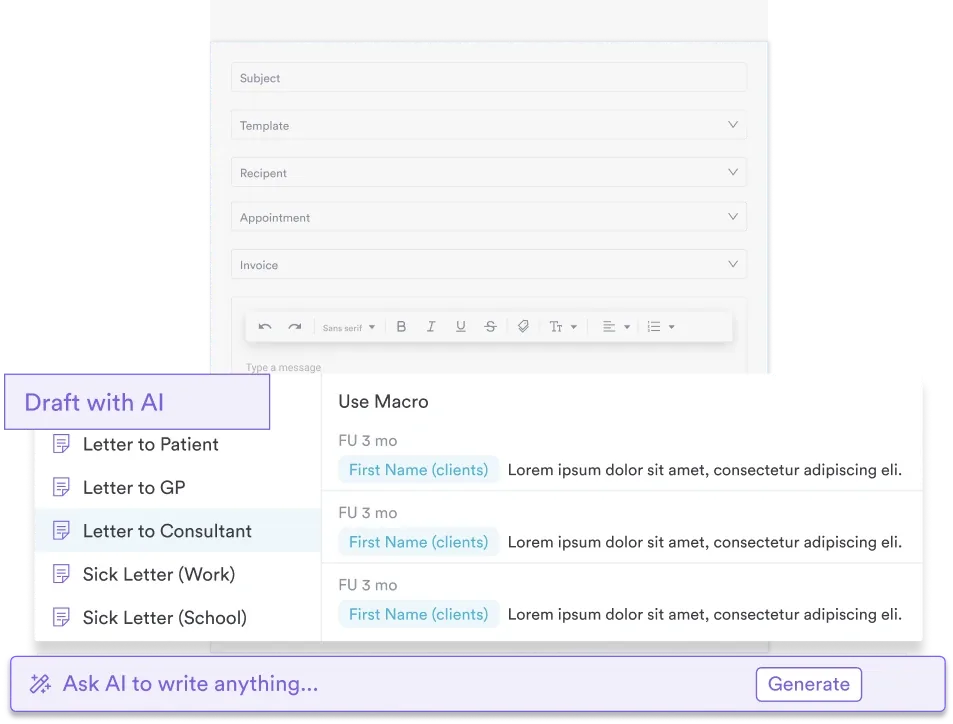
Practices focused on skin assessments can also reference standardized skin assessment tools to create consistent dermatological examination templates. Consistent templates reduce variation in how findings are described, making coding decisions more straightforward.
Pityriasis rosea is visually diagnosable in many cases, making it suitable for telehealth assessment when image quality is adequate. For telehealth encounters using L42, documentation must specify that the clinician visually assessed the lesion morphology and distribution via secure video. The encounter note should match the telehealth-specific E/M code selected. For an overview of telehealth compliance frameworks in practice settings.
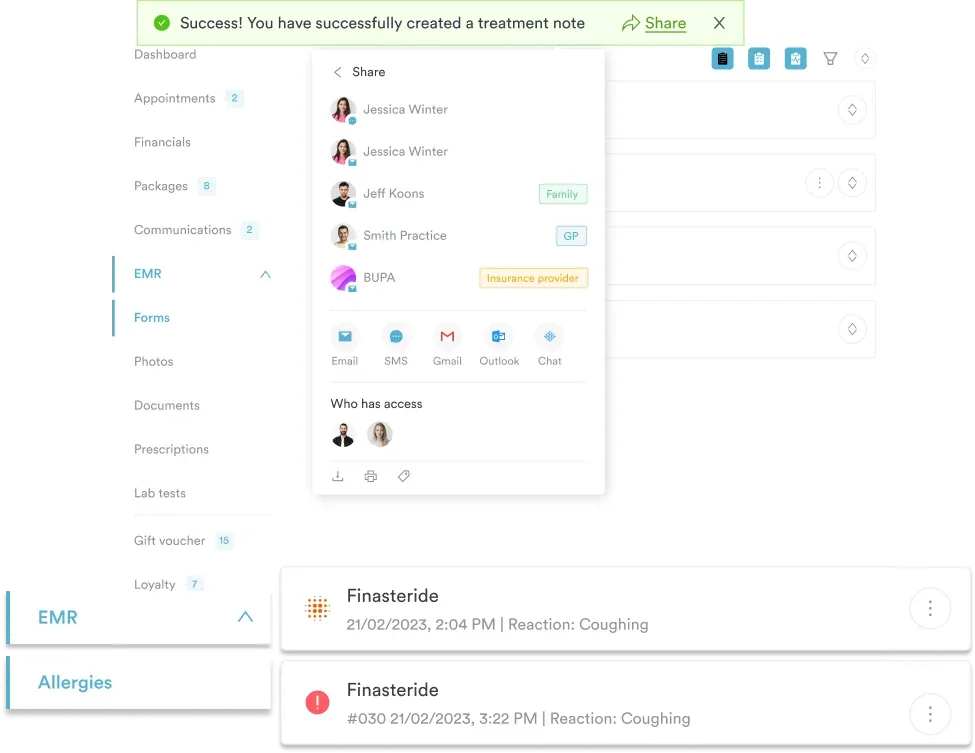
A patient record management system that links intake forms, clinical notes, and billing codes within one encounter record captures the details whose absence most commonly leads to claim scrutiny on dermatology diagnoses.
Claim errors on L42 encounters almost always trace back to the same root cause: documentation that does not reflect the specificity the code requires. Getting pityriasis rosea coding right means noting the herald patch, documenting differentials excluded, and matching the E/M level to what the note actually supports.
Pabau’s claims management software helps dermatology and general practice teams validate code pairings before submission, build diagnosis-specific encounter templates, and maintain audit-ready patient records. To see how Pabau handles dermatology documentation workflows end to end, book a demo.
ICD-10 code L42 is the billable diagnostic code for pityriasis rosea, a self-limiting inflammatory skin condition characterized by salmon-colored maculopapular lesions in a Christmas tree distribution. Clinicians use it to document and bill for dermatology and primary care encounters where pityriasis rosea is the confirmed or working diagnosis.
Yes. L42 is a billable, specific ICD-10-CM code with no subcategories. It can be used directly on claims for dates of service on or after October 1, 2015. No additional specificity codes are required beneath it.
Office and outpatient E/M codes (99202 through 99215) are the most frequently paired CPT codes. The specific level depends on medical decision-making complexity or total time documented. Skin biopsy code 11102 may apply when tissue sampling is performed to exclude other diagnoses. UVB phototherapy code 96910 (tar and ultraviolet B) applies for extensive cases requiring light therapy.
L42 maps to ICD-9-CM code 696.3 (Pityriasis rosea) in a direct one-to-one crosswalk. There are no additional mapping options or alternative ICD-9 codes for this condition.
The encounter note should describe the herald patch, lesion morphology (oval, salmon-colored, collarette scale), distribution pattern (trunk, Christmas tree), differentials excluded (including secondary syphilis serology when clinically indicated), medication review for drug-induced causes, and the patient counseling provided. Structured examination templates improve consistency across encounters. Using practice management software with built-in dermatology documentation templates helps capture every required detail and reduces coding errors.
Two synonyms appear under L42: pityriasis rosea (the primary idiopathic form) and pityriasis rosea-like drug eruption (morphologically identical but caused by specific medications including ACE inhibitors and gold compounds). Both are coded to L42.
The ICD-10-CM diagnosis code for pityriasis rosea is L42. It is a billable, terminal code with no subcategories, valid for dates of service on or after October 1, 2015. Its ICD-9-CM predecessor was 696.3.
Pityriasis rosea is most often confused with guttate psoriasis (L40.4), lichen planus (L43), tinea corporis (B35.4), and secondary syphilis (A51.39). Secondary syphilis is the one to rule out first, since its rash can mimic the same trunk distribution. A negative RPR or VDRL documented in the note protects the L42 assignment on audit.