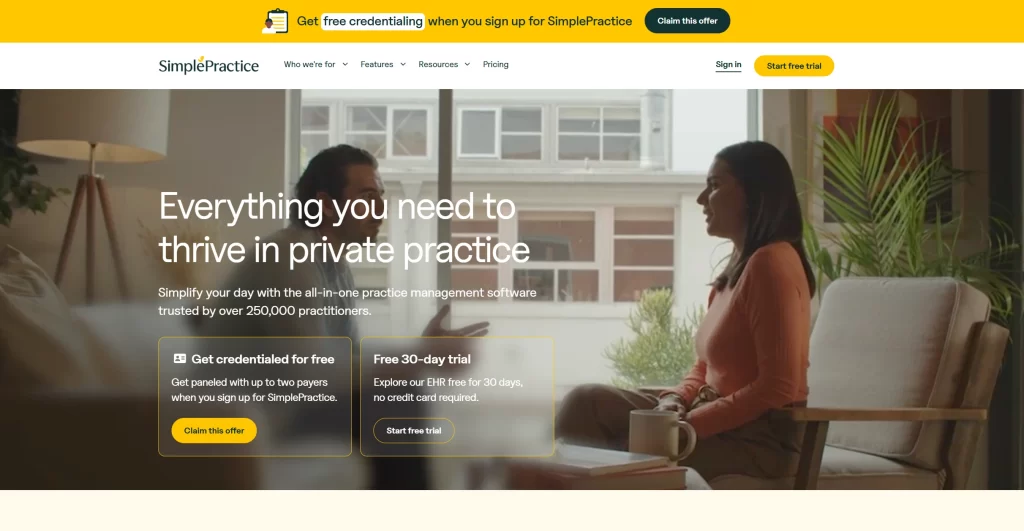
SimplePractice dominates therapy-specific billing with insurance claim automation and measurement-based care tools.
Carepatron provides the most generous free tier with unlimited users and core EHR features.
TherapyNotes delivers robust group practice management with dedicated mental health documentation templates.
Zenoti excels in multi-location spa and wellness environments but lacks mental health-specific workflows.
Found our content helpful?
Introduction to Mental Health Software in 2026
Therapists, psychiatrists, and counseling practices need software that supports workflows specific to behavioral healthcare. Beyond scheduling and patient records, mental health platforms must handle recurring therapy sessions, standardized assessments, insurance billing, and strict privacy regulations. Many practices also keep printable session materials on hand, such as therapeutic worksheets and a psychology intake form, to support sessions and speed up onboarding.
In the United States, systems must also support compliance with 42 CFR Part 2, which governs the handling of substance use disorder records and requires additional privacy protections.
Telehealth has become a core feature, while insurance billing and documentation requirements have grown more complex as payers increasingly expect structured clinical notes and measurement-based care.
This guide compares seven mental health software platforms used by US practices in 2026: Pabau, SimplePractice, Carepatron, TherapyNotes, Zenoti, TheraNest, and Headway.
Mental Health Software Quick Comparison
This table compares core capabilities across the seven platforms evaluated in this guide. Ratings reflect user feedback from Capterra and G2 where available. Starting prices indicate the lowest-tier plan per user per month, with both USD and GBP equivalents shown.
Name
Best For
Standout Feature
Starting Price
Rating
Pabau
Multi-specialty clinics requiring unified operations across mental health, wellness, and medical services
AI clinical documentation (Pabau Scribe) with customisable templates for diverse healthcare specialties
$62 / £49 per user/month
4.7/5 (600+)
Carepatron
Solo practitioners and small practices prioritising cost-effective entry with core EHR features
Generous free tier with unlimited users, telehealth, and scheduling
$0 / £0 (free plan available)
4.9/5 (522+)
SimplePractice
Therapists and counsellors focused on insurance billing automation and outcome tracking
Integrated insurance claim creation with measurement-based care tools for recurring assessments
$49 / £39 per user/month
4.6/5 (2,800+)
TherapyNotes
Group practices requiring robust mental health documentation workflows and detailed reporting
Pre-built therapy templates with automated scoring for clinical assessments
Contact for pricing
4.7/5 (945+)
Zenoti
Multi-location spa and wellness centres integrating mental health services with aesthetic treatments
Enterprise-grade booking infrastructure with resource management across locations
Contact for pricing
4.5/5 (1,200+)
TheraNest
Small therapy practices seeking straightforward billing and documentation without complexity
Simplified insurance billing workflows with guided claim submission
Contact for pricing
4.4/5 (900+)
Headway
Therapists prioritising patient acquisition through insurance network participation
Credentialing support and patient referral matching through insurance partnerships
Contact for pricing
N/A
Pabau: Best All-in-One Clinic Management Platform for Multi-Specialty Healthcare Practices
Pabau is built for clinics that operate across more than one discipline — mental health, wellness, primary care, and aesthetic services under a single roof. That makes it particularly useful for integrative health centers and longevity clinics, where mental health sits alongside IV infusions, hormone replacement consultations, and med spa treatments rather than existing as a standalone service line. Clinics whose aesthetic side is the main event should start from the other direction, with an EMR built for med spas and add mental health on top. Fertility practices sit in the same camp, typically starting with dedicated software for IVF clinics before layering on counseling services.
For practices in this category, a functional medicine EMR that keeps complex patient data unified across specialties is essential to keeping care coordinated and actionable.
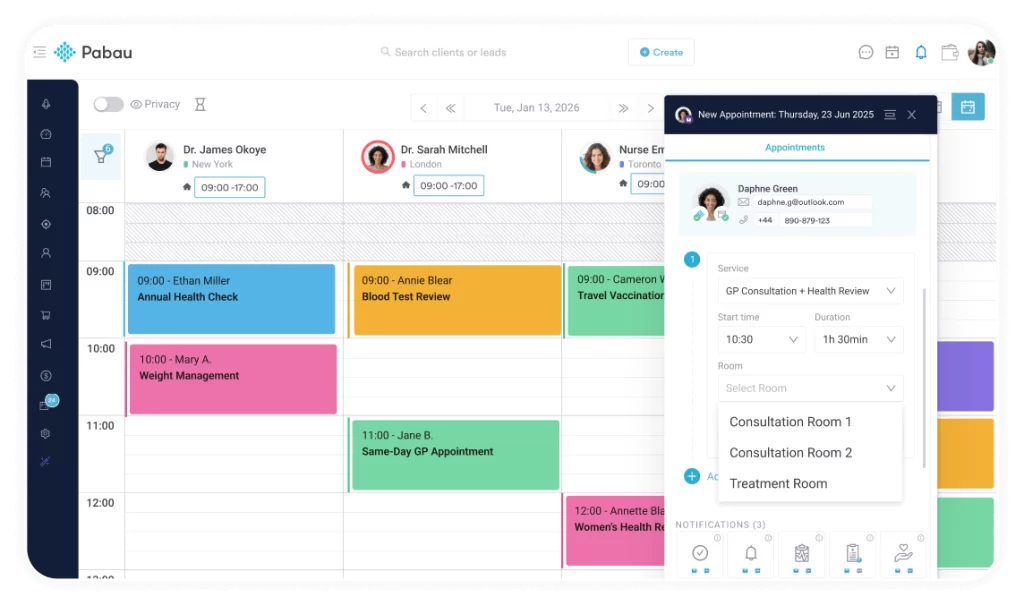
Pabau Calendar
The platform’s clinical documentation system adapts to each specialty through a customizable form builder. For mental health practitioners, that means intake assessments, SOAP notes, and treatment plans structured around psychiatric and counseling workflows, including standardized cognitive screens such as the Mini-Mental State Examination. Therapists can also share client resources, such as a healthy boundaries worksheet, through the same document system. The same builder simultaneously produces medical history questionnaires for hormone therapy patients and consultation forms for dermatology, all feeding into one unified patient record.
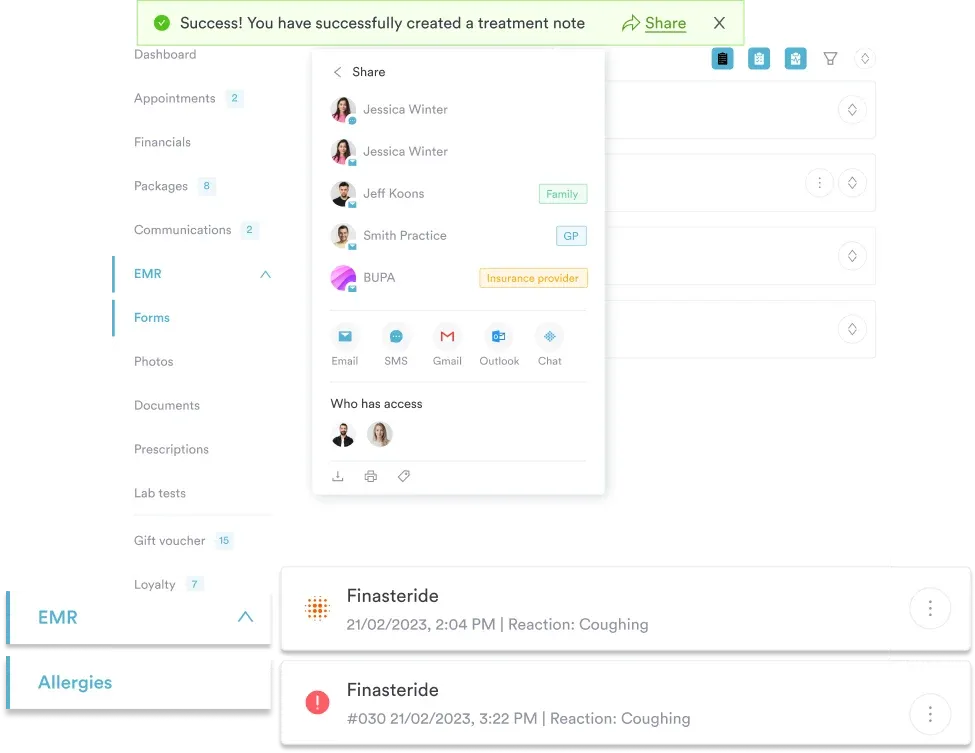
Pabau Patient Records
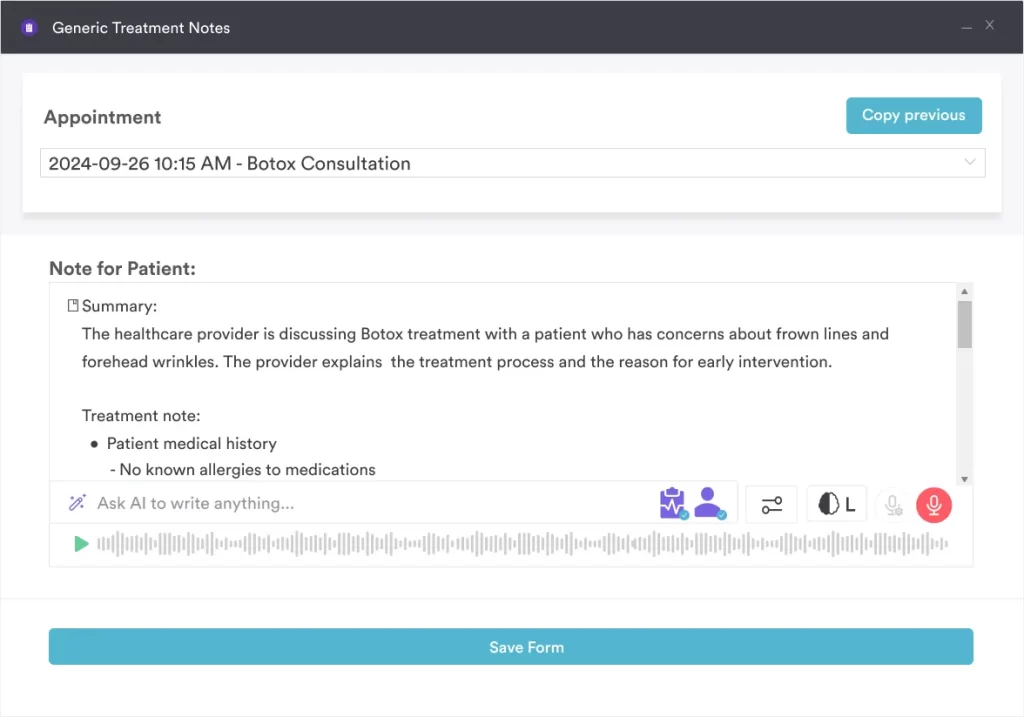
Pabau’s AI documentation tool, Pabau Scribe, transcribes provider–patient conversations and generates structured clinical notes, and it works the same way across every specialty the platform supports.
Pabau Scribe doesn’t replace clinician review — notes still need to be checked and signed off before they’re finalized — but it removes most of the typing.
Note-taking with Pabau Scribe
Key Features
Multi-specialty clinical documentation: Customizable form builder supporting mental health assessments, medical intake questionnaires, and specialty-specific templates within unified patient records
Pabau Scribe clinical scribe: Voice-to-text transcription with automated SOAP note generation, applicable across therapy sessions, medical consultations, and wellness appointments
Integrated telehealth: HIPAA-compliant video platform embedded within patient records, with session recording and encrypted communication channels
Revenue cycle management: Payment processing, insurance verification, and automated claims submission supporting both mental health billing codes and multi-specialty reimbursement workflows
Multi-location operations: Centralised calendar system managing appointments, staff scheduling, and resource allocation across multiple clinic sites with role-based access controls
Prescription management hub: Centralised system for creating, reviewing, and sending prescriptions via email with drug interaction checking and formulary reference integration
Pricing
Plan / Tier
Price
Details
Starter
From $65/month
Per practitioner; billed monthly
Team / Group
Scales by location and user count
Volume-based pricing
Enterprise
Custom pricing
Contact sales for a quote
Where Pabau Shines
Cross-specialty flexibility: Single platform supporting mental health, wellness, aesthetics, and medical services without requiring separate systems or data silos, enabling integrative care models where therapists coordinate with nutritionists, hormone specialists, or functional medicine practitioners under one operational roof
Advanced automation infrastructure: Workflow builder allowing clinics to automate appointment confirmations, recall campaigns, waitlist notifications, and post-treatment follow-ups with condition-based logic that adapts messaging to patient status and service type
Robust multi-location capabilities: Centralised calendar, inventory, and reporting systems designed for practices operating across 3-10+ locations, with role-based permissions ensuring staff access only relevant data for their assigned sites while administrators maintain enterprise-wide visibility
Where Pabau Falls Short
Mental health-specific templating: While customisable, the platform requires clinics to build mental health assessment templates from scratch rather than offering pre-configured PHQ-9, GAD-7, or other standardised tools out of the box
Insurance billing learning curve: Revenue cycle management features support mental health billing codes, but clinics transitioning from therapy-specific platforms may find the broader feature set requires additional training to navigate efficiently
Customer Reviews
Pabau holds a 4.7 out of 5 rating on Capterra based on over 465 verified reviews, a 4.7 out of 5 rating on G2 across 370+ reviews, and a 4.7 out of 5 “Excellent” rating on Trustpilot. Reviewers consistently highlight the platform’s comprehensive all-in-one approach, strong automation capabilities, and responsive customer support during onboarding. Common concerns centre on the initial setup investment required for practices without dedicated IT resources, particularly when configuring complex workflows across multiple specialties.
Who Pabau Is Best For
Multi-specialty clinics offering mental health services alongside wellness, aesthetics, or primary care
Integrative health centres requiring unified patient records across diverse treatment modalities
Multi-location practices needing centralised operations and consolidated reporting
Clinics prioritizing automation for appointment workflows, patient communication, and recall campaigns
Carepatron: Best Mental Health Software for Cost-Conscious Solo Practitioners and Small Practices
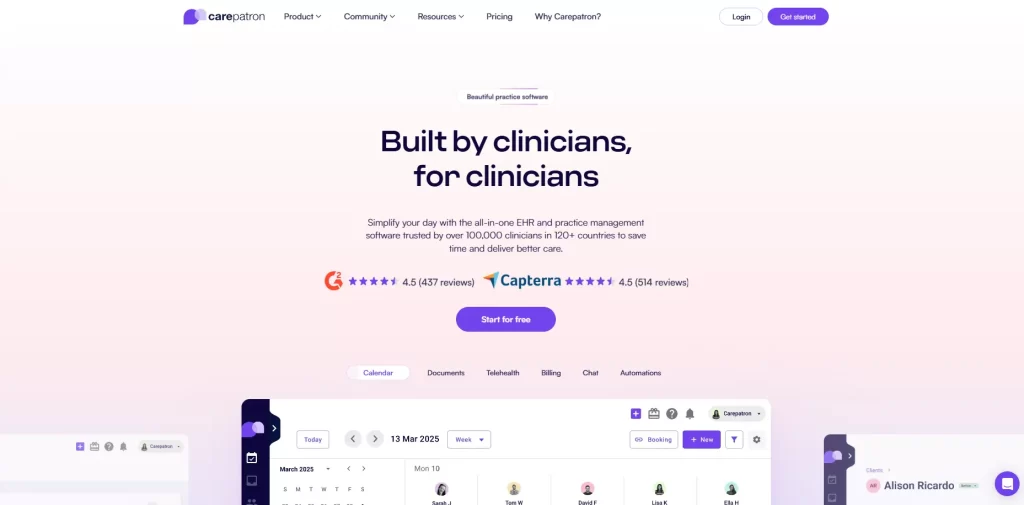
Carepatron positions itself as an accessible entry point for solo therapists and small counseling practices. Its free tier includes core EHR functionality, built-in telehealth, unlimited clients, and — notably — an AI scribe for session notes, all at no cost. That makes it especially appealing to newly licensed clinicians launching their first private practice, or to practitioners testing out digital systems before committing to a paid subscription. Many pair the free tier with ready-made materials, like a SMART goals worksheet or a personal values list, for early goal-setting work. Clinicians who mix counseling with coaching work weigh similar trade-offs; we compare coaching software for UK practices separately.
The platform’s design prioritizes simplicity over feature depth. Scheduling, documentation, and billing workflows follow straightforward paths built around the needs of individual providers rather than complex multi-practitioner coordination or high-volume insurance billing. Reviewers on Capterra and GetApp consistently highlight the low learning curve, though the trade-off is that features like shared inboxes, group telehealth, role-based permissions, and advanced reporting sit behind the Plus and Advanced tiers.
The free plan places no limit on the number of clients a practitioner can manage, which distinguishes it from competitors that tier by client volume. Storage on the free tier is capped at 1GB, and while additional practitioners can be added, they are billed per user on paid plans — so the “free forever” model works best for genuine solo practice rather than multi-clinician groups. For practices that do need to scale, paid plans start at around $15–$19 per user per month (billed annually), with electronic insurance claim filing available at a per-claim fee on paid tiers.
Key Features
Free tier with unlimited clients: Core EHR, scheduling, telehealth, client portal, and AI scribe at no cost for solo practitioners (1GB storage cap)
HIPAA-compliant telehealth: Embedded video platform with secure messaging and encrypted communication, including group sessions on higher tiers
Customizable intake forms: Digital form builder for therapy-specific assessments, consent documents, and clinical questionnaires
Calendar integrations: Two-way sync with Google Calendar and Outlook (two-way sync unlocks on paid plans)
Cash-pay billing with optional insurance claims: Invoice generation and online payments on all plans; electronic claim filing on paid tiers at a per-claim fee
Client portal: Secure patient access for booking, form completion, and messaging with clinicians
Pricing
Plan / Tier
Price
Details
Free
$0/month
Unlimited clients; telehealth; 1GB storage; AI scribe
Plus
$22/month per user
Save 50% for 6 months
Advanced
$27/month per user
Save 50% for 6 months
Custom/Enterprise
Contact sales
No specific price listed
Where Carepatron Shines
Zero-cost entry barrier: The free tier provides indefinite access to core EHR and telehealth tools without a credit card. A closer look at the Carepatron pricing structure shows how practices can operate long-term without subscription costs if basic features meet their needs.
Rapid deployment: Streamlined interface and minimal configuration requirements allow practices to achieve operational readiness within 2-3 days, significantly faster than platforms requiring extensive setup workflows or multi-week onboarding programmes
User-friendly telehealth: Embedded video platform requires no third-party integrations or additional subscriptions, with session launching directly from patient records and encrypted messaging channels supporting asynchronous communication between appointments
Where Carepatron Falls Short
Limited insurance billing depth: Basic invoice generation supports cash-pay workflows effectively, but practices handling complex insurance claims or requiring automated HCFA 1500 form generation will need supplementary billing software or manual workarounds
Smaller ecosystem: As a newer platform, Carepatron’s user community and third-party integration marketplace are less developed than established competitors, potentially limiting access to peer support and specialised add-ons for niche workflows
Customer Reviews
According to Capterra reviewers, Carepatron holds a 4.4 out of 5 rating based on over 800 verified reviews. Users consistently highlight the platform’s ease of use and the value provided by the free tier. Common praise focuses on intuitive navigation, responsive customer support, and the ability to operate a full practice without monthly software costs. Negative feedback centres on limited advanced features on the free plan and occasional requests for deeper reporting capabilities or more extensive template libraries for specialised therapy modalities.
Who Carepatron Is Best For
Newly licensed therapists establishing first private practices with limited startup capital
Small counselling groups (2-5 clinicians) operating cash-pay models without complex billing needs
Practices prioritising cost control and willing to accept trade-offs in advanced feature availability
Clinicians seeking simple, fast-deployment software without extensive training requirements
See How Pabau Supports Multi-Specialty Mental Health Practices
Discover how Pabau’s unified platform manages therapy, wellness, and medical services within a single system. Book a personalised demo to explore clinical documentation, telehealth, and revenue cycle management tailored for integrated care models.
SimplePractice: Best Mental Health EHR for Therapists Focused on Insurance Billing and Outcome Tracking
SimplePractice is the most widely adopted therapy-specific EHR in the US. Its strength lies in two areas therapists care about most: deep insurance billing workflows and built-in measurement-based care tools.
The platform is aimed squarely at mental health practitioners who rely on insurance reimbursement rather than cash-pay, with automated claim creation, eligibility verification, and electronic remittance advice (ERA) processing configured for the specific requirements of mental health billing codes.
The measurement-based care functionality lets clinicians schedule recurring assessments — most commonly the PHQ-9 for depression and GAD-7 for anxiety — at defined intervals throughout treatment. Patients complete the instruments through the client portal; SimplePractice automatically scores responses, graphs trends over time, and flags high-risk responses such as suicidal ideation items on the PHQ-9.
For solo therapists and small groups managing their own billing, SimplePractice’s claim tools are a major draw.
That said, practices with complex scenarios — multiple payer contracts, high claim volumes, or significant denial management — often still need dedicated billing staff or outsourced revenue cycle support to keep up.
Key Features
Integrated insurance billing: Automated HCFA 1500 claim generation, eligibility verification, and electronic remittance advice processing specifically configured for mental health billing codes (90791, 90834, 90837, etc.)
Measurement-based care tools: Recurring assessment scheduling with automated scoring for standardised instruments (PHQ-9, GAD-7, PCL-5) and longitudinal outcome tracking visualisations
Unlimited telehealth on mid-tier plans: HIPAA-compliant video platform with no time restrictions on Essentials and higher tiers, supporting both scheduled sessions and urgent care consultations
Client portal with self-scheduling: Secure patient access for appointment booking, intake form completion, telehealth session launching, and payment processing without clinician intervention
Pre-built therapy templates: Extensive library of mental health-specific note templates including SOAP formats, treatment plan structures, and diagnostic assessments aligned with common therapy modalities (CBT, DBT, EMDR)
Group practice management: Multi-clinician scheduling coordination, consolidated billing workflows, and practice-wide reporting dashboards for revenue, appointment volume, and clinician productivity
Pricing
Plan / Tier
Price
Details
Starter
$49/month
Promo $24.50/mo first 3 months; 30-day free trial
Essential
$79/month
Promo $39.50/mo first 3 months
Plus
$99/month
Promo $49.50/mo first 3 months
Add-on: ePrescribe
$49/month
+ $89 one-time setup fee
Where SimplePractice Shines
Insurance billing automation: Platform reduces claim creation time from 15-20 minutes per session to under 5 minutes through automated form population, integrated eligibility checks, and direct clearinghouse submission, particularly valuable for therapists managing 20+ insurance-billed sessions weekly
Outcome tracking infrastructure: Automated recurring assessment delivery and scoring eliminates manual administration burden while generating longitudinal data visualisations that support treatment plan adjustments and payer-required progress documentation
Therapy-specific workflow design: Pre-built templates, measurement instruments, and billing configurations reflect deep understanding of mental health practice operations, reducing customisation requirements and accelerating onboarding for clinicians transitioning from paper-based or generic EHR systems
Where SimplePractice Falls Short
Feature gating across tiers: Essential capabilities like unlimited telehealth and insurance billing require the mid-tier Essentials plan at $89/month, creating a price jump that may strain budgets for solo practitioners building their caseloads or cash-pay-focused clinicians who don’t need billing automation
Limited customisation flexibility: While therapy-specific templates accelerate deployment, practices with unique documentation workflows or specialised assessment instruments may find the platform’s structure constraining compared to more open-ended form builders offered by competitors
Customer Reviews
SimplePractice holds a 4.6 out of 5 rating on Capterra based on over 2,800 verified reviews, making it one of the most-reviewed mental health software platforms. On G2, the platform scores 4.1 out of 5 across 122 reviews. Users consistently praise the platform’s ease of use for scheduling and billing, with therapists frequently citing the value of integrated telehealth during the transition to hybrid practice models.
Common concerns centre on recent price increases of approximately 50%, with users reporting that essential features like telehealth now require higher-tier plans. Some reviewers note declining customer service responsiveness following the platform’s rapid growth.
Who SimplePractice Is Best For
Therapists and counsellors whose revenue depends primarily on insurance reimbursement
Practices prioritising measurement-based care and outcome tracking for evidence-based treatment protocols
Solo practitioners and small groups (2-10 clinicians) seeking therapy-specific workflows without extensive customisation
Clinicians transitioning from paper-based documentation to digital systems and requiring structured templates that reduce learning curves
TherapyNotes: Best Mental Health Software for Group Practices Requiring Robust Documentation and Reporting
TherapyNotes is an ONC-certified behavioral health EHR built around structured clinical documentation and compliance workflows. It scales particularly well for group practices that need supervisory oversight, consistent documentation standards across clinicians, and reliable insurance billing.
The platform’s documentation system covers psychotherapy progress notes, treatment plans, intake assessments, psychiatric evaluations, and medication management, with diagnosis management auto-populating claims with the ICD-10 codes selected during documentation. Clinicians building those assessments often use standardized tools, such as a trauma history questionnaire and a strengths list, to keep evaluations consistent across the group. TherapyNotes’ signature feature is its To-Do List system, which automatically generates administrative tasks from clinical actions — when a session ends, a progress note task appears; when a note is signed, a billing task follows.
For group practices, the supervision workflow is the real differentiator. Supervisors can review, approve, and co-sign notes for supervised clinicians and interns, with configurable settings that enforce co-signatures before claims are submitted. The platform also supports incident-to billing under a supervisor’s credentials, where payer contracts allow.
Key Features
Structured mental health templates: Note templates for psychotherapy progress notes, treatment plans, intake assessments, psychiatric evaluations, and medication management, with formats that support psychologists, LCSWs, LPCs, and psychiatrists
Automated clinical scoring: Built-in calculation engines for standardised instruments (PHQ-9, GAD-7, PCL-5, Y-BOCS, AUDIT) with automatic result interpretation and longitudinal tracking dashboards.
To-Do List workflow engine: Automatic task generation linking scheduling, documentation, and billing — a self-reinforcing compliance workflow unique to TherapyNotes.
Advanced reporting suite: Customisable report builder generating practice-wide analytics for revenue by clinician, appointment utilisation, no-show rates, insurance reimbursement analysis, and clinician productivity metrics
Supervisory workflows: Documentation review and approval systems supporting clinical supervision relationships, co-signature requirements, and training programme compliance tracking
Insurance billing infrastructure: Claim generation with clearinghouse integration, electronic remittance advice processing, denial management tracking, and payer-specific rule sets for common mental health insurance plans
Client portal with payment processing: Secure patient access for appointment scheduling, intake form completion, balance payments, and document retrieval with integrated credit card processing
Pricing
Plan
Price
Who It’s For
Key Features
Solo
$69/month
Single-clinician practices
Full EHR, scheduling, documentation, telehealth, insurance billing, client portal, 24/7 support
Group
$79/month first clinician + $50/month per additional clinician
Multi-clinician group practices
Everything in Solo, plus supervisory workflows, co-signing, incident-to billing, unlimited non-clinical users (admins, schedulers, billers)
Enterprise
$79/month first clinician + $50/month per additional clinician (30+ users required)
Large practices with 30+ users
Everything in Group, plus a dedicated account manager
TherapyNotes does not publish pricing publicly. According to discussions in practitioner forums, the platform typically quotes pricing based on clinician count and practice size, with reported ranges suggesting costs align with or exceed SimplePractice’s mid-tier plans when accounting for full feature access.
Where TherapyNotes Shines
Enterprise-grade reporting: Customisable analytics dashboards provide practice administrators with granular visibility into clinician productivity, revenue by service type, insurance reimbursement patterns, and operational efficiency metrics essential for managing multi-clinician operations and making data-driven growth decisions
Supervisory workflow infrastructure: Built-in approval processes, co-signature requirements, and supervision tracking tools address administrative complexity inherent in training programmes, associate licensure supervision, and multi-tier clinical oversight structures without requiring third-party add-ons
Mental health documentation depth: Pre-built templates reflect nuanced understanding of therapy-specific documentation requirements, reducing time spent customising forms and ensuring notes align with insurance payer expectations for common treatment modalities and assessment instruments
Where TherapyNotes Falls Short
User interface learning curve: Platform’s comprehensive feature set creates a steeper onboarding process compared to simpler competitors, with practices reporting 2-3 week training periods before clinicians achieve full operational proficiency versus days for streamlined alternatives
Pricing opacity: Lack of published pricing requires practices to engage sales processes before understanding cost implications, creating barriers for smaller groups evaluating multiple platforms or solo practitioners exploring group practice expansion
Customer Reviews
TherapyNotes holds a 4.7 out of 5 rating on Capterra based on over 900 verified reviews, and a 4.4 out of 5 rating on G2 across 97 reviews. The platform also maintains a 4.9 out of 5 “Excellent” rating on Trustpilot. Reviewers consistently praise the intuitive interface, exceptional customer service responsiveness, and strong HIPAA compliance features, including two-factor authentication and built-in compliance processes.
Common praise focuses on documentation thoroughness and insurance billing reliability. Negative feedback centres on limited treatment plan template customisation and occasional requests for more granular reporting options.
Who TherapyNotes Is Best For
Group practices with 10+ clinicians requiring centralised administrative oversight and detailed operational reporting
Training programmes managing supervision relationships between licensed clinicians and associate-level providers
Multi-location mental health practices needing consistent documentation standards across sites
Practices prioritising comprehensive clinical templates and insurance billing depth over interface simplicity
Zenoti: Best Enterprise Platform for Multi-Location Spa and Wellness Centres Integrating Mental Health Services
Zenoti is an enterprise-grade platform for large spa, salon, medspa, and multi-location wellness operations, used by over 30,000 businesses globally. It isn’t purpose-built for mental health practices, but its scheduling and operations depth make it a credible choice for integrative wellness centers where therapy and counseling sit alongside massage, acupuncture, nutrition, IV therapy, or aesthetic services. Pricing is quote-based and oriented toward multi-location operators rather than solo therapists.
The scheduling engine is where Zenoti stands out. Appointments can be coordinated across multiple resources at once — staff availability, treatment rooms, equipment, and product inventory — in ways that single-practitioner-focused systems don’t attempt.
HIPAA compliance, forms and charting, memberships, and point-of-sale are all handled natively, along with AI-driven features like an AI receptionist and abandoned-cart recovery.
Key Features
Enterprise-grade scheduling: Multi-resource appointment booking coordinating staff, treatment rooms, equipment, and inventory across locations with automated conflict prevention and capacity optimisation algorithms
Comprehensive point-of-sale: Integrated checkout system processing service payments, retail product sales, package purchases, and membership subscriptions with inventory tracking and automatic stock depletion
Membership and package management: Flexible pricing structures supporting recurring membership billing, prepaid service packages, and tiered loyalty programmes with automated usage tracking and renewal processing
Multi-location operations: Centralised dashboard providing enterprise-wide visibility into appointment volume, revenue by location, staff productivity, and inventory levels with role-based access controls for location managers and corporate administrators
Marketing automation: Campaign builder for targeted email and SMS promotions based on client purchase history, appointment patterns, and demographic segmentation with performance tracking dashboards
Mobile app for clients: Consumer-facing application enabling self-service booking, package purchase, membership management, and loyalty point redemption without staff intervention
Pricing
Plan
Price
Who It’s For
Key Features
Zenoti OS
Custom — contact for quote
Multi-location spa, salon, medspa, and integrative wellness operations
Appointment book, POS, online and social booking, marketing automation, memberships and packages, inventory, payroll and commissions, forms and charting, reporting
AI Plus
Custom — contact for quote
Enterprise operators wanting AI automation on top of the core platform
Everything in Zenoti OS, plus AI Workforce agents (AI Receptionist, AI Lead Manager, AI Concierge, AI Retention Manager, AI Employee Scheduler, AI Inventory Manager, and more) and a dedicated Customer Success Manager
Zenoti operates on an enterprise pricing model that scales based on location count, staff size, and feature requirements. The platform does not publish standard pricing, requiring organisations to request customised quotes. Industry discussions suggest monthly costs typically start in the multiple thousands of dollars range for multi-location operations, positioning Zenoti as a premium solution for established wellness centres rather than small practices or solo practitioners.
Where Zenoti Shines
Multi-resource scheduling sophistication: Platform handles appointment complexity that exceeds typical therapy practice requirements, supporting scenarios where wellness centres coordinate 50+ daily appointments across 10+ treatment rooms with equipment dependencies, product inventory requirements, and specialised staff certifications
Integrated retail and service management: Unified system tracking service revenue alongside product sales eliminates disconnected point-of-sale systems, providing comprehensive financial visibility and enabling cross-selling workflows where therapists recommend supplements or self-care products during consultations
Enterprise scalability: Architecture designed for organisations managing 5-50+ locations supports centralised policy management, consolidated reporting, and standardised operational workflows while maintaining location-specific customisation for regional pricing variations or service menu differences
Where Zenoti Falls Short
Mental health documentation limitations: Clinical note templates and therapy-specific workflows require extensive customisation or third-party EHR supplementation, as the platform’s form builder prioritises spa treatment documentation over psychotherapy progress notes and mental health assessment instruments
Complexity for small practices: Feature breadth and enterprise-focused design create operational overhead inappropriate for solo therapists or small group practices, with practitioners reporting they utilise under 30% of available functionality when mental health services represent their primary service line
Customer Reviews
Zenoti holds a 4.4 out of 5 rating on Capterra based on over 1,200 verified reviews. Spa and wellness centre operators frequently cite the platform’s comprehensive feature set, robust appointment booking tools, and the value of integrated retail management and membership automation.
Users note the platform is fairly easy for beginners to learn and that the support team is prompt when assistance is requested. Common concerns focus on the learning curve during onboarding, occasional mobile app reliability issues, and the lack of practice-mode functionality that would allow staff to train before going live with the system.
Who Zenoti Is Best For
Large wellness centres offering mental health services alongside massage, acupuncture, nutrition, and aesthetic treatments
Multi-location spa and wellness operations requiring centralised management and standardised workflows
Organizations prioritising integrated retail management and membership automation over mental health-specific clinical tools
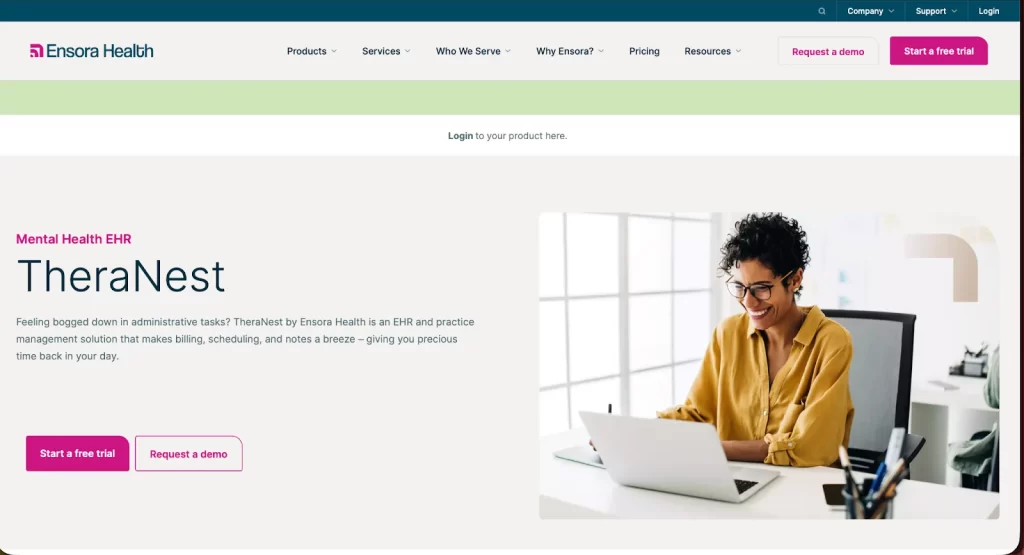
TheraNest: Best Mental Health Software for Small Therapy Practices Seeking Straightforward Billing and Documentation
TheraNest — now branded as Ensora Mental Health, though still marketed under the TheraNest name — targets solo therapists and small counseling practices that prioritize simplicity over feature breadth. The platform streamlines the core therapy workflow: appointment scheduling, progress note documentation, and insurance claim submission. It avoids the depth of enterprise systems built for large group practices or multi-specialty clinics, which makes it a fit for clinicians who find feature-rich platforms overwhelming or who realize they use only a fraction of available tools.
The platform’s billing workflows guide users through claim creation with step-by-step prompts, reducing the knowledge barrier for therapists managing their own billing without dedicated administrative staff. TheraNest generates HCFA 1500 forms, performs basic eligibility verification, and tracks claim status through clearinghouse integration. However, practices handling complex billing scenarios involving multiple payer contracts, frequent denials, or high-volume claim processing may find the simplified approach limiting compared to more robust revenue cycle management tools.
Key Features
Guided insurance billing: Step-by-step claim creation workflow with eligibility verification and clearinghouse submission supporting common mental health CPT codes (90791, 90834, 90837, etc.)
Simplified clinical documentation: Customisable note templates for SOAP, DAP, and progress note formats with treatment plan builders and diagnosis tracking
Client portal: Secure patient access for appointment scheduling, intake form completion, and billing statement review
Appointment scheduling: Calendar system with automated reminder functionality and waitlist management
Telehealth integration: Third-party video platform integration supporting virtual sessions with encrypted communication
Pricing
Product
Pricing
Key Features
Fusion
$49–$229 first user/month, $39–$99 per additional user
Scheduling, note-taking, payment processing, secure client portal, custom forms and messaging, waitlist, insights reporting, telehealth, home exercise program, and unlimited claims and reminders on the Premier plan
Ensora RCM
Custom pricing
Daily claim submission, ERA and EOB posting, rejected claim correction, payer setup, accounts receivable and denial management, advanced insights, and A/R cleanup
TheraNest
$29–$89 per therapist/month
Scheduling, client portal, intake forms and notes, AI note enhancement, online booking and messaging, insurance billing automation, telehealth, reminders, and reporting and dashboards
Where TheraNest Shines
Streamlined user experience: Interface prioritises essential workflows without overwhelming users with advanced features, reducing training time for clinicians transitioning from paper-based documentation and enabling operational readiness within days rather than weeks
Guided billing workflows: Step-by-step prompts through claim creation reduce common errors and provide educational context for therapists learning insurance billing, particularly valuable for newly licensed clinicians managing their own administrative tasks
Appropriate feature scope: Platform avoids feature bloat common in enterprise systems, focusing on tools actually used by solo therapists and small groups rather than administrative capabilities relevant only to large multi-clinician practices
Where TheraNest Falls Short
Limited pre-built templates: Platform provides basic documentation structures but lacks extensive library of therapy-specific assessment instruments and outcome tracking tools, requiring clinicians to build custom forms for specialised assessment needs or outcome measurement protocols
Basic reporting capabilities: Financial and operational reports cover essential metrics but lack the granular analysis tools needed for data-driven decision-making in growing practices evaluating clinician productivity, service line profitability, or payer mix optimisation
Customer Reviews
TheraNest holds a 4.4 out of 5 rating on Capterra based on over 900 verified reviews. Clinicians frequently cite the platform’s straightforward interface, quick onboarding, and responsive customer support as key strengths.
Users appreciate the simplicity of the billing workflow and the ability to manage essential practice operations without excessive complexity. Common concerns centre on requests for more advanced reporting capabilities and occasional desires for deeper integration with third-party practice management tools.
Who TheraNest Is Best For
Solo therapists prioritizing simplicity and ease of use over comprehensive feature sets
Small counselling practices (2-5 clinicians) without dedicated administrative staff
Newly licensed clinicians learning insurance billing and seeking guided workflows
Practices comfortable with basic reporting and willing to accept trade-offs in advanced analytics
Headway: Best Mental Health Software for Therapists Prioritising Patient Acquisition Through Insurance Networks
Headway is structurally different from the other platforms in this roundup. Rather than charging therapists a monthly subscription, the platform is free for providers — it makes money by negotiating rates with insurance companies and keeping the spread between what payers pay and what therapists receive. In exchange, Headway handles credentialing, insurance billing, eligibility checks, claim submission, and guarantees biweekly payments whether or not the payer has actually processed the claim.
Credentialing is the feature Headway markets most aggressively, and with reason. The platform advertises that providers can go in-network with major payers in as little as 2-4 weeks, compared with the 3-6 months typical of direct credentialing. Headway’s onboarding integrates CAQH to pre-populate application data and flag missing information before it causes delays. Providers can then accept clients from Aetna, Cigna, UnitedHealthcare, Anthem, Oscar, Oxford, and selected Blue Cross Blue Shield plans (availability varies by state). Headway also handles ongoing re-credentialing and provides 150+ hours of free CEUs through its provider resources, which is material for licensure renewal.
Key Features
Free for providers: No subscription fees, no commission on therapist pay; Headway monetizes through rates negotiated with insurers
Rapid credentialing: In-network in as little as 2-4 weeks with Aetna, Cigna, UnitedHealthcare, Anthem, Oscar, Oxford, and selected BCBS plans; CAQH integration pre-populates applications
Patient referral matching: Consumer-facing directory connecting therapists with patients seeking in-network providers based on specialty area, location, and insurance coverage
Guaranteed biweekly payments: Direct deposit on the 15th and last day of each month for completed sessions, regardless of whether the payer has processed the claim; Headway handles denials and clawbacks
Scheduling and intake: Calendar system with client self-booking, automated intake form delivery, and appointment reminder functionality
Guaranteed biweekly payments: Direct deposit on the 15th and last day of each month for completed sessions, regardless of whether the payer has processed the claim; Headway handles denials and clawbacks
Telehealth platform: Integrated video functionality supporting virtual sessions with HIPAA-compliant communication channels
Headway operates on a different business model from traditional practice management platforms. The software is free for providers — no monthly subscription, no commission taken from therapist pay. Headway earns its margin on the insurer side of the transaction by negotiating reimbursement rates with payers and paying therapists a separately agreed per-session rate, keeping the difference. Therapists know their per-session rate at onboarding and receive guaranteed biweekly direct deposits for completed sessions.
This model eliminates upfront software costs and payment risk, but the trade-off is that Headway’s negotiated session rates vary by state and payer — sometimes above what a therapist could secure through direct contracting, sometimes below — and insurance credentials are held under Headway’s NPI rather than the therapist’s own.
Where Headway Shines
Credentialing acceleration: In-network approval in as little as 2–4 weeks compared to 3–6 months for direct credentialing, eliminating the administrative burden of CAQH submissions and payer follow-ups for solo practitioners.
Guaranteed payment certainty: Biweekly direct deposits for completed sessions regardless of whether the payer has processed the claim, removing cash-flow risk from insurance-based practice.
Built-in patient acquisition: Consumer-facing directory matches therapists with in-network clients by specialty, location, and insurance, driving steady referrals without self-managed marketing.
Zero upfront cost: Completely free for providers — no monthly subscription and no commission on therapist pay, with Headway monetizing on the insurer side rather than the provider side.
Where Headway Falls Short
No portable credentials: Insurance contracts are held under Headway’s NPI rather than the therapist’s own, so providers who leave the platform lose those payer relationships and must re-credential directly.
Variable reimbursement rates: Session rates vary by state and payer and can fall below what experienced therapists could negotiate through direct contracts, particularly with Blue Cross Blue Shield plans.
Referral volume unpredictability: Directory-driven patient flow depends heavily on geographic market saturation and specialty demand, producing inconsistent results across practitioner locations and niches.
Customer Reviews
Headway does not maintain traditional software review profiles on Capterra or G2, as the platform operates as an insurance network marketplace rather than a standalone EHR product. On Trustpilot, patient-facing reviews reflect mixed experiences with billing transparency and therapist communication, though these reviews assess the patient experience rather than the practitioner platform.
Therapist feedback from professional community discussions highlights strong appreciation for credentialing support and the value of patient referrals for building insurance-based practices. Common concerns centre on revenue-sharing percentages, referral volume variability across markets, and occasional requests for more robust clinical documentation features.
Who Headway Is Best For
Therapists prioritising insurance-based practice models and seeking credentialing assistance
Newly licensed clinicians building initial caseloads through patient referral support
Solo practitioners without dedicated administrative staff for insurance billing management
Clinicians willing to accept revenue-sharing model in exchange for reduced administrative burden and patient acquisition support
How to Choose the Right Mental Health Software for Your Practice
Selecting mental health software requires aligning platform capabilities with your practice’s operational model, patient volume, and growth trajectory. The evaluation framework below prioritises decision criteria that distinguish platforms meaningfully rather than comparing feature checklists that appear similar on paper but perform differently in daily workflows.
Revenue model drives software requirements: Cash-pay practices require simpler billing tools than insurance-dependent operations. If 80%+ of your revenue comes from insurance reimbursement, prioritise platforms with robust claim automation, eligibility verification, and denial management workflows. SimplePractice and TherapyNotes excel here. If you operate cash-pay or sliding-scale models, Carepatron’s free tier or TheraNest’s simplified approach may suffice without paying for insurance billing infrastructure you won’t use.
Practice size dictates administrative complexity: Solo practitioners benefit from streamlined interfaces that minimise training requirements. Small groups (2-5 clinicians) need coordination tools but not enterprise-grade reporting. Large practices (10+ clinicians) require supervisory workflows, detailed analytics, and role-based access controls. TherapyNotes serves larger operations well; Carepatron and TheraNest suit smaller practices. Pabau bridges this gap for multi-specialty clinics where mental health is one service line among many.
Clinical documentation depth varies by specialty: Therapists conducting CBT or DBT benefit from platforms offering measurement-based care tools and pre-built assessment instruments. Psychiatrists prescribing medications need ePrescribe functionality and drug interaction checking. Counsellors focused on talk therapy may find basic SOAP note templates sufficient. SimplePractice delivers strong measurement-based care support; Pabau offers prescription management across specialties; TheraNest provides basic documentation without extensive templating. Many also keep printable tools on hand, such as a positive reframing worksheet for cognitive work or a serenity prayer worksheet for acceptance-based coping.
Growth trajectory influences scalability needs: Practices planning multi-location expansion within 2-3 years should evaluate platforms supporting centralised operations and location-specific customisation upfront rather than migrating systems mid-growth. Pabau and Zenoti handle multi-location complexity; SimplePractice and TherapyNotes scale to moderate group sizes; Carepatron and TheraNest suit practices maintaining single-location operations long-term.
Integration requirements reflect existing workflows: Evaluate which third-party tools your practice relies on (accounting software, marketing platforms, lab ordering systems) and confirm the mental health software integrates natively or through middleware. Practices heavily invested in specific ecosystems (Google Workspace, QuickBooks, Zapier) should verify integration depth before committing. Carepatron emphasises Google Workspace integration; SimplePractice connects with QuickBooks; Pabau offers broader healthcare-specific integrations (labs, payment processors, marketing tools).
The platform that best fits your practice may not rank highest on generic “best of” lists. A solo therapist building a cash-pay practice values different capabilities than a 15-clinician group managing complex insurance contracts across four states. The same trade-offs show up across specialties — choosing dental practice software follows an almost identical framework.
Evaluate platforms against your specific operational reality rather than aspirational features you may never implement. Our mental health EHR evaluation checklist lets you score each shortlisted vendor against the same criteria in every demo. For practices operating across multiple healthcare disciplines, explore how unified practice management systems streamline operations when mental health services integrate with wellness, medical, or aesthetic offerings.
Conclusion
Mental health software fit comes down to your revenue model, scale, and how clinical workflows actually run, not feature checklists. Insurance-heavy therapy practices live in SimplePractice or TherapyNotes territory; cash-pay solos start free on Carepatron; enterprise wellness operators land on Zenoti; therapists chasing referrals try Headway. Pabau wins when mental health sits inside a broader multi-specialty practice (medical, wellness, aesthetic) and you need one patient record, one EHR, one billing engine, and one operational system across all of it.
Book a demo with Pabau to see how a single platform supports mental health alongside the rest of a multi-specialty clinic.
Continue your research
Screening for pathological lying in session?Pathological liar test provides a free nine-statement screening form with score bands based on the Pathological Lying Inventory.
Planning to expand across multiple clinic locations?Multi-Location Management explores centralised calendar systems, consolidated reporting, and role-based access controls essential for managing 3-10+ practice sites.
Assessing telehealth reliability for virtual therapy sessions?Telehealth Software examines HIPAA-compliant video platforms, encrypted communication channels, and virtual waiting room functionality critical for hybrid practice models.
Frequently Asked Questions
What are the benefits of mental health apps?
Consumer mental health apps offer direct patient tools like guided meditation, mood tracking, CBT exercises, and peer communities. Clinical practice management platforms are a different category — they focus on practitioner workflows (scheduling, billing, documentation) rather than patient-facing interventions. Some platforms like SimplePractice deliver assessments through a client portal, but the primary user is the clinician, not the patient.
Are mental health apps effective?
Research shows digital mental health tools can deliver measurable improvement for anxiety and depression when used alongside traditional therapy or as stepped-care for mild-to-moderate presentations. Clinical intervention apps that make therapeutic claims may require FDA clearance, while general wellness apps don’t. Practice management software is evaluated differently: its effectiveness shows up in operational metrics like claim approval rates, reduced no-shows, and time saved on documentation. Software doesn’t drive clinical outcomes — the therapist does — but the right platform removes friction that eats into clinical time.
Can mental health apps replace traditional therapy?
No. Self-directed consumer apps can supplement therapy for maintenance or early intervention, but they don’t replace professional care for moderate-to-severe conditions that need diagnosis, treatment planning, and ongoing monitoring. Practice management platforms support therapy delivery through telehealth, scheduling, and documentation, but they’re operational tools — the therapeutic relationship still drives outcomes.
How can I tell if a mental health app is trustworthy?
Look for concrete compliance signals: HIPAA compliance with a Business Associate Agreement, encrypted data in transit and at rest, and third-party certifications like SOC 2 Type II or HITRUST. Check that the vendor publishes a clear privacy policy explaining how patient data is handled. For practice management software specifically, vendor stability matters too — company age, funding, and market presence all affect whether your data and workflows will still be there in five years. Established platforms with verifiable references and a track record generally carry less risk than newer entrants with limited operating history.