OT SOAP note sample: Free template and worked examples
Download your free OT SOAP note sample A four-page form with an identifying head...

6
Last Updated: Nov 5, 2026
The Palliative Performance Scale (PPS) rates how well a patient with a life-limiting illness functions, on 11 levels from 100% to 0%. The PPS score is the single level that best fits five observations: ambulation, activity and evidence of disease, self-care, intake and conscious level.
A score of 100% means fully active with no evidence of disease, and 0% means death. Scores of 70% to 100% signal maintained function, 40% to 60% progressive decline, and 10% to 30% advanced decline. Hospice teams use the score to track decline, support eligibility reviews and frame prognosis conversations with families.

The Palliative Performance Scale scores patients from 0% to 100% across five observable dimensions, in steps of 10%.
PPSv2, developed at Victoria Hospice in British Columbia, is the current standard version used in clinical practice.
A PPS score of 10% or 20% means total bed rest and total care, with intake down to sips or mouth care.
Lower PPS scores track with shorter median survival, so the scale informs clinical judgment without replacing it.
Accurate PPS documentation supports hospice eligibility reviews, care planning and multidisciplinary team communication.
Clinicians caring for patients in the final months of life need a shared way to describe what they see. It has to hold up across handovers, family conversations and hospice eligibility reviews. The palliative performance scale (PPS) was built for exactly that. It remains one of the most widely used functional measures in palliative and hospice care.
According to CDC National Center for Health Statistics data, roughly 1.8 million patients received hospice care in the United States in 2022. Structured functional scoring is one of the practical foundations of consistent care across that population. Developed at Victoria Hospice in British Columbia, the PPS gives clinicians a reproducible way to describe current function and track how it changes.
The scale runs from 0 to 100 in 10-point increments, giving eleven levels. Each level describes ambulation, activity, self-care, oral intake and consciousness. A score of 100 reflects full health and independent function; a score of 0 indicates death.
The palliative performance scale scoring system is built around five observable clinical dimensions. The clinician considers each dimension, then picks the level from 10 to 100 that best fits the patient across all five areas. The scoring is not additive; the clinician selects the single row on the PPS table where the patient’s profile fits most accurately.
Once that row is chosen, the percentage itself carries clinical weight. The score levels below explain how each range shapes prognosis and care planning.
Each level on the palliative performance scale is defined by descriptors across five columns. Clinicians need a clear read on what each dimension captures to score consistently between assessors and across care settings.
The current version in clinical use is PPSv2, which replaced the original tool with refined descriptor language to improve inter-rater reliability. Victoria Hospice Society released PPSv2 in 2001, with scoring instructions and a definitions sheet beside the table.
The five dimensions and 11 score levels stayed the same. The tighter wording makes two practitioners assessing the same patient more likely to arrive at the same score.
Clinicians working in primary care and specialist practices who see palliative patients should confirm they are using PPSv2. Some older institutional documentation tools may still reference the first version.
Scoring reads across each row of the PPSv2 table from left to right. It starts with Ambulation, then works through Activity and Evidence of Disease, Self-care, Intake and Consciousness. A patient’s profile can fall between two levels, such as ambulation at 50 and self-care at 40.
PPSv2 guidance then applies the “leftward precedence” rule. The left columns (Ambulation, then Activity and Evidence of Disease) take precedence over Self-care, Intake and Consciousness. The left columns are stronger determinants of overall functional status. Clinicians read across the row to determine the best-fit score, anchored by the leftmost matching column.

Documentation of a palliative performance scale score should include the date of assessment, the clinician’s name and role, and brief supporting notes for each dimension. This record supports continuity across a multidisciplinary patient record and provides the audit trail required by care quality frameworks.
Clinicians familiar with the numeric levels of the palliative performance scale can communicate a patient’s functional status in seconds. But the numbers only become clinically meaningful when practitioners understand what each range implies for care planning, family communication, and prognosis.
The chart below groups the 11 PPSv2 levels into the three bands clinicians use most, with the descriptors that change inside each band.
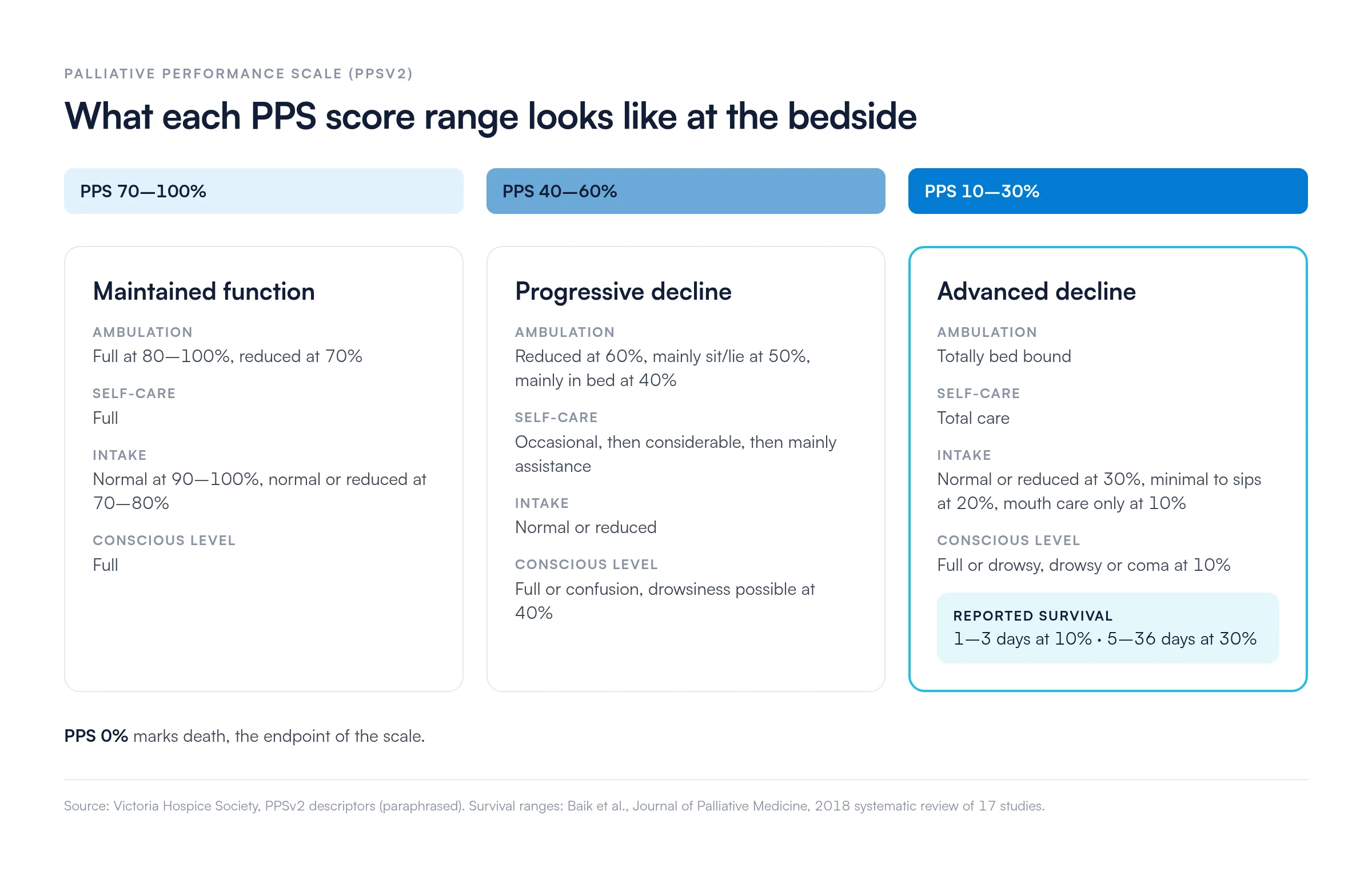
Patients scoring in this range are ambulatory and capable of self-care, with normal or near-normal intake and full consciousness. Evidence of disease may be present, but functional capacity remains largely intact. At this level, palliative care usually focuses on symptom management, advance care planning and support for the patient and family. Intensive physical care is rarely needed yet.
This range represents a meaningful shift in functional status. Patients at PPS 50, for example, mainly sit or lie, cannot do any work and need considerable assistance with self-care.
Intake may be reduced, and periods of drowsiness or confusion may begin to appear. A score of 40 suggests the patient is mostly in bed and needs mainly assistance with self-care, with intake normal or reduced.
In the 40-60 range, multidisciplinary reviews usually intensify and care-at-home assessments take place. Hospice eligibility discussions often begin here too. Lower scores in this range go with progressively shorter median survival. The 1996 paper by Anderson and colleagues that introduced the PPS and later studies both show this. These associations describe population-level trends rather than individual prognoses.
At PPS 30% and below, patients are totally bed bound and need total care. Intake can still be normal or reduced at 30%, then falls to minimal sips at 20% and mouth care only at 10%.
Conscious level ranges from full to drowsy at 20% and 30%, and from drowsy to coma at 10%. Clinical focus at these levels moves to comfort-directed care, anticipatory prescribing, and family support.
Reported survival at the bottom of the scale is short. A 2018 systematic review of 17 studies found estimates of 1 to 3 days at PPS 10%, against 5 to 36 days at PPS 30%. A hospice team that records PPS 20% or 10% is usually planning for the final days, with comfort care and family support in place.
Bed-bound patients who rely on caregivers for every position change score at the bottom of the mobility and activity subscales on the Braden Scale. That pressure injury score is reassessed whenever mobility or food intake declines, two dimensions the PPS already tracks.
These scores correspond to the final days and weeks of life for many patients. Documenting this stage through structured digital clinical forms supports CMS hospice benefit documentation requirements in the US.
Clinicians working across oncology, palliative care, and general practice will encounter several functional assessment scales during their careers. Knowing where the palliative performance scale sits among these tools, and why it was developed, helps practitioners choose the right instrument for each setting.
The Karnofsky Performance Scale (KPS), in use since 1948, is the direct predecessor of the palliative performance scale. Both use a 0-100 scoring range in 10-point increments, and the PPS was explicitly designed as a palliative-specific adaptation of the Karnofsky framework.
The key difference is that Karnofsky uses one descriptor per level. That single statement summarizes the patient’s ability to work and care for themselves. The palliative performance scale replaces this with five distinct observable dimensions, making it considerably more granular and more reliable across different assessors.
The addition of intake and consciousness level as explicit scored dimensions reflects the clinical reality of advanced illness. These dimensions tend to change most in the final weeks of life. The Karnofsky scale captures neither in a structured way.
Across the full palliative trajectory, the palliative performance scale generally gives more clinical information per assessment than the KPS.
The ECOG Performance Status scale, also used as the WHO Performance Scale, runs from 0 to 4 for living patients. It was designed for oncology trials and treatment decisions. A score of 0 means fully active; 4 means completely disabled.
While ECOG is widely used and well validated, its five levels offer far less granularity than the palliative performance scale’s eleven levels. ECOG also does not assess intake or consciousness, which limits its utility in the final phase of life.
Teams conducting structured clinical assessments across a palliative care program tend to prefer the palliative performance scale over ECOG. It captures more dimensions at the end of life and tracks finer change over time.
ECOG remains useful in oncology treatment settings. Its resolution falls short when a clinician must tell a largely bed-bound patient from a fully bed-bound one, and that distinction changes the care plan.
Two other tools often sit beside the PPS. The Australia-modified Karnofsky Performance Scale (AKPS) adapts Karnofsky descriptors for palliative care and is widely used in Australia and New Zealand. The Barthel Index and similar activities of daily living scales measure independence, but they were not built for palliative populations.
None of these scales captures overall illness burden. For that, the Charlson comorbidity index weights 19 chronic conditions to estimate one-year mortality.
When a patient moves from active treatment to palliative-focused care, run a palliative performance scale assessment at that point. Document it in the clinical record alongside the care pathway decision. This baseline score gives the whole team a reference point for tracking functional change and supports any hospice eligibility review that may follow within weeks.
The palliative performance scale is most valuable as a repeated measurement across a patient’s palliative journey. Serial PPS scores, recorded at regular intervals, show the trajectory of decline. The team can then plan for care needs before they become urgent.
Many teams tie actions to set points on that trend. A fall from 60% to 40% might trigger a specialist palliative care referral, for example. Reaching 20% to 30% often prompts a review of advance care planning, including preferred place of care and resuscitation decisions.
Several palliative care programs and hospice eligibility frameworks use PPS scores as one criterion among several. They help decide whether a patient meets the threshold for specialist hospice services. Medicare contractor guidance lists a PPS below 70% as one general sign of decline, and its stroke guideline sets 40% or less.
The cancer criteria rest on metastatic spread and set no PPS cut-off. Eligibility criteria still vary by payer, care setting and jurisdiction. The CMS Medicare Hospice Benefit guidance emphasizes holistic clinical assessment alongside functional scoring. PPS feeds the broader clinical picture and never acts as a standalone admission criterion.
For the first Medicare hospice benefit period, the hospice physician certifies a prognosis of six months or less. The attending physician also certifies if the patient has one. That assumes the illness follows its expected course.
PPS scores contribute to that clinical documentation, particularly where functional decline is rapid and observable. Clinicians should consult the specific payer guidelines applicable to their care setting rather than applying any single PPS threshold as a universal rule.
Multidisciplinary palliative care teams – typically comprising physicians, nurses, social workers, and allied health professionals – benefit significantly from a shared, documented PPS score. It provides a common language that removes ambiguity from handover communications. A nurse who notes “PPS has declined from 50 to 30 over the past two weeks” says more than a narrative of the same length.

Practices using integrated patient record systems can embed palliative performance scale assessments as structured fields within the clinical note, making them searchable, reportable, and auditable.
This matters at survey and audit, where reviewers look for documented functional assessment over time. For practices managing a panel of complex patients, PPS scores in the patient timeline give at-a-glance context. That supports safer handovers and quicker care reviews.
Most palliative teams record a PPS score at every significant contact. That means the initial referral, each home visit, each inpatient or day hospice attendance, and any visible change in function. In a fast decline, weekly or more frequent scoring keeps the trend current.
Two problems undermine consistency. Clinicians can rate the same patient differently, most often on ambulation and self-care, and brief team training on the PPSv2 definitions narrows that spread. A score taken on a bad day can also understate typical function. Some teams log a “best of the past week” score beside the current one.
Record how the assessment was done, too. A score observed in person and one reported over a video visit carry different weight at the next review.
A 2018 systematic review of PPS survival studies links lower PPS scores with shorter median survival. This evidence base makes the scale a useful prognostic indicator – particularly when combined with other clinical assessments. A patient entering a palliative program with a PPS of 30 has a statistically different outlook than one presenting at 70.
That said, survival predictions derived from population-level data do not translate into individual timelines. Clinicians should present PPS-related prognostic information to patients and families with care. Frame it as a reflection of current function and a general indicator of trajectory, never a precise forecast.
The language used in clinical documentation matters here. Notes that tie survival estimates directly to a PPS score without context can create medico-legal exposure and undermine patient trust.
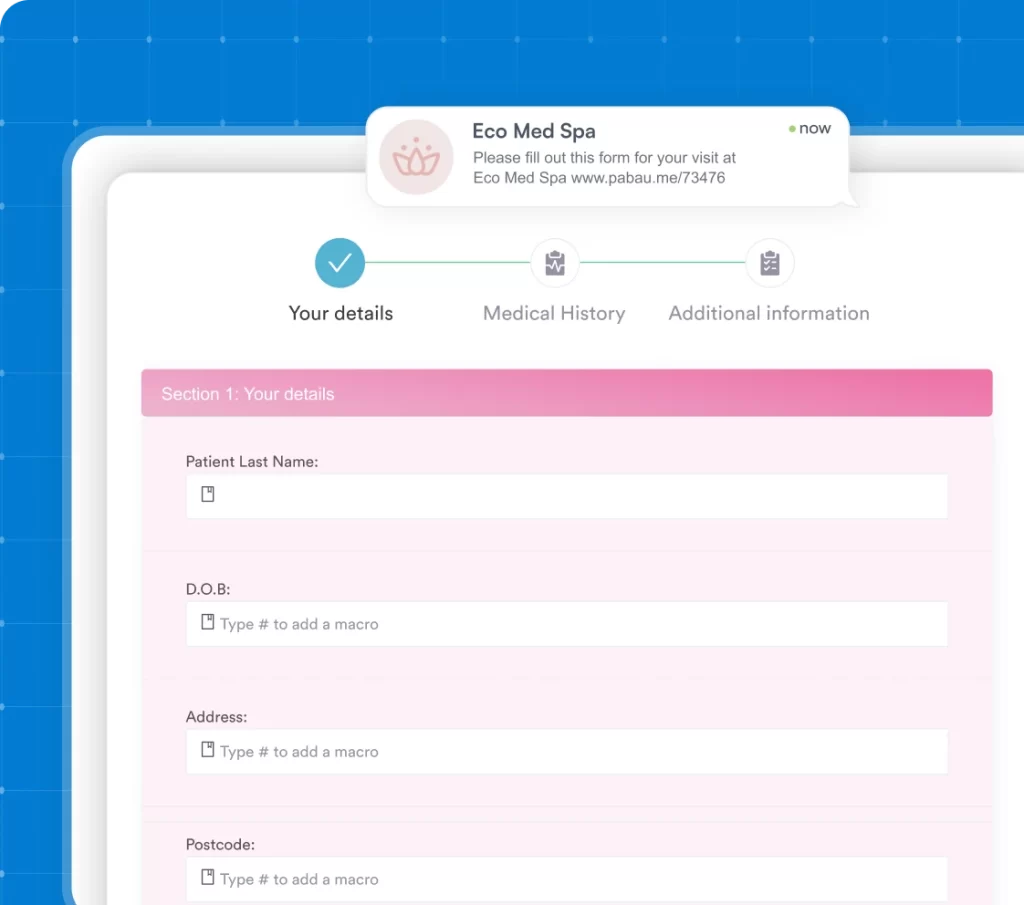
Pabau, the practice management platform we build, lets you turn the PPSv2 table into a digital form your team completes at each visit. The form follows the left-to-right column order, so ambulation anchors every score.
Each completed form saves to the patient’s client record with the date and the assessing clinician’s name. The score history sits beside notes and documents, so a falling trend shows up before the next team meeting.
Pabau Scribe, our AI scribe, drafts the consultation note from the conversation. That leaves more of each visit for the patient and family, and the PPS score still lands in a structured field.

Pabau’s digital forms and client records capture each PPS score with its date and assessor, so your palliative team sees the trend before every review.

Score the PPS the same way at every contact, and record it where the whole team can see it. A single number describes one day, while a series shows where the patient is heading. That trend supports a timely hospice referral and an honest conversation with the family.
Treat survival figures as a guide for planning, never a forecast for one patient. Book a demo to see how Pabau keeps PPS scores, care notes and assessment forms together for palliative and end-of-life teams.

Admitting a patient to hospice? Hospice admission note template structures the admission record, including functional status and the plan of care.
Staging dementia for hospice? FAST scale guide explains the Functional Assessment Staging Tool and how its stages map to decline in dementia.
Assessing pain in patients who cannot speak? Abbey pain scale template scores pain from observed behavior in people with advanced dementia.
Want faster, safer clinical notes? Faster, safer clinical notes guide shows how AI tools speed up note-taking while keeping records accurate.
The palliative performance scale is used to assess and document functional status in patients receiving palliative or end-of-life care. It gives a reproducible score across ambulation, activity, self-care, intake and consciousness. The score supports care planning, hospice eligibility assessment and team communication.
Clinicians review a table of 11 score levels, from 0 to 100 in increments of 10. They pick the single level that best describes the patient’s overall status across all five dimensions. When the patient’s profile falls between two levels, PPSv2 applies a “leftward precedence” rule. The leftmost columns (Ambulation, then Activity and Evidence of Disease) take precedence over the columns on the right. The score is not calculated by adding up individual dimension scores.
A PPS score of 50 means the patient mainly sits or lies down and needs considerable assistance with most activities. Oral intake may be reduced. Disease is extensive, and the patient is unable to do any work. This level often corresponds to a significant functional transition point in palliative care planning.
The palliative performance scale was developed as a palliative-specific adaptation of the Karnofsky Performance Scale. Both use 0-100 scoring in 10-point increments. The PPS adds intake and consciousness as explicit scored dimensions, which the single-descriptor Karnofsky scale does not capture in a structured way.
Multiple peer-reviewed studies show that lower palliative performance scale scores correlate with shorter median survival times in palliative populations. However, these are population-level associations, not individual predictions. Clinicians should use PPS as one input among several in prognostic discussions, always framing survival-related information with appropriate clinical nuance.
The palliative performance scale was developed at Victoria Hospice in British Columbia, Canada. The Victoria Hospice Society later published PPSv2, the current standard version. It refined the descriptors to improve inter-rater reliability and kept the five-dimension, 11-level structure.
In palliative and hospice care, PPS stands for Palliative Performance Scale. It is an 11-level functional score from 100% to 0%, developed at Victoria Hospice in British Columbia. The same letters can mean other things elsewhere, such as post-polio syndrome, so read the abbreviation in context.
A PPS score of 10% to 30% indicates advanced decline, and 10% or 20% usually means the final days. Patients at these levels are totally bed bound and need total care, with intake reduced to sips or mouth care. A 2018 systematic review found reported survival of 1 to 3 days at PPS 10%.
Reassess the PPS score at every significant clinical contact, such as each home visit, inpatient review or day hospice attendance. In a rapid decline, weekly or more frequent scoring keeps the trend current. Always reassess when function visibly changes.