GLP-1 diet plan
A GLP-1 diet plan is a structured eating framework for patients taking semagluti...

2
Last Updated: Oct 13, 2026

The FAST scale (Functional Assessment Staging Tool) tracks Alzheimer’s progression through seven stages, and Stage 7 splits further into substages 7a through 7f.
Medicare hospice eligibility under a primary dementia diagnosis needs FAST Stage 7 plus at least one qualifying complicating condition.
The scale scores what a patient can still do, which is what separates it from cognitive tests such as the MMSE.
Reisberg validated the instrument for Alzheimer’s disease, so staging other dementias with it takes extra clinical judgment.
Pabau’s digital forms and patient records let care teams capture and track FAST assessments across every visit.
The FAST scale (Functional Assessment Staging Tool) stages dementia by what a patient can still do for themselves. It runs from Stage 1, normal adult function, through Stage 7, severe dementia. Stage 7 then divides into six substages.
That functional focus is why hospice teams reach for it. Medicare hospice eligibility under a primary dementia diagnosis turns on FAST Stage 7 plus a qualifying complication. This guide covers the stages, the scoring method, the hospice criteria, and how the FAST scale compares with the GDS and the CDR.
It also settles the acronym clash with the stroke FAST mnemonic. It is written for clinicians, care coordinators, and practice managers working in hospice, palliative care, neurology, or geriatrics.
The FAST scale is a clinician-administered instrument developed by Dr. Barry Reisberg at New York University in the 1980s. It tracks the progression of Alzheimer’s disease. Cognitive screens measure memory test performance. This one measures what a person can still do. That means managing money, dressing, bathing, and eventually holding the head upright.
FAST stands for Functional Assessment Staging Tool, also rendered as Functional Assessment Staging Test. The instrument has seven stages, and Stage 7 divides into six substages, 7a through 7f. Hospice and palliative care teams use it most, because it is what Medicare eligibility for a dementia-primary diagnosis rests on.
Its focus on activities of daily living (ADLs) is what makes it fit that job. Cognitive scores from tools like the MMSE can swing from one day to the next. Functional losses tend to be steadier and more linear in Alzheimer’s disease. That stability is why hospice determination rests on the FAST scale rather than a cognitive test alone.
The FAST scale maps Alzheimer’s decline in order, and each stage is a discrete level of functional ability. Patients generally move through the stages in sequence. That is part of why the scale predicts well in Alzheimer’s specifically.
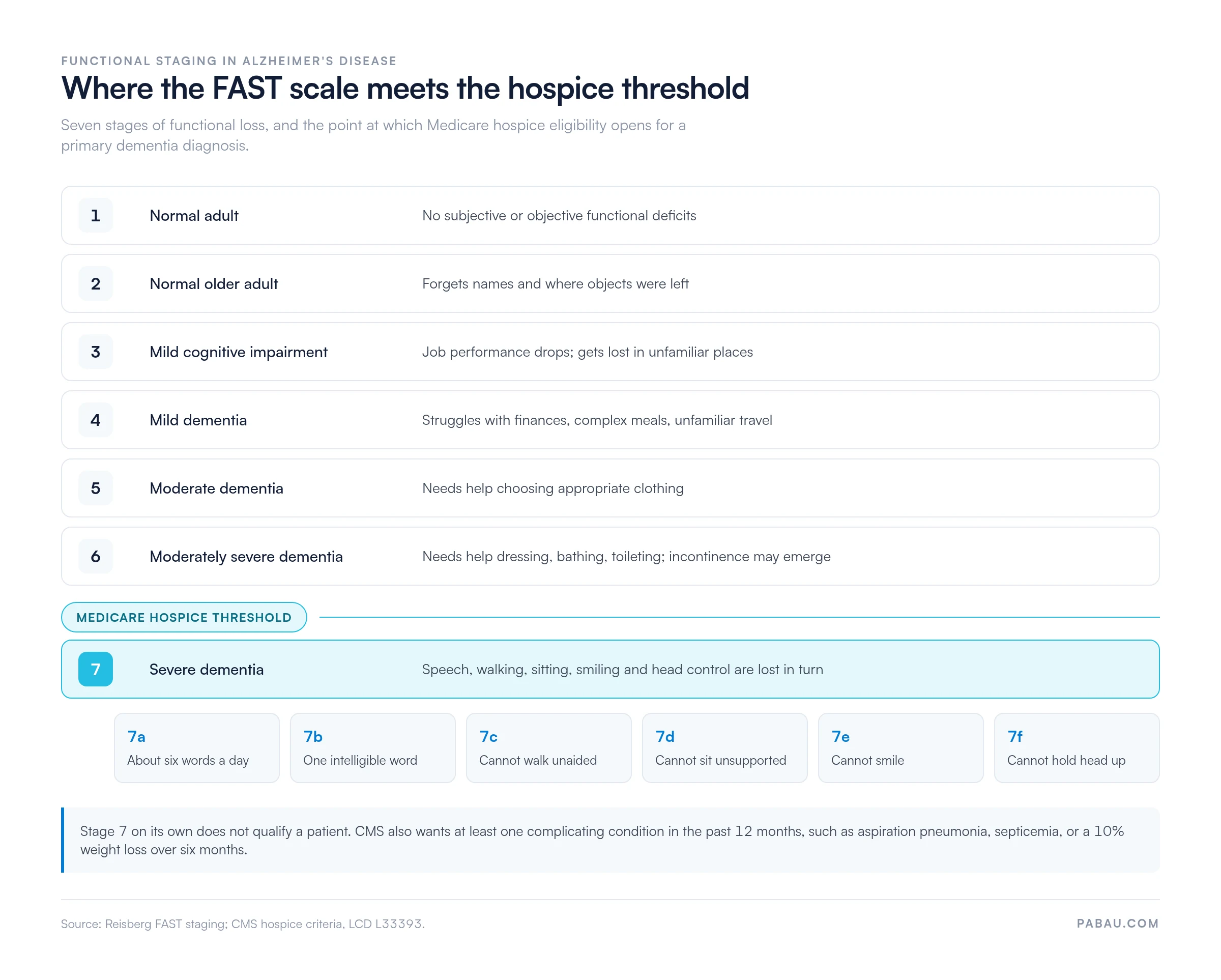
Stage 7 is where the FAST scale gets most precise. Each substage marks a further loss of ability, in this order:
Medicare hospice eligibility for dementia references Stage 7, but Stage 7a on its own is not always enough. The full CMS framework asks for supporting conditions as well, which the next section covers.
The FAST scale is clinician-administered, not self-reported. A physician, nurse practitioner, or trained hospice clinician assigns the stage from direct observation and a caregiver interview. There is no point total to calculate. The clinician selects the highest stage at which the patient shows consistent functional loss.
Two practical rules govern scoring. If a patient appears to skip a stage, document the highest relevant stage and note the anomaly. Patients with non-Alzheimer’s dementias often show non-sequential patterns, which limits how far the instrument can be trusted outside its validation context.
Whatever the stage, the note has to show the work. Recording the specific ADL observations behind an assignment is one habit behind safer clinical notes. It is also the first thing a Medicare reviewer looks for.
Document the ADL observations behind the stage, not just the number. ‘Stage 7a: produced about six intelligible words in a 20-minute assessment on three consecutive days’ will hold up in a Medicare review. ‘FAST Stage 7a’ on its own will not.
For a patient whose primary terminal diagnosis is dementia, CMS Medicare hospice guidelines require FAST Stage 7 or beyond. Reaching Stage 7 is necessary, but it is not sufficient on its own. Payers and hospice physicians also look for at least one complicating condition in the past 12 months, per LCD L33393:
The ladder below shows where that threshold sits on the scale, and how far Stage 7 can still travel after a patient crosses it.
Hospice intake documentation works best when it collects both halves at once. The FAST stage sets the functional baseline. The complicating-condition checklist supplies the clinical complexity a payer wants to see. Missing either half is a common cause of hospice eligibility denials.
One caveat matters here. The FAST scale was validated for Alzheimer’s disease. For vascular dementia, Lewy body dementia, or frontotemporal dementia, the staging may not follow the same linear path. The Alzheimer’s Association recommends pairing the scale with clinical judgment and further assessment when Alzheimer’s is not the primary diagnosis.
Hospice clinicians use the FAST scale at two moments: initial eligibility assessment and recertification. At admission, the stage and the complicating-condition evidence form the clinical argument for hospice. Recertification falls due every 60 to 90 days under Medicare. Each time, the team has to show the patient is still at Stage 7 or has progressed further.
Care teams running geriatric or end-of-life services on primary care practice software can fold the scale into an assessment workflow they already use. Each substage transition is worth flagging as a clinical event. Moving from 7b to 7c means the patient has stopped walking, which shifts care planning toward mobility, fall risk, and skin integrity.
Stage 7 also changes how symptoms get assessed. Once speech is down to a word or two, a patient cannot report pain. Teams switch to an observational instrument such as the Abbey Pain Scale.
Families follow the stages better in plain language. Stage 6 is the phase when a person needs help with all personal care. Stage 7f is the point where the brain can no longer coordinate head control. That translation helps families decide about feeding tubes, hospitalization, and comfort-focused care.
Three tools dominate dementia staging in clinical practice, and each has a different focus and best use. Knowing where the FAST scale sits against the alternatives is what stops a team filing the wrong one. Where the terminal diagnosis is not dementia, hospice teams usually score function with the palliative performance scale instead.
The GDS and the FAST scale both came from Reisberg, and they align closely in staging philosophy. GDS Stages 1 through 7 map roughly onto the matching FAST stages, but the GDS adds cognitive observations to the functional ones.
The CDR works differently. It box-scores six domains: memory, orientation, judgment, community affairs, home functioning, and personal care. Research settings prefer it, because granular measurement matters more there than Medicare-documentation clarity.
When to use each: the FAST scale is the instrument to reach for when hospice eligibility is the goal. The GDS suits general clinical monitoring in memory clinics. The CDR is the choice for clinical trials and longitudinal research cohorts, per National Institute on Aging guidance.
The FAST scale’s validity is strongest in Alzheimer’s disease. In other dementia subtypes, the sequential stage model often breaks down. Vascular dementia can produce a sudden functional drop followed by a plateau. Lewy body dementia can swing from day to day, which makes a single-visit score unreliable without longitudinal context.
None of that undermines how useful the scale is. It does argue for pairing it with structured caregiver interviews, consistent documentation, and periodic reassessment rather than a single score.
Searches for “fast scale” pull in stroke-screening content too, and the overlap confuses care teams. Several separate tools share the acronym:
The dementia scale and the stroke mnemonic share no scoring method and no clinical overlap. One is a staging tool a trained clinician administers in a practice. The other is a public health prompt written for a bystander. Say which FAST you mean when you brief care teams or families, and the confusion never reaches the patient.
Hospice and palliative care teams have a documentation problem more than a scoring problem. The stage has to be recorded accurately, dated precisely, and pulled up again months later for a recertification review. Paper forms and freeform notes make that slow, and they lose the ADL detail that supports the stage.
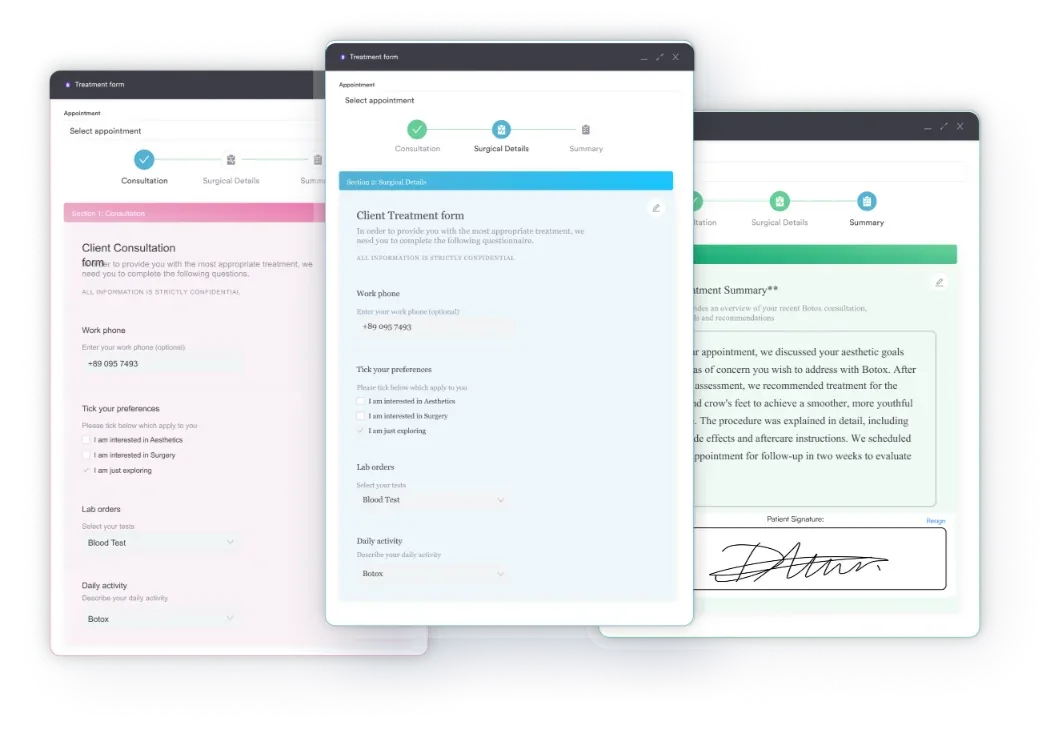
Practice management software like Pabau lets a team build the assessment once and reuse it at every visit. Pabau’s digital intake forms capture the stage, the substage, the supporting ADL observations, and the caregiver interview in one structured record.
Each submission is timestamped and attributed to the clinician who made it. It then sits in the patient’s longitudinal history, so the next reviewer can find every earlier assessment without opening a filing cabinet.
For teams that would rather talk than type, Pabau Scribe, our AI scribe, drafts the note during or after the assessment. The clinician still edits and signs it, so the specificity a Medicare review needs stays in the record.
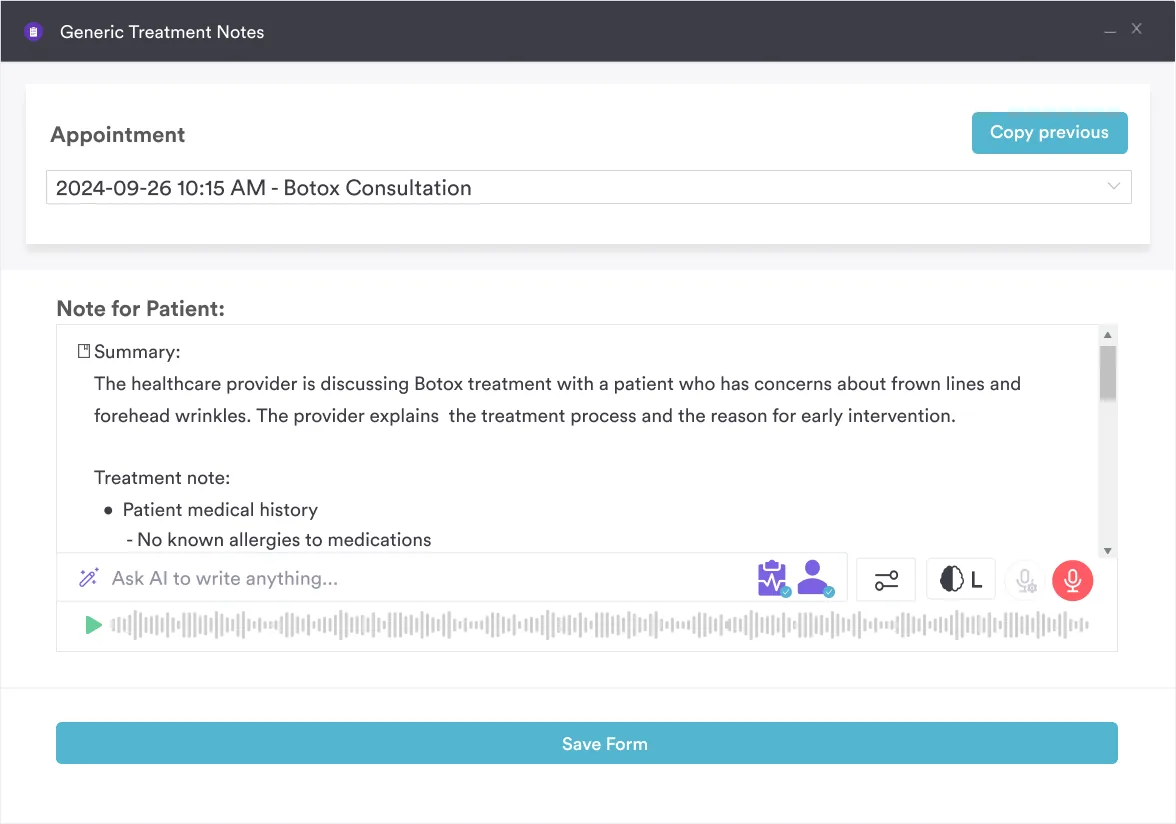
The result is a FAST history a reviewer can read in one pass. Nobody has to reconstruct it the week recertification falls due.

Pabau helps hospice and palliative care teams capture FAST assessments, track functional change across visits, and keep the supporting evidence in one patient record.

The FAST scale earns its place in hospice work because it measures the thing Medicare asks about: what the patient can still do. Learn the seven stages and the six substages of Stage 7, and the eligibility argument largely writes itself.
The trap is treating Stage 7 as the whole test. Without a documented complicating condition, and without the ADL observations behind the stage, a correct score still gets denied. Score the patient, then evidence the score.
That is a documentation habit rather than a clinical one, which makes it worth building into the form your team already fills in. Book a demo to see how Pabau keeps FAST assessments and recertification records ready for review.

Assessing whether a patient still manages at home? Assisted living assessment tool walks through the functional and safety checks behind a placement decision.
Building the day-to-day care plan around a stage? Daily care plan for elderly patients sets out a structure you can hand to caregivers.
The FAST scale (Functional Assessment Staging Tool) is a seven-stage instrument for tracking Alzheimer’s progression. It scores what a patient can still do, from normal adult function at Stage 1 to severe dementia at Stage 7. Dr. Barry Reisberg developed it at NYU. Hospice teams use it to establish Medicare eligibility for patients with a primary dementia diagnosis.
A FAST score of 7 means severe dementia. Speech has usually fallen to about six words or fewer, and the patient cannot walk or sit unsupported. Stage 7 is the threshold Medicare requires for hospice under a primary dementia diagnosis. It has to be paired with at least one complicating condition, such as aspiration pneumonia or significant weight loss.
Both tools came from Dr. Barry Reisberg and both run to seven stages. The FAST scale looks only at functional ADL performance, which is why hospice documentation relies on it. The Global Deterioration Scale (GDS) adds cognitive observations, so it suits broader clinical monitoring. That also makes it less precise for the ADL criteria Medicare wants for hospice admission.
The scale was validated for Alzheimer’s disease, where decline follows a predictable order. In vascular, Lewy body, or frontotemporal dementia, functional loss can be sudden or fluctuating, so sequential staging often breaks down. Clinicians can still use the FAST scale as a reference framework. Supplement it with clinical judgment and document any out-of-order staging explicitly.
A trained clinician assigns the stage from direct observation plus a structured caregiver interview. There is no numerical point calculation. The clinician picks the highest stage at which the patient consistently shows functional loss. Specific ADL observations should support that assignment in the record, especially at Stages 6 and 7, where Medicare documentation rules are strictest.
Stage 7 has six substages. They run 7a, speech down to about six words a day, then 7b, one intelligible word. Next come 7c, no unaided walking, and 7d, no unsupported sitting. The last two are 7e, no smile, and 7f, no head control. Each substage marks further decline and matters for care planning and Medicare recertification.