How to Start Private Practice in California as a LCSW (Step-by-Step)
Pabau helps new LCSW practices stay organized and compliant with integrated clie...

April 6, 2026


Buy now, pay later is now available in Pabau

You need an active BBS license before seeing a single private pay client — no exceptions. Complete your 3,000 supervised hours, pass the ASWB Clinical Exam, and wait for the Board to officially issue your license.
In California, you can only operate as a sole proprietorship or a professional corporation — choosing the right structure from day one can save you thousands in taxes.
Starting a private practice in clinical social work costs money upfront — budget for insurance, office space, software, and marketing before you open your doors.
The right systems make or break your practice — from HIPAA-compliant record keeping to automated reminders, having the right tools in place from day one saves time, reduces no-shows, and keeps clients coming back.
Starting a private practice is one of the most rewarding steps mental health professionals can take, and as an LCSW in California, you’re in a strong position to do it.
There are a lot of tough decisions ahead of you. This guide serves to walk you through exactly how to start a private therapy practice in California as an LCSW, from choosing the right business structure to landing your first clients, and more.
One thing to know upfront: as an LCSW in California, you can only set up as a sole proprietorship or a professional corporation — and knowing which one is right for you can make a big difference from day one.
Let’s get into it.
Yes — but only once you hold an active LCSW license issued by the California Board of Behavioral Sciences (BBS).
Important: According to the BBS, you cannot begin independent practice until your license has been officially issued — no exceptions.
First, you’ll need to have completed your supervised hours and passed your exams before you can practice independently.
With over 41,000 total LCSW licensees in California, it’s a thriving field with a clear, well-worn path ahead of you.
Here’s everything you need to do — in order — to go from licensed LCSW to running your own counseling private practice in California.
| Step | What It Involves |
|---|---|
| ✅ Licensing & Legal | Active BBS license, CE requirements, renewals |
| 🏢 Choose Your Model | Solo vs. group, in-person vs. telehealth |
| 🏠 Office Setup & Compliance | Space, HIPAA, malpractice insurance |
| 💰 Financial Planning | Startup costs, pricing, billing setup |
| 📣 Marketing & Attracting Clients | Website, directories, SEO, social media |
| ⚙️ Managing Your Practice | Scheduling, workflows, client tracking |
| 💻 Technology & EHR | Practice management software, telehealth tools |
| 📈 Growing Your Practice | Scaling services, adding locations or staff |
We’ll walk through each one in detail below. 👇
Before you see a single private pay client, your LCSW license needs to be active and in good standing with the California Board of Behavioral Sciences (BBS).
Here’s what that looks like in practice:
| Requirement | Details |
|---|---|
| Supervised Hours | 3,000 supervised clinical hours over a minimum of 104 weeks |
| Licensing Exam | Candidates must pass the Association of Social Work Boards (ASWB) Clinical Exam after meeting experience requirements. |
| License Renewal | Every 2 years |
| CE Requirements | LCSWs must complete 36 hours of CE every two years. |
| Law & Ethics CE | At least 6 of the 36 hours must be in law and ethics each renewal cycle. |
| California Law & Ethics Exam | You must pass the California Law and Ethics Exam before obtaining your LCSW license |
Sources:
Before you receive your full LCSW license, you’ll register as an Associate Clinical Social Worker (ASW) with the BBS — this is the supervised stage where you complete your 3,000 clinical hours.
Once licensed, you’re also responsible for keeping up with renewal deadlines and continuing education (CE) requirements — missing these can put your license at risk.
One more thing people often overlook — depending on your city or county, you may also need a local business license to legally operate your practice. Requirements vary across California, so check with your local city or county clerk’s office early in the process.
Set a calendar reminder 6 months before your renewal date. CE courses can be completed online and don’t need to be left to the last minute.
Important: Practicing without an active license, even accidentally due to a lapsed renewal, can result in serious disciplinary action from the BBS. The California State Board of Behavioral Sciences Bill Analysis lists these:
One of the first big decisions you’ll make is how you want to run your practice day-to-day. But before committing to a model, it helps to put together a basic business plan.
Solo vs. Group Practice
One of the first decisions you’ll make is whether you want to run a solo private counseling practice or grow a group, and both are completely valid paths. A group practice means shared costs and more referral potential, but also more complexity.
Most LCSWs start solo and scale later.
In-Person vs. Telehealth vs. Hybrid
| Model | Pros | Cons |
|---|---|---|
| In-Person | Stronger therapeutic alliance for some clients | Higher overhead, geographic limits |
| Telehealth | Low overhead, flexible, wider reach | Tech requirements, not ideal for all clients |
| Hybrid | Best of both worlds | Requires more scheduling coordination |
Whichever model you choose, our Pabau practice management system helps you manage it all in one place, like online booking and scheduling, client records and client billing. From your first client to your hundredth, Pabau works for solo practitioners and enterprises alike.
However you see clients, in-person or telehealth, there are a few key legal considerations to keep in mind before opening your doors.
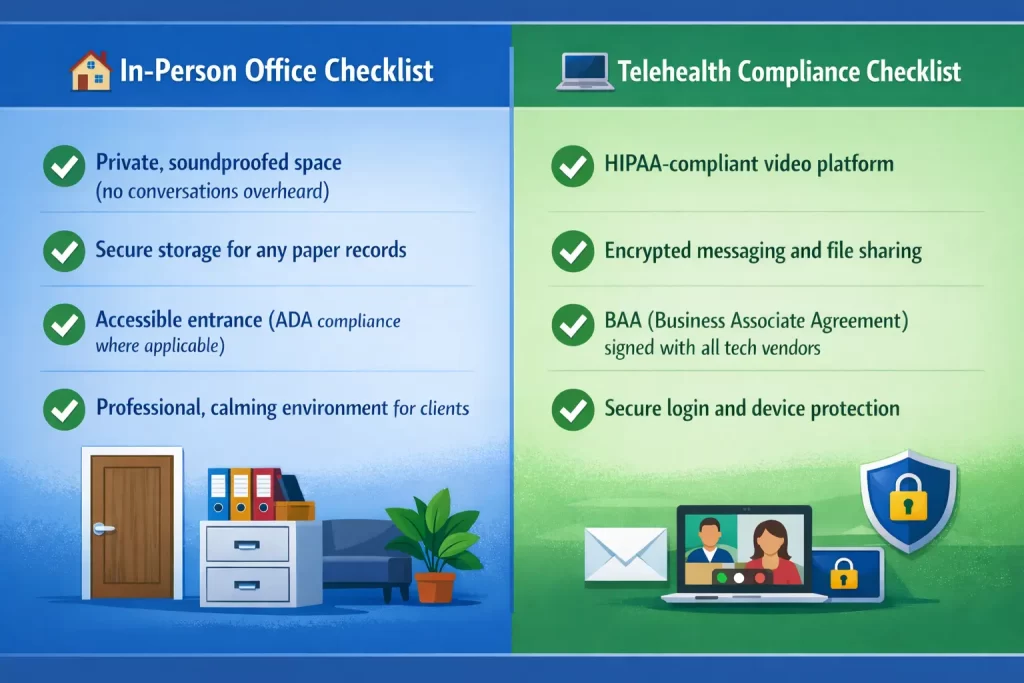
Your setup must comply with HIPAA regulations from day one — and in California, you’ll need to meet both federal and state laws around client privacy.
In California, you’re also covered by the California Confidentiality of Medical Information Act (CMIA), which adds an extra layer of protection on top of HIPAA. Together, these set the confidentiality standards every LCSW private practice must meet.
In-Person office checklist:
Telehealth compliance checklist:
Insurance you’ll need:
Before signing up for any tool or platform, always ask the vendor for a signed Business Associate Agreement (BAA). No BAA = not HIPAA-compliant, no matter what their website says.
Source: Pabau
Starting a private therapy practice has real costs. Going in with a clear budget saves you from nasty surprises in month three.
Sample startup budget:
| Expense | Estimated Cost |
|---|---|
| Business registration & legal | $500–$2,000 |
| Local business license | $90–500 (depending on the location) |
| Malpractice insurance | $5,000–$25,000+/year (low-risk specialties) |
| General liability insurance | $1,000–$3,000/year |
| Office rent (per month) | $2,000–$8,000 |
| EHR / practice management software | $200–$800/provider/month typical |
| Website | $1,000–$5,000 typica |
| Marketing (directories, ads) | $3,000–$10,000 |
| Accounting software | $1,000–$3,000 |
Note: Cost estimates are based on industry averages compiled from multiple healthcare startup guides, including PatientNotes, Dojo Business, and Upmetrics, City of Clearlake Fee Schedule, Fillmore Business License, and Cost Check USA 2026. Actual costs may vary depending on location, specialty, and clinic size.
California LCSWs typically charge around $150–$250 for a standard 50-minute therapy session, depending on experience, specialization, and location. Don’t race to the bottom — your rate should reflect your expertise and the value you provide.
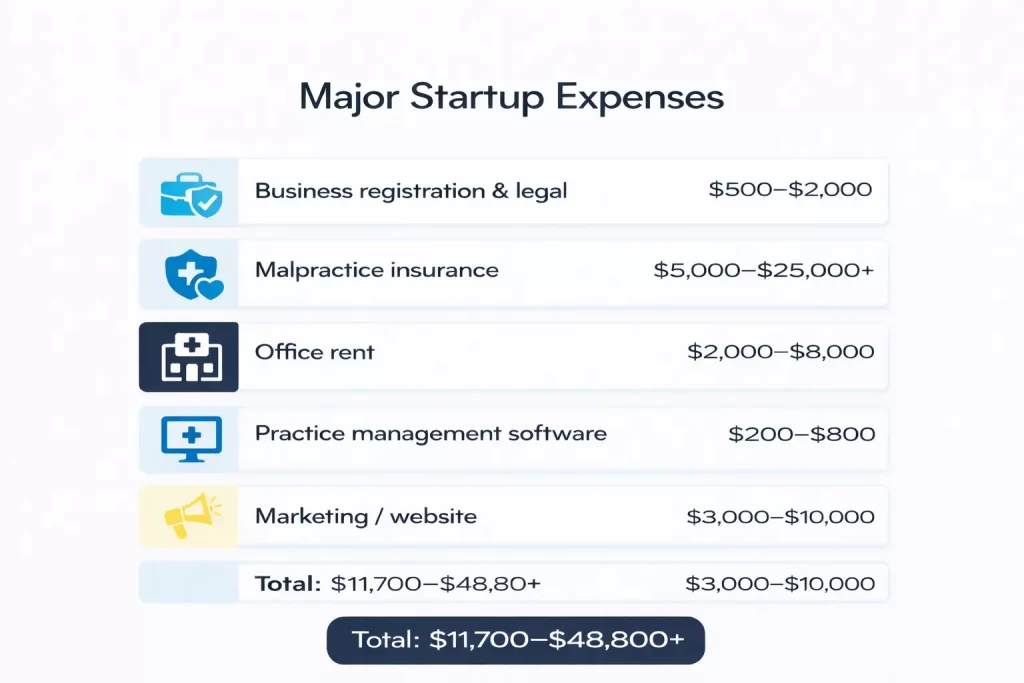
Illustration: Pabau
Common mistake: Underpricing because it feels uncomfortable. Factor in your overhead, taxes, and unpaid admin time — then set a rate that actually sustains your practice.
A great practice with zero visibility won’t fill your schedule. You need a simple, consistent marketing strategy.
Where to start:
Consistent follow-up is one of the biggest drivers of client retention — but it’s easy to let slip when you’re busy. Pabau’s marketing tools handle automated reminders, follow-ups, and client engagement for you, so nothing falls through the cracks. See Pabau’s marketing tools
For a deeper dive into growing your client base, check out our guide on marketing for clinics.
The admin side of running a practice can quietly eat your time if you let it. The goal is to systematise everything that doesn’t need your direct clinical attention.
What to have in place:
No-show rates in mental health practices average around 20–30%. Automated reminders alone can cut that number significantly.
Further reading: Thinking about the bigger picture of running a private therapy practice? Check out our guide on how to start a private practice.
Choosing the right practice management software early on saves you a painful migration later. You need a system that handles:
This doesn’t mean you need to juggle multiple tools. Instead of paying for separate systems for your EHR, scheduling, billing, and telehealth, Pabau brings everything together in one secure platform with HIPAA compliance built in. Explore Pabau’s EHR features
Not sure what to look for in a platform? Our guide on the best medical practice management software breaks it down for you.
Once your practice is stable, the natural next question is: what’s next?
Common growth paths for LCSWs:
Growth can get complicated fast without the right systems in place. Choose tools that scale with your practice so adding staff, locations, or services doesn’t disrupt your workflows or data organization. Read more on how to grow a medical practice

Pabau brings everything together — scheduling, client records, billing, automated reminders, and more — so you can focus on your clients, not the admin.

You’ve mapped out every step—from licensing to growth, but the real challenge is keeping it all running smoothly. That’s where Pabau comes in.
Imagine managing bookings, client records, billing, and follow-ups all from one platform, so you can focus on what truly matters: helping your clients. No juggling apps, no missed appointments, no administrative headaches.
🚀 Take the leap: Book a free demo and see how Pabau helps LCSWs build smarter, smoother, more efficient practices from day one.
📖 Next up: Learn what features a practice management system should include to deliver a seamless, stress-free patient experience that keeps clients engaged and coming back.
Actual reported earnings for Licensed Clinical Social Workers (LCSWs) in private therapy practice vary widely depending on caseload, location, specialisation, insurance vs self‑pay, and hours worked. According to recent salary data:
The average salary for an LCSW in a private practice setting in California is around $92,925 per year, with a typical range from about $71,100 to $110,500 annually and top earners over $140,000.
Becoming an LCSW usually takes 6–7 years — about 4–5 years to complete a bachelor’s and master’s degree, followed by at least 2 years of supervised clinical experience (3,000 hours over a minimum of 104 weeks).
No. Many LCSWs run successful private pay-only practices. Accepting insurance widens your client base but comes with lower reimbursement rates and heavier admin. It’s a business decision, not a requirement.
Yes, you can run a 100% telehealth private therapy practice in California. Many therapists use telehealth to cut overhead and reach clients remotely, as long as they use a HIPAA‑compliant platform with a signed Business Associate Agreement (BAA) and follow professional standards for privacy, informed consent, and supervision.
A sole proprietorship is simpler and cheaper to set up, but offers no liability protection. A professional corporation (PC) costs more upfront but can provide significant tax advantages — especially when elected as an S-Corp. Talk to a CPA before deciding.