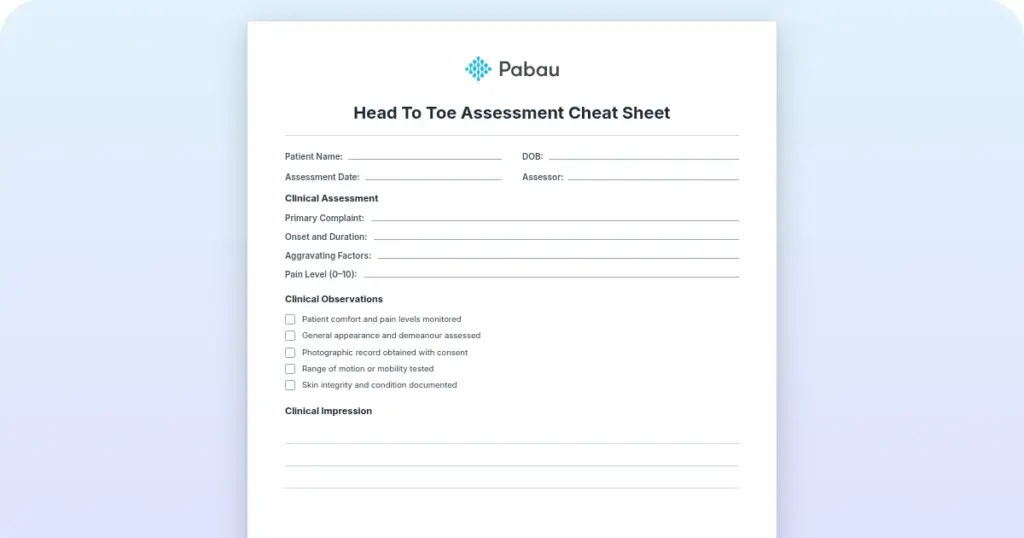
Head to toe assessment cheat sheet: Printable nursing guide
A head to toe assessment cheat sheet gives you one fixed order at the bedside, s...

2
Last Updated: Oct 23, 2026

The compression rotation test is a shoulder orthopedic special test used to identify SLAP (Superior Labrum Anterior to Posterior) lesions of the glenohumeral joint.
A positive result is a click, a clunk, or reproduction of the patient’s pain during humeral rotation under axial compression.
A positive test is a clinical indicator that warrants imaging, not a confirmed diagnosis.
Published studies report specificity of up to 99% but variable sensitivity, so a negative test does not rule out a SLAP lesion.
No single shoulder test is enough on its own, so pair this one with the O’Brien test and the Crank test.
Shoulder special tests are only as useful as the clinician performing and interpreting them. The compression rotation test is one of a small group of orthopedic assessments that are highly specific for SLAP lesions. When it is positive, the finding carries clinical weight.
Its sensitivity is low, though, so a negative result tells you far less than a positive one does. This guide is written for physical therapists, sports medicine practitioners, and clinical students assessing shoulder pain in active patients. It covers the test from anatomy through technique to battery design and referral decisions.
The compression rotation test is a passive shoulder assessment that identifies pathology at the superior glenoid labrum. It targets SLAP lesions, or Superior Labrum Anterior to Posterior tears. It was first described as a way of mechanically trapping a torn labral flap between the humeral head and the glenoid rim. That trapping produces a reproducible click or clunk during rotation.
The mechanism is often compared to the McMurray test of the knee. That comparison describes how the two tests work, and it is not an alternate name for this one. Both combine axial compression with rotation to catch intra-articular pathology.
Understanding why the compression rotation test works takes a working knowledge of the superior labrum and its relationship to the biceps anchor.
Technique precision matters, because incorrect hand placement or inadequate axial load reduces both sensitivity and specificity. Practices that document assessments in practice management software can record each step in the same place. That cuts transcription errors and keeps an audit trail.
Position the patient supine with the test shoulder at the edge of the treatment table. The arm rests at the patient’s side in a relaxed, anatomically neutral position. Ask the patient to confirm they are comfortable and have no pain at rest before you start.
With practice, the whole sequence takes under two minutes. Students often apply too little axial load, which weakens the mechanical impingement needed to reproduce a positive finding.
A positive compression rotation test does not confirm a SLAP lesion. It flags a clinically significant finding that warrants further investigation. The distinction matters for how you explain the result to the patient and how you write it into the record.
Three findings constitute a positive result:
Differential diagnoses to consider alongside a positive test include rotator cuff tears, particularly supraspinatus, plus glenohumeral instability and biceps tendinopathy. Each can produce shoulder pain with rotation, so the full clinical picture decides.
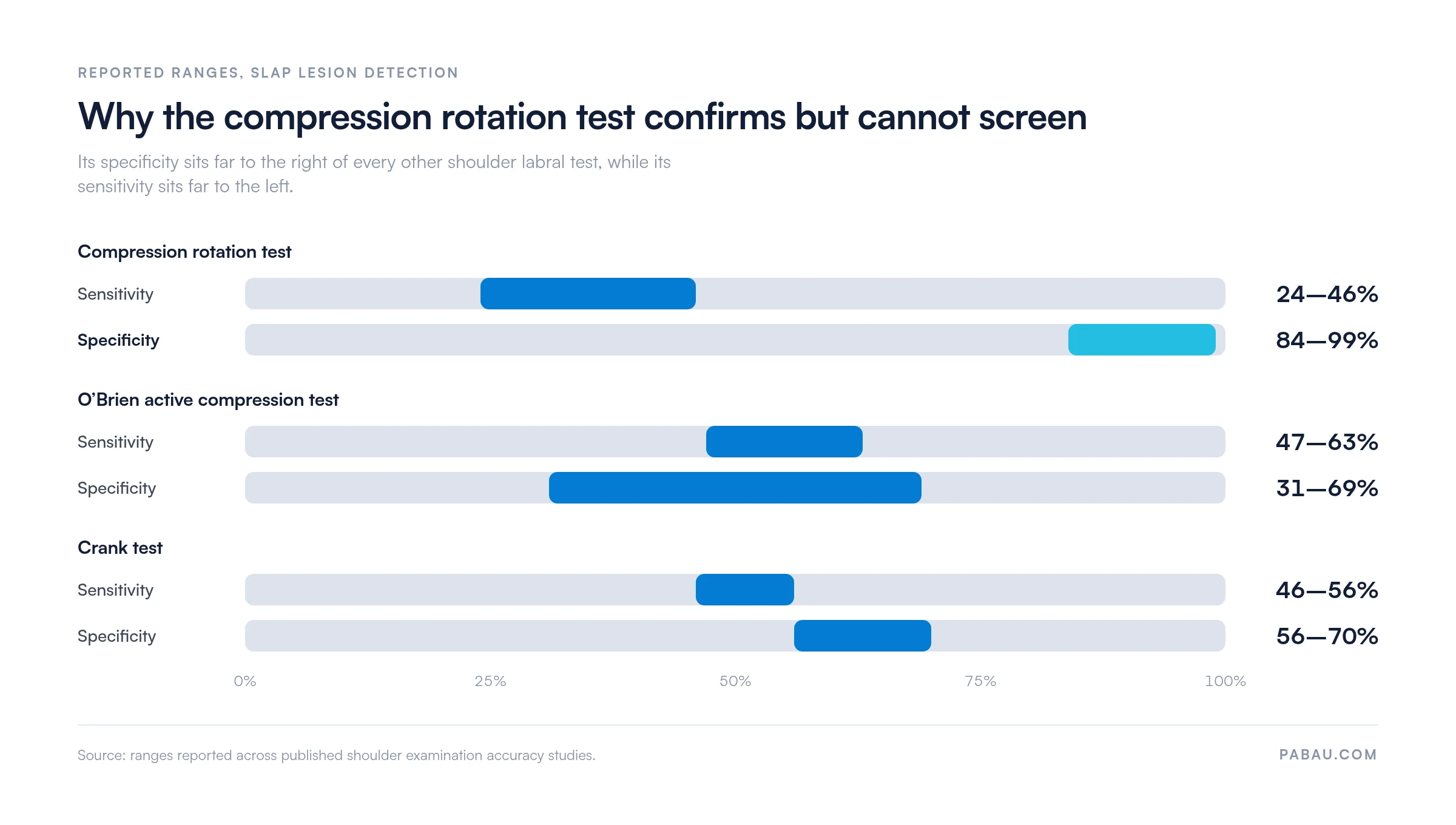
Published accuracy data for the compression rotation test varies across studies. The differences come from patient populations, examiner experience, and the reference standard used, which is typically arthroscopic confirmation. Treat these figures as population-level estimates rather than precise thresholds for one patient.
The high specificity is the test’s primary clinical value. In a patient with overhead shoulder pain and a mechanism consistent with SLAP injury, a positive result raises the probability enough to support imaging. Set alongside the two other labral tests, that trade-off is easier to see.
Document the specific finding, whether that is a click, a clunk, or pain reproduction, rather than a bare ‘positive’ or ‘negative’. It gives the referring surgeon something to work with and gives you a baseline for reassessment if symptoms change.
The compression rotation test should never be used alone to rule SLAP pathology in or out. Several well-documented limitations affect its clinical utility.
These limitations are the case for using the test inside a structured shoulder assessment battery rather than as a standalone diagnostic tool.
Three tests dominate the clinical literature on SLAP assessment: the compression rotation test, the O’Brien active compression test, and the Crank test. Each targets the same pathology through a different mechanism, and each has its own diagnostic profile.
Recording all three results at the same visit matters, because the battery is what carries the diagnostic weight. Practices running sports medicine software keep those results on one client record instead of three separate notes.
In the O’Brien active compression test, the patient resists a downward force. The arm sits in 90° of flexion, 10 to 15° of horizontal adduction, and full internal rotation. It relies on patient effort rather than examiner-applied compression. That makes it sensitive to acromioclavicular joint pain as well as labral pain.
In practice, the O’Brien test is the screening step because of its higher sensitivity. The compression rotation test then adds confirmatory specificity when the O’Brien is positive.
The Crank test is performed with the arm elevated to roughly 160° in the scapular plane. The examiner loads the joint axially and rotates the humerus. The positional difference matters. Near-full elevation loads the superior labrum differently from the supine, adducted position used here.
The Crank test may suit overhead athletes better, because their symptomatic position sits closer to full elevation. The compression rotation test is better tolerated by patients with acute or severe pain who cannot elevate the arm without provocation.
The evidence consistently supports a battery approach. A 2012 systematic review in the British Journal of Sports Medicine found that no individual shoulder examination test carried enough diagnostic value on its own. Combining tests substantially improves the yield.
A practical three-test battery for SLAP assessment:
Other tests worth considering in a full labral assessment:
Record the whole battery, not only the positive tests. The referring clinician needs to see what was negative just as much as what was positive.
A positive compression rotation test does not automatically trigger referral, but it does inform the decision. What decides it is the full clinical picture, not the test result alone.
Consider referral for imaging, typically an MRI arthrogram, or for orthopedic and sports medicine assessment in these scenarios:
MRI arthrogram with intra-articular contrast is the reference standard for imaging SLAP lesions, and standard MRI has lower sensitivity for superior labral tears. When you refer, document which tests were positive, what sign was elicited, and the bilateral comparison. That gives the receiving clinician the pre-imaging context they need.
Referral is not the end of the rehabilitation plan either. Practices that already run a return-to-sport pathway can set the referral decision point inside that timeline, so rehabilitation continues while imaging is arranged.
Practices running shoulder special tests every week hit the same documentation problem. Battery findings have to be recorded consistently, tied to the referral decision, and still legible months later for an audit or a medicolegal review. Practice management software like Pabau holds all of that in one client record. Our physical therapy EMR software is built around how rehabilitation practices work.
Pabau’s client record system supports structured note templates. You can build one that captures the compression rotation test finding, the specific positive sign, and the rest of the battery in a fixed format. Every clinician then records the same fields in the same order.

For practices moving off paper assessment forms, Pabau’s digital forms let you build custom assessment templates. You get dropdown fields, checkboxes for positive and negative test results, and free-text sections for clinical reasoning. That consistency matters most where several clinicians share a caseload and documentation standards are a governance requirement.


Pabau helps physical therapy and sports medicine practices record structured orthopedic assessments, manage referral workflows, and keep every clinical note audit-ready. See how it works for your practice.

The compression rotation test earns its place as a confirmatory test rather than a screening one. A positive result raises your suspicion of SLAP pathology by a useful margin. A negative result should change your thinking very little.
So run it inside a battery with the O’Brien and Crank tests, and record the specific sign rather than a bare positive. Then let mechanism, symptoms, and response to conservative care drive the referral decision.
Pabau keeps those records structured and audit-ready for physical therapy and sports medicine practices. Book a demo to see how a shoulder assessment template looks inside a live client record.

Need the posterior labral counterpart to this test? Kim test covers the technique, the positive sign, and how it fits a labral assessment.
Ruling out a rotator cuff tear at the same visit? Infraspinatus test walks through the technique and what a positive result actually tells you.
Running a physical therapy or sports medicine practice and want tighter clinical workflows? Physical therapy EMR software covers how purpose-built software supports assessment recording, referrals, and client records.
Checking the compliance requirements for your practice? Physical therapy clinic requirements outlines the documentation and operational standards practices need to meet.
The compression rotation test is a shoulder orthopedic special test used to identify SLAP (Superior Labrum Anterior to Posterior) lesions of the glenohumeral joint. It mechanically impinges a torn labral flap between the humeral head and the glenoid rim during axial compression and rotation. The resulting click, clunk, or pain indicates labral pathology that needs further investigation.
Position the patient supine with the test arm at the edge of the treatment table. Apply axial compression through the humerus toward the glenoid. Then slowly rotate the arm through internal and external rotation, keeping the elbow at 90° of flexion. Palpate the joint for a click or clunk, ask the patient to report pain during the arc, and always compare bilaterally.
A positive compression rotation test indicates likely SLAP labral pathology, but it does not confirm it. The positive sign, whether a click, a clunk, or concordant pain, raises the post-test probability of a SLAP lesion. It usually warrants escalation to MRI arthrogram and orthopedic review, particularly alongside a supportive clinical history.
Published studies report sensitivity ranging from 24-46% and specificity from 84-99% for detecting SLAP lesions. The test’s clinical value lies in its high specificity, because a positive result is a meaningful finding. Its low sensitivity means a negative test does not rule out SLAP pathology, so a multi-test battery is recommended.