CRM for chiropractors: how to manage patients, bookings and marketing
A CRM for chiropractors is a patient relationship management system built around...

Last Updated: Oct 13, 2026
The benefits of patient engagement in healthcare land in three places: clinical results, patient trust, and the daily running of the practice. Engaged patients follow treatment plans more consistently, show up for appointments more reliably, and generate fewer emergency contacts and readmissions.
According to the CDC’s health literacy research, patients who understand their conditions and feel involved in their care make better decisions. This guide covers each benefit, the evidence behind it, and the five touchpoints where engagement effort pays for itself.

Benefits of patient engagement in healthcare include better treatment adherence, higher satisfaction scores, and fewer unnecessary appointments.
Health literacy comes first, since patients who cannot follow their care instructions cannot act on them.
Engaged patients attend preventive screenings and act on early warning signs, which lowers downstream costs for patients and practices alike.
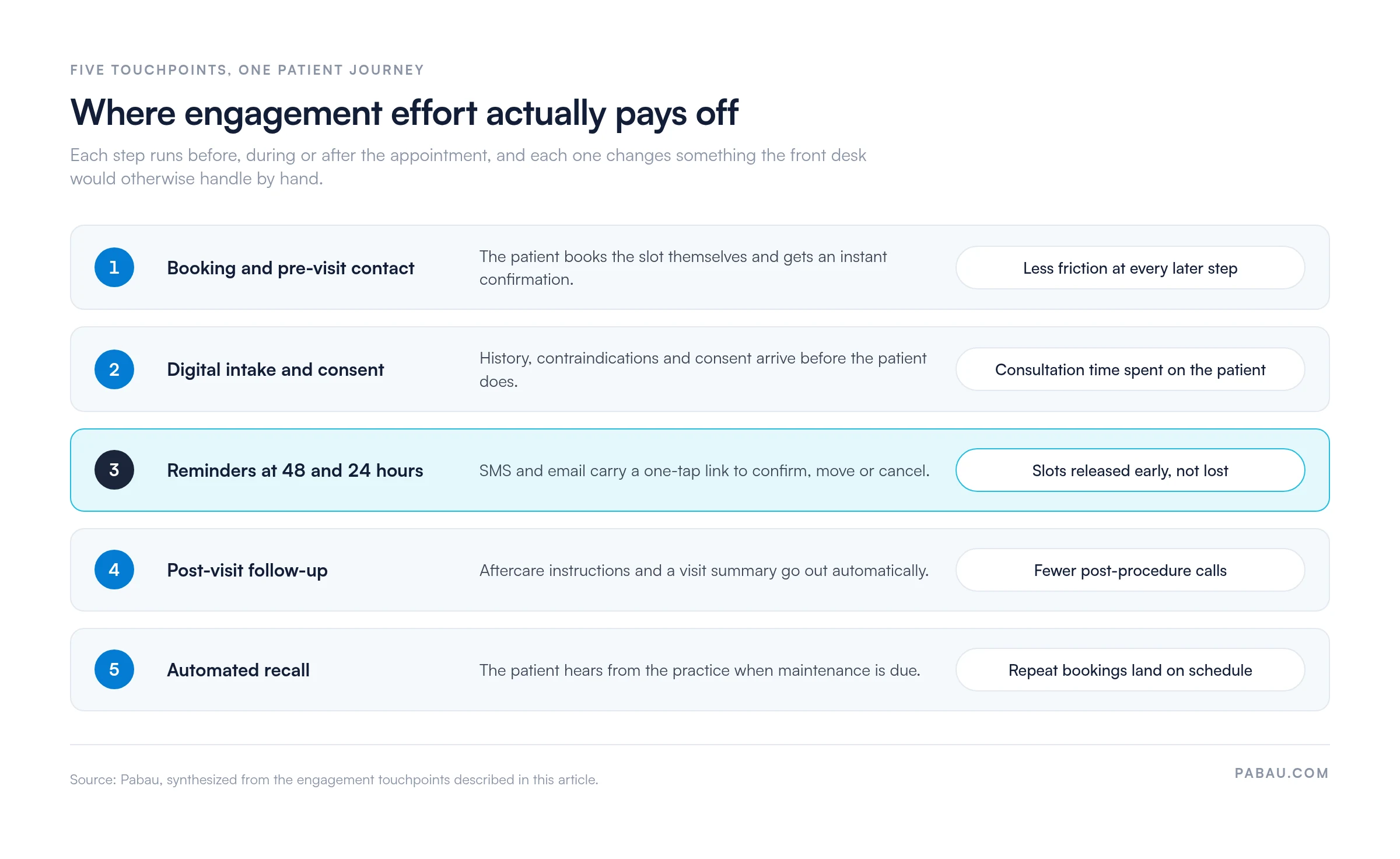
Five touchpoints carry most of the return: booking, digital intake, reminders, post-visit follow-up, and recall.
Practice management software like Pabau runs reminders, digital forms, and recall from one patient record.
Patient engagement produces gains across three dimensions. Clinical gains show up in health results, relational gains in trust and satisfaction, and operational gains in how the practice runs day to day. The research base under all three is solid.
Which dimension to chase first depends on what your practice treats. A practice managing long-term conditions should start with adherence. A practice living on elective, repeat bookings should start with reminders and recall.
Engaged patients follow treatment plans more consistently because they understand why each step matters. A peer-reviewed study published in PMC found that higher patient activation scores track with better adherence to medication and follow-up care. The effect is strongest in chronic disease management.
For practices treating diabetes, hypertension, or chronic pain, that adherence translates into fewer emergency contacts and fewer avoidable readmissions over a year.
Shared decision-making is the mechanism behind it. When patients help choose their treatment path instead of receiving instructions, they take on a personal stake in the outcome. Approaches to patient compliance that build in patient input at the decision point outperform those delivered top-down.
Patients receive the same clinical information either way. Being included in the decision is what moves adherence.
Patient satisfaction rises when people feel heard. Patients who are asked about their preferences, and who get answers they understand, report more trust in the people treating them. That trust shows up in survey scores and in whether they come back.
Satisfaction scores matter operationally too. In value-based care models, HCAHPS and similar patient experience measures feed into reimbursement rates and performance rankings. Private practices see the same effect by a different route. Satisfied patients leave positive reviews, refer others, and return.
Measuring patient satisfaction through post-visit surveys gives practices the data to see where the experience is falling short before retention suffers.
Patients who feel connected to their care team are more likely to attend routine screenings and respond to wellness reminders. They also act on early warning signs instead of waiting for symptoms to escalate. Health literacy is the variable sitting underneath all of that.
The CDC defines health literacy as the degree to which people can find, understand, and use health information to make decisions. Patients with low health literacy disengage at the moment engagement matters most.
Plain-language pre-appointment instructions, post-visit summaries, and condition-specific education materials fix that. Those materials cost little to produce. Their effect on screening attendance and early intervention rates is large. In a screening program, catching a condition early changes the whole treatment path.
Operational efficiency is where practice managers see the clearest return on engagement work. Evidence from professional sources, including the Agency for Healthcare Research and Quality, points the same way.
Engaged patients self-manage between appointments, miss fewer bookings without notice, and complete intake paperwork faster when they have been prepared in advance. Reducing no-shows and smoothing appointment handling are the two most measurable efficiency gains a practice sees from higher engagement.
A patient who received a reminder, confirmed the slot, and completed the intake form before arriving needs far less handling on the day. Multiply that across a full appointment book and the saving becomes a staffing question.
Audit your no-show rate before and after you switch on automated appointment reminders. Track the change over 60 days. Practices running structured reminder sequences report a 20-40% drop in missed appointments, with no extra staff time.
The case for investing in patient engagement rests on peer-reviewed research, government health agency guidance, and clinical association work. All of it points the same way. Practices that engage patients get better clinical results, stronger satisfaction scores, and more efficient operations.
The Agency for Healthcare Research and Quality (AHRQ) has published extensive toolkits on patient activation, self-management support, and measurable health outcomes. Their research shows the most effective interventions are cheap and simple.
Clear communication, structured follow-up, and tools that let patients manage their own conditions between appointments do most of the work. None of that requires new clinical capacity.
For practice owners, the business case lines up with the clinical one. Winning a new patient costs money. Keeping one costs far less. Practices that score well on engagement metrics retain patients longer, generate more referrals, and field fewer complaints.
Strategy matters as much as intent. Knowing that engagement improves outcomes is the starting point. Knowing which touchpoints to invest in is what separates practices that see results from practices that try engagement without a system.
Five touchpoints produce the clearest return, and they run in order across the patient journey.
Patient-centered care is the framework that makes engagement coherent. The Institute of Medicine defined it as care that respects and responds to individual patient preferences, needs, and values. Those values then guide the clinical decisions that follow.
Engagement is how that principle plays out in practice, at the level of individual appointments, messages, and follow-ups. Three elements of patient-centered care support it directly.
Values alone deliver none of this. The practice needs systems that make continuity, personalization, and shared decision-making possible at scale, across every patient interaction. Otherwise continuity depends on which clinician happens to be on duty that day.
Technology is the layer that makes engagement scalable. A solo practitioner can hold engagement together through personal attention alone. A practice seeing 200 patients a week needs the routine touchpoints to run automatically, or they stop happening.
A patient portal gives people access to their records, appointment history, and messages outside practice hours. That cuts inbound calls, speeds up pre-appointment paperwork, and raises satisfaction among patients who are comfortable online.
Portals work best when they sit inside the practice’s core system. A patient asked to log into three separate systems to view records, confirm an appointment, and complete a form will not do all three.
The software you choose decides which touchpoints you can automate and which stay manual. Our roundup of the best patient engagement software walks through what separates the options on that point.
Mapping the patient journey end to end is the practical first step. Note which touchpoints staff handle manually today, then decide which of those can run automatically without losing the personal quality of the interaction.
Walk your patient journey from first booking to post-visit follow-up as if you were a new patient. Note every point where a patient has to chase the practice for information. Each one is an engagement failure and an automation opportunity.
Most practices run engagement across separate tools. Reminders come from one system, forms from another, and recall from a spreadsheet somebody keeps by hand. Every handover between them is a step where a patient falls out of the sequence.
Pabau runs all five touchpoints from one patient record. Online booking feeds the calendar, digital forms arrive before the visit, and reminders go out on a schedule you set once.
Pabau’s Client Portal is patient portal software that gives each patient one link to their bookings, forms, and post-visit instructions. Aftercare goes out automatically after the appointment, and recall workflows contact patients when maintenance is due.
For HIPAA-compliant messaging, communications stay inside the platform instead of routing health information through standard email. So the front desk stops chasing forms and confirmations, and the clinical team meets patients who arrive prepared.

From digital intake forms to automated recall workflows, Pabau connects every patient touchpoint into one system. Book a demo and see how it works in practice.

Engagement work pays back unevenly, so pick the dimension your practice needs most. A practice managing long-term conditions should start with adherence. A practice living on elective, repeat bookings should start with reminders and recall.
Engagement is a standing commitment. A reminder sequence that runs for two months and then stops teaches patients to ignore the next one you send. That costs more than never starting at all.
Pick one touchpoint, automate it properly, and measure the change over 60 days before you add the next. Book a demo to see how Pabau runs booking, forms, reminders, and recall from a single patient record.

Want a concrete plan to start from? Patient engagement strategies sets out the tactics practices use at each stage of the patient journey.
Need to capture better patient feedback? How to capture patient feedback outlines the tools and processes for collecting and acting on satisfaction data.
Looking for the numbers behind the case? Patient engagement statistics gathers the figures on adherence, no-shows, and retention.
Patient engagement is the active involvement of patients in their own healthcare decisions, treatment plans, and ongoing care. It matters because engaged patients adhere to treatment more consistently, attend preventive screenings, and make fewer emergency contacts. Practices get better outcomes and less administrative work.
Engagement improves outcomes primarily through treatment adherence. Patients who understand their diagnosis and help choose their treatment follow through more reliably. That covers medication schedules, lifestyle changes, and follow-up appointments. In chronic disease management, the difference compounds over time.
The main operational benefits are lower no-show rates, less administrative work from self-completed intake forms, stronger patient retention, and better online reviews. For value-based care providers, engagement also influences quality scores that affect reimbursement rates directly.
Health literacy is a prerequisite for engagement. Patients who cannot understand their diagnosis or care instructions cannot participate in their own care. That makes communication design a clinical responsibility as much as an administrative one. Plain-language materials, post-visit summaries, and condition-specific education resources build the foundation engagement depends on.
Three interventions do most of the work. Involve patients in treatment decisions instead of handing down instructions. Send structured follow-up after every appointment. Give patients digital access to their own information between visits. Engagement holds up only when every team member communicates the same way.