How to Grow a Medical Practice in 2026: 10 Proven Strategies That Work
Learn how to grow a medical practice with proven strategies to attract more pati...

April 6, 2026


Buy now, pay later is now available in Pabau

Generic marketing doesn’t work for functional medicine. Your patients have longer decision cycles and need education, trust, and personalisation before they book.
The highest-ROI channels are SEO, email, and referrals. Showing up in symptom-based searches, nurturing leads with automated email sequences, and building a strong review profile will consistently outperform paid advertising alone.
Education is your best conversion tool. Clinics that publish consistent, symptom-focused content across website content, blogs, social media, and email attract more patients and retain them longer.
The right software ties it all together. Tools like Pabau combine clinical workflows, medical marketing automation, and patient follow-up in one place, so growth doesn’t depend on juggling multiple systems.
Most functional medicine marketing advice sounds like it was written for a general GP clinic. It wasn’t made for you.
Functional medicine marketing is different. Your patients need more education, more trust-building, and more proof before they book. Generic marketing approaches won’t cut it.
This guide covers the strategies that actually work in 2026 — from content that attracts the right patients to tools that show you real ROI.
Functional medicine is booming. The U.S. complementary and alternative medicine market hit $36.65 billion in 2025 and is projected to reach $293.57 billion by 2035.
But more practices also means more competition. And you can’t win that competition with the same playbook as a walk-in clinic.
Here’s why your patient-centered approach marketing needs to be different:
94% of patients want educational content from their healthcare providers, yet a third don’t receive it. Those who do report better experiences and are 68% more likely to return to the same provider.
Generic “book now” campaigns don’t cut it here. Your marketing needs to educate, nurture, and build long-term relationships at every step. Not sure where your business model fits into all this? Here’s a guide to functional medicine business models that actually scale.
Some marketing channels work better for holistic health and functional medicine. Here’s a breakdown of what actually moves the needle and how to use each one.
| Channel | Best For | Effort Level | ROI Potential |
|---|---|---|---|
| SEO & Content | Long-term patient acquisition | Medium | ⭐⭐⭐⭐⭐ |
| Social Media | Trust-building & education | Medium | ⭐⭐⭐⭐ |
| Email Marketing | Patient retention & nurturing | Low | ⭐⭐⭐⭐⭐ |
| Paid Ads (PPC) | Fast lead generation | High | ⭐⭐⭐ |
| Referral Programs | Word-of-mouth growth | Low | ⭐⭐⭐⭐ |
| Webinars & Events | Authority building | Medium | ⭐⭐⭐⭐ |
This is your biggest long-term asset. 77% of patients begin their healthcare journey on search engines, and functional medicine patients are especially research-driven.
Your ideal patients are deep-dives — searching “why do I always feel tired” or “root cause of autoimmune diseases” long before they ever consider booking an appointment.
That’s where functional medicine SEO comes in. A strong SEO strategy helps you show up for the specific, intent-driven searches your ideal patients are already typing, and an SEO/AEO optimised website makes sure they land somewhere that converts.
What works:
Common mistake to avoid: Targeting broad keywords like “functional medicine” instead of specific, local terms like “functional medicine doctor in [city].” Broad keywords attract browsers. Local, intent-driven keywords attract patients ready to book.
Social media isn’t just for brand awareness. For functional medicine, it’s one of the best tools you have to educate patients and build trust at scale.
A report on the evolution of patient choice states that 35% of patients have chosen a healthcare provider based on social media presence.
What to focus on:
Educational posts earn 2.3x more engagement than promotional posts in healthcare. Talk less about your services and more about your patients’ problems.
🚩 Red flag: Posting only promotional content (“Book now!”, “New service available!”) with no educational value. Patients will tune you out fast. Your feed should feel like a resource, not an ad.
For more inspiration, check out these clinic marketing ideas that go beyond the basics.
Email is criminally underused in functional medicine — and that’s actually good news for you. Email delivers more than 43% average open rates in healthcare and $36 ROI for every $1 invested — far ahead of most other channels.
For functional medicine specifically, email is perfect for the long nurture cycle your patients need before they book.
What to send:
Nurture and automated email sequences (which include drip campaigns) achieve around a 52% open rate, far higher than standard email campaigns, significantly higher than one-off marketing emails. Set up automated sequences rather than blasting your list with ad hoc emails.
Timing matters — Email engagement tends to peak early in the week. According to research from HubSpot, 27% of marketers say Tuesday performs best for email engagement, followed by Monday (19%) and Thursday (17%), making early- to mid-week campaigns the most effective.
Things to avoid: Sending generic health tips with no connection to your practice or your patient’s journey. Personalised, segmented emails always outperform one-size-fits-all blasts.
Paid ads can get you in front of high-intent patients fast, but they work best as a complement to organic strategies, not a replacement.
Paid search ads are the most convertible channel in healthcare at 2.6%.
Where to focus your budget:
🚩 Red flag: Running paid ads without a strong landing page. If your ad sends patients to your homepage instead of a focused, conversion-optimised page, you’re wasting money.
Word-of-mouth is still one of the highest-converting channels in healthcare. For functional medicine, trust is everything.
Your online reputation can make or break a booking decision. Patients check your star rating before they ever visit your website. Dropping below 4.0 stars can quietly cost you a significant chunk of potential bookings.
How to build this channel:
SMS review requests have a 38% engagement rate compared to 27% for email. After a great appointment, a simple text with a review link is one of the easiest wins you can action today.
Looking to grow your practice more strategically? This guide to growing a medical practice walks you through the full picture.
This one is often overlooked, but it’s a goldmine for functional medicine clinics. Hosting free educational events (online or in person) positions you as the expert and warms up potential patients who aren’t ready to book yet.
Topics that work well:
These events build your email list, generate referrals, and create content you can repurpose across every other channel.
Educational content-based marketing consistently drives higher patient conversion in healthcare. Webinars double as lead generation tools — gate them behind an email signup and you’ll grow your list every time you host one.
Ready to systemize your patient journey from first contact to follow-up? Pabau’s functional medicine software helps you automate intake forms, appointment reminders, and post-visit follow-ups — so nothing falls through the cracks.
Also, see how marketing and automation work together.
Here are the strategies that are actually working right now, packed with practical moves you can put into action.
The biggest mistake functional medicine clinics make? Trying to appeal to everyone.
Patients rarely search for abstract concepts like “functional medicine philosophy.” They search for help with specific symptoms — fatigue, weight resistance, perimenopause, brain fog, or autoimmune flares.
The fix is to get specific about who you serve and what you specialise in:
Your differentiator might be your diagnostic depth, advanced lab testing, virtual care
model, or integrative approach. Whatever it is — lead with it. Don’t bury it on your About page.
Search behaviour is shifting fast. Functional medicine patients are now asking AI tools things like “Why hasn’t anyone helped my hormones yet?” or “Is functional medicine worth it?” — and they expect relevant, trustworthy answers.
In 2026, showing up in AI-generated summaries (ChatGPT, Perplexity, Google AI Overviews) is becoming just as important as traditional SEO rankings.
How to position for AI search:
Most functional medicine clinics haven’t started optimising for AI search yet. That’s your window.
Education is your most powerful conversion tool. Functional medicine patients arrive with questions — lots of them. The clinics that answer those questions best win.
Patient pre-education builds confidence and shortens the path to booking. What a patient education engine looks like:
Common mistake: Publishing one blog post a month and calling it a content strategy. Consistency is everything. A tight editorial calendar — even two posts per month — beats sporadic publishing every time.
For more ideas on how built-in marketing features and tools can help you create and automate content that converts, check out this guide to marketing.
Here’s a hard truth: most clinics offer good care, but lose patients because of bad follow-up.
What to automate:
Keeping your current patients engaged is one of the highest-ROI moves you can make and automation makes it effortless.
Automation doesn’t mean impersonal. The best follow-up sequences feel like they were written just for that patient, referencing their treatment plan, their last visit, or their specific health goals.
One of the biggest blockers for functional medicine clinic growth is not knowing which marketing efforts are actually working.
Tracking your marketing ROI means you stop guessing and start making decisions based on real data. Here’s what to measure:
| Metric | Why It Matters |
|---|---|
| Cost per new patient | Shows which channels are most efficient |
| Patient lifetime value (LTV) | Helps justify higher acquisition spend |
| No-show & cancellation rates | Signals gaps in communication or automation |
| Conversion rate by channel | Reveals where leads drop off |
| Retention rate | The truest measure of patient satisfaction |
If you can’t answer “where did this patient come from?”, your tracking is broken. Set up source attribution from day one, whether that’s through your practice management software, UTM links, or intake form questions.
Need tighter control over your compliance and operations as you scale? Compliance management tools keep your clinic audit-ready while your marketing does its thing.
The right software should keep your clinic organized and actively support your marketing, patient retention, and growth.
Here’s a look at the top platforms built for functional medicine practices in 2026.
| Tool | Standout Feature | Starting Price | Best For | Rating |
|---|---|---|---|---|
| Pabau | All-in-one: EMR + marketing + automations | $62/month | Growing & multi-location clinics | 4.7/5 |
| Practice Better | Wellness-focused EHR with telehealth | $25/month | Solo practitioners & health coaches | 4.5/5 |
| OptiMantra | Deep lab integrations + custom FM templates | $99/month | Multi-modality integrative clinics | 4.6/5 |
If you want one platform that handles your clinical workflows and your marketing, Pabau is the clear starting point. Here’s why.
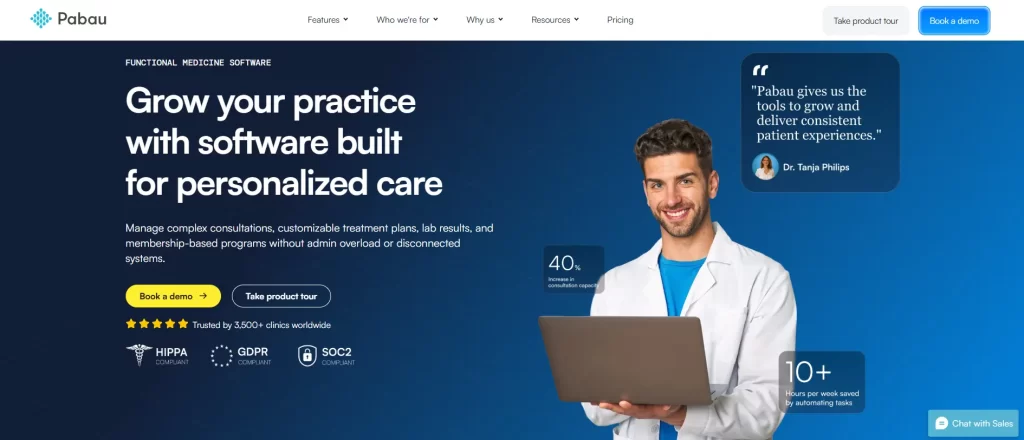
Pabau is trusted by 3,500+ practices across 40+ countries, and it’s built for exactly the kind of complex, patient-centred work functional medicine demands.
It handles long consultations, customisable treatment plans, and complex clinical workflows — without the admin overload. But what really sets it apart is that it combines clinical tools with built-in marketing and business operations — all in one place.
Key features:
Best for: Growing clinics and multi-location practices that want one connected system — not five separate tools.
Pricing: Starts at $62/month per user (annual plan), or $69/month monthly plan, with full platform access. No feature gating — every plan includes scheduling, records, payments, marketing, and reporting.
Pros:
Cons:
Pabau’s built-in marketing tools mean you don’t need a separate CRM or email platform.
Everything from lead capture to post-visit follow-up runs from one dashboard.
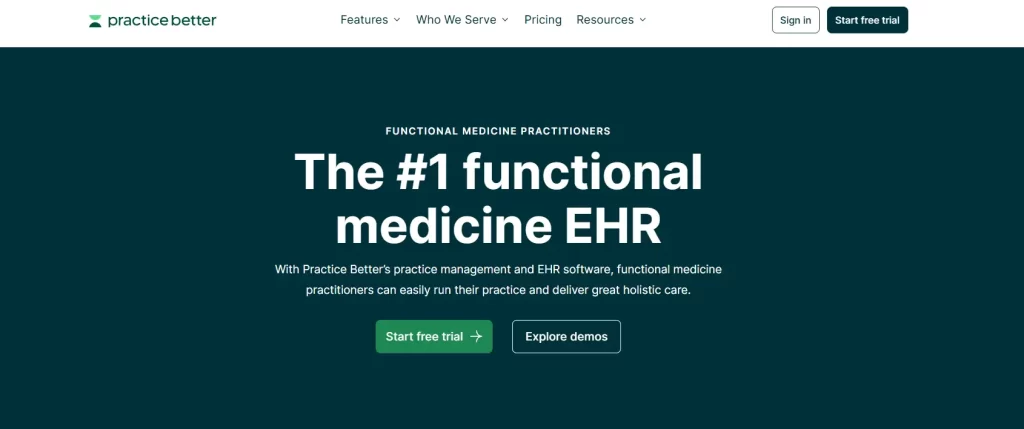
Practice Better is an all-in-one practice management platform designed for holistic health and wellness professionals, including functional medicine practitioners, naturopaths, dietitians, and health coaches.
It’s a strong fit if you’re a solo practitioner or small practice focused on lifestyle-based care, telehealth, and patient engagement, and you don’t need the depth of a full clinic management system.
Key features:
Best for: Solo or small functional medicine practices with a strong lifestyle and coaching focus.
Pricing: Four plans ranging from $25/month (Starter) to $145/month (Team).
Pros:
Cons:
Not sure which EMR is the right fit for your functional medicine clinic? This guide breaks down everything you need to know.
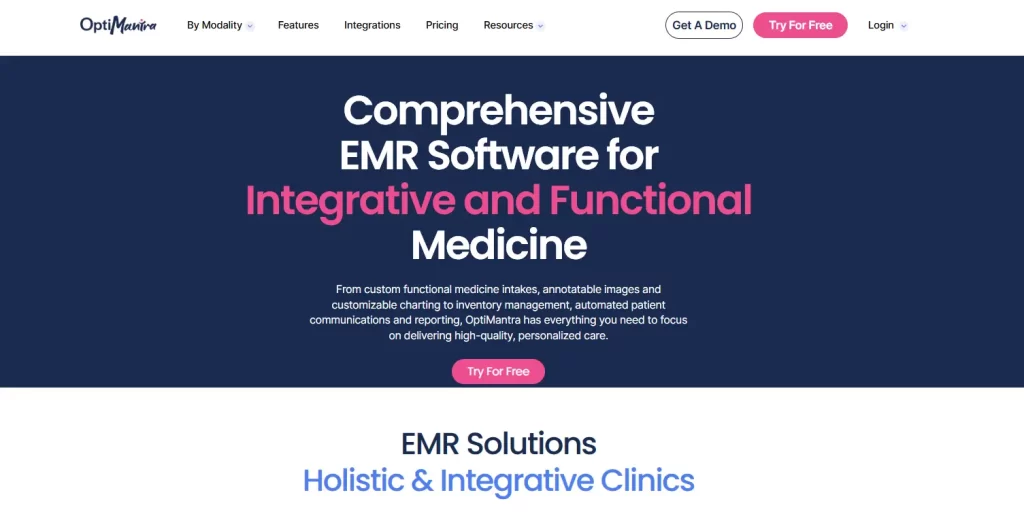
OptiMantra is a comprehensive EMR and practice management solution specifically designed for integrative and holistic healthcare providers, making it a solid fit for clinics running multiple modalities under one roof.
It’s particularly strong on lab integrations and customisable charting templates built specifically for functional medicine workflows.
Key features:
Best for: Multi-modality integrative clinics — naturopaths, chiropractors, acupuncturists, and functional medicine providers operating together.
Pricing: Starts at $99/month for the first practitioner, with discounts available for part-time providers and multi-provider practices.
Pros:
Cons:
Use this as your quick reference to make sure your marketing foundations are solid.
🏷️ Brand & Positioning
🔍 SEO & Online Presence
📱 Social Media & Content
📧 Email & Patient Nurturing
⭐ Reputation & Referrals
📊 Tracking & ROI
Don’t try to fix everything at once. Pick two or three unchecked items and focus there first. Small, consistent improvements compound fast.
Great marketing brings patients in. Pabau makes sure they stay.
From online booking and automated follow-ups to built-in marketing tools and in-depth reporting, Pabau gives functional medicine clinics everything they need to grow, all in one place.
Want to go deeper? Explore how patient experience management can become your biggest competitive advantage in 2026.
Education-first marketing works best. Functional medicine patients research deeply before booking. Clinics that answer their questions through content, email, and social media consistently attract more of the right patients.
It depends on the channel. Paid ads can generate leads within weeks. SEO and content marketing typically take 3–6 months to gain traction, but deliver far better long-term ROI.
Yes, significantly. Functional medicine patients are some of the most search-driven in healthcare. Ranking for the right symptom-based keywords puts your clinic in front of people actively looking for your approach.
Absolutely. Social media is one of the most effective trust-building tools available. Short-form educational videos, in particular, help potential patients understand your approach before they book.
Not necessarily, but the right platform makes a huge difference. Tools like Pabau combine patient management with built-in marketing automations, so you can run follow-ups, reminders, and recall campaigns without juggling multiple systems.


![Medical Aesthetics Marketing: 8 Strategies to Grow Your Practice [Updated 2026]](https://pabau.com/wp-content/uploads/2022/07/Medical-Aesthetics-Marketing-8-Strategies-to-Grow-Your-Practice-Updated-2026-1-1024x614.webp)