Despina Petrushevska

OT SOAP note sample: Free template and worked examples
Download your free OT SOAP note sample A four-page form with an identifying head...

3
Last Updated: Nov 5, 2026
Free PDF 3 pages, print-ready Clinician-reviewed
The VR-12 (Veterans RAND 12-Item Health Survey) is a self-administered questionnaire that measures physical and mental health-related quality of life. Its 12 scored items produce two composite scores, the Physical Component Summary (PCS) and the Mental Component Summary (MCS). Both composites draw on every item, each with its own weight. This printable form adds two questions on change in health over the past year, which sit outside both scores. Physical therapy, chiropractic, primary care and mental health teams use it for routine outcome tracking. It is short enough to complete in a single appointment.
A ready-to-use VR-12 form with 12 scored items covering general health, physical functioning, role limitations, bodily pain, vitality, social functioning and mental health. It also asks about change in health over the past year and has boxes for the PCS and MCS scores.
Start from scratch, or upload this PDF or any form you already use, and Pabau's AI Form rebuilds it with tick boxes, text fields and a signature. Attach it to the treatment once, and every patient gets it on time.
AI Form rebuilds the consent, history and aftercare forms you already use. You review each one, then publish.
Patients complete forms on their phone before they arrive, so the front desk stops retyping paper.
Every signed form is versioned and attached to the treatment record, ready when you need it.
Set how long a consent stays valid. Returning patients skip forms they have already signed.
Supports HIPAA and GDPR compliance AES-256 encryption 4.8 on G2 4.7 on Capterra Trusted by 4,000+ practices worldwide

The VR-12 scores 12 items into a Physical Component Summary (PCS) and a Mental Component Summary (MCS).
Both composites use all 12 items with different weights, and the form adds two unscored questions on change over a year.
Scoring follows the official Boston University and RAND algorithm, and a simplified approximation is not equivalent.
Norms differ between veteran and general populations, so choose the reference set that matches your patients.
Pabau, the practice management platform we build, sends the VR-12 as a digital form and keeps each response on the patient record.
The Veterans RAND 12-Item Health Survey (VR-12) is a patient-reported outcome measure of health-related quality of life. It was developed for the Veterans Health Administration from the 36-item VR-36. The VR-36 was itself adapted from the SF-36 of the RAND Medical Outcomes Study.
Clinicians use the instrument to capture how patients perceive their own physical and mental health. Because it is self-administered, it adds the patient’s view to the clinical record without long assessment time. CMS also uses the VR-12 in the Medicare Health Outcomes Survey, which tracks the health of Medicare Advantage members over time.
The VR-12 form is available as a free PDF from this page. Print it for paper administration, or use it as a reference when you build an electronic version in your own system.
Access to the instrument and its scoring algorithm is by request through Boston University and RAND. Confirm their terms before commercial reproduction.
The VR-12 scores 12 items across eight health domains. Both composites use all 12 items, each with its own weight, so no item belongs to one score alone. The form also carries two questions comparing physical health and emotional problems with one year ago. Those two items track change and are not part of PCS or MCS.
Each domain still leans toward one composite, as the map of the form below shows.
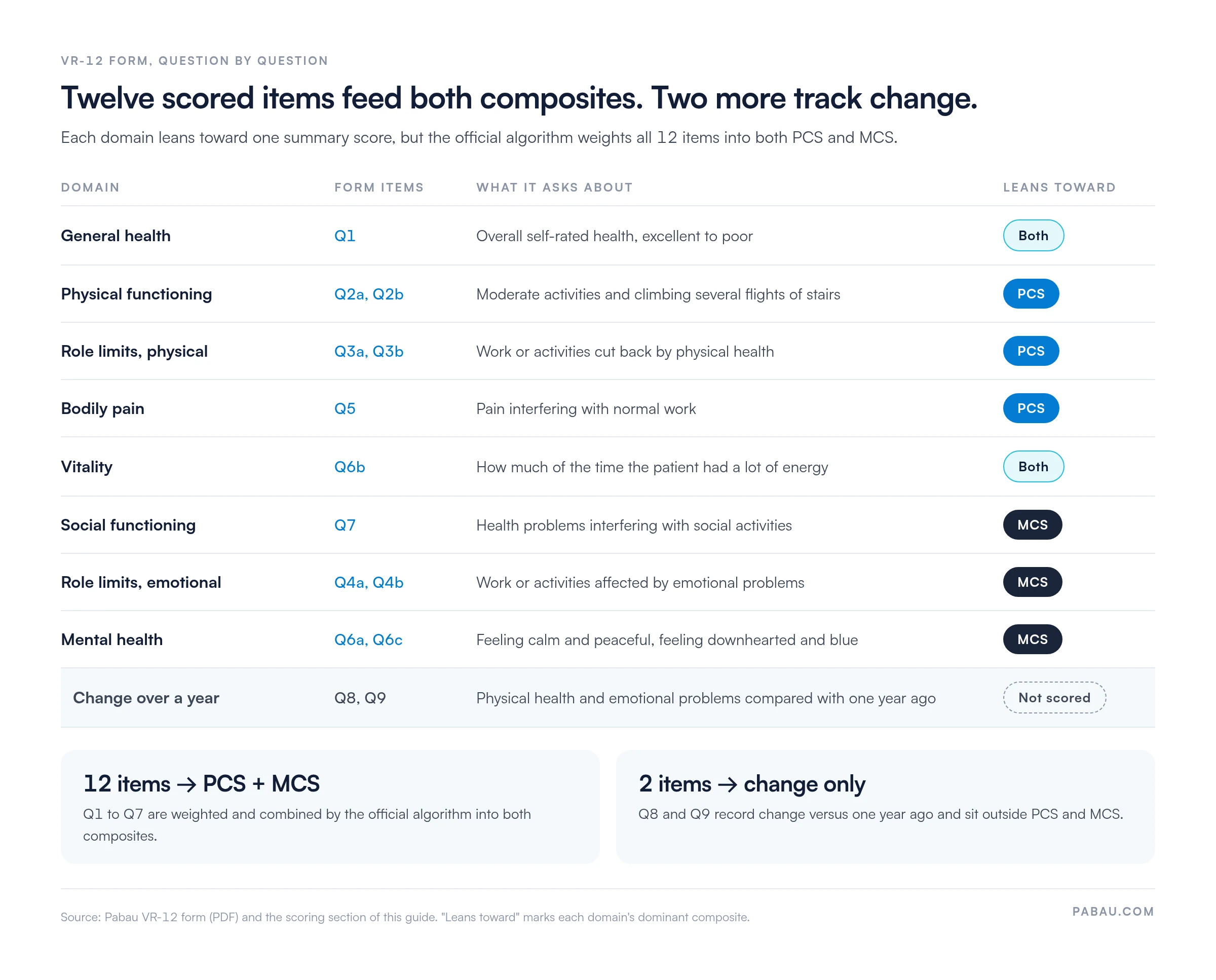
The table gives the same mapping by domain, with the composite each one weighs on most heavily.
Scoring the VR-12 requires the official algorithm. Items are weighted, transformed and combined into PCS and MCS scores. A simplified or approximate method is not equivalent to the published procedure.
PCS weighs physical functioning, role limits and pain most heavily, while MCS weighs emotional, social and mental health items most heavily. Higher scores indicate better reported health within the reference population.
Read scores against norms rather than in isolation. A low MCS in a patient with chronic pain may signal a different clinical priority than a low PCS in a patient recovering from surgery.
PCS and MCS are norm-based scores, set so the reference population averages 50 with a standard deviation of 10. A 2008 study built an updated U.S. population standard from Medical Expenditure Panel Survey data, alongside the original 1990 norms.
Boston University also offers a VR-6D utility value set and an algorithm that maps SF-12 responses to VR-12 scores. Check which standard your comparison data uses, and select the reference set that matches your patient group.
The VR-12 was developed for the Veterans Health Administration, but it is now used widely in non-veteran groups. Score those patients against general-population norms rather than veteran ones.
Practices that run quality-based care programs use repeat PCS and MCS scores to show how patients change over a course of care.
Hand out the VR-12 at intake or at a defined review point, so you can compare scores over time. Explain that most questions concern the past four weeks, and that answers are confidential.
The VR-12 and SF-12 share a common origin in the Medical Outcomes Study, but they are distinct instruments. The VR-12 was developed for the Veterans Health Administration and is now used widely outside it. The SF-12 was built for the general population.
Scores from the two instruments are not directly interchangeable. Linking between them is probabilistic, so treat any crosswalk estimate as an approximation rather than an exact equivalent.
Two common alternatives to the VR-12 are the SF-36 and PROMIS Global Health. The SF-36 questionnaire covers the same eight domains with 36 items, so it reports a score for each domain as well as the two summaries.
PROMIS Global Health uses 10 items to produce a global physical health score and a global mental health score. Pick the SF-36 when you need domain-level detail, and a shorter form when completion time matters more.
Audit your outcome forms each year. Confirm each VR-12 copy in use matches the current version from Boston University, and retire unofficial copies still in circulation.
Paper outcome forms tend to end up in a scanned file, with the scores written on the last page. Repeat measures only work when each response is easy to find at the next review.
With Pabau’s digital forms, you send the VR-12 to the patient before the appointment, and the completed form is stored on the patient record.
Primary care teams can run the same workflow inside Pabau’s GP clinic software, alongside booking and clinical notes.

See how Pabau sends patient-reported outcome forms before the visit and keeps each completed form on the patient record.

The VR-12 earns its place as a repeat measure. A single score says little, while the same form at intake and at each review shows whether treatment is moving physical or mental health.
Request the scoring algorithm before your first patient fills in the form, and pick a norm set that matches your patients. Book a demo to see how Pabau keeps each VR-12 response on the patient record, ready for the next review.

Comparing the VR-12 with its longer parent? SF-36 questionnaire template gives you the 36-item form with a score for each of the eight domains.
Using outcome scores to show quality of care? Leading quality-based health care programs explains how practices build programs around measured outcomes.
Need a broader health check at intake? Health appraisal form collects history, lifestyle and risk factors alongside a quality-of-life score.
Planning routine adult reviews? Annual physical exam checklist lists the checks to run at each age, so repeat VR-12 scores have context.
Deciding which screening tests to offer? Health screening tests sets out what to test for and at what age.
The VR-12 is a 12-item self-administered health survey that produces physical (PCS) and mental (MCS) composite scores. It was developed for the Veterans Health Administration from the 36-item VR-36, which was itself adapted from the SF-36.
Yes. It was developed for the Veterans Health Administration and is now used widely in non-veteran groups. Select norms that match your patient group before you interpret results.
Pabau’s form is a free download, but the instrument’s owners, Boston University and RAND, require a permission request for use. Check their terms before you use it.