Medication tracker template: Free PDF for clinicians and caregivers
A medication tracker is a form that records each medication a patient takes, whe...

3
Last Updated: Oct 12, 2026
A health appraisal form is a record a licensed provider signs to document someone’s medical history, immunizations, and physical exam findings at a single visit. Schools, childcare programs, camps, and some employers require one before a person joins a group setting. The signed form also becomes the baseline you compare future checkups against.
Validity commonly runs 12 months, and some states, such as Michigan and New York, name the exact form they’ll accept. Below you’ll find a free PDF template, a five-step completion guide, and the state rules that decide whether a school accepts the form.
A ready-to-use form with sections for patient demographics, medical history, immunization records, physical exam findings, contraindications screening, and the provider’s signature and credentials. Adapt it to your state’s required fields before you use it.
Download template
A health appraisal form records a patient’s medical history, immunizations, exam findings, and baseline measurements in one signed document.
Schools, childcare programs, camps, and some employers require a completed form before a person joins a group setting.
Some states mandate their own form, such as Michigan’s MDHHS Form 3305, so check before you reach for a generic template.
Validity commonly runs 12 months before entry, and an expired form means the patient needs a new examination.
Practice software such as Pabau lets you rebuild your state’s fields once and store each signed form in the patient record.
A health appraisal form captures an individual’s health status at a specific point in time. Providers use it to document current health, past medical events, family history, immunization status, and baseline measurements. That record becomes the reference point for spotting changes and health risks at later visits.
It differs from an intake form or a physical exam note in scope. An intake form gathers contact and insurance details. A physical exam note documents findings from one visit. A health appraisal combines history, immunizations, and exam findings to set a baseline and guide preventive care.
Many US states require health appraisals for school enrollment and licensed childcare, and some employers use them for occupational health screening. Regulators want proof that children and staff meet health and immunization standards before they enter group settings.
Completing the form takes five steps, and each one builds on the last to produce a complete baseline.
Health appraisals are required across several healthcare and institutional settings in the United States. These are the most common.
Regulatory compliance and liability protection. Completed forms document required screening and create an audit trail that shows due diligence. That evidence protects you against claims of negligent screening.
Standardized documentation. A structured form gives every patient the same assessment. History, exam, immunizations, and contraindications are recorded the same way each time, so no domain gets skipped.
HIPAA compliance and secure record retention. Health appraisals contain protected health information, known as PHI. Digital systems reduce privacy breaches: No lost charts, no intercepted faxes, and secure access logs that support HIPAA compliance.
Workflow efficiency. A well-designed form captures data once. That cuts administrative rework and the calls from schools or licensing bodies asking for clarification.
Verify state-specific form requirements before you complete the appraisal. Some states require an official form that schools will only accept, such as Michigan’s MDHHS Form 3305. A generic template in that case sends the family back for a second form. Bookmark your state’s education department and childcare licensing websites so you catch form changes early.
Requirements differ significantly across US states. Each state sets which form to use, who may complete it, and how long it stays valid. Michigan, Colorado, and New York show the common variation.
Some states have one mandatory form, while others accept any form that meets minimum field requirements. Validity periods commonly run 12 months, and some settings accept longer. Always verify the state’s rule before completing the form.
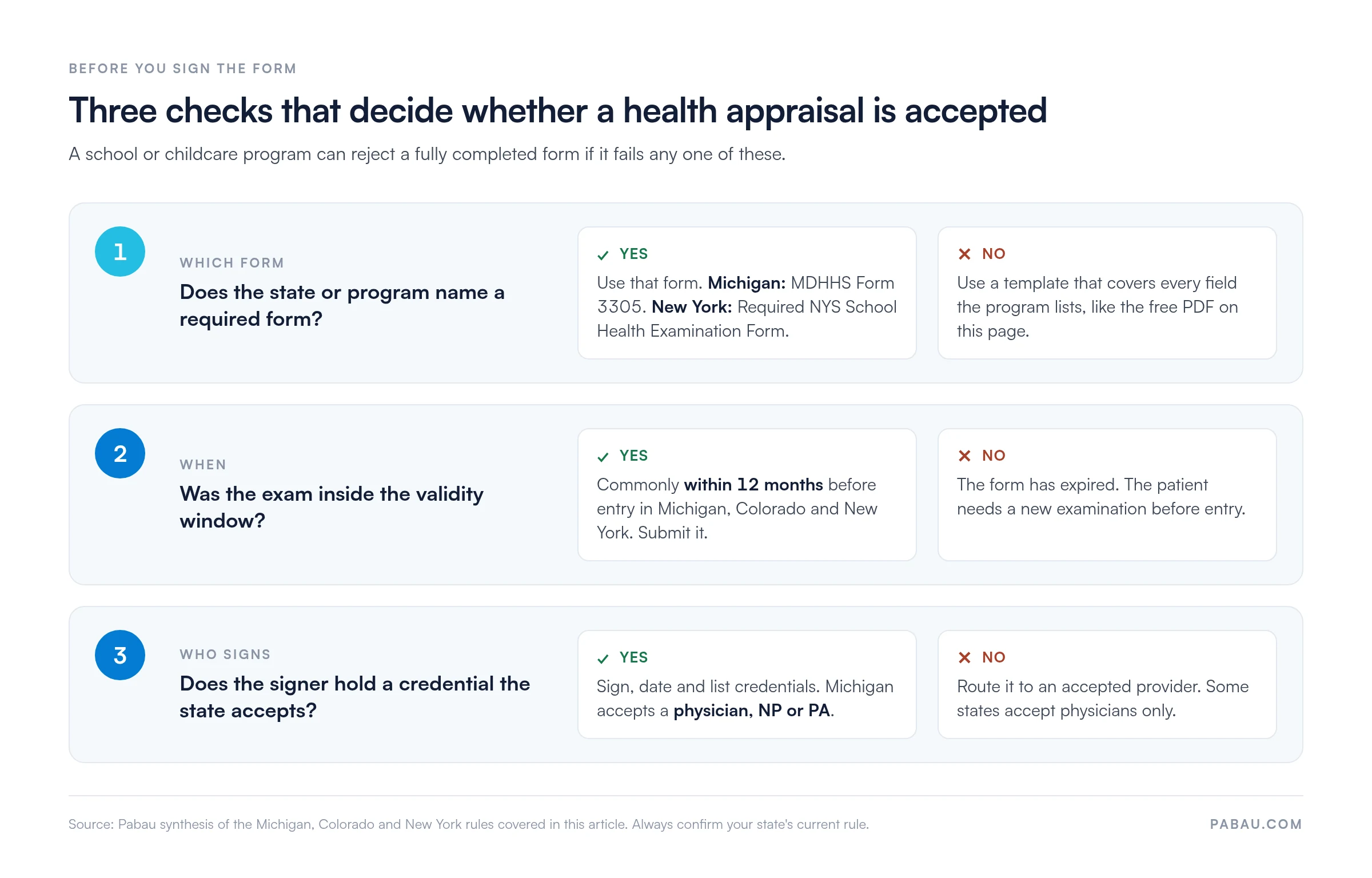
Whichever state you work in, three checks decide whether a school or childcare program accepts the form you sign. Digital intake forms make the first one easier, because you can rebuild a state-mandated layout once and reuse it.
On paper, the appraisal gets printed, filled in by hand, and scanned into the chart. When a school rejects it, someone has to dig out the exam date and the signer’s details.
Pabau, the practice management platform we build, turns the form into a digital template you set up once. Rebuild your state’s required fields in the form builder, then send the history and immunization sections to the family before the visit. Their answers land in the patient record, so the provider only adds exam findings and signs.

Pabau’s vaccination management tools keep immunization dates next to the appraisal. Because it all sits in Pabau’s software for primary care, each signed form stays linked to its visit date and provider. When a school calls about a form, you can answer in minutes rather than searching a filing cabinet.

Pabau stores each completed appraisal in the patient record, with immunization dates and the signing provider attached. When a school or licensing body asks, the form is a quick search away.

A health appraisal only does its job if the receiving school or program accepts it. Before you fill one in, confirm the state’s form, the exam date, and the signer’s credentials. Getting those three right saves the family a repeat visit and saves your team a phone call.
The template above covers the clinical content. The admin around it, from sending forms before the visit to finding them a year later, is where a digital system earns its keep. Book a demo to see how Pabau keeps signed appraisals, immunization dates, and provider details in one patient record.

Running yearly checkups too? Annual physical exam checklist by age sets out what to cover at each age, so no screening slips through.
Screening adults for risk factors? Health risk assessment template gathers lifestyle and history answers before the visit.
Examining a child for school entry? Pediatric physical examination guide walks through each exam component and how it changes with age.
Need a fuller symptom review for children? Pediatric review of systems template gives you a 13-section checklist covering each body system.
Onboarding new adult patients? General practice intake form template collects demographics, history, and medications in one document.
A health appraisal form is a structured assessment document that providers use to set a patient’s health baseline. It records demographics, medical history, immunizations, physical exam findings, and measurements for ongoing monitoring. Schools, childcare programs, and occupational health screenings often require one.
A licensed healthcare provider completes and signs the form. Accepted providers typically include physicians, nurse practitioners, and physician assistants, though some states accept physicians only. Check your state’s credential rules before you sign.
Yes, most US states require a health appraisal form for school entry. Requirements vary by state: Some require completion typically within 12 months before entry. Check your state for longer allowances, and confirm the accepted form with your state’s education department.
A physical exam form documents clinical findings from a single visit, such as vital signs and organ system assessment. A health appraisal form is broader: It captures medical history, immunizations, and baseline metrics in addition to the physical exam. Health appraisals set a comprehensive baseline, while physical exam notes focus on one visit.
Validity varies by state and setting. School-based appraisals are typically completed within 12 months before entry, so check your state for longer allowances. Childcare appraisals often require annual renewal. An expired form may mean the patient needs a new examination before entry.
MDHHS Form 3305 is Michigan’s official health appraisal form for childcare licensing and school entry. It covers demographics, medical history, immunizations, physical exam findings, and provider credentials. A licensed physician, nurse practitioner, or physician assistant must complete it.
Update frequency depends on the setting and the state. School-based appraisals typically need renewal annually, and some states ask for a new one at set grade levels. Childcare appraisals often need annual updates, so check your state’s renewal timeline to stay compliant.