GLP-1 diet plan
A GLP-1 diet plan is a structured eating framework for patients taking semagluti...

2
Last Updated: Oct 13, 2026
A health screening test looks for disease in a patient who has no symptoms yet. That silent window is when treatment works best. Every adult carries a running list of these tests, and each one has its own start age. Blood pressure begins at 18, cholesterol at 20, colorectal and breast cancer at 45.
Family history and lifestyle pull those dates earlier. For a practice, the list is an operating problem as much as a clinical one. A recall that never goes out is a screening that never happens.
What follows covers the test types, the age-by-age intervals, and the workflow behind them.

A health screening test targets patients with no symptoms, which separates it from a diagnostic test ordered after a complaint.
The main categories are blood panels, cancer screenings, cardiovascular and metabolic checks, and questionnaire-based tools.
Start ages cluster at 18, 20, 45, and 65, so most patients have several tests due at once.
A screening visit can be rebilled as diagnostic when the clinician finds and treats something, which changes what the patient pays.
Practices that automate recalls and structure their intake complete more screenings than practices waiting for patients to ask.
A health screening test is a standard exam or lab test given to people without symptoms, to find early disease or raised risk. According to the U.S. Office of Disease Prevention and Health Promotion, it catches illness at its most treatable stage, often before the patient feels unwell.
The result never confirms a diagnosis on its own. A positive screen tells the clinician to order the next test. A negative one buys the patient a defined interval before the next round.
The two test types also differ in who receives them. Screening casts a wide net across a whole patient panel. Diagnostic testing starts once a symptom or a positive screen exists, and the question narrows from a population down to one person.
Almost every health screening test sits in one of four groups. Those groups are blood and laboratory panels, imaging, physical measurements, and validated questionnaires. A single preventive visit usually pulls from at least two.
Blood work is the most ordered screening of all, because one draw covers several conditions at once. The table below lists the panels that appear in almost every comprehensive health test.
One result tells you far less than a trend. A blood pressure reading of 138/88 reads very differently when the same patient sat at 120/78 two years ago. Panels kept in a patient record, in order, let the clinician see the direction of travel.
Cancer screening targets the malignancies where early detection meaningfully shifts survival. The American Cancer Society keeps current guidelines for each of these:
Cardiovascular disease remains the leading cause of death in the United States. The American Heart Association recommends these core screenings for adults:
Several of the highest-impact screenings use a validated questionnaire or a physical assessment instead:
No single schedule fits every patient. Still, the start ages cluster in a pattern worth knowing. Most adults pick up a new screening at 18, 20, 45, 50, and 65. The chart below puts every test on one age axis.
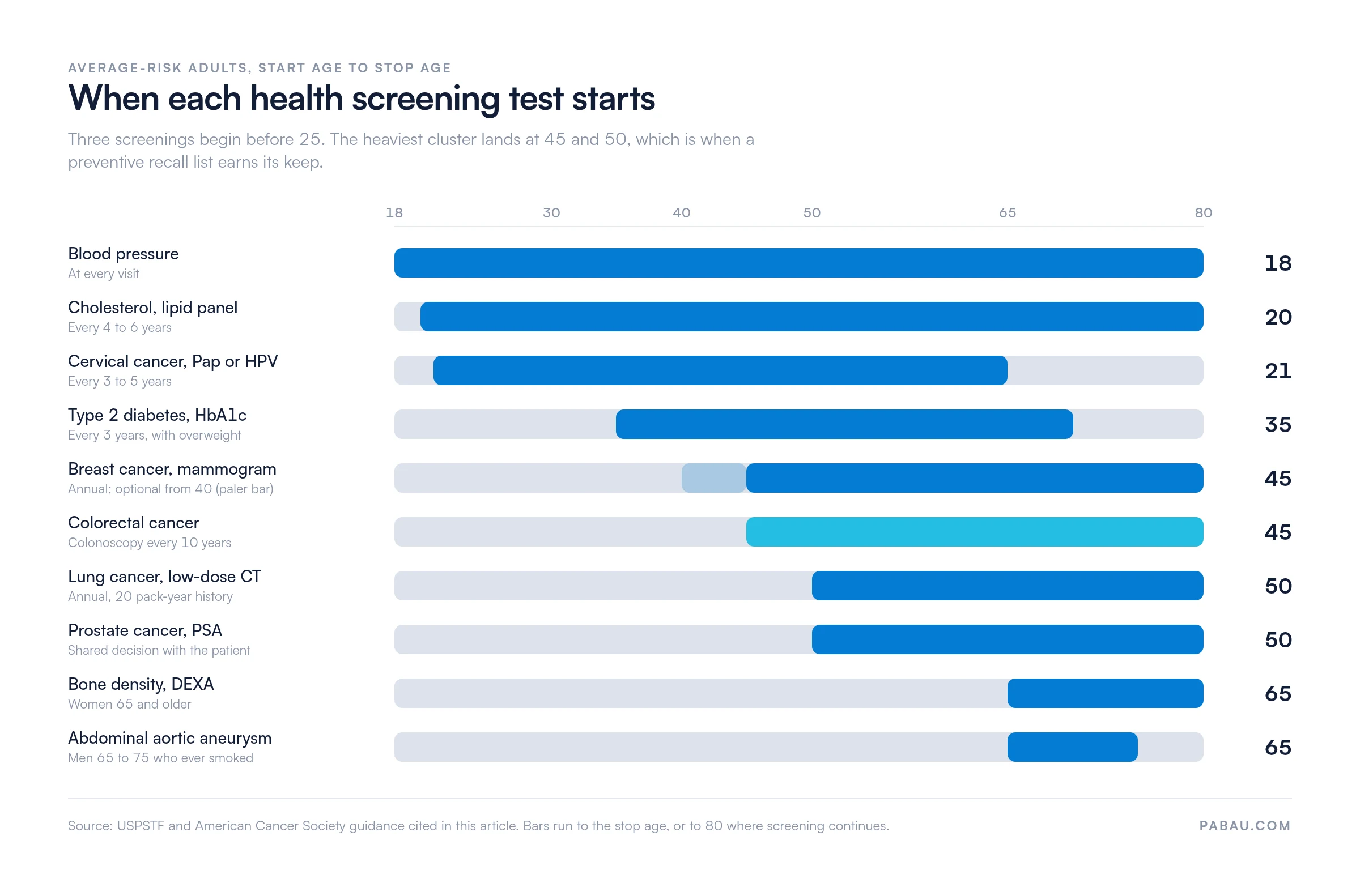
The table below breaks the same schedule down by decade, with the sex-specific additions. Risk factors and clinical judgment still move any of these dates.
Reading the schedule is the easy half. Knowing which of your patients is due, on any given Monday, is the half that decides whether the screening happens.
The two answer different clinical questions, and that difference lands on the bill. It also changes how the visit is documented and how results get followed up.
Here is where it bites. A patient books a routine colonoscopy, and the gastroenterologist removes a polyp during the same procedure. The insurer can reclassify that encounter as diagnostic, and the patient who expected full coverage gets a bill. Nobody at the front desk caused it, but the front desk gets the phone call.
Most of those calls are avoidable. Before a preventive visit, confirm four things:
Two minutes of checking beats a billing dispute three weeks later.
Intervals move for three reasons, and all three come from the patient rather than the guideline. The U.S. Preventive Services Task Force publishes the A and B-rated recommendations that most primary care schedules start from.
Those flags are only useful if you capture them the same way every time. A patient who answers yes to early heart disease in the family should drop onto a different pathway from a patient who answers no. A structured health risk assessment questionnaire at intake is what makes that sorting possible later.
Review your patient panel once a year and segment it by age and documented risk. Patients aged 45 to 65 with no colonoscopy, lipid panel, or HbA1c on file in the past three years are your highest-yield recall list.
Guidelines are the easy part. Three operational points decide whether a practice delivers the screenings it recommends, and each one fails quietly.
Intake you cannot search later. A paper form scanned into a chart holds the answer but hides it. No one can pull a list of patients with a first-degree relative who had colorectal cancer. Structured fields stay queryable, so a risk flag captured in March still works in November.
Recall left to the patient. Screening intervals run in years, and patients do not track them. Practices that wait for the patient to ask lose a large share of due screenings. Automated recall workflows send the reminder on the interval, with no one building a list by hand.
A history split across systems. When the last lipid panel sits in the lab portal and the follow-up note sits in the chart, clinicians re-order tests or skip them. Practices running recalls, notes, and results inside one GP clinic software platform avoid both mistakes.
Preparation depends on the test, but a comprehensive preventive visit follows a predictable pattern. Send this list ahead of the appointment and the visit runs shorter and finishes complete.
The practice has its own prep list. Sending instructions automatically, confirming fasting by text, and flagging which screenings are due prevents half-finished visits. An annual physical exam checklist keeps the clinician’s side of the appointment just as structured.
Most practices run preventive recalls off a spreadsheet and a calendar reminder. Someone filters the patient list every few months, checks who has had a colonoscopy, and sends the messages by hand. The system holds up until that person takes a week off.
Practice management software like Pabau turns that job into a rule. You set the interval per service, so a lipid panel recalls at four years and a colonoscopy at ten. Pabau matches patients against the rule and queues the message, and your team sends it with one click.
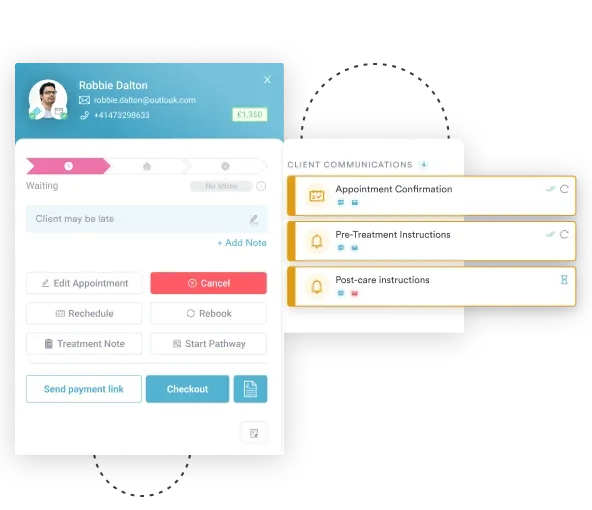
The patient record carries the rest. Past results, the date of the last screening, and the follow-up action all sit in one place. Solid medical records management is what turns a recall into a completed test, so you can prove the pathway ran end to end.
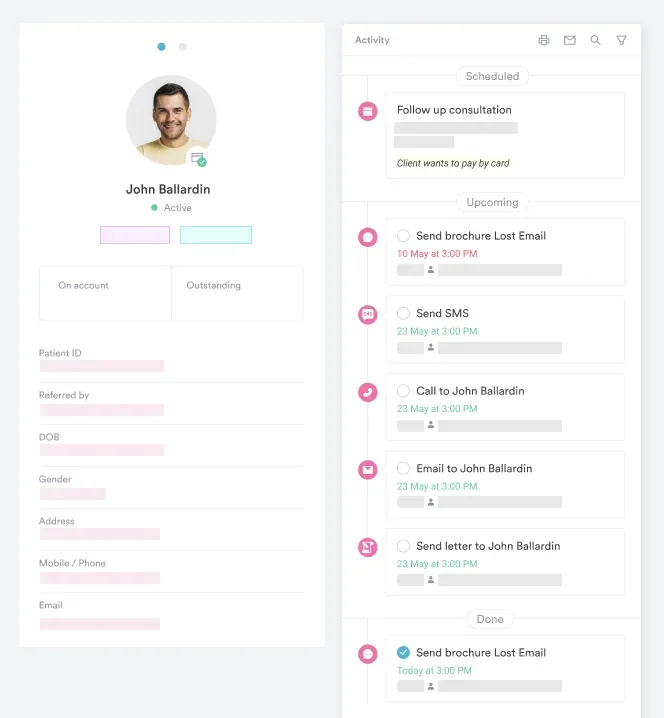

Set a recall interval per service, let Pabau queue the reminder, and store each screening result on the patient record. Your team sends the message instead of building the list.

Screening guidance moves slowly. Delivery is where a practice gains or loses ground, and delivery is the part you control.
So pick one fix and start there. Segment the panel by age. Pull the patients with no colonoscopy, lipid panel, or HbA1c in three years. Build the recall around that group. It is the shortest route from a recommendation to a completed test, and it pays back within a quarter.
To see recall intervals, intake forms, and screening results working together in one system, book a demo with our team.

Want the clinical detail behind the most repeated screening of all? Blood pressure monitoring covers technique, thresholds, and how to document readings that hold up.
Need a structure for the preventive visit itself? The annual physical exam checklist sets out what to cover by age group, ready to hand to a clinician.
Looking to capture risk factors in a form you can query later? The health risk assessment questionnaire gives you a CMS-aligned intake template.
Wondering how a targeted screening program runs in practice? Screening for lead poisoning walks through who to test, when to act, and how to follow up.
Yes. A false positive flags a healthy patient and leads to more testing. A false negative misses disease that is present. No screening test is perfect, which is why a positive result always needs a confirmatory diagnostic test before treatment begins.
It depends on the test. Stool-based colorectal kits and HPV self-collection have published performance data and count as accepted options. Home cholesterol and hormone kits vary far more. Any positive home result still needs a repeat test through a clinician before it changes care.
Yes. Screening outside the recommended interval raises the odds of a false positive, and each one brings more tests, more cost, and more anxiety. Some findings would never have caused harm. Guideline intervals balance early detection against that risk.
No. A physical exam checks what no lab panel covers, such as skin lesions, heart sounds, and symptoms the patient reports. Screening tests usually run alongside that visit. Most preventive appointments combine an exam, a set of measurements, and whichever screenings are due.
Most routine blood panels report within one to three business days. Imaging such as a mammogram or a low-dose CT usually takes a few days longer, because a radiologist has to read it. Tell patients the expected window during the visit.