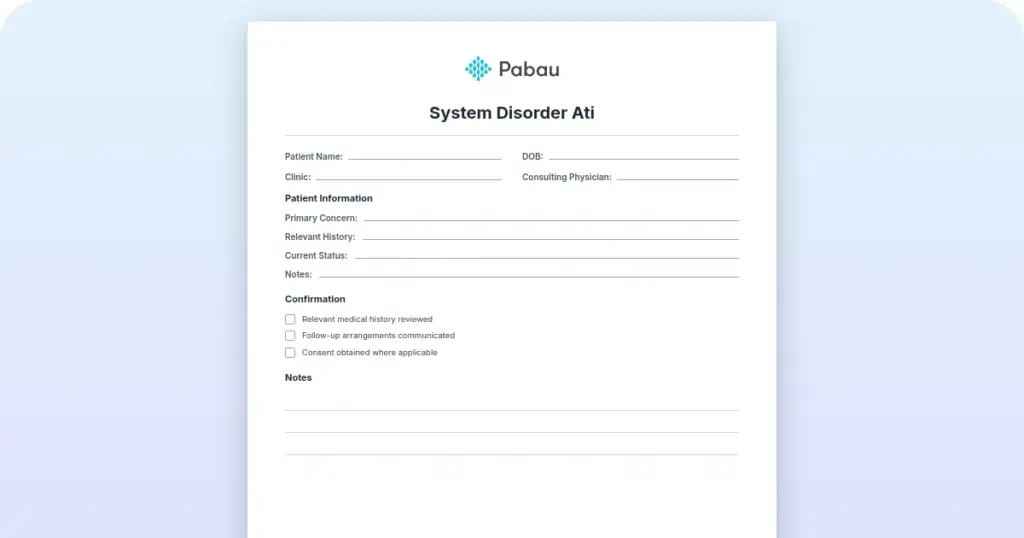
Nursing narrative note template
A nursing narrative note template is a structured PDF that guides you through re...

3
Last Updated: Oct 21, 2026

The piano key test is a clinical examination maneuver used to assess distal radioulnar joint (DRUJ) instability. It involves applying dorsal pressure to the ulnar head and watching for excessive movement.
A positive result shows dorsal-volar ulnar displacement compared to the contralateral wrist, often with pain, and suggests possible TFCC injury or DRUJ instability.
Standardized documentation of test findings, including patient positioning, examiner technique, grading, and bilateral comparison, improves clinical communication and supports medicolegal protection.
Practice management software like Pabau offers digital documentation tools that help clinicians record piano key test results consistently for audit readiness and continuity of care.
A ready-to-use clinical assessment form covering patient positioning, examiner technique, and result interpretation. It includes bilateral comparison, DRUJ stability grading, differential diagnoses, and findings documentation.
Download templateThe piano key test is a physical examination technique used by hand surgeons, physiotherapists, and orthopedic practitioners to assess distal radioulnar joint instability. It is a common part of wrist assessment in physical therapy EMR workflows.
When performed correctly and documented thoroughly, it gives clinicians reliable data to guide treatment decisions and communicate findings across the care team. This guide covers how to perform the piano key test, interpret results, and document findings using standardized terminology.
The piano key test, also called the piano key sign, is a physical examination maneuver designed to identify distal radioulnar joint (DRUJ) instability. The test derives its name from the resemblance of the ulnar head’s movement to a piano key being pressed down. The head translates dorsally under examiner pressure, then returns to its neutral position when pressure is released.
This movement pattern suggests DRUJ instability, often secondary to triangular fibrocartilage complex (TFCC) injury or ligamentous laxity.
DRUJ instability affects wrist function significantly. The joint normally permits subtle forearm rotation, and excessive movement compromises grip strength, rotational control, and pain-free wrist positioning. Clinicians performing the piano key test need to recognize normal laxity, which all wrists possess to some degree, from pathological instability. This makes bilateral comparison essential during every examination.
The distal radioulnar joint sits at the wrist’s ulnar border, where the radius and ulna articulate. This joint permits pronation and supination, the forearm’s rotational movements. The triangular fibrocartilage complex (TFCC) acts as both a shock absorber and ligamentous stabilizer, anchoring the ulna and preventing excessive dorsal-volar translation.
When the TFCC or its supporting ligaments tear (from wrist trauma, overuse, or repetitive supination-pronation activities), the DRUJ loses structural support. The ulnar head becomes hypermobile. A positive piano key test indicates this instability and points to likely TFCC pathology. It calls for further imaging (MRI, arthroscopy) or conservative management to prevent chronic wrist dysfunction.
The piano key test is warranted in clinical presentations that suggest DRUJ compromise:
Early detection of DRUJ instability improves outcomes. Clinicians who perform this test routinely during wrist assessment catch injuries that might otherwise progress to chronic dysfunction or require later surgical intervention.
Correct technique is essential for reliable results. Follow these steps to perform the piano key test accurately:
Interpreting the piano key test correctly requires understanding what constitutes a positive finding. A positive result does not automatically confirm TFCC tear or DRUJ instability-clinical context and supporting tests are always necessary.
Positive findings: Excessive dorsal-volar ulnar head movement compared to the contralateral wrist. The movement should be obvious, not a subtle translation seen only on the injured side. Pain with this movement strengthens the interpretation. Some clinicians grade the severity: mild (slight movement, no pain), moderate (obvious movement, mild pain), or severe (marked movement with significant pain or apprehension).
Negative findings: Minimal ulnar head movement, symmetrical to the contralateral side. The joint feels stable; no pain is reported. This makes DRUJ instability less likely, though it does not exclude subtle or partial TFCC tears.
Differential diagnoses to consider: A positive piano key test raises suspicion for TFCC injury, the most common finding. Also consider ulnocarpal impingement, DRUJ osteoarthritis, or ligamentous laxity, which can be physiological in some individuals. Always correlate with imaging (MRI or ultrasound) and other clinical tests to arrive at a diagnosis.
The piano key test’s diagnostic accuracy varies across studies, reflecting differences in examiner technique. LaStayo and Howell reported 66% sensitivity and 64% specificity for the test. Wijffels and colleagues found sensitivity of 65-66% and specificity between 44% and 68%, depending on the reference standard used.
The wide specificity range means a positive result raises suspicion rather than confirms a tear. A negative result carries more weight, since the test rules out DRUJ instability more reliably than it rules one in.
Examiner technique explains much of this variability: pressure applied, hand positioning, and experience all affect the observed result. Standardized technique, clear documentation, and correlation with imaging remain the best ways to reduce inconsistency when DRUJ instability is suspected.
The piano key test is one of several maneuvers clinicians use to evaluate wrist and DRUJ pathology. Understanding how it relates to other tests improves diagnostic confidence:
Best practice involves combining multiple tests. If the piano key test is positive but other DRUJ and TFCC tests are negative, the finding may reflect physiological laxity rather than pathological instability. Recording this context in patient intake software keeps the full picture with the rest of the chart. Clinical context, imaging, and patient history guide the final assessment.

The downloadable template above is built for physical therapists, hand surgeons, orthopedic practitioners, and sports medicine clinicians who perform this assessment regularly. It includes sections for:
Practices that use this template report improved consistency in assessment documentation, faster note completion, and better compliance during audits. It also works as a teaching aid for clinicians learning the procedure.
Standardized documentation is critical for three reasons: clinical continuity, medicolegal protection, and quality audit. Many practices still document findings in narrative form, such as “DRUJ appears stable.” This wording lacks specificity and leaves the clinical record incomplete.
Effective documentation captures the following details:
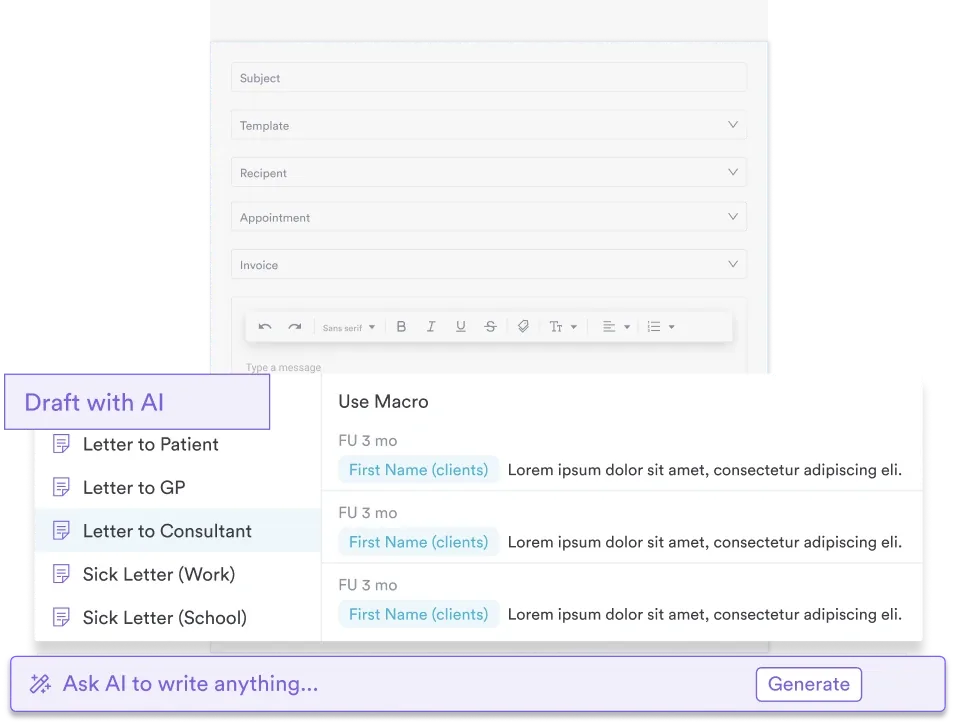
Pabau Scribe, our AI scribe, turns findings like these into structured clinical notes automatically, which reduces the risk of incomplete assessment records. Pabau Scribe captures the same detail every time, regardless of which clinician performs the test.
This is where the downloadable template becomes essential. Rather than relying on clinician memory or inconsistent shorthand, a standardized form keeps every assessment consistent. Every piano key test result includes the same data points, graded the same way, and available for follow-up providers to reference instantly.

Pabau’s digital assessment forms and clinical note templates help you capture piano key test findings, DRUJ stability grading, and patient history. Standardized formats support compliance, continuity, and faster assessments.

The piano key test is a valuable examination technique for evaluating DRUJ instability and guiding treatment decisions in wrist injury management. Mastering the technique, interpreting results with the examiner-dependent accuracy limits in mind, and documenting findings thoroughly all support better patient care.
Use the downloadable template to standardize documentation, and combine the test with bilateral comparison, clinical context, and imaging correlation for the most reliable read. Book a demo to see how Pabau’s clinical documentation tools support consistent special-test recording across your practice.

Need guidance on DRUJ examination workflows? Physiotherapy practice management tools help you document special tests systematically across all patient assessments.
Looking for intake form templates for wrist injury? Clinical consultation templates help capture history and exam findings consistently before the piano key test is performed.
Want to improve clinical note quality? Client record software with structured assessment fields ensures every piano key test finding is documented at the point of care.
The piano key test is used to assess distal radioulnar joint (DRUJ) instability by observing ulnar head movement under applied downward pressure. A positive test suggests TFCC injury or DRUJ ligamentous laxity and guides further diagnostic imaging and treatment planning.
Seat the patient with the forearm pronated, stabilize the radius with one hand, and apply steady downward pressure to the ulnar head with the other. Watch for excessive dorsal-volar movement compared to the contralateral wrist. Bilateral comparison is essential.
A positive piano key sign shows excessive dorsal-volar ulnar head movement, often with pain. This suggests DRUJ instability, frequently caused by TFCC injury, but clinical correlation with imaging (MRI or ultrasound) is necessary to confirm the diagnosis.
Reported accuracy varies by study. LaStayo and Howell found 66% sensitivity and 64% specificity. Wijffels and colleagues reported 65-66% sensitivity, 44-68% specificity, about 24% positive predictive value, and roughly 81% negative predictive value. The test is more useful for ruling DRUJ instability out than for confirming it on its own.
Yes. Bilateral comparison is mandatory because physiological DRUJ laxity varies between individuals and wrists. Testing both sides establishes a baseline, helping distinguish pathological instability from normal variation.
Include it whenever you suspect DRUJ involvement: ulnar-sided wrist pain, a clicking sensation, weakness with rotation, post-trauma presentations, or suspected TFCC tear. It is also valuable in pre-surgical workup and return-to-sport or return-to-work clearance.