Reflection questions: 14 examples and a free template
Reflection questions are open-ended prompts that guide a person through structur...

7
Last Updated: Oct 16, 2026

A personal training business plan sets out your services, target market, marketing, financial projections, and operations. Lenders and gym partners expect to see all five.
Writing the plan lowers your financial risk. It also forces you to price against your own costs and spot operational problems before they cost you money.
Nine sections make up the standard structure, from the executive summary through to licenses and insurance.
At $250 per client and $2,500 in monthly costs, you need 10 clients to break even and 20 to clear $2,500 in profit.
Practice management software like Pabau automates the scheduling, invoicing, and revenue reporting your operations plan depends on.
A ready-to-use outline of all nine sections, with worksheets for financial projections and local market research. It also includes example service packages you can price against your own market.
Download templateA personal training business plan is a strategic document that sets out your business structure, target market, services, pricing, marketing, operations, and financial projections. It works as a roadmap for growth and as a credibility document for lenders, investors, or gym partners.
A generic fitness business overview stops at the concept. A training plan gets specific: Who are your ideal clients? What packages do you sell? How do you find them, and what does it cost you to operate?
This guide walks through all nine sections and works the break-even math with numbers you can check. The free template above gives you the formatting and the examples.
According to the Bureau of Labor Statistics, employment of fitness trainers and instructors is projected to grow 12% between 2024 and 2034. That is much faster than the average occupation. The same agency’s data on business survival is less flattering. About one in five new businesses closes within its first year, and roughly half are gone within five. A written plan is what puts you on the right side of that number. A physical therapy practice tracking range of motion over weeks needs the earlier values beside the current one.
Decide which model fits your market before you write anything else. Each one carries different operating costs, staffing needs, and revenue ceilings.
Each section below answers a question a lender or a gym partner will ask you. Work through them in order, then use the template above for the formatting and examples.
Write this section last and put it first. It is a one to two page summary of the whole plan. Cover your business name, the problem you solve, your market, your edge, and your funding ask. Busy readers often get no further, so lead with something specific. “Helping corporate employees build sustainable habits through 12-week programs” beats “provide personal training services.”
Document your business name, mission, locations, and legal structure. Sole proprietor, LLC, and S-Corp each carry different tax, liability, and reporting consequences. List your certifications here too, whether that is NASM, ACE, or ACSM. Most solo trainers start as sole proprietors or single-member LLCs, and a business accountant can confirm which one suits you.
Cover local and national fitness trends, the competitors near you, and where you can win. Note market size, growth, seasonality, and any regulation that affects fitness businesses. A SWOT analysis works well here, covering strengths, weaknesses, opportunities, and threats. Specifics are what make the section useful: Eight studios in town, only two doing post-rehab work, which leaves injury-recovery coaching open.
Describe your ideal client in detail: Age, income, occupation, fitness level, and what is getting in their way. Example: Women aged 35 to 55, household income above $80,000, busy professionals, willing to spend $150 to $250 a month for guidance. Then say where you will reach them, whether that is referrals, local search, social media, or employer partnerships.
Set out your packages, session lengths, prices, and what each tier includes. Clear service descriptions do a lot of the selling for you. Example: four sessions a month at $160, eight at $300, or 12 at $450 with a nutrition plan.
Price your add-ons separately, whether that is a personal wellness plan, accountability check-ins, or quarterly progress assessments. Then justify the numbers against local competitors and the position you want to hold.
Your marketing plan explains how leads turn into paying clients. List the channels you will use, such as local search, referrals, partnerships, content, and paid ads. Then commit to a 90-day launch sequence with dated activities: Build the site, publish 20 posts, contact 50 former gym clients, open a referral offer. Assign weekly hours and a budget to each channel, or none of it will happen.
Spell out how the work actually runs: where you train, how clients book, and how you onboard them. Reliable scheduling software keeps sessions, cancellations, and reschedules in one place. Online booking lets clients pick their own slot, which cuts the back-and-forth over text.
Write down the rest of the routine as well: intake, progress tracking, communication cadence, and your cancellation policy. A structured progress note template keeps reviews consistent from month to month. If you hire coaches, add how you will track availability, certifications, and payroll.
Project three things: startup costs, monthly operating expenses, and revenue from client acquisition. Startup costs cover equipment, a space deposit, software, a website, and certifications. Operating expenses cover rent, software, insurance, marketing, and payroll if you have staff.
Then build a 12-month profit and loss projection from your own figures. The math matters more than the formatting. At $250 per client and $2,500 in monthly costs, 10 clients is break-even, and 20 clients puts $2,500 a month in your pocket.
Plot that curve before you sign a lease, because the first few months are the ones that hurt.
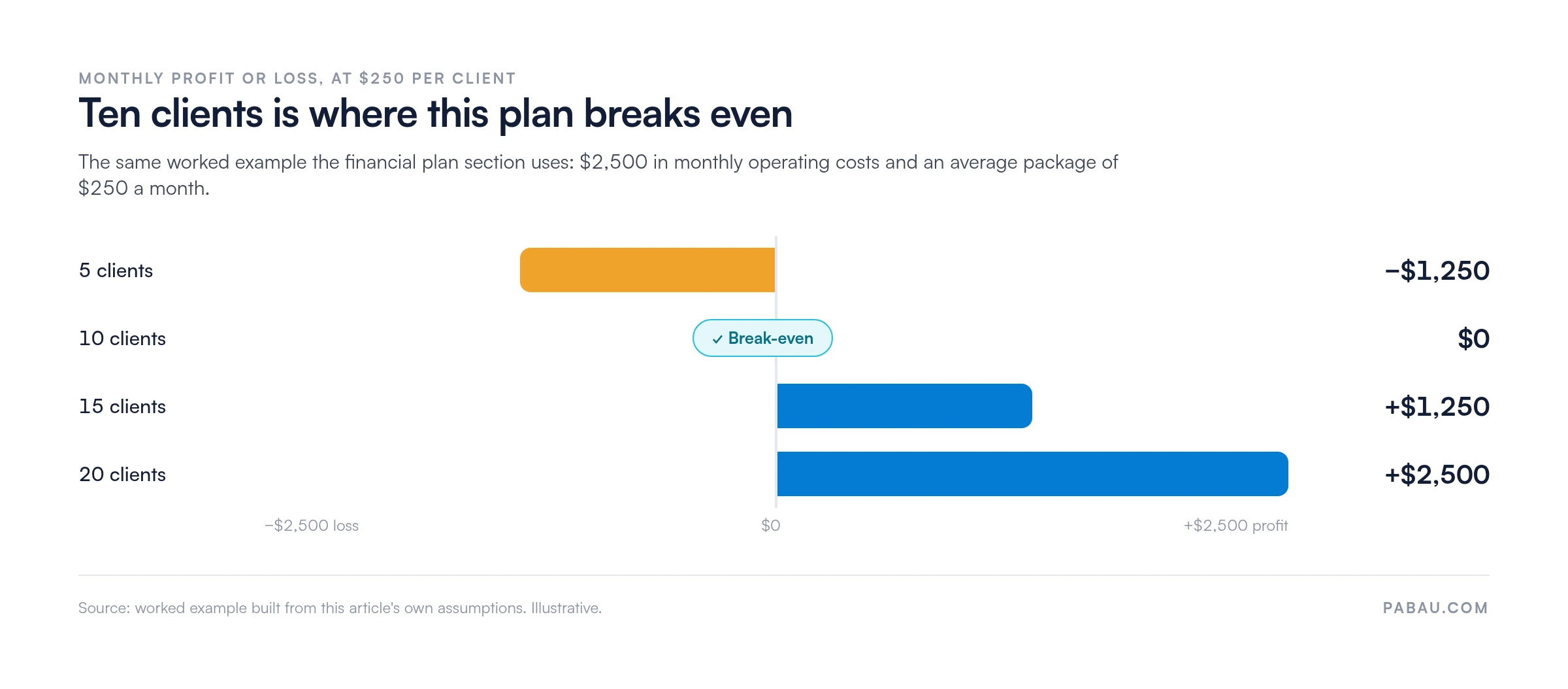
Knowing where that line crosses tells you how much cash you need to reach month three. It also tells you whether your pricing is doing enough work, because the fastest route to break-even is usually a higher average package.
Check what your jurisdiction requires before you take a booking. Most places want a business license, and some want a fitness instructor permit as well. Professional liability insurance is the one you cannot skip, since it covers you if a client is injured. Keep an incident form on hand so any injury is documented the same day it happens.
Confirm that your certification is current and recognized where you work. If you hire staff, add workers’ compensation insurance and payroll tax registration. Requirements vary by state and city, so a local accountant or attorney is worth an hour of your time.
Most new trainers run the operations section of their plan on a calendar app, a payment link, and a spreadsheet. That holds up until about client 15. Practice management software like Pabau replaces the stack with one system, so the plan you wrote is the one you actually run.
Sessions, client records, and invoices sit in the same place, so nothing gets copied across by hand. Payment processing collects package fees on schedule instead of after a reminder. Pabau is also used by coaching businesses and sports medicine practices, so progress notes and package balances live on the client record.
Reporting is where the plan closes the loop. Revenue by package, by client, and by month lands in one report, and automated email and SMS reminders keep sessions from going empty. You will know within weeks whether your pricing and acquisition assumptions hold.


Pabau brings scheduling, client records, payments, and revenue reporting into one system, so the operations and financial sections of your plan run themselves. Every subscription includes every feature, whether you have one user or fifty.

The plan is worth writing for one reason. It forces you to price against your own costs before a single client is on the books. Trainers who skip that step tend to find out in month four, when the rent is due and the calendar is half full.
Give it four to six weeks of honest work. Fill in the template with your own market research and your own numbers, not placeholders. Then treat it as a live document and revisit it each quarter, because prices, costs, and local demand all move.
The trade-off worth remembering is that a plan only earns its keep if you check it against what actually happened. Book a demo to see how Pabau tracks the scheduling, payments, and revenue your plan projects.

Building your intake process for new clients? Personal trainer assessment template covers the health history, movement screening, and goal-setting questions your target market section and operations plan should account for.
Adding clinical assessments to your service lineup? supine to long sit test guide covers the full technique, interpretation table, and evidence for spotting posterior iliosacral rotation.
Want to avoid false positives on a meniscus test? Thessaly test guide walks through the 5 and 20 degree technique and honest accuracy figures.
Start with the model you are running and the clients you serve, then work through the nine sections in order. Business description, market analysis, target market, services and pricing, marketing, operations, financials, and legal requirements each get their own page. Use the template above and fill in your own numbers. Write it for yourself first, then tighten it for a lender.
The nine sections are the executive summary, business description and legal structure, market analysis, and target market. Then come services and pricing, marketing strategy, operations plan, financial projections, and licenses and insurance. Each one answers a question a lender will ask.
Not legally, but it changes your odds. If you are bootstrapping alone, a written plan keeps you accountable and surfaces pricing problems early. If you want a loan, an investor, or a gym partnership, it is not optional. The planning itself is where most of the value sits, because it forces clarity on pricing, positioning, and cash flow.
Train in client homes, parks, or a gym that rents by the session, so you avoid studio rent. Use free tools at first, then move to paid software once the revenue supports it. Lean on referrals and your existing network instead of paid ads. Reinvest the first few thousand dollars into the systems that save you the most time.
It depends on how you want to work. Solo in-person training has the best margins but caps out at the hours you can sell. Online coaching scales without a room, though clients need more structure to stay engaged. Hybrid balances steady income with leverage, which is why most trainers land there. Group training and corporate wellness pay more per session but need consistent marketing or a long sales cycle.
Common options include Trainerize, TrueCoach, HevyCoach, Mindbody, and Pabau. They cover scheduling, invoicing, payments, progress tracking, and client messaging in one place. On a tight budget you can start with a calendar and a payment link. Pick for your model: Online coaches need programming and accountability, while in-person trainers need scheduling and payment automation.
Pick a name that signals your niche or your promise. Something like Post-Injury Performance Coaching tells a prospect exactly what you do. Keep it to two or three words, easy to spell and easy to remember. Check availability on Google, social media, and your local business register before you commit. Then reserve the domain and the social handles.
Most jurisdictions want a business license or registration, and the requirements vary by state and city. Professional liability insurance is the one constant, and policies commonly run from a few hundred to a couple of thousand dollars a year. Confirm that your certification is current and recognized locally, whether that is NASM, ACE, or ACSM. Hiring staff adds workers’ compensation insurance and payroll tax registration. A local accountant or attorney can confirm your exact obligations.