Printable values cards: What they are and how to use them in therapy
Printable values cards are a reflection tool that helps a patient work out which...

14
Last Updated: Sep 30, 2026
The Habit 1: Be proactive worksheet is a guided self-assessment built on Stephen Covey’s first habit from The 7 Habits of Highly Effective People. It asks a person to audit their own reactive language, then sort their worries into a circle of influence or a circle of concern. The last section turns what they control into two or three commitments for the week.
Download it free below. The rest of this page explains what sits in each section. It also gives you a 45-minute plan for running the worksheet in a session.
Five printable sections take the reader from spotting reactive language to committing to two or three actions this week. It includes blank circles for the influence and concern mapping exercise, plus reflection prompts to close a session.
Download template
Habit 1: Be proactive is the foundation of Covey’s framework, and it teaches people to own their choices rather than blame circumstances.
Proactive language such as ‘I choose’ and ‘I will’ replaces reactive phrasing like ‘I can’t’ and ‘I have to’.
The circle of influence holds what a person controls. The circle of concern holds what they only worry about.
Mapping worries into those two circles is the worksheet’s central exercise, and it takes about 15 minutes of a session.
Therapists, coaches, and educators can run the whole worksheet in 45 minutes using the session plan below.
Habit 1: Be proactive is the first principle in Stephen Covey’s 7 Habits of Highly Effective People. Being proactive means owning your choices and their outcomes instead of blaming circumstances, other people, or bad luck. It comes first because every habit after it assumes you believe your decisions matter.
Covey defines proactivity as the freedom to choose your response to any situation. Reactive people respond out of emotion, habit, or a sense of being wronged. Proactive people respond from their values and their longer-term goals. A coaching client management system lets a practitioner track that shift across sessions, though the worksheet is where the awareness starts.
The proactive-reactive distinction sits at the heart of Habit 1. The table below pairs the phrases that signal each one.
Your language reveals your mindset. Reactive phrasing (“I can’t,” “I have to,” “if only”) signals powerlessness. Proactive phrasing (“I choose,” “I will,” “I can”) signals ownership. The worksheet asks the reader to audit their own speech for a week and rewrite what they catch.
Habit 1 turns on two overlapping circles. The circle of concern holds what a person worries about but cannot steer, such as the economy, other people’s opinions, and events already past. The circle of influence sits inside it and covers their effort, their attitude, their reactions, and their daily choices.
Reactive people spend their energy on the circle of concern: They complain, worry, and blame. Their circle of influence shrinks, because the energy never reaches what they could change.
Proactive people work the other way. They act on what they control and let go of what they do not. Their circle of influence widens as that work produces results. Sorting worries into the two circles is the central exercise in the worksheet.
The worksheet is divided into five sections, each one targeting a different part of proactive thinking.
Each section stands alone, so a facilitator can cut the worksheet to the length of the session. Digital intake forms can also deliver it between appointments, as homework or as pre-session reflection.
This section is for the therapists, coaches, and educators running the worksheet with someone else. The plan below fills 45 minutes, and the timings tell you what to protect when a session runs short. Practices that log the work as they go, in practice management for therapists, can pick the thread back up at the next appointment.
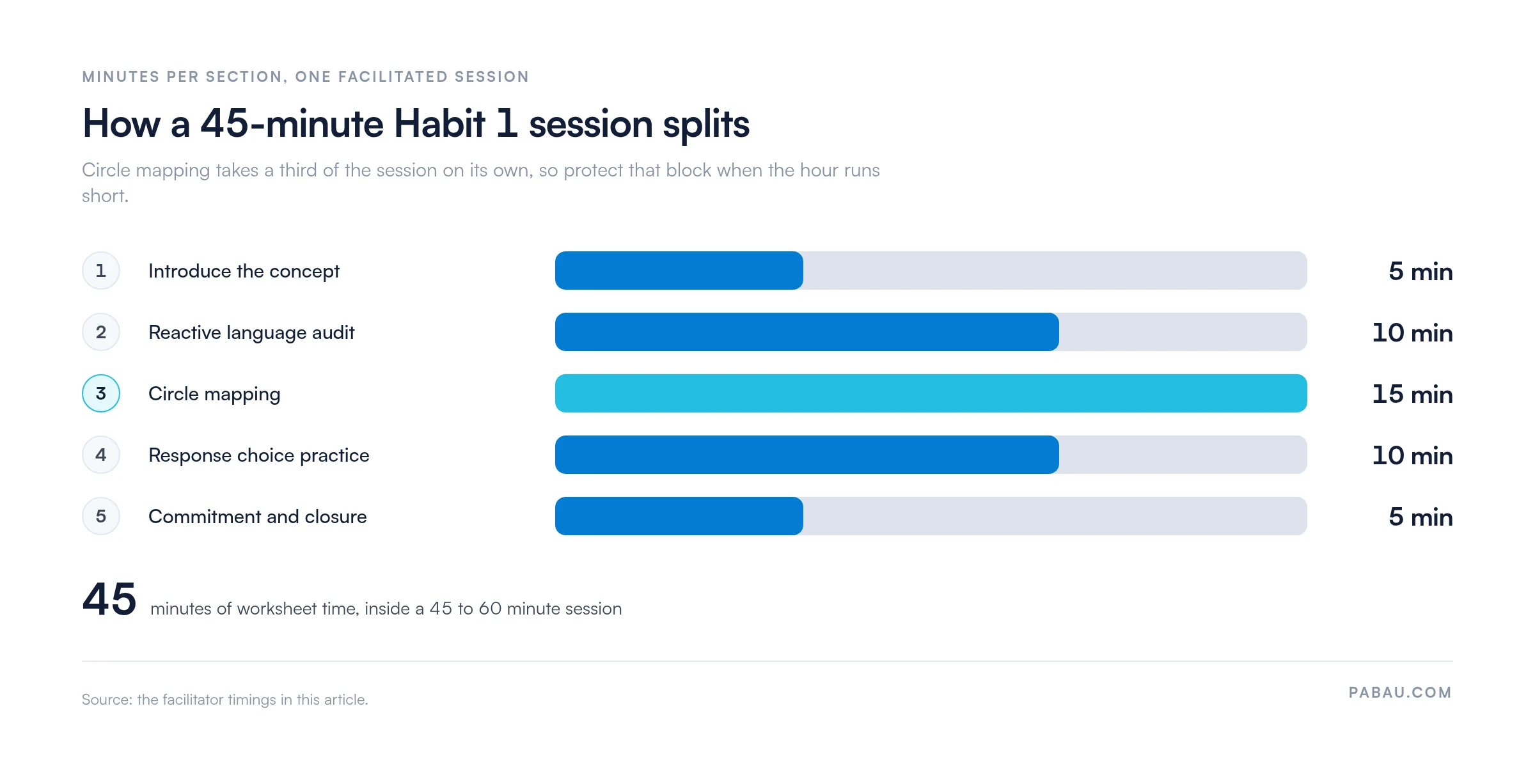
Total session time runs 45 to 60 minutes. The worksheet fills roughly half of it, and the rest is dialogue. Your job is to ask the reflective questions, not to fill the sheet in for them.
The contrast reads differently depending on where it lands. Three settings show what the shift sounds like in practice.
Reactive: “My teacher didn’t explain the material well, so I failed the test.” Proactive: “I don’t understand this topic. I’ll ask for clarification, form a study group, or find a tutor.” Counselors often see academic anxiety drop once a student swaps blaming a teacher for owning a study plan. A mental health EMR, an electronic medical record built for therapy, shows that pattern across a term rather than one session.
Reactive: “My boss gave me an impossible deadline and threw me under the bus in the meeting.” Proactive: “The deadline is tight. I’ll map what I can deliver by Friday, flag blockers early, and propose a realistic timeline in writing.” Colleagues notice the difference quickly, because one version ends in a plan and the other ends in a complaint.
Reactive: “I’m stressed because my partner never helps with housework.” Proactive: “I feel resentful. I’ll ask for a calm conversation about how we split the tasks.” A practice that keeps its medical records management in one system can show a patient how those commitments have built up over months.
Proactivity carries downstream effects, which is why Covey put it first. These are the ones that show up most often in a person’s week.
Every habit that follows assumes you already believe you have a say. Goal setting, prioritization, and problem solving all rest on that belief.
The worksheet usually leaves the room with the patient. Two weeks later, nobody can remember which three commitments were made, so the next session starts by reconstructing the last one.
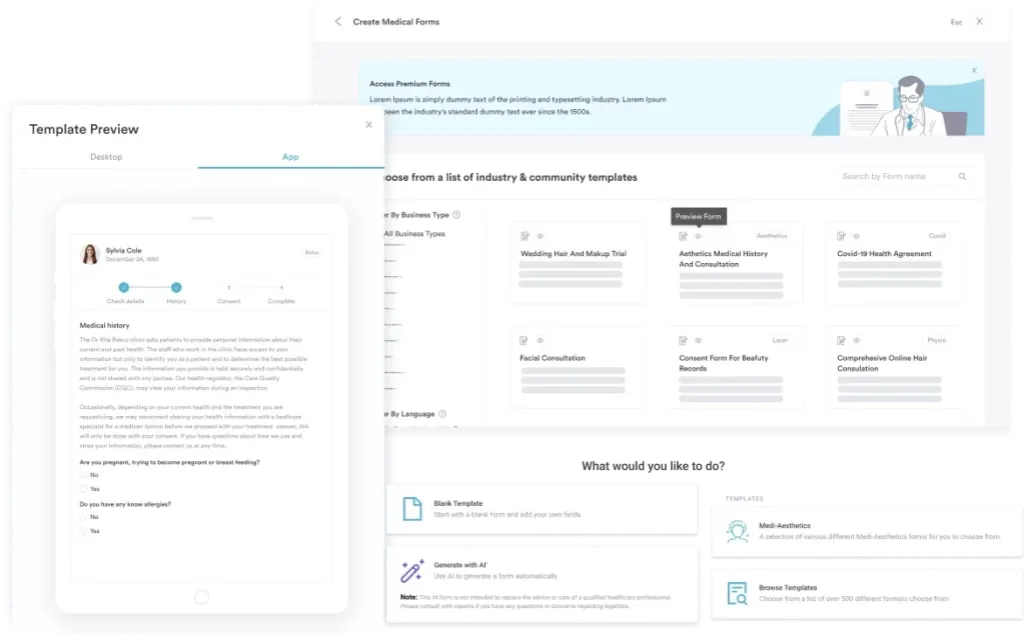
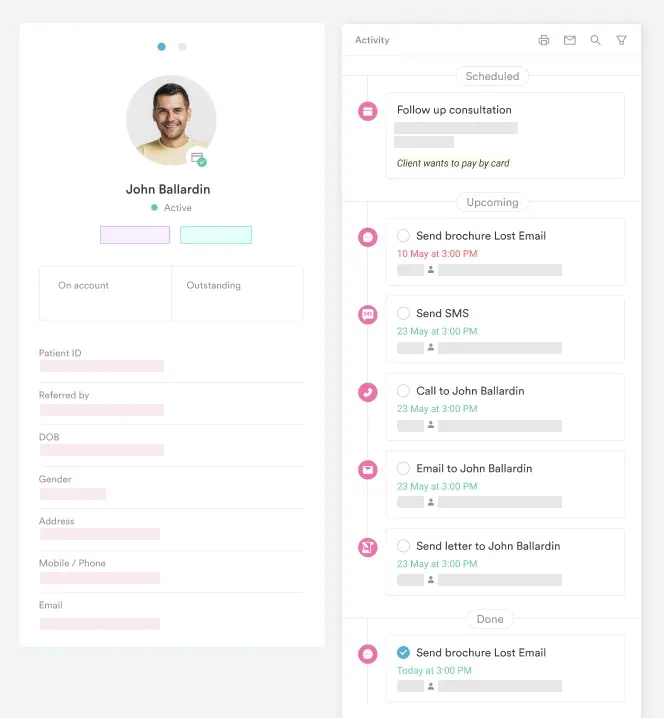
Practice management software like Pabau keeps that work attached to the person it belongs to. Send the worksheet as a digital form before the appointment, and the completed answers land on the patient record instead of in a drawer. The commitments sit next to the notes, so you open the file and see what was agreed.
Automated reminders then carry the commitment into the week, so you can check in on day three rather than at the next appointment. Every Pabau subscription includes the forms, the records, and the automations, so none of this depends on which plan a practice is on.

Pabau sends the worksheet as a digital form, files the answers on the patient record, and schedules the follow-up. You open the next session knowing exactly what was agreed.

Habit 1: Be proactive is the habit the rest of Covey’s framework rests on. The worksheet turns that idea into something a person can do on a Tuesday. Sort the worries, name the ones you own, and pick two actions for the week.
Run it once and you get a useful conversation. Run it every few weeks and you can see where someone’s sense of agency is moving, which is what changes outcomes.
Book a demo to see how Pabau files each completed worksheet on the patient record and chases the follow-up for you.

Want the worksheet that comes before this one? Self-awareness worksheet covers the noticing step that has to happen before a person can choose a different response.
Need a follow-on exercise for impulse control? Self-control worksheet gives patients a structured way to practice pausing between a trigger and their response.
Looking for end-of-session reflection prompts? Self-reflection worksheet helps patients review the week’s choices and carry what they learn into the next one.
Habit 1: Be proactive is the foundational principle of personal responsibility and choice. You cannot control what happens to you, but you can always control your response. That response is your attitude, your effort, and your next action.
Proactive means owning your choices and spending your energy on what you can control. Reactive means blaming circumstances and waiting for someone else to fix the problem. Proactive people ask “What can I do?” while reactive people say “There’s nothing I can do.”
At school, that means asking for help when a topic doesn’t land, forming a study group, and planning study time. At work, it means volunteering for stretch projects, proposing a fix before being asked, and flagging blockers early.
Work through the five sections over 45 to 60 minutes. Those are the language audit, circle mapping, proactive commitments, response choice practice, and the responsibility reflection. Treat it as a structured conversation rather than a checklist, and let the patient supply the examples.
The circle of concern holds what you worry about, most of which you cannot change. The circle of influence sits inside it and holds what you can change, such as your effort, your choices, and your reactions. Proactive people put their energy in the inner circle.
It gives an abstract idea a shape on paper. Sorting worries into two circles makes control and choice visible, which is hard to do in conversation alone. The written commitments then give the next session somewhere to start.