Reflection questions: 14 examples and a free template
Reflection questions are open-ended prompts that guide a person through structur...

5
Last Updated: Oct 16, 2026
A health coaching program gives patients a set number of weeks, usually 12, to change their habits with a coach’s weekly support. Wellness, functional medicine, and weight-loss practices use it to turn good advice into routines patients keep.
The number to plan around is 66. In a well-known University College London study, that’s how many days a new habit typically took to feel automatic. Some people needed 254. Plan only for the average, and your slowest patients leave before their habits stick.
Below, you’ll find a free template, a week-by-week plan, a launch checklist, and the mistakes that stall programs.
A two-page plan with space for the program overview, initial assessment, goal setting, action plan, and session schedule. It also covers resources, behavior change strategies, progress tracking, and program evaluation.
Download template
A health coaching program runs for a fixed period, usually 12 weeks, with one coaching session each week.
In University College London research, new habits took 66 days on average to feel automatic, with a range of 18 to 254 days.
Add one new habit every two to three weeks, and book booster sessions for patients who need longer.
NBHWC board certification requires an approved training program, 50 logged coaching sessions, and a passing exam score.
Practice management software like Pabau keeps intake forms, session notes, and reminders in one patient record.
A workable program has six parts, and each one feeds the next. Skip one, and the others get harder to run.
Coaching also works differently from a clinical visit. The coach doesn’t diagnose or prescribe. Instead, they help patients spot their own barriers and commit to small, specific changes.
The free template gives you a section for each part, from the program overview to the final evaluation. Fill it in once, and you have a plan every coach on your team can follow.
A good intake tells you whether a patient is ready to change right now. That answer sets the size of the first habit and the pace of the whole plan.
Alongside the health history, ask four short questions:
Treat a low readiness score as a cue to shrink the first habit, and keep the patient enrolled. Digital intake forms help because they can branch. If a patient picks weight loss, the form moves on to eating and activity questions.
SMART goals are specific, measurable, achievable, relevant, and time-bound. Here’s how one plays out in practice.
Next, split the goal into weekly milestones. Week one might be three 15-minute walks. Then agree on how you’ll check progress, such as a step count or a quick weekly message.
Patients often arrive with goals that are too big. Our goal-setting worksheets help them draft something smaller before the first session.
A predictable structure keeps sessions focused. Patients also learn what to prepare.
Open-ended questions do most of the work in step two. If you’re new to the technique, keep a motivational interviewing cheat sheet nearby.
Write the note straight after the session. Record the goal discussed, the barrier found, the action agreed, and the focus for next time. By week 12, those notes show patients how far they’ve come.
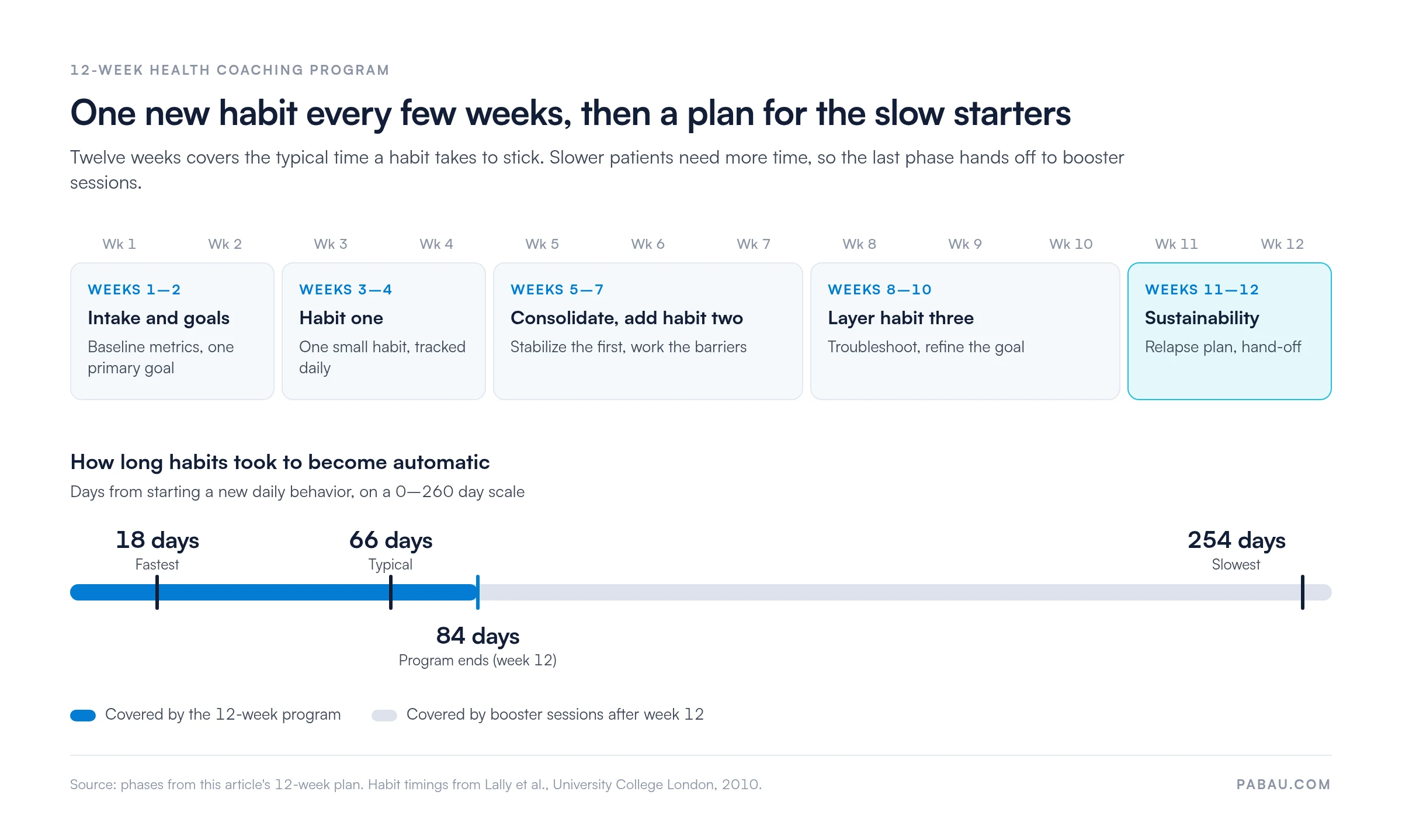
Twelve weeks is the most common length because it covers the time a typical habit needs. In the 2010 study led by Phillippa Lally at University College London, habits took 66 days on average to feel automatic. The range ran from 18 to 254 days.
That range is why the plan below adds a new habit only every two to three weeks. It’s also why week 12 hands off to booster sessions for patients still building their routine.
The timeline below sets those phases against the habit data. It shows where the slowest patients fall once the core weeks end.
If several coaches run the same program, give them the same phase plan. Patients then get a consistent experience, whoever they see.
Settle these points before you enroll your first cohort. Each one takes minutes now and far longer to fix mid-program.
Watch for these four mistakes once the first cohort is running. Each one has a simple fix.
No US law requires health coaches to be certified. Still, the National Board for Health and Wellness Coaching (NBHWC) sets the national standard. To sit its board exam, a coach needs three things:
Passing the exam earns the NBC-HWC credential. Plenty of popular courses train coaches without NBHWC approval, so check the board’s directory before you hire or fund training.
For your own program, borrow the board’s content areas. These cover coaching structure, behavior change theory, communication skills, ethics, and health knowledge. Build staff onboarding around them, even before coaches are board certified.
Most of a coaching program happens between sessions, so the admin has to run without you. A solo coach with 20 to 30 active patients can’t hand-send every reminder and form.
A coaching client management system handles that repeat work in one place:
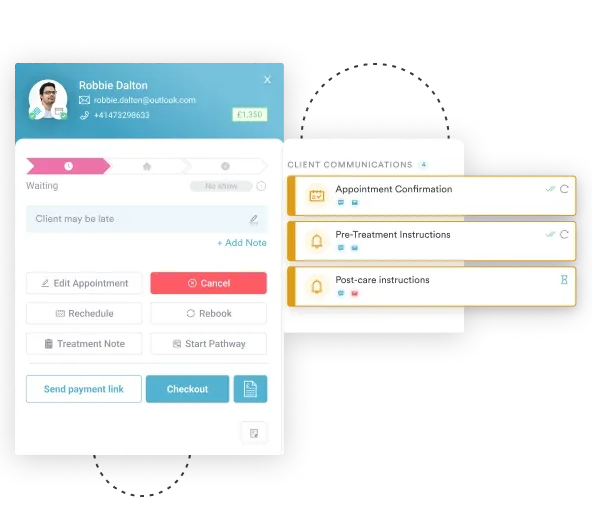
Online delivery works the same way. You run sessions over video, send forms digitally, and keep notes in one record. Practices that offer coaching alongside counseling can run both services from one therapy practice management system.
For more ways to keep patients engaged to the final week, read our guide to structuring coaching programs.
Most practices sell coaching as a fixed package rather than single sessions. Typical market ranges run from $500 to $750 for a six-week intro program. A 12-week core program usually costs $1,200 to $2,000.
Group coaching lowers the price per person, while corporate wellness contracts run on annual terms. Whatever the format, spell out what’s included, such as email support between sessions.
After each cohort, ask patients which goals they hit, what got in the way, and what they’d change. Track attendance and goal completion as well. Those numbers show where the program needs work, and they give you results to share with the next cohort.
Many coaches run a program like this from a PDF, a spreadsheet, and a calendar. Intake answers sit in one place and session notes in another, while reminders go out by hand.
Practice management software like Pabau brings the template into one patient record. You can rebuild the intake assessment as a digital form and send it automatically when a patient books online. Their answers are in the record before the first session starts.
From there, automated reminders prompt patients before each weekly session. Session notes sit alongside their goals and milestones, so you can see where each patient stands across all 12 weeks without chasing paperwork.

Pabau’s digital intake forms, session notes, and automated reminders keep each patient on their weekly plan. Your coaches spend session time on behavior change instead of admin.

The coaching conversation is only half the job. Whether patients finish depends on the structure around each session. That means a readiness check at intake, one habit at a time, and a plan for week 13.
If you’re launching your first program, start small. Run one 12-week cohort with the template, measure behaviors as well as outcomes, and book boosters before the last session.
The trade-off is patience. A slower habit schedule looks less impressive in week three. In return, more patients reach week 12 with routines that last. Book a demo to see how Pabau keeps intake, session notes, and reminders together for your coaching patients.

Want intake questions written for coaching? Coaching intake form gives you a ready-made first-session questionnaire.
Mapping goals for a single patient? Coaching plan template turns one patient’s goals into a session-by-session plan.
Need patients to log habits between sessions? Habit tracker gives patients a daily check-off sheet to bring to each session.
Unsure what to record after each session? Coaching notes template sets out the fields worth capturing every time.
Deciding what goes into a paid package? Coaching package template helps you set out sessions, support, and price in one offer.
They do if your practice is a HIPAA covered entity, which includes most practices that bill insurance electronically. Coaching notes then count as protected health information, known as PHI. Store them in a secure system, limit who can open them, and keep them off personal phones and email.
Coverage is limited. The Medicare Diabetes Prevention Program covers lifestyle coaching for eligible patients with prediabetes, but only through enrolled suppliers. Some employer wellness plans pay for coaching too. Most practices sell programs as self-pay packages and check each payer’s policy before promising coverage.
Sometimes. The IRS allows these funds for care that treats a specific diagnosed condition, not general wellness. A weight-loss program for diagnosed obesity may qualify, often with a letter of medical necessity. Ask patients to confirm with their plan administrator before they enroll.
Yes, and patients often already trust them. Coaching is still a separate skill from advising, so budget for training. Check your state’s rules as well, since some limit who can give individualized nutrition advice.