Head to toe assessment cheat sheet: Printable nursing guide
A head to toe assessment cheat sheet gives you one fixed order at the bedside, s...

3
Last Updated: Oct 23, 2026

During each daily assessment, the ICU Mobility Scale (IMS) records the highest mobility level a critically ill patient reaches. That range therefore runs from 0 (lying in bed) to 10 (walking unaided).
Levels 0 to 3 cover bed-based activity, while levels 4 to 6 cover standing, transferring and marching at the bedside. Levels 7 to 10 all describe walking, though with less help at each step.
Hodgson and colleagues reported a weighted kappa of 0.83 between physical therapists, so trained assessors usually score within one level of each other.
Screen cardiovascular, respiratory, neurological and structural status before moving a patient beyond bedside sitting.
Pabau, our practice management software, stores IMS scores as structured form fields, so every shift reads the same trend.
A one-page assessment form with fields for the patient, the provider and the date. In addition, it prints all 11 published level definitions, plus room for the score and for notes on barriers, equipment and staffing.
Download templateThe ICU Mobility Scale (IMS) is a critical care assessment tool, so physical therapy and nursing teams can record patient mobility in standard terms. Specifically, it runs from 0, lying in bed, to 10, walking independently without a gait aid. It was developed in Australia and has since been validated internationally.
Unlike a strength test, the IMS captures what the patient did that day. So the number reports delivered care as much as patient capability, which is why the run of scores tells you more than any single figure. Knowing how to score it, read it and act on it is now part of routine critical care practice.
The ICU Mobility Scale is a quick bedside tool built for intensive care, because standard mobility tests are impractical or unsafe there. Instead of grading strength, it records the highest level of mobility a patient achieves on a single scale. Overall, the range runs from 0, lying in bed with no active movement, to 10, walking independently without a gait aid.
Australian critical care researchers created the IMS so teams could track whether patients were moving, not only whether they were surviving. The scale reflects functional activity rather than isolated muscle strength.
A patient may have reasonable leg power and still be too deconditioned to sit over the edge of the bed. In that case, the IMS still records what the patient managed. The scale is also used in ICUs across Australia, Europe and North America.
A member of the multidisciplinary team scores the IMS during the daily assessment, usually a physical therapist or nurse. Because it takes a couple of minutes and needs no equipment, it stays usable on a busy unit. Afterward, most rehabilitation teams file the result in their physical therapy EMR alongside the day’s treatment note.
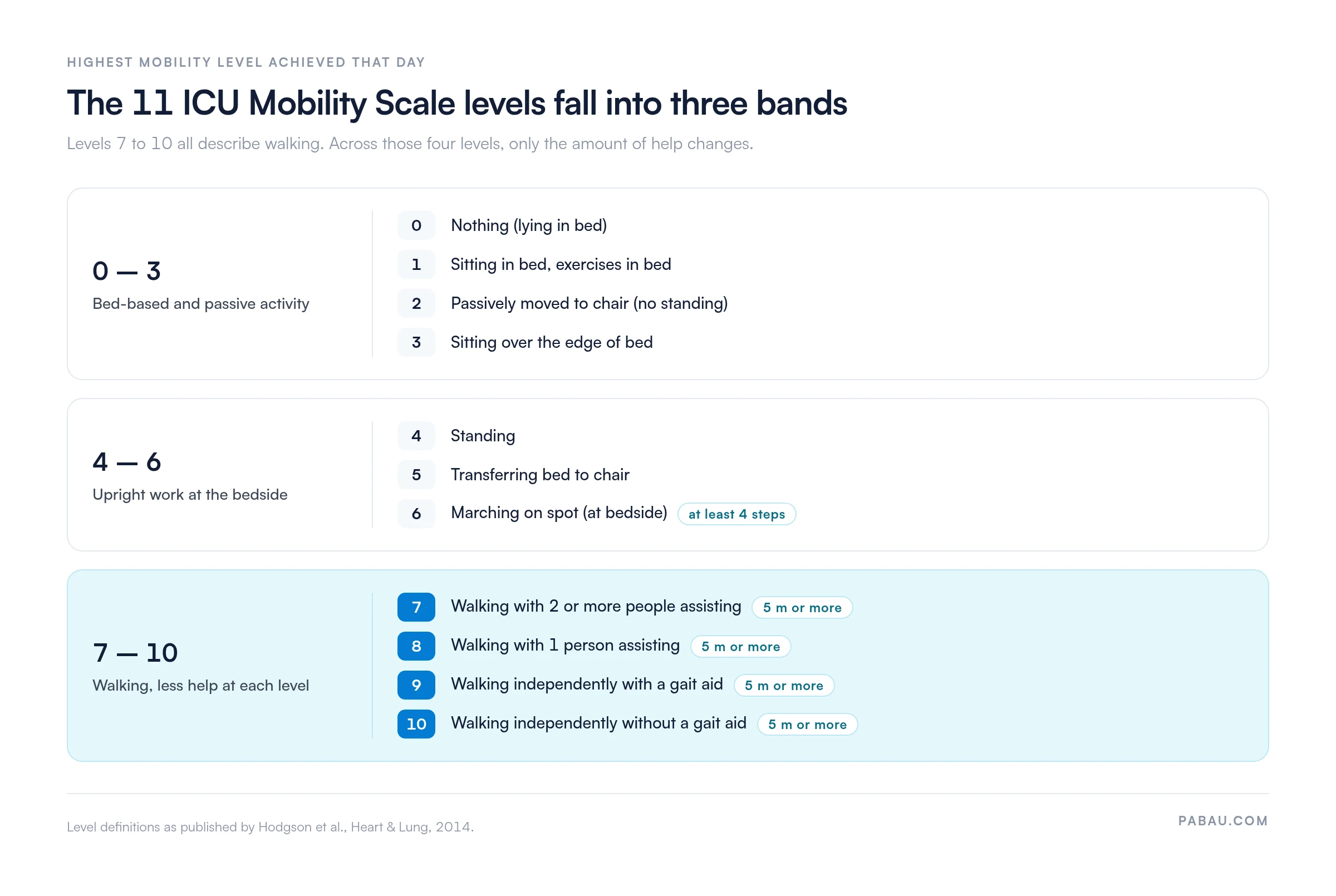
Because the IMS is an 11-point ordinal scale, each level describes one specific functional milestone. Additionally, the definitions below are the published ones from Hodgson et al., and they match the wording printed on the downloadable template.
Notably, two details decide most scoring disputes. Every walking level requires at least 5 meters (5 yards) away from the bed or chair. In contrast, a few steps at the bedside is marching on the spot, which is level 6. Similarly, a wheelchair user who self-propels 5 meters away from the bed without help scores 9.
Overall, the levels fall into three practical bands, as the diagram below sets out. First, levels 0 to 3 cover bed-based and passive activity, from being rolled by staff to actively sitting over the edge of the bed.
Second, levels 4 to 6 cover upright work at the bedside, running from standing, through transferring to the chair, to marching on the spot. Finally, levels 7 to 10 all describe walking, and across those four levels only the amount of help changes.
The template is a single page, so it can be completed at the bedside and filed with the rest of the day’s notes. It carries the published level definitions in full, so an assessor never has to score from memory.
The IMS was written for intensive care, but the form works anywhere a team is moving patients from bed rest back toward walking.
In addition, nursing teams usually pair the score with a written plan of care. For example, an impaired physical mobility care plan turns the day’s level into goals, interventions and a review date.
Of course, a raw score means little on its own. Instead, what you do with it shapes the rehabilitation plan and the handover conversation.
Read the score as a trend rather than a daily verdict. In particular, a plateau lasting three days or more is worth a formal review. Ask whether the clinical picture has changed, whether medication is limiting effort, or whether therapy frequency is simply too low.
The IMS itself is safe, since it records what a patient did and prescribes nothing. Starting a mobility activity is a different matter, so screen before you attempt any activity from level 4 upward. That is where weight-bearing begins.
These criteria align with the AHRQ Early Mobility Facilitator Guide, so they are evidence-based thresholds rather than arbitrary rules. Even so, institutional protocols may be stricter. In any case, always defer to your unit’s policy and to the medical team.
Because confidence in any clinical tool rests on evidence, it helps that the IMS has solid psychometric support.
First, Hodgson and colleagues published the original feasibility and reliability study in Heart & Lung in 2014. In particular, between a junior and a senior physical therapist, the weighted kappa was 0.83, with a 95% confidence interval of 0.76 to 0.90. As a result, two trained assessors scoring the same patient will usually land within one level of each other.
A later multicenter study by Tipping and colleagues tested the scale against outcomes in 192 adults. Indeed, IMS at ICU discharge correlated moderately with muscle strength. Also, higher values were associated with survival to 90 days and with discharge home. The scale also proved responsive, with scores rising in 86% of survivors during the ICU stay.
Furthermore, the IMS has been translated and cross-culturally adapted for other languages, such as Portuguese. Consequently, that supports its use well beyond the units where it was written.
Three validated tools dominate ICU mobility assessment, so the choice depends on what your unit needs from the number.
Use the IMS when your team needs a quick daily screen. Above all, it is fast enough for a ward round and specific enough to track recovery.
Use the Perme when you need comprehensive barrier identification, since it covers 15 domains including cognition and pain. Otherwise, use FSS-ICU for the middle ground. In practice, many teams run the IMS daily and then add a Perme or FSS-ICU weekly for a deeper look.
Outside critical care, however, the choice changes again. For instance, on a general or geriatric ward the Elderly Mobility Scale covers similar ground for older patients working back toward independence.
Scoring is straightforward as soon as the level definitions are in front of you. Documentation, however, is the harder part. Ultimately, the question is how teams stay consistent across shifts and turn the score into a therapy decision.
In general, treat any IMS plateau of three or more consecutive days as a prompt to investigate. A plateau points either to a physiological limit or to a modifiable barrier such as sedation, pain, staffing or equipment. As a first step, a five-minute team huddle usually tells you which one you are looking at. A physiological limit then deserves a formal multidisciplinary review.
Early mobility works, and that is why the score matters. In fact, randomized trials and meta-analyses report less ICU-acquired weakness and shorter ventilation among patients mobilized early. They also report faster functional recovery and shorter ICU and hospital stays. In any case, the IMS is the tool that quantifies it.
The score also carries information about the patient, not only about whether therapy was delivered. For example, studies commonly group IMS results into low mobility (0 to 2), moderate mobility (3 to 5) and high mobility (6 to 10).
In the multicenter cohort by Tipping and colleagues, a higher IMS at ICU discharge was likewise associated with survival to 90 days and discharge home.
Recording the score consistently is what lets your team show that early mobility is happening rather than being planned. Measurement tracking software stores each level as a comparable value, so an audit question has an answer without a chart review.
Early mobility also helps the clinicians delivering it. A structured assessment reduces cognitive load, because the team knows what it is working toward each day. Equally, it aligns physical therapy, nursing and medicine around one number. It also creates accountability, since a visible IMS trend in the chart is hard to ignore during a busy shift.
Even so, the IMS is a measurement tool, not a clearance and not a therapy. Consequently, a high score is never permission to bypass clinical judgment.
A patient who walked at level 9 yesterday may still have reasons not to walk unsupervised today. For instance, an active infection or unstable cardiac output would be enough. Cross-check the score against clinical status, your unit’s assessment protocols and its guidelines before therapy.
The scale also assumes a cooperative patient. Someone in delirium or under deep sedation can therefore score well below their underlying capability. Reassess when mental status changes, because a patient who scored 2 during delirium may reach level 5 once clear-headed. Record sedation and delirium status alongside every IMS score so the number can be read in context later.
Most teams either record the IMS on paper or type it into a free-text note. The number survives the shift, but the trend does not. As a result, anyone asking whether a patient is improving has to read back through a week of entries.
Pabau, our practice management software, stores the assessment as a structured form field instead. Each score is saved against the patient record with the date and the assessor’s name, so the history builds itself as the week goes on.
Because the score is a field rather than a sentence, it can be charted. Thus therapy teams see the run of levels at a glance and notice a plateau on the day it starts. Handover then happens with a figure everyone reads the same way.
Besides that, the same record holds the safety screen, the barriers noted at the bedside and the rehabilitation plan. Keeping the reason next to the score is what makes a weekly multidisciplinary review quick instead of forensic.

Instead of free text, Pabau’s digital forms store every IMS assessment as a structured field. As a result, teams can chart the trend, spot a plateau early and hand over with the same number.

The IMS earns its place because it is short enough to score every day and specific enough to mean something. The trade-off, however, is that one number carries no context on its own. For example, a patient at level 3 who is climbing needs a different conversation from one who has stalled there for a week. In short, only the trend tells them apart.
So score it daily, record the barrier whenever the level does not move, and review the run of scores rather than yesterday’s figure. Use the downloadable template to keep the wording identical across assessors, because consistency is what makes the trend trustworthy.
To that end, book a demo to see how Pabau keeps mobility assessments, safety screens and rehabilitation notes together in one patient record.

Need a broader measure of daily independence? The Barthel Index scores 10 activities of daily living, so it is where recovery goes next once walking returns.
Ready to measure gait speed? The 10 meter walk test then turns walking ability into a number you can track week by week.
Worried about falls once a patient walks? The Berg Balance Scale screens balance across 14 tasks before you reduce supervision.
Need a gait assessment for a step-down ward? The Functional Gait Assessment instead tests walking under the conditions that trip patients up.
Tracking recovery after discharge? The Functional Status Questionnaire later captures physical and social function once the patient is home.
Daily scoring is standard practice, ideally at a consistent point in the day such as morning rounds. If the patient’s status changes acutely, after extubation, a fall or a medical complication, then re-score immediately.
In general, higher scores are associated with better outcomes. For example, studies commonly group results into low mobility (0 to 2), moderate mobility (3 to 5) and high mobility (6 to 10). Notably, Tipping and colleagues published a multicenter cohort in 2016. Specifically, a higher IMS at ICU discharge was associated with survival to 90 days and with discharge home. It is one signal among several, so read it alongside muscle strength and delirium screening.
At least 5 meters (5 yards) away from the bed or chair. In fact, that distance applies to every walking level, 7 through 10. In contrast, a few steps at the bedside is marching on the spot, which is level 6. Similarly, a wheelchair user who self-propels 5 meters without help scores 9.
Generally, plateaus warrant reassessment. Check the modifiable barriers first: over-sedation, uncontrolled pain, staffing shortfalls or missing equipment. Multidisciplinary huddles often find a quick win, such as adjusting sedation or increasing therapy frequency. If no barrier is present and the patient is medically stable, then the plateau may be a genuine physiological limit, and clinical judgment takes over.
The IMS is a single-item 0 to 10 scale, so it captures only the highest functional level achieved. In contrast, the Perme is a 15-item assessment covering mobility, barriers, strength and cognition. As a result, the IMS is faster, at two to three minutes, and better suited to daily screening. The Perme, meanwhile, is more detailed and suits weekly review or research. In practice, many units run the IMS daily and then the Perme weekly.
Yes. Indeed, Hodgson and colleagues reported a weighted kappa of 0.83 between a junior and a senior physical therapist. In addition, the 95% confidence interval ran from 0.76 to 0.90. As a result, two independent assessors will usually score within one level of each other. So long as everyone trains on the same published level definitions, reliability holds up.
Yes. The IMS was designed for critical care, but it works in step-down wards, high-dependency units and general wards. In short, any setting moving patients from bed rest back toward independent walking can use it.