Stroke impact scale: Free PDF, scoring and MCID by domain
The stroke impact scale (SIS) is a 59-item questionnaire in which stroke survivo...

7
Last Updated: Oct 13, 2026

The goal attainment scale scores each patient’s own treatment goals on a five-point scale, from -2 to +2.
A score of 0 means the goal was met exactly as predicted. The T-score converts weighted raw scores onto a standardized scale centered on 50.
Kiresuk and Sherman’s T-score formula includes a correlation correction, so the denominator is not simply the square root of the summed squared weights.
Goal count changes the arithmetic, so a T-score from three goals is not directly comparable with one from a single goal.
Practice management software like Pabau stores the goal wording, the weights, and every dated review score on one patient record.
A ready-to-use scoring table with the -2 to +2 outcome descriptors, a goal weighting section, and a T-score calculation worksheet. Print it or attach it to the patient record at the goal-setting session.
Download templateThe goal attainment scale (GAS) measures whether a patient hit the treatment goals they helped set.
Instead of asking every patient the same questions, you write one goal per patient and score the outcome from -2 to +2. A score of 0 means the goal was met exactly as predicted.
This guide covers how to write a scorable goal, how to score it at review, and how the T-score works. The simplified formula in wide circulation drops a correction term, so this guide uses the full version with a worked example. The free template above gives you the worksheet.
The goal attainment scale is an individualized, criterion-referenced outcome measure. Kiresuk and Sherman developed it in 1968 for community mental health programs, and rehabilitation adopted it later. It answers a single question, which is whether this patient reached the goal you agreed with them.
Standardized measures ask the same questions of every patient, which makes them comparable but blunt. GAS goes the other way. You define the goal, the baseline, and the levels either side of the expected outcome before treatment starts.
At review, you score the outcome against that guide. The scoring is quick because the hard work happened at the start. That is when you decided what success and disappointment would each look like for this person.
Each level has a fixed descriptor and a fixed meaning. Using them consistently is what makes two clinicians score the same outcome the same way.
These five numbers are raw scores, and they do not add up on their own. That is what the T-score is for. A T-score of 50 means the goal set was met as expected overall, above 50 means better, and below 50 means short.
Some rehabilitation teams record the baseline at -1 rather than -2, which leaves -2 free for deterioration. Either convention works. Pick one and use it across the practice, or your scores stop being comparable.
Goal setting is a conversation, not a form-filling exercise. Work through these six steps with the patient before treatment starts.
Clear wording is what makes scoring quick later. “Improve mobility” is hard to score. “Walk 500 meters without stopping” scores itself. Capture that wording at baseline with digital patient intake forms, so the review scores against what you agreed rather than what anyone remembers.
A post-stroke patient wants to reach overhead again to put items on a shelf. At baseline she cannot lift her arm above shoulder height.
The expected outcome (0) is reaching full height with 80% accuracy. At +2 she reaches full height ten times in a row without fatigue. At -2 nothing has changed since baseline.
An adult returning to work after a wrist injury wants a full eight-hour day at a computer. Right now he types for 30 minutes before pain forces a break.
The expected outcome (0) is a full workday with a break every two hours. At +2 he works the day with minimal breaks. At -2 the 30-minute limit has not moved.
A patient with social anxiety wants to attend gatherings without a friend along. She currently avoids social events altogether.
The expected outcome (0) is one event a month, staying an hour. At +2 she attends twice a month and starts conversations herself. At -2 she is still avoiding events.
The T-score turns weighted raw scores into one standardized number centered on 50. Kiresuk and Sherman’s formula is:
T = 50 + 10Σ(wᵢxᵢ) / √(0.7Σwᵢ² + 0.3(Σwᵢ)²)
Here w is the weight you gave each goal and x is that goal’s raw score, from -2 to +2. The 0.7 and 0.3 terms are a correlation correction. Simplified versions drop them and show the denominator as the square root of the summed squared weights alone, which inflates the result.
Take three goals weighted 3, 2 and 1, scored +1, 0 and -1 at review. The weighted sum is 2. The denominator is the square root of 0.7 × 14 plus 0.3 × 36, which comes to 4.54.
So T = 50 + 20 / 4.54, or 54.4. The simplified formula would return 55.3 for the same review. One patient, one point of difference. Across a caseload the two versions tell you different stories about the same treatment.
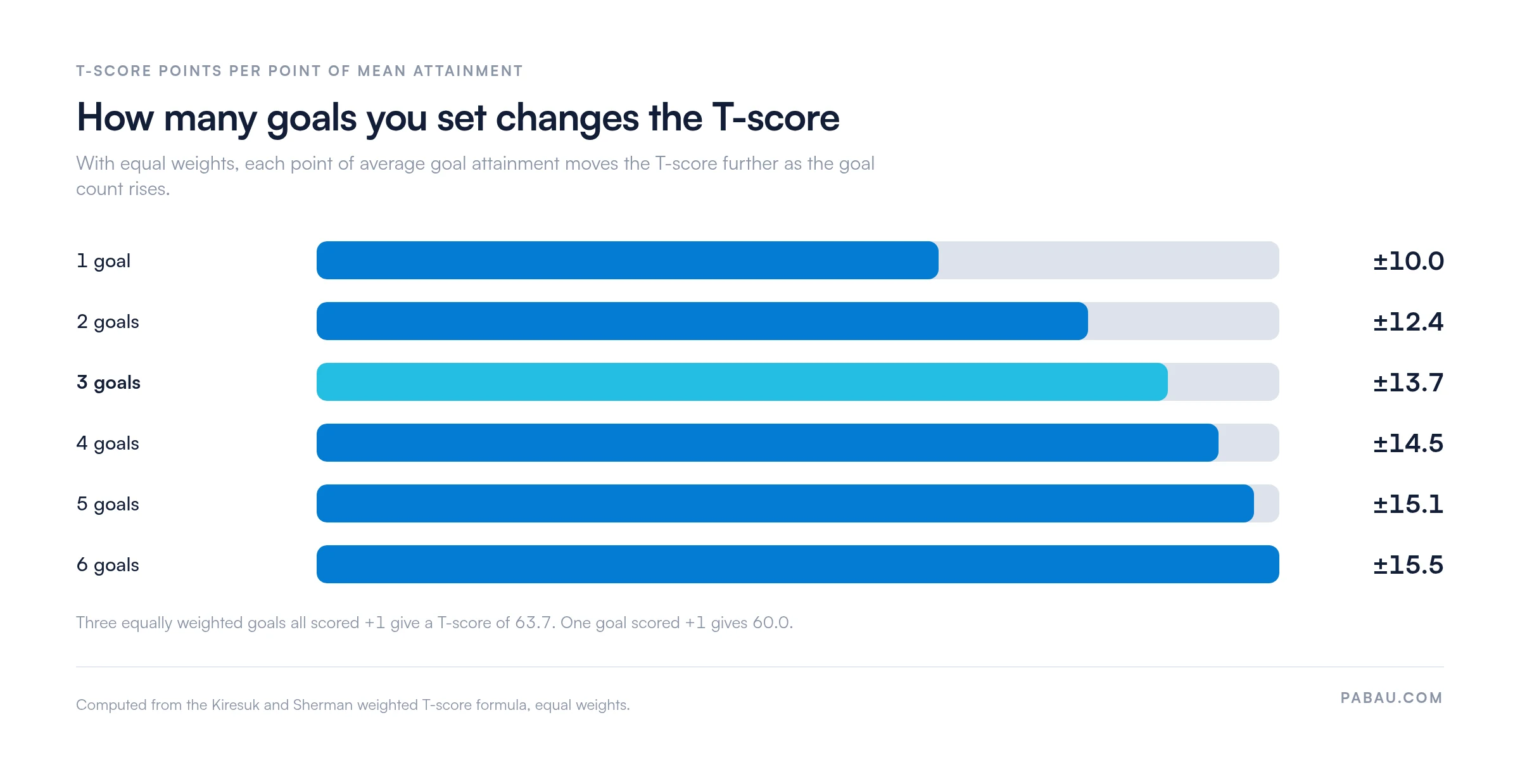
Goal count moves the arithmetic too. Because the correction term scales with the number of goals, one point of average attainment shifts the T-score further when the set is larger.
Most teams use a lookup table or a calculator rather than working this by hand. Whichever you use, check that it carries the correction term before you trust a number in a report.
What GAS does better than a standardized questionnaire:
What it costs you:
Where you want an individualized measure with published scoring already attached, the Canadian Occupational Performance Measure covers similar ground on a fixed 1-to-10 rating.
GAS Light simplifies the goal-setting stage, not the scoring. You write a SMART statement for the expected outcome only, at score 0, instead of drafting all five levels in advance. At review you rate the outcome against the same graded scale.
Published GAS Light forms, including the version from the Cicely Saunders Institute at King’s College London, keep a graded five- or six-point rating. It is sometimes described as a three-level scale, which is a misreading of the method.
The time saving lands at the goal-setting appointment, which is where standard GAS is slowest. That makes it a fit for primary care, brief interventions, and high-volume clinics where drafting five levels per goal is not realistic.
Doing the arithmetic by hand is fine for one patient and tedious for a caseload. A calculator applies the same formula every time, so a dropped correction term or a mis-keyed weight stops changing the answer.
Some occupational therapy software now builds goal scoring into the note itself. The weights and raw scores then sit beside the goal wording, rather than in a spreadsheet on someone’s desktop.
Aggregation helps at the practice level too. Group T-scores across a caseload show whether an intervention is working, which is difficult to see one patient at a time.
GAS turns up wherever treatment is organized around an individual’s goals rather than a diagnosis alone:
Funders and referrers often still want a normative score alongside the individualized one. Pairing GAS with a standardized measure such as the Barthel index covers both, without rewriting the goals.
When the goal is about talking less, a compulsive communication questionnaire gives you that standardized number. The GAS levels stay written for this patient, while the questionnaire asks every patient the same items.
Budget 10 to 20 minutes for the goal-setting conversation and 5 to 10 minutes per review to score. Those numbers hold once clinicians have written a few guides. The first two or three take longer than that.
Workflow matters more than training. When the goal wording, the weights, and the review scores live in the same physical therapy EMR, scoring becomes part of the review. Kept on a separate sheet, it becomes a task someone forgets.
Consistency is the rest of it. Agree one baseline convention, one weighting approach, and one calculator across the team. Then audit a sample of goals each quarter to check the wording is still specific enough to score.
Most practices set GAS goals on paper or in a document, then score them inside the progress note. The goal wording lives in one place and the score in another, so nobody can pull a caseload report without opening every record.
Practice management software like Pabau handles it differently. You build the GAS worksheet once as a custom form and attach it to the patient record at the goal-setting appointment. At each review you reopen the same form.
Two changes follow. Reviews get prompted rather than remembered, because the form is tied to the appointment. Reporting then reads across records, so you can see how a whole caseload scored over a quarter.
Custom forms and reporting come with every Pabau subscription, so goal scoring is not a feature you pay extra to switch on.

Pabau’s custom forms let you set weighted goals with a patient and score each review on the same record. Reporting then rolls those T-scores up across a caseload.

GAS earns the extra minutes when the outcome a patient cares about is not something a standard questionnaire asks about. A vaguely worded goal produces a score nobody trusts, so the wording is where the effort belongs.
Start with one clinician and two or three patients. Write the expected outcome carefully, score it at review, and check that your calculator carries the correction term. Then decide whether to roll it out.
Download the template above to run your first cycle on paper. Book a demo to see how Pabau keeps the goal wording, the weights, and each review score on one patient record.

Need a client-centered measure with published scoring? The Canadian Occupational Performance Measure rates performance and satisfaction on a fixed scale, so it complements an individualized GAS goal.
Reporting on upper limb function? The QuickDASH outcome measure gives you a normative arm, shoulder and hand score to sit alongside your goal scores.
Tracking independence after a stroke? The Barthel index scores ten activities of daily living, which is the comparison most funders and referrers ask for.
Building the baseline before you set goals? An ADL assessment tool gives you the functional detail that makes a GAS expected outcome specific enough to score.
Choosing a system to hold the scores? Our roundup of the best occupational therapy practice management software compares how each one handles custom forms and outcome reporting.
A goal attainment scale is an individualized outcome measure. You define a treatment goal with the patient, describe five outcome levels, then score the result from -2 to +2. Kiresuk and Sherman published the method in 1968.
Compare the outcome with the expected level you wrote at baseline. Score 0 if it matches, +1 or +2 if the patient did better, and -1 or -2 if they did not. Weights then combine several goals into one T-score.
GAS Light simplifies goal setting rather than scoring. You write a SMART statement for the expected outcome only, instead of drafting all five levels in advance. Published GAS Light forms keep a graded five- or six-point rating at review.
The formula is T = 50 + 10Σ(wᵢxᵢ) / √(0.7Σwᵢ² + 0.3(Σwᵢ)²). Here w is each goal’s weight and x is its raw score, from -2 to +2. The 0.7 and 0.3 terms are a correlation correction that simplified versions drop.
Physical therapy, occupational therapy, speech-language pathology, mental health, pediatrics, palliative care and coaching all use it. Any discipline that sets individual goals with a patient can score them this way.
Yes. Mental health teams use GAS for anxiety, mood, behavior change and social engagement goals. The measure adapts to each presentation, which is why it started in community mental health.