Stroke impact scale: Free PDF, scoring and MCID by domain
The stroke impact scale (SIS) is a 59-item questionnaire in which stroke survivo...

7
Last Updated: Oct 13, 2026

An elderly home safety checklist is a room-by-room tool for finding and fixing the hazards that cause falls in older adults’ homes.
Falls are the leading cause of injury-related death among US adults aged 65 and older, and most fall hazards sit inside the home.
The highest-value fixes are also the cheapest ones, including grab bars, brighter lighting, secure handrails, and removing loose rugs.
Occupational therapists can bill for a formal home safety evaluation, and that documentation often justifies insurance coverage for the modifications.
Home health and therapy practices use practice management software like Pabau to run these assessments digitally and track completed fixes.
A printable room-by-room assessment covering bathroom, kitchen, bedroom and stairway hazards, medication storage, fire safety, outdoor access, and emergency contacts. Use it during a home visit or a family safety conversation.
Download templateAn elderly home safety checklist is a structured tool for finding hazards in an older adult’s home before they cause a fall. Caregivers, family members, occupational therapists, and home health teams all use one. A room-by-room walkthrough turns a vague worry about safety into a short, ordered list of fixes.
This version also prices the work. Each section below flags what a fix typically costs. That lets you start with the cheap changes that prevent the most falls, then plan the structural work later.
An elderly home safety checklist is an evaluation tool that walks through a senior’s home room by room and records every hazard found. Family caregivers, occupational therapists, home health aides, geriatric care managers, and clinical social workers all use one.
The checklist covers eight areas of the home. They are bathrooms, kitchens, bedrooms, stairways and hallways, medication storage, fire and carbon monoxide safety, outdoor access, and emergency preparedness.
Occupational therapists use the same structure for formal assessments that inform a treatment plan and justify insurance reimbursement for home modifications. Practices running these visits at volume keep the forms and findings in occupational therapy software rather than on paper.
Every 11 seconds, an older adult in the US is treated in a hospital emergency room after a fall. Falls cost the US healthcare system about $80 billion in 2020, and the total is projected to pass $101 billion by 2030. The cost to the person is worse. One fall often starts a chain of hospitalization, lost independence, cognitive decline, and early death.
The CDC’s STEADI initiative asks clinicians to screen every patient aged 65 and older for fall risk each year. A documented fall risk assessment gives the home visit a starting score, and this checklist explains what is driving it.
Home modification handles the environment. The other half of fall prevention is the person, since leg weakness and poor balance drive most falls. Pair the checklist with strength exercises and a regular balance routine.
Writing the findings down matters as much as spotting them. A dated checklist gives the family a baseline and shows which fixes were made. At the next visit, it tells you whether the risk actually dropped.
The core of the walkthrough is a room-by-room pass. Below are the hazard categories to check in each area, in the order most assessors work through a house.
Medication errors are among the most common preventable harms for older adults. Missed doses, doubled doses, and taking the wrong pill all trace back to how medication is stored and labeled at home. Check these items on every visit.
Older adults are at higher risk in a house fire because reaction times are slower, senses are duller, and mobility is limited. Escape time is the constraint, so working detectors and a clear exit route are the two items to get right.
Outdoor falls account for a large share of senior injuries, and the front path is where many of them happen. Assess the route from the street to the front door in daylight, then again after dark.
Hazard removal covers the predictable risks. Emergency preparedness covers the sudden ones, from a fall with nobody else at home to a power cut. Confirm these items before you close the visit.
Once the hazards are listed, the next decision is the order to fix them in. Cost and impact do not line up the way people expect, so the cheapest items are often the ones that prevent the most falls.
The ranges below put the six do-it-yourself fixes on one scale, so the trade-off is visible at a glance.
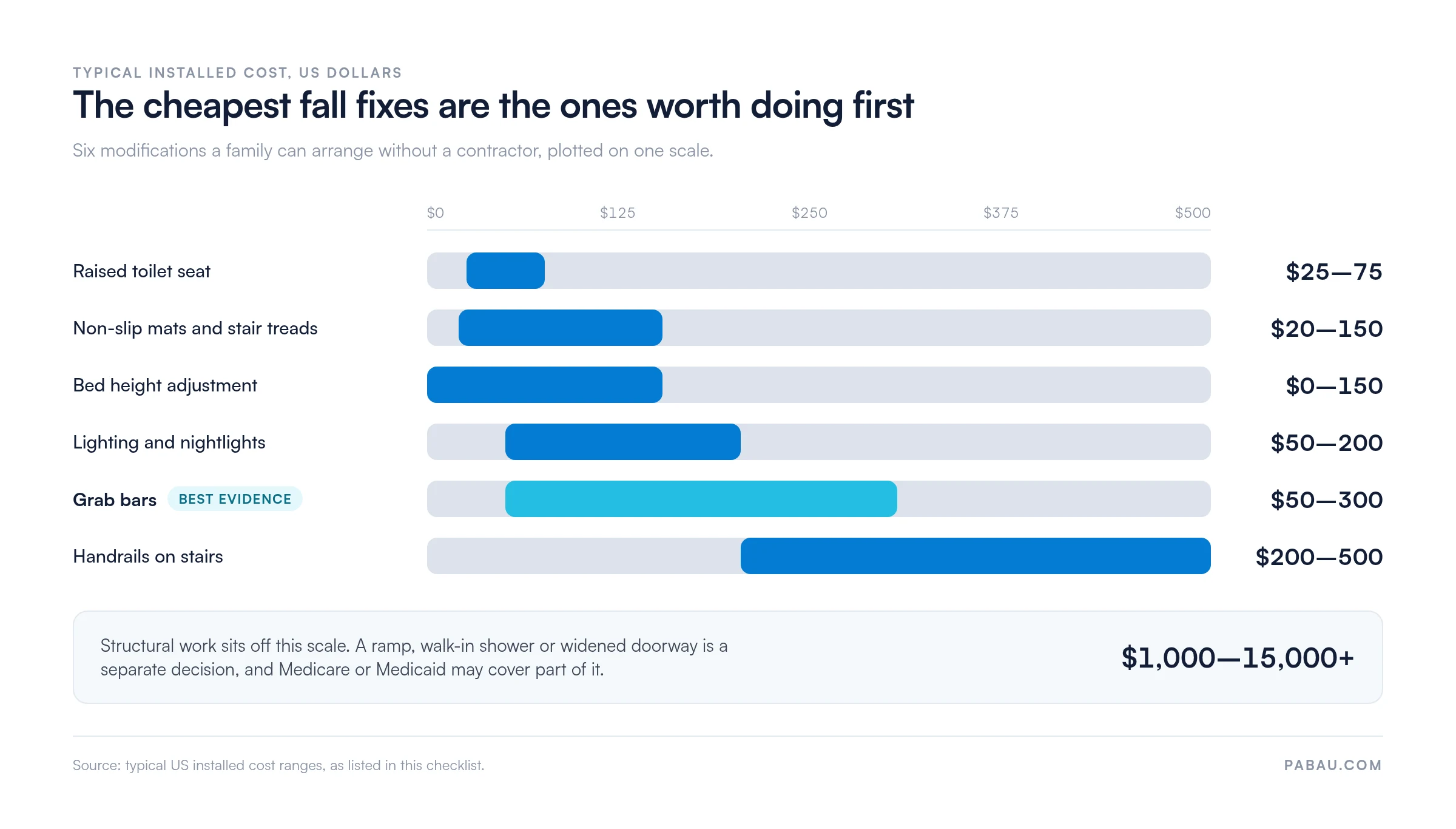
Professional work is the outlier. A ramp, a walk-in shower, or a widened doorway runs from $1,000 to well over $15,000. Medicare or Medicaid may cover part of that when a clinician documents medical necessity.
The National Institute on Aging publishes free aging in place guidance that covers the same ground for families planning ahead.
A family member can run this checklist without any training. A formal occupational therapy evaluation is worth arranging when one of the following applies:
An OT evaluation also scores the person, not only the house. A short 4-stage balance test takes about a minute and shows whether static balance is part of the problem.
Occupational therapists can bill for a home safety evaluation as a skilled assessment under the relevant CPT codes. Practices doing this regularly document it in an EMR built for therapists. The assessment, the plan, and the follow-up then sit in one client record, which is what strengthens an insurance claim later.
Most home health and occupational therapy teams still carry this checklist on paper. The form gets filled in during the visit, then typed up back at the office. It ends up filed somewhere the next clinician will not think to look.
Practice management software like Pabau replaces that with a digital form your team completes on a tablet in the client’s home. Photos of each hazard attach to the client record, and the completed assessment is stored the moment you save it.
Follow-up is where the difference shows. Pabau can schedule the three-month review automatically, so you find out whether the grab bars were ever installed. Reporting across a caseload shows which recommendations were completed and which clients still need chasing.
Every Pabau subscription includes every feature, so a two-therapist practice runs the same assessment workflow as a multi-site group.

Pabau digitizes your home safety checklist, attaches hazard photos to the client record, and schedules the follow-up review automatically. Your team sees which modifications were completed without chasing paper.

The value of this checklist is the order it imposes. Walk the house once, write down what you find, and a vague fear of falling becomes six items with prices next to them.
Start with grab bars and lighting. They cost the least and can go in this week. They also cover the bathroom and the night-time route to it, which is where falls cluster. Leave the ramp and the walk-in shower for a planned conversation with an occupational therapist.
Repeat the walkthrough every twelve months, or straight after any fall or hospital stay. A home that was safe last year may not be safe after a change in vision, medication, or mobility. Book a demo to see how Pabau keeps every home safety assessment, photo, and follow-up in one client record.

Need to score fall risk before the visit? Fall risk assessment template gives you a documented starting point to measure later changes against.
Measuring the person rather than the house? Elderly mobility scale scores everyday movements such as standing, transferring, and walking.
Is fear of falling holding them back? Falls efficacy scale measures how confident someone feels doing daily tasks without falling.
Ready to prescribe the exercises? Home exercise program template sets out the strength and balance work to do between visits.
Running assessments across a caseload? Best occupational therapy practice management software compares the platforms therapists use to document and schedule visits.
A complete checklist covers eight areas of the home. Those are bathrooms, kitchens, bedrooms, stairways and hallways, medication storage, fire and carbon monoxide safety, outdoor access, and emergency preparedness. In each area you are checking for trip hazards, missing supports, poor lighting, and blocked exits.
Run a baseline assessment at least once, ideally when the older adult moves into a new home. Repeat it after any fall or health change. Otherwise, reassess every 12 months, or sooner after a decline in mobility, vision, or cognition. Someone living alone or managing several chronic conditions may need more frequent reviews.
Grab bars in the bathroom, brighter lighting, secure stair handrails, and the removal of loose rugs have the strongest evidence behind them. Non-slip flooring in wet areas is close behind. These are also the cheapest and quickest fixes, which makes them the place to start.
Yes. Occupational therapists conduct formal home safety evaluations as part of skilled therapy services. Medicare may cover an OT-led assessment if the person is homebound and has an active therapy order from a physician. Coverage depends on the plan and the diagnosis. Verify it with Medicare or the insurer before you schedule.
Yes. The checklist at the top of this page is free to download, print, and use during home visits. No account or purchase is required, so you can share the PDF with clients, family members, or your care team.