Patient reported outcome measures
Patient reported outcome measures (PROMs) are validated questionnaires that reco...

Last Updated: Oct 13, 2026
The box and block test is a timed measure of unilateral gross manual dexterity.
The patient moves 2.5 cm wooden cubes over a central partition, one hand at a time. The score is the number of blocks that clear the partition in 60 seconds.
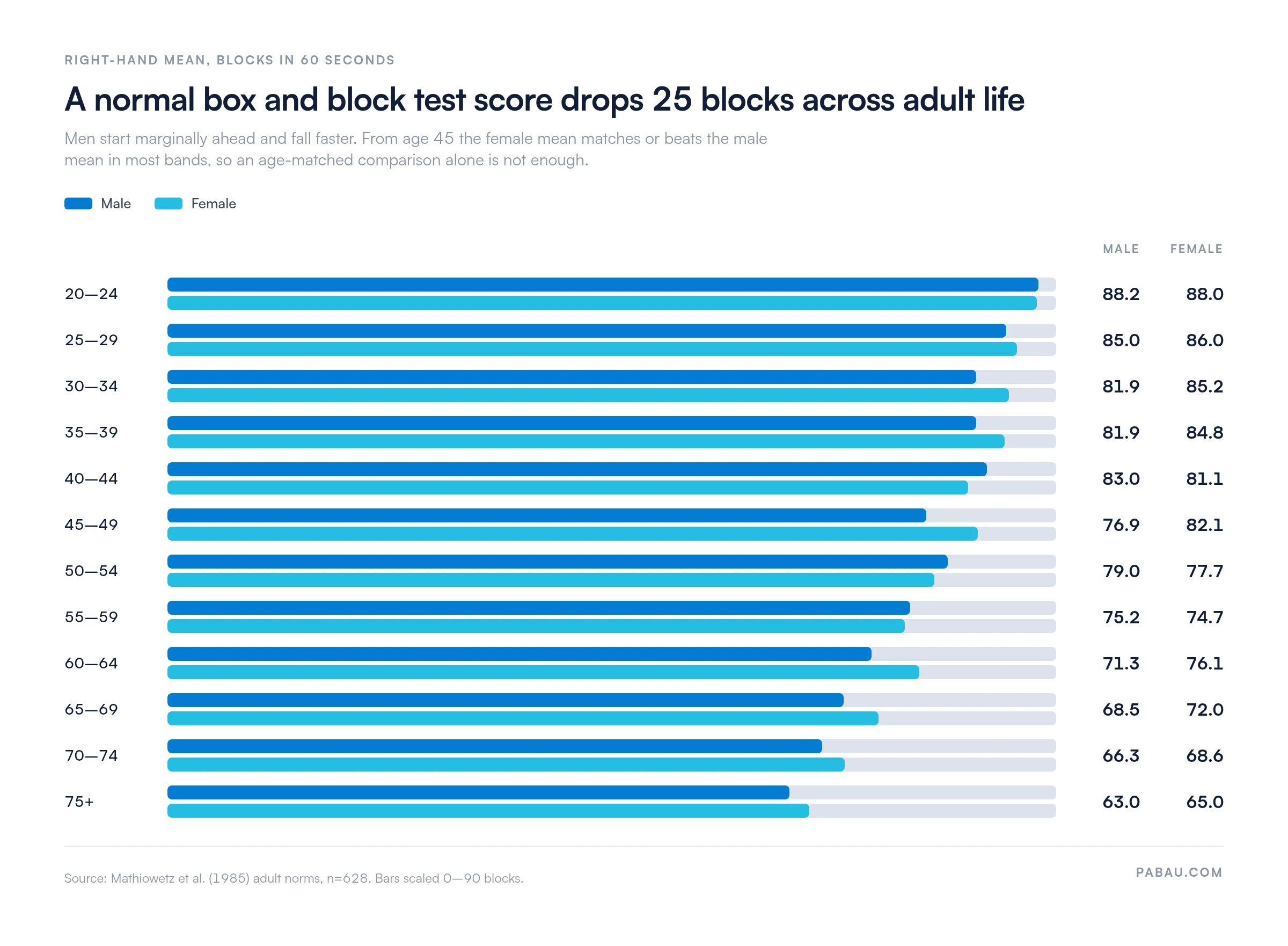
Mathiowetz and colleagues published the adult norms in 1985, and those norms remain the reference standard. A healthy adult aged 20 to 24 averages about 88 blocks with the right hand. By age 75 the mean falls to roughly 63 for men and 65 for women.
The test takes about five minutes per patient and needs inexpensive, portable equipment. This guide covers administration, scoring, normative values, and how the test compares with other dexterity assessments.

The box and block test counts how many 2.5 cm cubes a patient moves over a partition in 60 seconds, one hand at a time.
Equipment is a partitioned box measuring 53.7 cm by 25.4 cm by 8.5 cm, 150 wooden cubes, a timer, and a table.
Mathiowetz et al. (1985) adult norms run from about 88 blocks at ages 20 to 24 down to 63 at 75 and over.
Female means match or exceed male means in most age bands from 45 onward, so sex-matched comparison matters as much as age matching.
Pabau’s measurements tracking software lets occupational and physical therapy teams log every score against the patient record.
The box and block test is a timed assessment of one hand’s ability to grasp, carry, and release objects at speed. The patient moves 2.5 cm wooden cubes from one compartment of a partitioned box to the other. Each hand gets its own 60-second trial and its own raw score.
Mathiowetz and colleagues published it in the Archives of Physical Medicine and Rehabilitation in 1985. According to the SRALab RehabMeasures Database, it has since been validated across neurological, musculoskeletal, and developmental populations. Its appeal is practical: it is quick, portable, cheap to equip, and sensitive to functional change in patients with limited grip or coordination.
Fine dexterity tests ask the patient to pinch, thread, or place small pegs. The BBT asks for whole-hand control instead. That distinction decides which test you reach for. A stroke patient with proximal arm weakness needs a gross measure, because a fine-pinch measure will simply floor out.
The BBT measures unilateral gross manual dexterity: the ability to grasp, transport, and release objects with a single hand at speed. It does not assess fine pinch, bilateral coordination, or upper arm strength separately. That narrow construct is the point. It isolates one measurable component of hand function without confounding motor variables.
Validated clinical populations include:
The equipment list is short, standardized, and sold by most rehabilitation suppliers:
Before the session, place all 150 blocks in one compartment. Set the box flush with the table edge on the side of the hand being tested. Capturing the dominant hand, relevant history, and any seating adaptations on the intake form saves setup time once the patient is in the room.

Standardized administration is what makes scores comparable between sessions and between clinicians. Follow these steps in sequence for every patient.
Read these instructions verbatim, or as close to verbatim as the patient’s communication needs allow. Consistent scripting is one of the main sources of inter-rater reliability:
“I want you to pick up one block at a time with your [right/left] hand. Carry it over the partition and drop it into the other side of the box. Work as quickly as you can. If you knock any blocks off the table, do not pick them up. Ready? Go.”
Reinforce two points before the timed trial. Only one block travels per trip, because carrying two at once invalidates the second. And blocks must fully clear the partition. A block that falls back into the starting compartment, or rests against the partition without clearing it, does not count.
The score is the number of blocks that clear the partition and land in the opposite compartment in exactly 60 seconds. Each hand is scored separately.
Rules that affect the count:
The result is two integers, one per hand. A typical clinical notation reads: BBT: Right (dominant) = 72, Left (non-dominant) = 65.
The reference standard for healthy adults is the Mathiowetz et al. (1985) dataset of 628 participants, split into five-year age bands. Scores decline steadily with age. Compare a patient’s raw score against the matching age and sex band below. Figures are as tabulated by SCIRE Professional from Mathiowetz et al. (1985).
The table also carries a pattern that a single aggregate mean hides. Male and female means sit level in the twenties, then diverge. From 45 onward the female mean matches or beats the male mean in five of the seven remaining bands. Scoring a woman of 62 against a male norm therefore understates her by around five blocks.
Pediatric norms for ages 6 to 19 sit in a separate 1985 dataset by the same authors. Never apply adult norms to a child. A six-year-old boy averages 54.4 blocks with the right hand, which would read as severe impairment against any adult band.
A raw score becomes clinically meaningful in two ways. Compare it against age- and sex-matched norms, then against the patient’s own previous score using the minimal detectable change (MDC). A score below the normative mean does not by itself indicate impairment. Patient history and the side-to-side difference both feed the judgment.
The MDC is the smallest change in score that exceeds measurement error. A smaller shift could be test variability rather than progress. MDC values differ by population:
Clinical note: the stroke MDC above is reported by the StrokEngine BBT assessment page and the SRALab entry. Verify the precise value against the primary study for your patient population before it drives a discharge or funding decision.
A workable three-step framework:
The BBT has strong psychometric properties across its validated populations. Knowing them helps clinicians defend the measure in outcome reporting and justify how often they repeat it.
A high ICC means the score reflects the patient’s ability rather than rater inconsistency. The BBT delivers that when the scripted procedure is followed. Specific ICC values vary by study and population. Cite the primary source that matches your patient group whenever a figure goes into a clinical report.
Use the BBT whenever gross unilateral manual dexterity is the target construct. It is the wrong tool for fine pinch, bilateral arm function, or endurance. Reach for it when you need a fast, repeatable, normed measure of one hand’s ability to move objects.
The BBT works with children from around age six, provided you score against pediatric norms. The Mathiowetz pediatric dataset covers ages 6 to 19 in two-year bands, and the means climb sharply as gross dexterity develops. Right-hand means rise from 54.4 blocks at ages 6 to 7 to 79.9 at ages 18 to 19 for boys.
Administration changes are minor. Simplify the verbal instructions, and allow a longer practice trial if a younger child has not understood the task.
Always document which normative dataset you used. Adult norms applied to a pediatric patient, or a stroke MDC applied to an MS patient, produce clinically misleading interpretations. Record the source reference alongside the raw score in every clinical entry.
The BBT occupies a specific position in the hand assessment toolkit. Knowing where it sits helps you choose one measure or combine two for a fuller picture. The wider family of dexterity tests splits along the same gross-versus-fine line.
A practical rule: reach for the BBT when you need a quick gross dexterity baseline or progress check. Pair it with the Nine Hole Peg Test when both gross and fine dexterity matter. Use the Jebsen when you need a comprehensive functional picture and the session has room for it.
Recording the raw score is only part of the job. A complete clinical entry also names:
That contextual detail is what gets lost when teams keep scores on paper or in a separate spreadsheet. Six months later the number survives and the reasoning behind it does not, so the re-assessment has no baseline to read against. Structured, timestamped records also stand up better if a discharge decision is ever questioned.
Most rehabilitation teams record a BBT score in a session note, then hand-search old notes when the next review comes round. Practice management software like Pabau removes that search. Pabau’s measurements tracking software stores each score as a tracked value on the patient record rather than as free text buried in a note.
Record a score today, and it plots against the baseline you captured six weeks ago. The diagnosis, treatment history, and every other outcome measure sit on the same record. You can see at a glance whether a six-block gain fits the rest of the picture. Teams running a physical therapy EMR alongside occupational therapy caseloads keep both in one timeline.
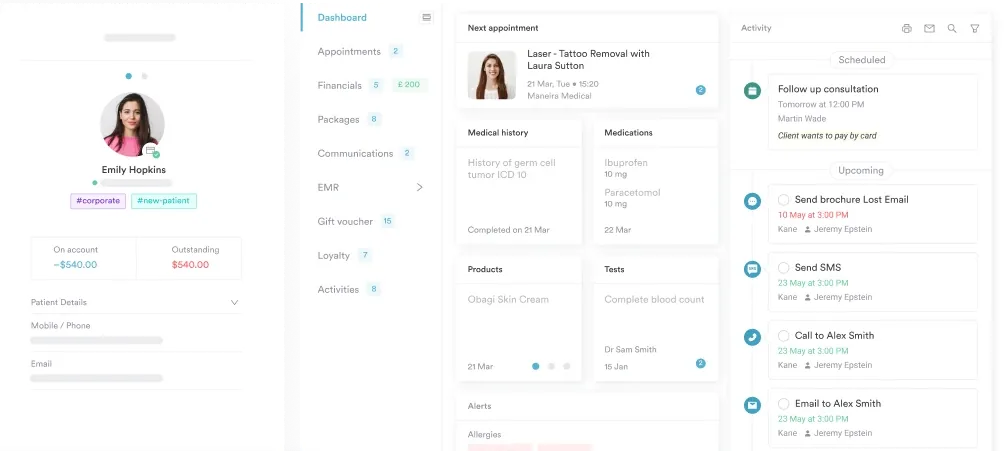
Automated recalls handle the interval between reviews. Set the re-assessment window once, and Pabau contacts the patient when it comes due. A busy stroke caseload stops drifting past its review dates.

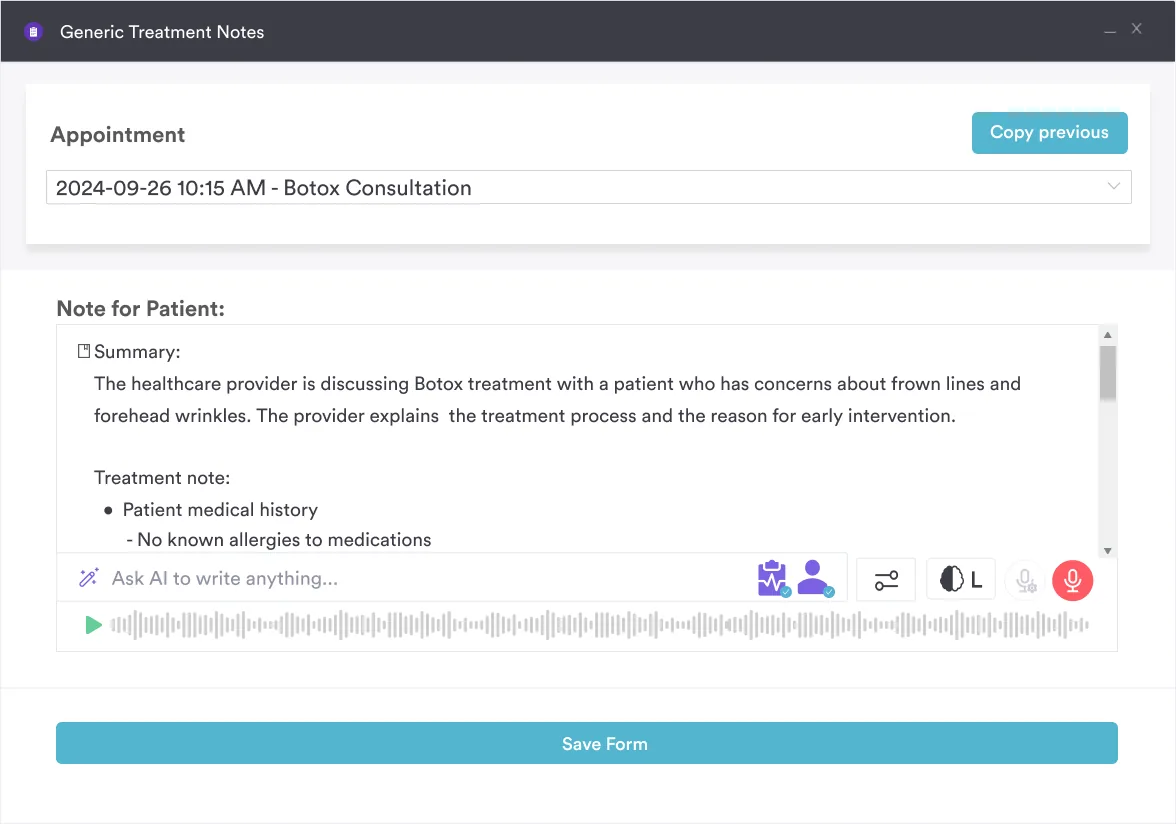
The narrative around the score still has to be written. Pabau Scribe, our AI scribe, drafts that note from the conversation in the room. The clinician’s reasoning gets recorded without twenty minutes of typing after the session.
If you are still comparing platforms, our roundup of the best occupational therapy software covers how the main options handle outcome measures and progress reporting.

Pabau lets occupational and physical therapy teams log box and block test results at each session. Compare each score against baseline and generate progress reports without paper records.

The box and block test earns its place because it is cheap, fast, and unambiguous to score. The discipline it demands is in the interpretation, not the administration. Score against the right age band, the right sex, and the right MDC, or the number tells you less than it appears to.
Get that right and a five-minute test gives you defensible evidence of change across a whole course of treatment. Get it wrong and you have a tidy integer with no meaning attached. The difference is mostly documentation.
Book a demo to see how rehabilitation teams keep BBT scores, normative references, and clinician interpretations in one searchable patient record.

Managing occupational therapy documentation compliantly? Occupational therapy software by Pabau covers digital records, outcome tracking, and appointment management in one platform.
Looking for a broader upper limb rehabilitation workflow? Physical therapy EMR from Pabau supports multi-discipline teams with shared patient records and automated recall workflows.
Want to reduce post-session admin for your clinicians? Pabau Scribe, our AI scribe captures clinical notes from voice during the session, so clinicians spend less time writing and more time with patients.
Need a deeper upper limb measure than the BBT? The Action Research Arm Test template adds grasp, grip, pinch, and gross movement subtests to your assessment set.
Choosing between dexterity measures? Our guide to dexterity tests compares the gross and fine options side by side, with the populations each one suits.
The box and block test measures unilateral gross manual dexterity: the ability to grasp, transport, and release objects with a single hand at speed. Each hand gets its own 60-second trial. It does not assess fine pinch strength, bilateral coordination, or proximal arm function.
Seat the patient at a table with the box on the side of the hand being tested, then give a 15-second practice trial. Start the 60-second timed trial for the dominant hand and count the blocks that fully clear the partition. Repeat for the non-dominant hand and record each score separately.
Normal scores vary by age and sex. A healthy adult aged 20 to 24 averages about 88 blocks with the right hand. At 75 and over the mean is roughly 63 for men and 65 for women. Use the Mathiowetz et al. (1985) adult tables, and pediatric-specific norms for patients aged 6 to 19.
Yes. The test has strong validity and reliability in stroke populations, with test-retest ICC values typically above 0.90. It is sensitive to functional change in upper limb rehabilitation, which makes it suitable for baseline assessment and for outcomes monitoring during recovery.
The box and block test measures gross manual dexterity using large wooden cubes. The nine hole peg test measures fine manual dexterity using small pegs placed in narrow holes. Both take around five minutes, but they target different motor constructs. Pair them when fine dexterity is also a concern.
The targeted box and blocks test is a modified variant of the standard BBT, developed to evaluate prosthetic hand function in upper limb amputees. It differs in block size, compartment configuration, and target placement. Do not conflate its scores with standard BBT scores when reporting or comparing results.