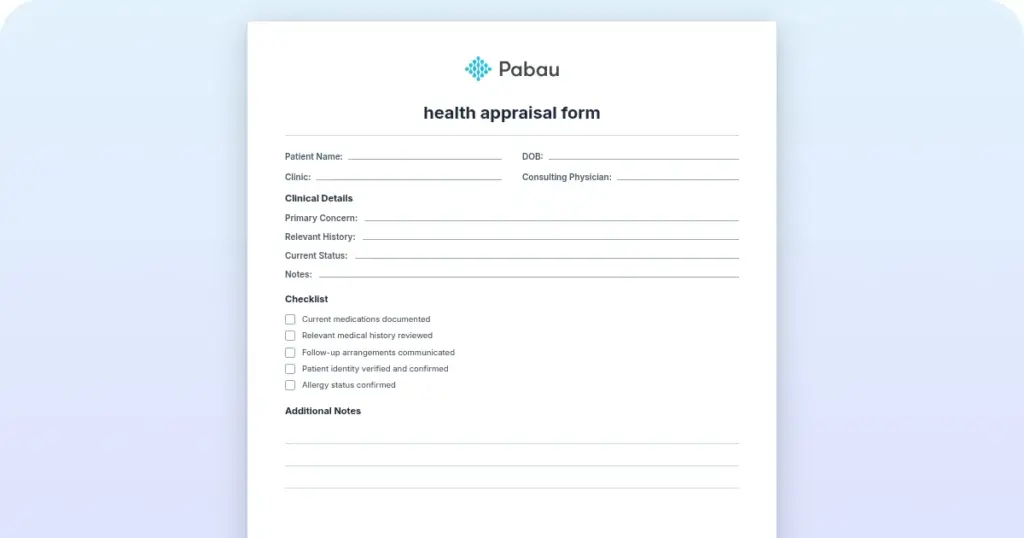
Health appraisal form
A health appraisal form is a record a licensed provider signs to document someon...

2
Last Updated: Oct 13, 2026

Software covered: 1. TheraPlatform, 2. Fusion by Ensora Health, 3. SimplePractice, 4. Jane App, 5. Pabau, 6. Carepatron, 7. AdvancedMD
The 7 best occupational therapy practice management software options span solo-practitioner tools, telehealth-first platforms, and multi-location practice systems – no single tool fits every OT practice model
Insurance billing depth varies widely: TheraPlatform and Fusion handle batch claims natively; Pabau and Jane App are stronger for private-pay and mixed-revenue OT practices
Pabau stands out for multi-location OT practice operations, combining scheduling, customizable clinical documentation, automated reminders, and integrated payments in one platform
According to the American Occupational Therapy Association (AOTA), accurate, timely documentation is a core professional responsibility for every OT practitioner. The software your practice uses shapes how well that responsibility can be met.
This guide compares the 7 best occupational therapy practice management software options, from lightweight occupational therapy documentation software to full multi-location systems, evaluated across scheduling, clinical documentation, billing, telehealth, and operations so you can match the right tool to how your practice actually runs.
Whether you run a solo outpatient practice, a pediatric OT practice, or a multi-practitioner rehabilitation center, the platforms below represent the strongest contenders across the full spectrum of OT practice models. Pediatric OT caseloads lean on standardized testing, so Beery VMI scoring interpretation is a useful companion read.
Use this matrix to orient yourself before the deep dives. Products are ranked by how well they fit occupational therapy practice — clinical documentation, therapy billing, telehealth, and how purpose-built each tool is for OT. The Capterra, G2, and Trustpilot columns show each vendor’s overall user rating across all industries, included as general context, not as the basis for the OT ranking.
The Capterra, G2, and Trustpilot figures are each vendor’s overall user rating across its entire customer base at the time of writing — they are not OT-specific, so they inform but do not determine the OT-fit ranking above. “N/A” means too few public reviews were available on that platform to report a reliable score.
TheraPlatform was built from the ground up as a telehealth platform for therapy professionals before expanding into broader practice management. That origin gives it a distinct advantage for OT practices where remote session delivery is central to the model. Whether serving home-based pediatric OT clients, school-based practitioners, or rural patients with limited access to in-person therapy, TheraPlatform’s telehealth infrastructure is purpose-built rather than bolted on.
Beyond telehealth, TheraPlatform covers scheduling, documentation with OT-specific templates, and a notably capable insurance billing module that includes both manual and automated claims processing. According to TheraPlatform’s product description, practices can batch process multiple claims simultaneously, which reduces the time OT billing staff spend on claims submission.
Pediatric telehealth caseloads sometimes include referrals for a possible PDA profile. The PDA test outlines the screening signs and next steps OTs use at intake.
All plans include a 30-day free trial (no credit card required). Prices in USD.
Overall user ratings (all industries): Capterra 4.3/5 · G2 3.9/5 · Trustpilot 3.9/5
In OT and therapy-focused Reddit discussions, TheraPlatform is valued most for its purpose-built telehealth and interactive in-session tools, particularly for pediatric and remote caseloads. The recurring criticisms are a dated-feeling interface and limited business reporting compared with newer platforms.
Fusion by Ensora Health is designed specifically for outpatient therapy practices across occupational therapy, physical therapy, and speech-language pathology. That specialization means its documentation templates, billing workflows, and scheduling tools are built with therapy-specific clinical requirements as the baseline rather than an add-on consideration. For a practice running OT alongside PT and SLP services, Fusion handles the multi-discipline caseload in a way that generic practice management platforms cannot match out of the box.
Fusion is built specifically as an all-in-one EHR for occupational, physical, and speech therapists, and that therapy-specialist pedigree makes it a natural consideration for OT practices that value clinical documentation depth over operational breadth.
Fall-risk and balance retraining often show up in shared OT-PT caseloads. Postural stability exercises are a common outcome-tracking target worth documenting consistently across both disciplines.
Prices in USD, billed per user. Telehealth and AI add-ons are extra.
Overall user ratings (all industries): Capterra 4.3/5 · G2 4.5/5 · Trustpilot not available
Fusion has relatively little publicly verifiable review data on the major directories, and it surfaces only occasionally in OT-community discussion. Where it is mentioned, the focus is on its therapy-specific documentation depth and billing built around therapy procedure codes rather than broad operational features.
Before committing to a therapy-specialist platform like Fusion or TheraPlatform, audit your billing split. If more than 40% of your OT revenue comes from private pay or mixed-service delivery rather than insurance claims, a broader practice management platform like Pabau may offer better operational value overall.
SimplePractice is one of the most established names in private-practice management software for allied health professionals. Its clean interface and straightforward feature set have made it a default choice for solo and small-group OT practices in the US, particularly those working with insurance panels or building a private-pay caseload from the ground up.
The platform covers scheduling, documentation, billing, telehealth, and a client portal within a single subscription.
The platform reportedly supports more than 225,000 practitioners across mental health, OT, PT, and SLP disciplines, according to SimplePractice’s own published figures. For an OT in solo private practice who needs a professional, reliable system that does not require significant configuration, SimplePractice remains a strong default.
Many solo OT practices are hand-therapy caseloads, where nerve-provocation findings need consistent notes. A posterior interosseous nerve test result belongs in that same structured record.
All plans include a 30-day free trial. Prices in USD.
Overall user ratings (all industries): Capterra 4.6/5 · G2 4.1/5 · Trustpilot 3.1/5
On Reddit’s therapist and OT communities, SimplePractice is consistently described as easy to learn and reliable for solo private practice, with its telehealth singled out as a strength. The most frequent complaints are price increases over time and per-clinician costs that add up for group practices, along with occasional slow support responses.
If you’re comparing SimplePractice to Pabau for a growing OT practice, run the numbers on per-clinician pricing at your target team size. For practices with three or more clinicians, platforms with location-based or team-level pricing often come out cheaper over a 12-month period.
Jane App is widely regarded as one of the most user-friendly allied health practice management platforms available. Built in Canada, it has become popular with OT practices in both Canada and the US that want polished online booking, straightforward charting, and integrated payments without the complexity of enterprise-level systems. Clinicians in allied-health communities frequently single out its interface as among the easiest to learn.
Jane positions itself as all-in-one, covering scheduling, charting, billing, online booking, and a client portal. For OT practices where the patient booking experience and intake process are a priority, Jane’s front-end polish is a genuine differentiator, and it is frequently recommended in OT and allied-health communities for practices that want booking, charting, and integrated payments in one place.
Upper-extremity caseloads that track nerve entrapments benefit from customizable charting. A pronator teres syndrome test finding fits neatly into Jane’s templated notes.
Jane bills in Canadian dollars; the figures above are approximate USD conversions (1 CAD ≈ 0.70 USD). Insurance billing is a +CAD $20/month add-on. No free trial (live demo available).
Overall user ratings (all industries): Capterra 4.8/5 · G2 4.0/5 · Trustpilot 3.7/5
Jane App earns some of the warmest sentiment in OT and allied-health Reddit threads, where users repeatedly praise the online booking experience and clean interface and note a strong fit for Canadian practices. US users sometimes mention that insurance billing requires more manual effort than dedicated US billing tools. If that trade-off worries you, compare the leading Jane App alternatives for allied health clinics first.
Pabau is an all-in-one practice management platform built for clinical operations at scale. While it was originally adopted by aesthetic and wellness practices, its architecture suits occupational therapy practices that need a unified system across scheduling, documentation, billing, client management, and team operations.
Practices running two or more practitioners, offering a mix of in-person and remote OT sessions, or managing complex caseloads across multiple sites find that most OT-specialist tools run out of capability quickly at that level.
Where Pabau stands apart is the depth of its operational layer. Appointment management, staff calendars, client records, automated workflows, and financial reporting all live in one platform. There is no separate billing add-on to reconcile, no third-party scheduling tool to sync, and no separate client portal to maintain.
For an OT practice owner managing five clinicians across two locations, that consolidation alone removes a significant administrative load.
Template flexibility matters for mixed caseloads too, for example when documenting an ankle brachial index (ABI) assessment in a rehab setting.
The same template flexibility helps when a caseload spans neuro rehab. Logging a pronator drift test result during a stroke-recovery evaluation needs the same structured format as any other assessment.
Pabau publicly lists the Solo tier; pricing varies by region and larger tiers are quoted via a demo.
Overall user ratings (all industries): Capterra 4.7/5 · G2 4.8/5 · Trustpilot 4.7/5
Across occupational therapy and allied-health threads on Reddit, Pabau is most often praised for consolidating scheduling, documentation, and billing into one system, with practitioners running multi-location setups highlighting the shared calendar and client records. The most common critique is that onboarding a larger team takes time, given the breadth of the platform.

From multi-location scheduling to automated reminders and integrated billing, Pabau gives occupational therapy practices a single platform for every operational workflow.

Carepatron targets the cost-sensitive end of the OT software market with a free tier that includes scheduling, basic documentation, and goal tracking. For a newly qualified OT building a caseload from scratch, or a solo practitioner who does not yet need the overhead of a full practice management suite, Carepatron offers a functional starting point without an upfront subscription commitment.
The platform’s OT-specific page emphasizes goal tracking and milestone management across months of treatment, which aligns with the long-term, episodic nature of many OT caseloads. Documentation templates, progress tracking, and scheduling are all present, though advanced billing features and integrations sit behind paid tiers, according to Carepatron’s published product positioning.
Milestone-based motor coordination goals fit Carepatron’s goal-tracking model well. Bilateral coordination is often assessed with a hand wall toss test during a pediatric OT evaluation.
Prices in USD per user; annual billing is roughly 20% lower.
Overall user ratings (all industries): Capterra 4.4/5 · G2 4.5/5 · Trustpilot 3.9/5
Carepatron comes up in OT and solo-practitioner Reddit threads as a budget-friendly starting point, with users highlighting the genuinely useful free tier and clean interface. The main limitations noted are reduced billing depth on the free plan and fewer integrations than established enterprise tools.
AdvancedMD positions itself at the enterprise end of practice management, offering a comprehensive revenue cycle management suite, broad EHR integration capability, and multi-channel patient communication tools. For occupational therapy groups operating at significant scale across multiple sites, with complex payer mixes and dedicated billing departments, AdvancedMD provides the infrastructure to match that operational complexity.
According to AdvancedMD’s occupational therapy specialty page, the platform automates appointment reminders across text, email, and automated phone call, and supports online self-scheduling for patients. These front-office automation features reduce administrative overhead for large OT groups where manual scheduling and reminder management would otherwise require dedicated staff time.
Enterprise OT groups often run co-located upper-extremity programs alongside general caseloads. A pressure provocation test finding still needs to reach the same billing record as any other note.
AdvancedMD does not publish prices on its website; pricing is provided after a sales call.
Overall user ratings (all industries): Capterra 3.6/5 · G2 3.6/5 · Trustpilot 2.2/5
AdvancedMD’s RCM depth and integration breadth are well regarded for large organizations, but Reddit feedback from smaller practices skews more critical, most commonly around the complex pricing structure, a steep learning curve, and uneven support. Much of that frustration reflects a mismatch between AdvancedMD’s enterprise focus and the expectations of smaller practices that adopt it.
Choosing the right occupational therapy software comes down to three variables that decide fit: your billing model, your headcount, and how many service lines your practice runs. See how those factors map to the platforms in this guide with the reference on allied health practice management software decisions. Whichever platform you pick, pairing it with patient satisfaction survey software closes the feedback loop on outcomes.
One factor that rarely features in software guides but consistently surfaces in practitioner communities: documentation speed. OTs completing 8-10 sessions per day cannot afford documentation tools that require five minutes per note.
Before committing to any platform, time how long a standard SOAP note takes from the moment you open it to the moment you sign it off. If that number is above three minutes, the platform will create a documentation backlog within weeks.
Caseloads heavy in post-surgical shoulder rehab feel slow documentation the most. Clinicians logging a passive compression test on nearly every visit need a fast, structured note field.
No single platform dominates across every OT practice model. The 7 best occupational therapy practice management software options in this guide each serve a distinct clinical and operational context. Solo insurance-billing practitioners lean toward SimplePractice or TheraPlatform.
Budget-conscious OTs starting out will find Carepatron’s free tier valuable. Multi-discipline outpatient practices get the most from Fusion. Enterprise groups with complex RCM needs are best served by AdvancedMD.
Multi-location OT practices and those offering OT alongside other allied health or wellness services find that Pabau delivers the operational breadth those scenarios demand. Unified scheduling, customizable documentation, automated reminders, integrated billing, and practice-level analytics in a single platform – without needing five separate tools to do the same work.
To see how Pabau handles your specific OT practice setup, book a demo and walk through your actual workflows with the team.

Need a refresher on newborn hip screening? Barlow and Ortolani test explains the technique, interpretation, and referral steps for this newborn hip screening test.
Managing OT alongside multiple therapy disciplines? Pabau’s occupational therapy software covers how the platform handles multi-discipline allied health practice operations.
Need to interpret cardiopulmonary exercise test results? Cardiopulmonary exercise testing explains the five variables in a CPET result and what each one means.
Occupational therapists use practice management software that combines scheduling, clinical documentation (SOAP notes, treatment plans), billing, and client records. Commonly used platforms include SimplePractice, Jane App, TheraPlatform, Carepatron, and Pabau. The choice depends on practice size, billing model (private pay vs insurance), and whether the OT delivers sessions remotely or in person.
The best EMR for occupational therapy depends on your practice model. TheraPlatform and Fusion by Ensora Health have the deepest OT-specific clinical templates and therapy billing workflows. SimplePractice is the strongest option for solo practitioners who also need telehealth. Pabau is the strongest option for multi-location OT practices that need operational management alongside clinical documentation.
Yes, SimplePractice works well for solo and small-group OT practitioners, particularly those in US private practice billing through insurance panels. It includes scheduling, HIPAA-compliant telehealth, CMS-1500 generation, and documentation templates suited to therapy workflows. Its limitations for OTs are the per-clinician pricing model (which scales expensively for larger groups) and less advanced customization compared to platforms built specifically for multi-practitioner practice operations.
Core features for OT practice management software include: appointment scheduling with practitioner calendar views, clinical documentation with SOAP note and treatment plan templates, billing tools (either private-pay invoicing or insurance claims management depending on your payer mix), a client portal for online booking and intake forms, and automated appointment reminders. For remote OT delivery, built-in telehealth is essential. Multi-location OT practices additionally need cross-site scheduling visibility and consolidated reporting.
Yes. UK OT practices typically operate on private-pay or funded-care models rather than US insurance billing, which shifts the software requirements. Pabau is well-suited to UK OT practices given its private-pay billing, GDPR-aligned data handling, and multi-location capability. Jane App also has UK users. US-centric insurance billing platforms (SimplePractice, TheraPlatform) are less relevant for UK-based occupational therapists, though their documentation and scheduling features still apply.
The strongest occupational therapy documentation software is the platform whose note templates match how your team actually charts. TheraPlatform and Fusion by Ensora Health lead on OT-specific SOAP notes, goal tracking, and assessment libraries. Pabau is the better fit if you want fully customizable documentation tied to scheduling, billing, and reporting in one system. Weigh how fast a standard note takes to complete over the length of the feature list.
Occupational therapy EMR software centers on the clinical record: SOAP notes, treatment plans, assessments, and patient history. Practice management software wraps that clinical core in the business layer, adding scheduling, online booking, insurance and private-pay billing, automated reminders, inventory, and reporting. Most OT practices want both in one platform, so a note, an appointment, and an invoice all live against the same patient record.