Professional development record
A professional development record is a structured log of a healthcare practition...

8
Last Updated: Oct 8, 2026

Informed consent means a patient formally agrees to treatment after being fully informed of its nature, risks, benefits, and alternatives. It is a legal and ethical requirement in all healthcare practice.
The five core elements of informed consent are: disclosure of information, patient comprehension, voluntary agreement, patient capacity to decide, and the patient’s documented decision.
Minors typically require parental consent, but emancipated minors and those under the mature minor doctrine may self-consent depending on state law. Always verify jurisdiction-specific rules before proceeding.
Practice management software like Pabau adds digital consent forms with e-signatures, automated templates, and audit trails, helping practices streamline consent management while maintaining legal compliance and detailed documentation.
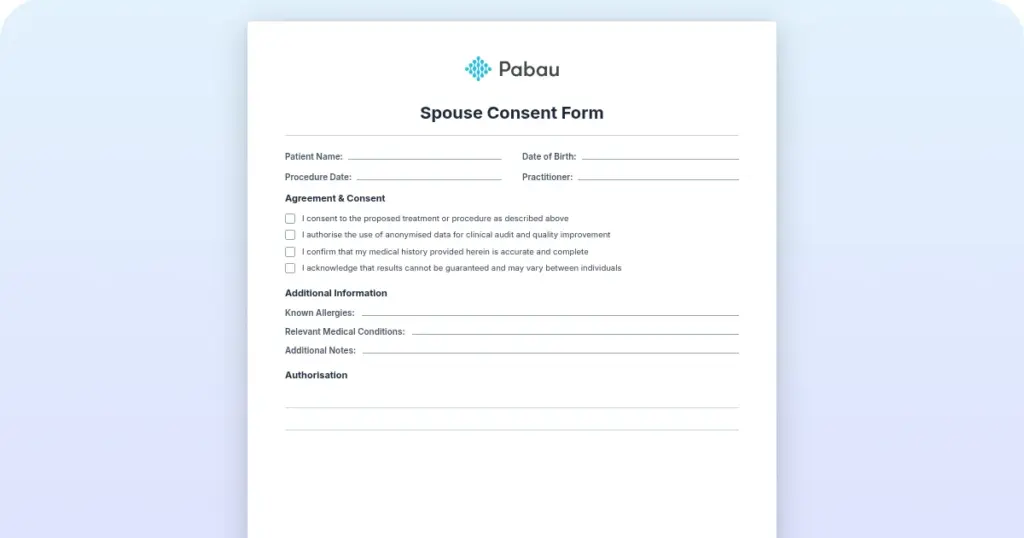
A comprehensive consent form covering patient details, treatment description, risks and benefits disclosure, contraindication screening, consent declarations, and signature blocks for clinicians and guardians.
Download templateInformed consent is the foundation of ethical and legal healthcare practice. Before any treatment, clinicians must ensure patients understand what they are agreeing to, what could go wrong, and what alternatives exist.
This guide covers the legal framework, practical elements.

Whether you run a private practice, aesthetic practice, or surgical facility, having a robust consent process protects both patients and practitioners. A well-structured consent for medical treatment demonstrates that you have met your duty to inform and respected patient autonomy, which is the cornerstone of modern medical practice.
Consent for medical treatment is a patient’s formal, documented agreement to undergo a specific medical procedure or course of care after being fully informed about the proposed intervention. Unlike casual agreement, informed consent requires that the patient has received sufficient information to make a voluntary, competent decision.
The legal and ethical requirement for consent stems from the principle of patient autonomy. Clinicians have a duty to respect patients as independent decision-makers rather than passive recipients of treatment.
The AMA Code of Ethics explicitly states that informed consent to medical treatment is fundamental to both the ethical practice of medicine and to the legal relationship between physician and patient.
Consent can take different forms depending on the clinical context and the patient’s circumstances. Understanding these distinctions helps you implement consent procedures that match your practice setting.
For non-emergency procedures, express written consent is the standard of care and provides the clearest legal protection for both clinician and patient.
Valid informed consent requires five core elements. Each must be present for the consent to be legally and ethically sound.
If any of these elements is missing or questionable, consent is invalid and treatment should be delayed until the missing element is resolved.
Informed consent is a two-way process. Patients have the right to full information; clinicians have the duty to provide it clearly and verify understanding.
Patients have the right to:
Research on minor consent from NIH PMC confirms that patients also have a right to privacy and confidentiality in their healthcare decisions.
Clinicians carry matching responsibilities:
Minors generally lack the legal capacity to consent to medical treatment, so a parent or legal guardian must provide consent on their behalf. However, several exceptions exist depending on state law and the minor’s circumstances.
Always verify your state’s specific minor consent laws before treating a minor without parental involvement. Requirements vary significantly, and non-compliance can expose your practice to legal liability.
While informed consent is the standard, a few narrow exceptions allow treatment without explicit patient agreement.
These exceptions are narrow and jurisdiction-specific. Document any exception carefully, as they may be subject to legal challenge.
A properly constructed medical consent form serves as evidence that consent was sought and obtained. Include these essential elements in every consent form used in your practice:
Some practices include a section where the patient confirms they have had the opportunity to ask questions and understand the information provided. This comprehension confirmation is a best practice.
Obtaining informed consent is a process, not just a form. Follow these steps to ensure you meet the legal standard and protect both patient and practice.
If the patient declines consent, respect their decision and document it clearly. Do not proceed with treatment unless the patient later changes their mind and provides valid consent.
Informed consent works best as an ongoing clinical conversation, not a one-time legal checkbox. Getting it right demonstrates respect for patient autonomy and protects your practice.
By understanding the five elements of valid consent, handling special cases like minors carefully, and implementing a structured consent process, you uphold both the ethical and legal standards of medical practice.
Manual paper-based consent processes are time-consuming and prone to errors. Pabau’s digital consent management tools streamline the entire workflow.
Practices using Pabau can send consent forms to patients electronically, track completion status, collect e-signatures with legal validity, and maintain a complete audit trail for compliance verification.
Pabau’s templates are fully customizable, so you can tailor consent forms to your specific procedures and patient populations. Book a demo to see how digital consent workflows reduce administrative burden while improving legal compliance in your practice.

Handling other disclosure and consent paperwork? authorization for disclosure of information template A HIPAA-compliant form covering recipients, disclosure purposes, expiration dates, and signatures.
Meeting the eight required elements of a valid authorization? authorization to use and disclose health information Covers the eight elements a valid HIPAA authorization needs, including the redisclosure notice.
Need the wider policy behind these consent forms? client rights policy template Covers the seven core client rights, including confidentiality, informed consent, and records access.
Express consent is explicit agreement given verbally or in writing after receiving information. Implied consent is agreement demonstrated through the patient’s behavior (e.g., rolling up their sleeve for a blood pressure check). Express consent is required for invasive or high-risk procedures; implied consent is limited to routine, low-risk care.
A competent minor can voice objections, and ethical practice involves respecting the minor’s developing autonomy. However, in most jurisdictions, parental consent is legally sufficient to authorize treatment even if the minor dissents, except in cases where the minor is legally emancipated or mature enough for independent decision-making under state law.
Unconscious patients are presumed to consent to emergency treatment necessary to preserve life or prevent serious injury (implied consent exception). Document the emergency circumstances, the treatment provided, and any attempts to contact family or guardians. Once the patient regains consciousness, obtain their consent for any non-emergency ongoing care.
Verbal consent is legally valid but riskier because it relies on the clinician’s documented recollection. Always follow verbal consent with written documentation in the clinical record. For any invasive or high-risk procedure, written consent is the legal standard of care.
Disclose the nature of the procedure, all material risks (both common and rare), expected benefits, and available alternatives. Material means risks that would reasonably influence the patient’s decision. HHS HIPAA guidance also requires you to explain how patient information will be used and protected.
A standardized template is a good starting point, but you should customize it for specific procedures, patient populations, and jurisdictions. Designing effective medical forms requires procedure-specific detail and clear language tailored to your patient demographics.