

CCSD code G5100: Bypass of duodenum billing guide
CCSD code G5100 bills a bypass that leaves the duodenum in place CCSD code G5100...

Last Updated: Oct 16, 2026
V5249 is the HCPCS Level II code for a hearing aid that is analog, binaural and in-the-canal (ITC). One unit covers the pair of devices dispensed to one patient on one service date.
The code sits in the V5xxx hearing aid series maintained by CMS. It applies only to an analog device fitted to both ears whose shell sits in the canal opening. A shell fully inside the canal is coded V5248. Traditional Medicare Part B excludes hearing aids by statute, so payment depends on Medicaid, Medicare Advantage or commercial plans.
Let Pabau's smart automation suggest the right codes, reduce claim denials, and keep your practice compliant—effortlessly.
Automate repetitive tasks and focus on what matters most—your patients.
Reduce coding errors and ensure compliance with the latest regulations.
Clean claims, fewer denials, and faster reimbursements.
Powerful insights and reporting to help your practice thrive.
HIPAA compliant SOC 2 certified GDPR-compliant Trusted by 4,000+ clinics worldwide

HCPCS code V5249 covers one analog, binaural, in-the-canal (ITC) hearing aid pair, not a single device.
Bill 1 unit for a binaural pair, because billing 2 units is a common error that triggers automatic denial.
Traditional Medicare Part B does not cover V5249 under the statutory hearing aid exclusion in the Social Security Act.
Canal depth separates V5249 from V5248. An ITC aid sits in the canal opening, while a CIC aid fits fully inside the canal.
A one-ear analog ITC fitting is coded V5243, and a digital device moves to the V5254 through V5261 series.
HCPCS code V5249 is the Level II code for a hearing aid, analog, binaural, in-the-canal (ITC). It belongs to the V5xxx hearing aid series maintained by CMS.
As a permanent HCPCS code, its descriptor stays stable year over year unless CMS issues a revision. The code covers one binaural pair of analog ITC devices dispensed to one patient on one service date.
Three descriptor terms define exactly what V5249 covers. “Analog” means the device uses analog signal processing rather than digital processing. “Binaural” means the code covers a pair of aids for both ears, not a single monaural device.
“In-the-canal” defines the physical form: The aid shell sits in the opening of the ear canal but does not extend fully into it. All three terms must match the dispensed device for the code to be appropriate. A binaural pair with full in-the-ear shells bills as V5130 instead.
Knowing the inclusion and exclusion boundaries prevents overbilling, which is one of the primary audit triggers for hearing aid HCPCS codes.
Billing for batteries or fitting fees under V5249 constitutes unbundling. Each of those services has its own dedicated code, and payers audit hearing aid claims specifically for bundled accessories. Batteries for the pair belong on their own claim line under V5266.
Contralateral routing systems are another exclusion. A BICROS unit routes sound from the non-hearing ear and amplifies only at the better ear, so the V5249 descriptor does not fit. Those in-the-ear fittings carried V5210 until CMS deleted the code on January 1, 2019.
The behind-the-ear version of that routing system carried V5220, which CMS deleted on the same date. Neither style belongs on a V5249 claim line.
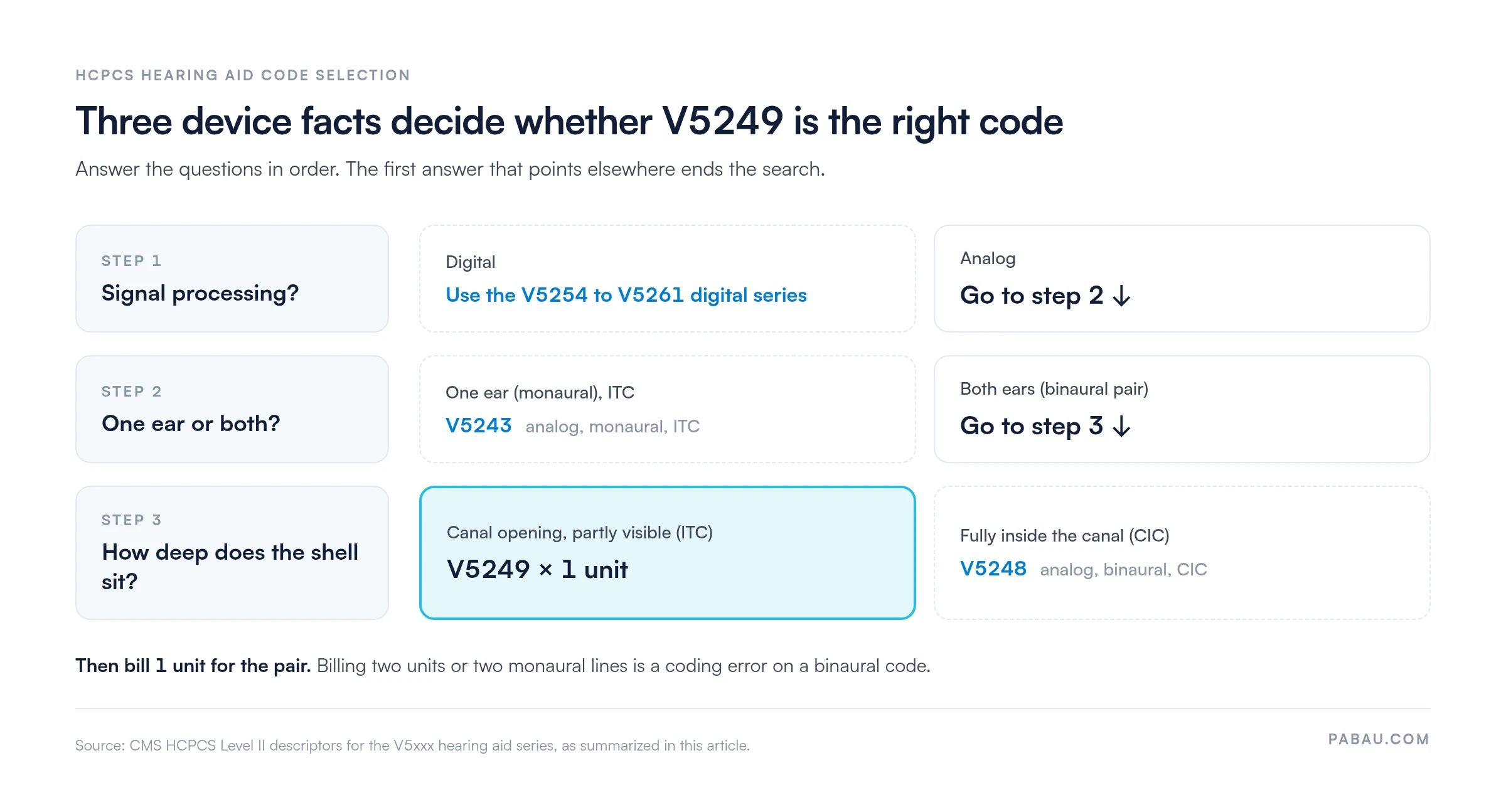
Canal depth is the single deciding factor between V5248 and V5249. An ITC aid (V5249) fills the canal opening and is partially visible. A completely-in-canal aid (V5248) is inserted deeper and sits flush with or recessed into the canal.
The AAPC HCPCS code index lists both in the V5008-V5364 hearing services range. Choosing the wrong one is a common denial cause for analog binaural claims.
The decision takes three questions, in a fixed order. If the audiologist confirms analog signal processing, a fitting for both ears, and a shell that sits in the canal opening, V5249 is correct.
If the device is fully inserted and invisible in the canal, use V5248. If only one ear is being fitted with an analog ITC aid, use V5243. If the device is digital, move to the digital series, V5254 through V5261.
Within that digital series, the monaural behind-the-ear device is V5257, and its binaural counterpart is V5261.
Traditional Medicare Part B does not cover V5249. The exclusion is statutory, established under Social Security Act Section 1862(a)(7), which explicitly excludes hearing aids and hearing aid examinations from Medicare coverage.
No local coverage determination overrides this exclusion for standard hearing aid supply codes. Submitting V5249 to traditional Medicare Part B will result in a denial categorized as a non-covered service.
Medicare Advantage (Part C) plans may cover hearing aids as a supplemental benefit. Coverage rules, prior authorization requirements, and approved device lists vary by plan. Verify coverage with each patient’s specific Medicare Advantage plan before dispensing and billing.
State Medicaid programs vary significantly in their coverage of V5249. Some states cover hearing aids for adult beneficiaries; others restrict coverage to pediatric populations or exclude analog technology entirely in favor of digital devices.
Because Medicaid coverage for V5249 is state-specific, check with the state Medicaid agency and review its published hearing aid benefit policy before billing. Verifying insurance eligibility before each dispensing appointment prevents claim surprises.
Commercial health plans that include hearing aid benefits typically require prior authorization and may publish a maximum allowable amount for V5249 in their fee schedule. Check each plan’s benefit manual or call the payer’s provider line. Some commercial plans restrict coverage to digital devices, which would make V5249 a non-covered benefit under those contracts.
Prior authorization (PA) requirements for V5249 are payer-specific and state-specific. There is no universal rule. The only certainty is that traditional Medicare Part B does not require prior authorization for V5249 because it does not cover the code at all.
For state Medicaid and commercial payers that do cover hearing aids, the typical prior authorization process includes these steps:
Practices with a high volume of hearing aid patients benefit from systematic PA tracking. Claims management software that flags pending authorizations before the dispensing date prevents the most common PA-related denial.
Documentation for V5249 has to prove medical necessity, confirm the device type, and establish provider credentials. Incomplete records are a denial cause in their own right, separate from coding errors. Keep every hearing aid dispensing record HIPAA-compliant, and use digital intake forms so the same data gets captured at each visit.

Keep these records accessible for retrospective audit. Payers performing post-payment reviews on hearing aid claims look specifically for audiogram currency and device style confirmation.
The binaural billing rule for V5249 is fixed: Bill 1 unit for the pair. Billing 2 units is incorrect because the code descriptor already specifies binaural (both ears).
Splitting the claim into two monaural lines using V5243 when V5249 is correct is also a coding error. Set up the superbill for hearing aid dispensing so it pre-populates V5249 at quantity 1, and unit errors stop at the point of claim creation.
LT (left side) and RT (right side) laterality modifiers generally do not apply to binaural hearing aid codes like V5249. The code already specifies both ears. Appending LT or RT to a binaural code can cause denial with some payers, as it implies a monaural fitting that contradicts the code descriptor.
Modifier usage on V5249 should be treated as payer-specific: Check the payer’s billing guidelines before appending any laterality modifier, rather than applying them by default.
Before filing, run the claim through your billing software’s clean claim checklist and confirm modifier requirements with the payer.
Denials for HCPCS code V5249 cluster around a predictable set of causes, and each one can be fixed before the claim goes out. When a claim does come back, the remittance carries a reason code, and this guide to medical billing denial codes explains what each one means.
Run a pre-dispensing checklist for every V5249 patient. Confirm payer coverage, verify PA status, check the device style in the clinical note, and set the quantity to 1. Catching these four items before the appointment prevents most HCPCS code V5249 denials without any post-submission rework.
Traditional Medicare Part B does not cover V5249, so Medicare publishes no fee schedule amount for it. No relative value unit (RVU) or payment rate appears in the CMS Physician Fee Schedule lookup for this code. You can confirm this through the PGM Billing HCPCS lookup tool, which draws directly from CMS data.
For state Medicaid programs that do cover V5249, maximum allowable amounts are published in each state’s Medicaid fee schedule. These amounts vary widely. The table below shows the structure of a typical state Medicaid hearing aid fee schedule entry. Actual figures must be verified through your state’s Medicaid agency portal, as they update annually and differ by state.
Audiology practices that bill Medicaid should keep an updated matrix of V5249 maximum allowable amounts by payer. Rates change with each state fiscal year.
V5249 sits within the V5xxx hearing aid series. Familiarity with the neighboring codes prevents miscoding when device types, fitting configurations, or technology classes differ. The NLM HCPCS Level II lookup API provides programmatic access to the full series for practices building billing software integrations.
Most audiology practices check V5249 claims by hand. Someone confirms the device style in the clinical note, looks up the PA number, and sets the quantity to 1 before the claim leaves.
Practice management software like Pabau keeps those checks next to the patient record. The dispensing note, the audiogram date, and the authorization status sit in one place, so the biller codes from what the audiologist documented.
The result is fewer unit errors and fewer CIC-for-ITC mix-ups. Claims that would have come back for a missing authorization get caught before submission.

Pabau helps audiology and hearing care practices track prior authorization status, flag missing documentation, and submit cleaner HCPCS claims. See how it works for your practice.

V5249 pays when the claim describes the device the patient walked out with. Settle signal processing, fitting, and canal depth in the clinical note first, and the code follows from the documentation rather than from memory.
Coverage is the harder variable. Traditional Medicare will never pay, so the work that protects revenue happens before dispensing. That means a verified benefit, a PA number on file, and a signed ABN for self-pay Medicare patients.
Book a demo to see how Pabau keeps hearing aid documentation and authorizations ready before each V5249 claim goes out.

Need a framework for managing claim denials systematically? Denial management in healthcare covers the workflows audiology practices use to track, appeal, and prevent recurring rejections.
Want to understand how HCPCS fits into the broader billing picture? Revenue cycle management fundamentals explains how hearing aid supply codes connect to the full claim-to-payment cycle.
Looking to streamline your superbill for hearing aid dispensing? Superbill preparation guidance shows how to structure billing templates that pre-populate HCPCS codes correctly at point of service.
HCPCS code V5249 is the Level II billing code for an analog, binaural, in-the-canal (ITC) hearing aid. It covers the supply of one pair of analog ITC hearing aids dispensed on a single service date, billed as 1 unit.
V5248 covers an analog binaural completely-in-canal (CIC) hearing aid, while V5249 covers an analog binaural in-the-canal (ITC) hearing aid. The deciding difference is canal depth. CIC devices sit fully inside the ear canal and are not visible from the outside. ITC devices sit in the canal opening and are partially visible.
No. Traditional Medicare Part B does not cover V5249. The statutory exclusion under Social Security Act Section 1862(a)(7) explicitly excludes hearing aids from Medicare coverage. Medicare Advantage plans may offer hearing aids as a supplemental benefit. Coverage varies by plan, so verify it with the specific plan before dispensing.
Bill 1 unit. V5249 is a binaural code, so the descriptor already specifies both ears. Billing 2 units is a coding error that triggers automatic denial. If only one ear is being fitted with an analog ITC device, use V5243 (analog, monaural, ITC) instead of V5249.
Generally no. V5249 specifies binaural (both ears), so laterality modifiers are typically not applicable and can cause denials with some payers by implying a monaural fitting. Modifier rules on binaural hearing aid codes are payer-specific. Check the payer’s published billing guidelines before appending LT or RT to a V5249 claim line.
The most frequent causes are submission to traditional Medicare, which excludes hearing aids by statute, and a missing prior authorization. Billing 2 units instead of 1 and coding V5248 for an ITC device are the common coding errors. Missing or expired audiograms and provider credentialing mismatches account for most of the rest.



