CCSD code H4430: Examination of rectum under anaesthetic
CCSD code H4430 pays for the examination alone CCSD code H4430 is the UK private...

Last Updated: Oct 20, 2026
V2203 is the HCPCS Level II code for spherocylinder, bifocal, plano to plus or minus 4.00d sphere, .12 to 2.00d cylinder, per lens.
Let Pabau's smart automation suggest the right codes, reduce claim denials, and keep your practice compliant—effortlessly.
Automate repetitive tasks and focus on what matters most—your patients.
Reduce coding errors and ensure compliance with the latest regulations.
Clean claims, fewer denials, and faster reimbursements.
Powerful insights and reporting to help your practice thrive.
HIPAA compliant SOC 2 certified GDPR-compliant Trusted by 4,000+ clinics worldwide

HCPCS code V2203 describes a spherocylinder bifocal lens, plano to plus or minus 4.00D sphere, 0.12 to 2.00D cylinder, billed per lens.
V2200, V2201, and V2202 are sphere-only bifocal codes with no cylinder component, so a prescription with cylinder power starts at V2203.
Medicare Part B covers V2203 only when CMS Policy Article A52499 lists a qualifying diagnosis, such as aphakia after cataract surgery. Routine refractive correction is not covered.
V2203 prices off the DMEPOS fee schedule at a state-level allowable, and post-cataract claims go to the DME MAC for the patient’s permanent address.
V2203 is billed per lens, not per pair. Submit two units or two line items when both lenses are dispensed.
Practice management software like Pabau keeps HCPCS V-code fee data current and flags V2203 claim errors before submission.
HCPCS code V2203 is an HCPCS Level II code maintained by the Centers for Medicare and Medicaid Services (CMS). It identifies a specific bifocal spherocylinder lens for claim submission. The V2200 to V2299 range it belongs to covers bifocal lenses across a spectrum of sphere and cylinder powers.
The official long description reads: Spherocylinder, bifocal, plano to plus or minus 4.00d sphere, .12 to 2.00d cylinder, per lens. The CMS short description is: Lens sphcyl bifocal 4.00d/.1.
The code identifies a lens with these specifications:
One detail separates V2203 from the codes just below it. V2200, V2201, and V2202 are sphere-only bifocal codes with no cylinder component at all. V2203 is the first spherocylinder code in the range, so any prescription carrying cylinder power starts here rather than at V2200.
The “per lens” billing unit is the second detail that decides whether the claim pays correctly. Practices supplying both lenses in a pair must bill two units of V2203 (or two separate line items), not one.
V2203 sits in the Vision Services section of the HCPCS Level II code set, specifically in the Lenses Bifocals subsection. Knowing where it sits in the classification hierarchy helps billers confirm they are using the right section of the fee schedule.
The V-series designation confirms this is an HCPCS Level II code, distinct from CPT codes. V-series codes are used specifically for vision services including frames, lenses, and contact lenses.
Medicare Part B does not cover routine vision care, including bifocal lenses prescribed solely for refractive error correction. This is the most common coverage misconception attached to V2203.
Coverage applies in a narrow set of medically necessary circumstances. CMS Policy Article A52499 (Refractive Lenses) governs coverage determinations for the V2200 to V2299 range. Under that policy, Medicare Part B may cover bifocal spherocylinder lenses when:
Post-cataract lens claims do not go to the local Part B MAC. They go to the Durable Medical Equipment MAC (DME MAC) for the jurisdiction covering the patient’s permanent residence. A52499 is a DME MAC policy article, which is why its rules govern V2203 rather than a physician-side coverage determination.
Medicaid coverage rules vary by state. Practices billing V2203 to a state Medicaid program should confirm coverage criteria in that state’s provider manual before submitting. Documentation for vision codes has to align with both the payer’s coverage policy and the patient’s clinical record.
Optometrists and ophthalmologists are the primary providers eligible to bill V2203 under Medicare. Optical dispensaries billing independently should verify their Medicare supplier status and any applicable assignment rules before submission.
V2203 does not price off the Medicare Physician Fee Schedule. As a vision supply code, it prices off the DMEPOS fee schedule, which CMS publishes with separate allowable amounts by state.
Because the allowable is a state-level DMEPOS amount, no GPCI adjustment applies and there is no facility versus non-facility split. Payment follows the schedule for the state where the patient permanently resides. Two practices a few miles apart across a state line can be paid different amounts for the same lens.
Practices should verify current amounts in the DMEPOS fee schedule file for their DME MAC jurisdiction. CMS refreshes that file each January and revises it during the year, so the figure in your billing system has a shelf life.
Because amounts change with each fee schedule release and differ by state, this guide does not list a single figure. Billing at last year’s amount is a frequent cause of payment shortfalls in vision billing. Pull the current DMEPOS file for your jurisdiction instead.
Accurate V2203 billing depends on a few precise rules. Misapplying any one of them typically results in either a denial or a compliance audit flag.
V2203 is billed per lens. When both the right and left lens meet the V2203 diopter specifications, the practice bills two units. Two separate line items, one per lens, work equally well. Billing a single unit for both lenses is incorrect and will under-reimburse the claim.
V2203 is typically billed on a CMS-1500 claim form. The place of service code should reflect where the lens was dispensed, such as an office, optical shop, or outpatient setting. Send the claim to the DME MAC for the patient’s permanent address rather than the local Part B MAC.
Practices submitting electronically should use the 837P transaction format. Before the claim goes out, confirm the dispensing details on the line match what the patient record documents.
Denials still land even in careful practices, so a defined appeal route for vision codes protects the revenue cycle. Our guide to claim denial management covers the workflow for working one back.
Before submitting V2203, run a three-point pre-submission check. Confirm the prescription carries cylinder power between 0.12 and 2.00 diopters with sphere no greater than plus or minus 4.00 diopters. Confirm the unit count matches the number of lenses dispensed. Confirm the linked ICD-10-CM code appears on the covered list in CMS Policy Article A52499. These three checks catch the majority of V2203 denials before they reach the payer.
When billing V2203 to Medicare, the claim must carry a diagnosis from the covered list in CMS Policy Article A52499 and LCD L33793. That list is short, and it is narrower than most billers expect.
It covers aphakia and pseudophakia, so a refractive-error diagnosis such as myopia (H52.11) or astigmatism (H52.211) will not support coverage. Confirm the current list against A52499 before billing, since it is subject to annual update.
Always verify that the ICD-10-CM code on the claim matches the patient’s clinical documentation. Using a diagnosis code that does not appear in the patient’s record, even if it technically supports V2203 coverage, creates a compliance risk. Link the diagnosis to the HCPCS code when the claim is built, not as a final check before submission.
CMS Policy Article A52499 specifies what documentation must be on file to support a V2203 claim. Missing any one item gives a MAC auditor grounds to recoup the payment.
Practices that rely on paper records tend to discover missing documentation during an audit rather than before one. Switching to a structured digital workflow cuts that risk considerably. Prescriptions, dispensing records, and eligibility confirmations then sit in a single patient record.
Digital forms and integrated clinical records mean documentation is captured at the point of care. During an audit response it comes back in seconds rather than hours. Automated superbill generation pulls the dispensing details and diagnosis codes into the claim, which removes the manual steps where errors enter.

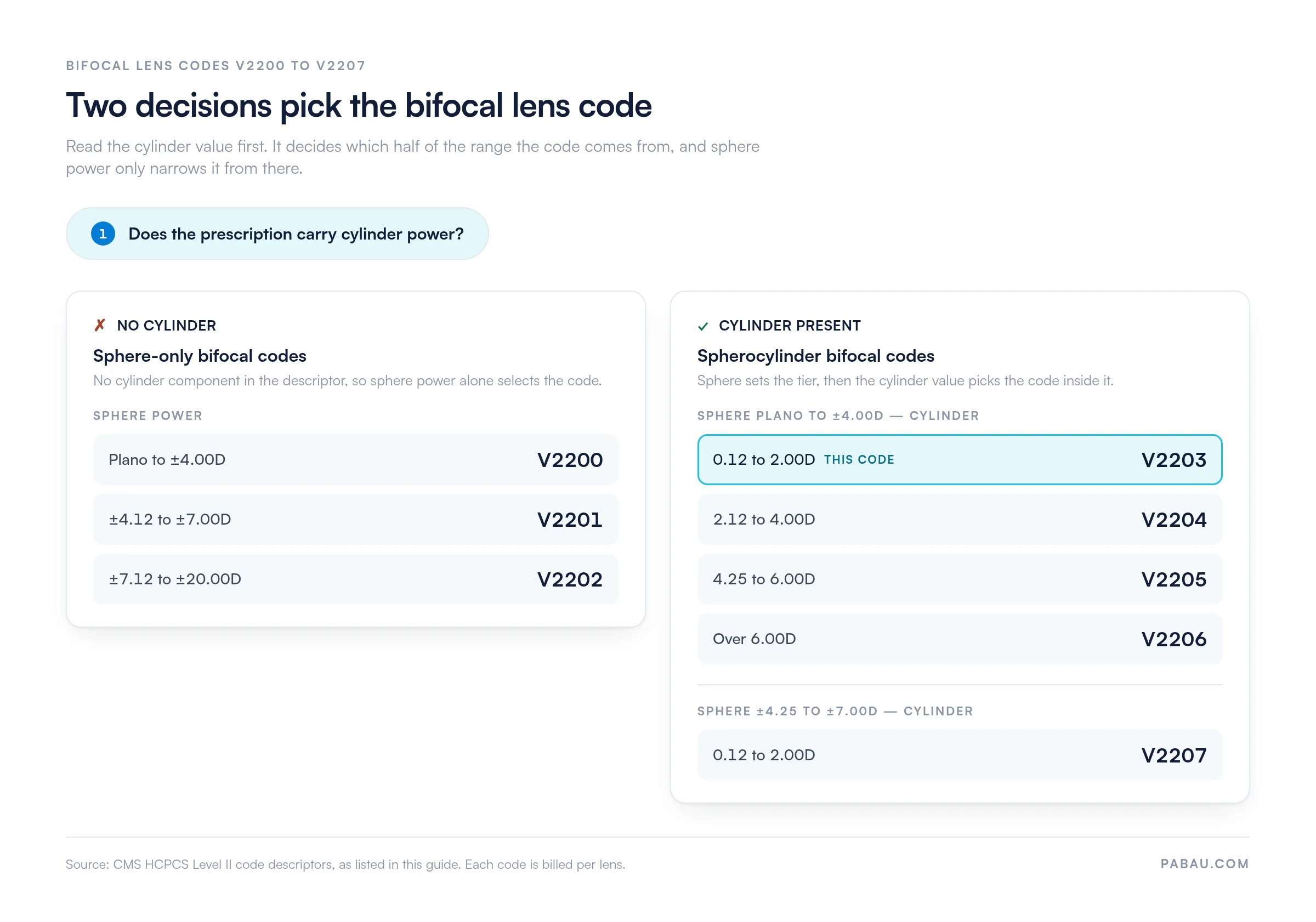
The V2200 to V2299 range covers bifocal lenses across different sphere and cylinder combinations, and it splits in two. V2200 to V2202 are sphere-only codes separated by sphere power alone. V2203 onward are spherocylinder codes that add a cylinder component. Coding across that split is the primary error in the series.
One bifocal design sits outside this range. A variable asphericity bifocal bills as V2430, which is never added on top of a V2200-series code.
Code selection starts with a single question. Does the prescription carry cylinder power? If it does not, the code comes from V2200 to V2202 on sphere alone.
If it does, and the sphere is plano to plus or minus 4.00 diopters, the cylinder value decides between V2203 and V2206. Above that sphere range, the same cylinder tiers repeat from V2207. A lens in that higher sphere band with 2.12 to 4.00D of cylinder takes V2208.
The diagram below runs both branches in the order a biller reads the prescription.
For commercial code verification, the AAPC Codify HCPCS lookup provides a searchable reference for the full V2200 to V2299 range. Our HCPCS code library covers the other V-series codes an optical practice bills alongside this one.
Manual HCPCS V-code billing creates predictable failure points. A biller might pick the code from memory rather than from the patient’s prescription. Another might enter quantity 1 for a pair of lenses. Both produce a denial that a system check would have caught.
Pabau’s claims software for optometrists handles V-code claims from the same record that holds the prescription. Built-in checks flag any mismatch between the documented prescription and the selected code.
Billers then no longer have to remember which codes in the V2200 range carry cylinder and which do not. The system validates the entry against the clinical record before the claim leaves the practice.

For practices managing multiple providers and locations, keeping the DMEPOS fee schedule current is an ongoing operational burden. When amounts change in January, practices on manual systems frequently bill at the prior year’s figure for weeks before catching it. Automated fee schedule updates mean the allowed amounts billers see reflect the current CMS file.
Documentation retrieval during an audit is the other area where integrated software earns its keep. A DME MAC may request the prescription and dispensing record for a V2203 claim. A practice with a centralized digital record produces both in minutes rather than hours, and the payer’s window for additional documentation is short.
Set up a V-code billing audit internally at the start of each calendar year. Pull all V2200-range claims from the prior quarter and check three things. Confirm that any claim coded V2200 to V2202 had no cylinder power on the prescription. Confirm that billing units match the number of lenses dispensed. Confirm that the current-year DMEPOS amounts are loaded in your billing system. This 30-minute check prevents the most common systemic errors in bifocal lens billing before they accumulate across hundreds of claims.

Pabau keeps your V-code fee schedule current and flags claim errors before submission, helping optometry and ophthalmology practices reduce V2203 denials and get paid faster.

Getting the code right hangs on one reading of the prescription. Check the cylinder value before you reach for a code, and V2200 to V2202 stop being candidates the moment cylinder power appears.
Coverage is the second discipline, and it works in the opposite direction. The diagnosis has to come from the patient’s chart and then match the A52499 list, never the other way around. A covered code sitting on an unsupported record is what gets recouped.
Neither check is difficult, and both get skipped under time pressure. That is the argument for validating the code against the prescription in the system rather than in someone’s head. Book a demo to see how Pabau handles HCPCS V-code claims for optometry and ophthalmology practices.

Need to understand how medical billing works end-to-end? What is medical billing covers the full revenue cycle from claim creation to payment posting.
Facing recurring claim denials on vision codes? Denial management in healthcare walks through the appeal workflow and prevention strategies for common denial reasons.
Want to understand how clean claims reduce payment delays? Clean claim submission explains the pre-submission checks that prevent the most frequent billing errors across HCPCS codes.
HCPCS code V2203 is a Level II code for a spherocylinder bifocal lens, billed per lens. It covers plano to plus or minus 4.00 diopters of sphere with 0.12 to 2.00 diopters of cylinder. Optometrists, ophthalmologists, and enrolled optical suppliers use it to bill Medicare, Medicaid, and private payers for that lens.
Medicare Part B does not cover V2203 for routine refractive correction. Coverage applies when the lens is medically necessary, such as after cataract surgery with an intraocular lens implant. The record must document that necessity in line with CMS Policy Article A52499.
V2203 covers a sphere of plano to plus or minus 4.00 diopters and a cylinder of 0.12 to 2.00 diopters. A lens outside either range takes a different code in the V2200 to V2299 series. V2204 covers cylinder from 2.12 to 4.00 diopters, for example.
V2203 is billed per lens. When both lenses in a pair meet the V2203 specification, the practice submits two units of V2203 or two separate line items. Billing one unit for a pair is incorrect and will result in under-reimbursement.
V2201 and V2202 are sphere-only bifocal codes with no cylinder component. V2201 covers plus or minus 4.12 to 7.00 diopters of sphere, and V2202 covers plus or minus 7.12 to 20.00 diopters. V2203 is a spherocylinder code for plano to plus or minus 4.00 diopters of sphere. It applies only when the prescription also carries 0.12 to 2.00 diopters of cylinder.
Bifocal lens HCPCS codes fall within the V2200 to V2299 range. V2200 through V2202 are sphere-only codes, split by sphere power. V2203 through V2206 add cylinder at plano to plus or minus 4.00D of sphere. The right code depends on the sphere and cylinder powers in the dispensed prescription.
Post-cataract lens claims go to the DME MAC covering the patient’s permanent residence, not the local Part B MAC. Payment follows the DMEPOS fee schedule amount for that state. Sending the claim to the wrong contractor usually produces a rejection rather than a payable claim.