HCPCS Code Q4185: Cellesta flowable amnion billing guide
HCPCS Code Q4185: definition and official descriptor HCPCS Code Q4185 is the Lev...

Last Updated: Nov 20, 2026
Billable Code Specific Code
S0191 is the HCPCS Level II code for misoprostol, oral, 200 mcg, billed at one unit per 200 mcg tablet. It is a temporary national S-code used by Medicaid and private payers, set through the HCPCS panel (CMS, AHIP, BCBSA).
Coders most often see it in medication abortion billing, on its own line beside mifepristone (S0190). Some state Medicaid policies also recognize it for cervical ripening. Medicare fee-for-service does not cover S-codes, and unit-reporting errors are a common cause of claim denials.
Let Pabau's smart automation suggest the right codes, reduce claim denials, and keep your practice compliant—effortlessly.
Automate repetitive tasks and focus on what matters most—your patients.
Reduce coding errors and ensure compliance with the latest regulations.
Clean claims, fewer denials, and faster reimbursements.
Powerful insights and reporting to help your practice thrive.
HIPAA compliant SOC 2 certified GDPR-compliant Trusted by 4,000+ clinics worldwide

S0191 is an HCPCS Level II S-code, not a CPT code, and covers only oral misoprostol in 200 mcg tablets.
One unit equals one 200 mcg tablet, so an 800 mcg dose goes on the claim line as 4 units.
Mifepristone is billed separately with S0190, while S0199 covers the abortion service itself and excludes the drugs.
Medicare fee-for-service does not pay S-codes. Coverage comes from Medicaid and commercial plans, with rates that vary by state and contract.
Pabau, the practice management platform we build, runs eligibility checks and sends CMS-1500 and 837P claims through Claim.MD from the patient record.
HCPCS code S0191 is the HCPCS Level II code for misoprostol, oral, 200 mcg, billed at one unit per 200 mcg tablet. The National Library of Medicine’s HCPCS record lists S0191 with that exact descriptor, added on January 1, 2001, and no end date.
S0191 sits in the S range of HCPCS codes, the temporary national codes used by Medicaid and private payers. S-codes are set through the HCPCS panel, which brings together CMS, America’s Health Insurance Plans (AHIP), and the Blue Cross Blue Shield Association (BCBSA).
The CMS HCPCS overview describes Level II as the code set for products, supplies, and services that CPT codes don’t cover. CMS does not use S-codes for Medicare fee-for-service (FFS) claims. An S0191 line sent to Medicare Part B is typically denied as non-covered.
S0191 is billed per 200 mcg tablet, so the units on the claim line must match the tablet count dispensed. A common error is entering the total dose in micrograms, such as 800, instead of the tablet count of 4.
On the CMS-1500 form, units go in Box 24G. On an 837P electronic claim, they go in the SV1 service unit count (SV104). Confirm the tablet count in the dispensing record before you enter units.
The unit count is only one of five fields an 800 mcg line carries. The diagram below follows that dose from the tablets to the diagnosis pointer.
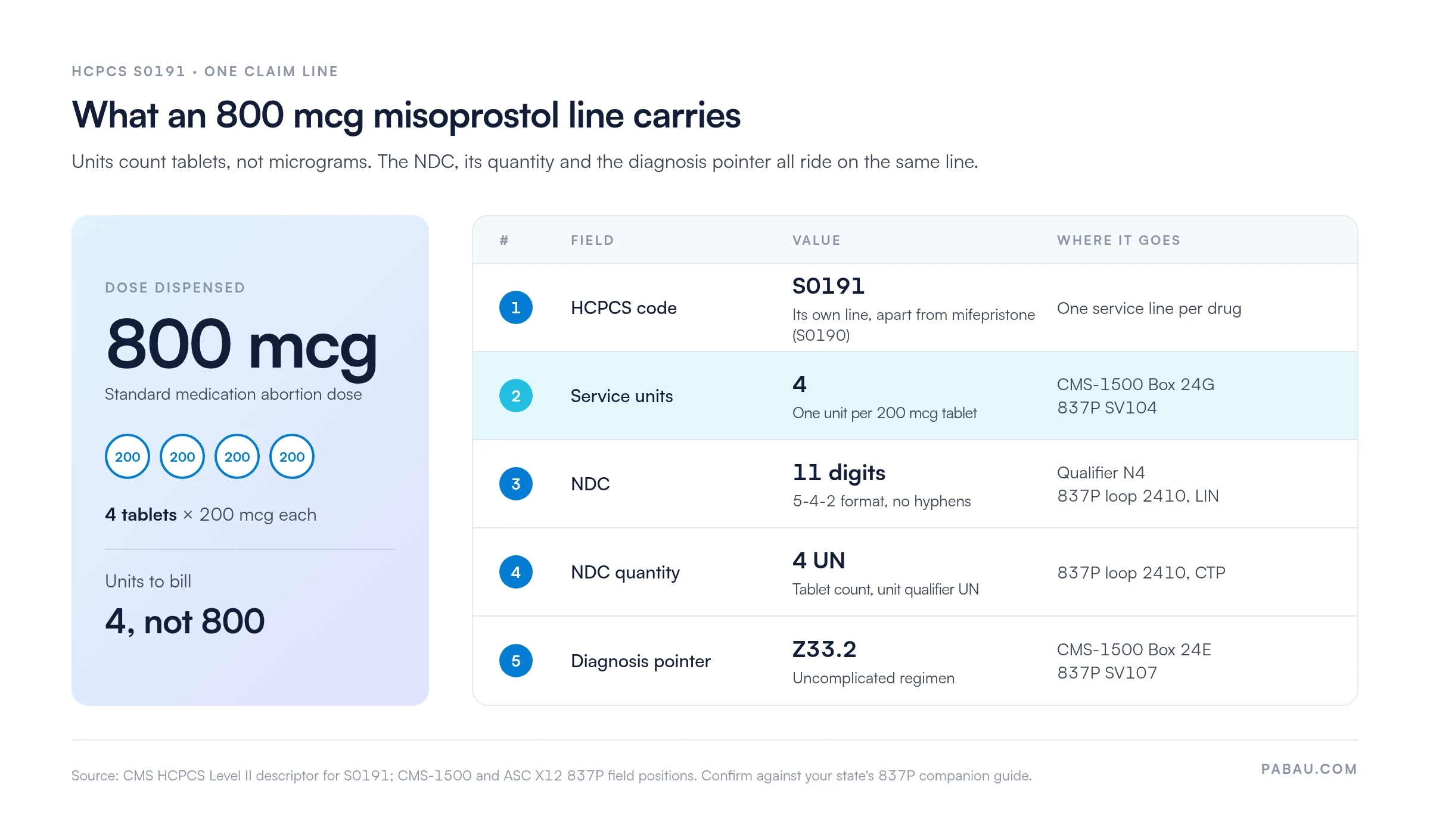
When a practice dispenses both mifepristone and misoprostol for a medication abortion, each drug gets its own HCPCS code and claim line. Mifepristone 200 mg is reported with S0190, and misoprostol is billed with S0191 at one unit per tablet. Each line carries its own NDC, unit count, and diagnosis pointer on the CMS-1500 or 837P.
S0199 is a different kind of code. It covers the medically induced abortion service with all associated services and supplies, except drugs. Because its descriptor leaves the drugs out, S0190 and S0191 still go on their own lines where a payer accepts S0199.
REMS documentation note: Mifepristone remains subject to an FDA Risk Evaluation and Mitigation Strategy (REMS) program. Payers may request the prescriber’s REMS certification with a prior authorization request or during a claims audit. Keep it in the patient record, ready to submit.
REMS requirements don’t apply to the misoprostol line itself. Incomplete mifepristone documentation can still trigger a denial of the entire encounter.
Coverage for HCPCS code S0191 varies sharply by payer type. Medicare FFS is the clearest case, because CMS does not recognize S-codes for Part B fee-for-service billing. An S0191 line sent to Medicare FFS is typically denied as non-covered (for example CARC CO-96). The exact code varies by payer system.
Because medication abortion access varies by state law, coverage for S0191 depends heavily on geography. Practices serving patients across state lines should keep a payer-by-state coverage matrix and update it at least once a year. Pabau’s claims management software runs eligibility checks before the visit. Your billing team can confirm a patient’s plan before an S0191 line goes out.
Before billing S0191 to any Medicaid managed care plan, pull the plan’s current preferred drug list and prior authorization grid. Many managed care organizations layer additional S-code requirements on top of the state’s fee-for-service policy. A call to provider relations before the first claim saves weeks of denial resolution later.
Because S0191 is an S-code, CMS publishes no national fee schedule rate for it. Reimbursement is set by each state Medicaid program and by individual commercial payer contracts. The table shows where each payer’s rate comes from. Verify current allowable amounts with each payer before quoting patients or setting fee expectations.
Use the AAPC Codify HCPCS lookup to review current descriptor and crosswalk data, and the PGM Billing HCPCS lookup to cross-reference against CMS published data. Neither source replaces the state Medicaid fee schedule as the controlling document for Medicaid reimbursement.
Every S0191 claim line must carry at least one ICD-10-CM diagnosis code that medically justifies the dispensed drug. Payers validate the diagnosis pointer in Box 24E of the CMS-1500, or SV107 on the 837P. A mismatched or absent code is one of the top three denial triggers for this code.
Confirm the active status of these codes against the current ICD-10-CM tabular list before submission. Where misoprostol supports labor augmentation, check the coding rules for O62.0 before you point the S0191 line at it. Mapping approved diagnosis codes to encounter types in your practice management system cuts manual keying at the point of claim creation.
Most Medicaid programs require the National Drug Code (NDC) on drug claim lines alongside the HCPCS code. The NDC identifies the specific manufacturer and package of the product dispensed. Without a valid NDC, many state Medicaid programs will deny the claim automatically, even when S0191 itself is correct.
Misoprostol 200 mcg oral tablets are dispensed under multiple NDCs, depending on the manufacturer. Common options include Pfizer’s brand Cytotec and generic manufacturers’ products. Always use the NDC from the product dispensed, not one from memory or a static crosswalk list. Record the NDC in the clinical documentation at dispensing, so billing staff can retrieve it accurately.
Denials on S0191 lines tend to come from five causes. The table pairs each one with its usual claim adjustment reason code (CARC) and the fix.
Tracking denials by code shows which of these causes keeps coming back in your practice. Pabau imports electronic remittances (ERAs) through Claim.MD, so each S0191 denial arrives with its reason code against the claim it belongs to.
Run a monthly denial analysis filtered to S-codes only. Within one practice, S0191 denials tend to cluster around the same two or three root causes. Fix the upstream step behind the top cause first, and that rejection stops recurring on later claims.
A clean S0191 claim needs both complete clinical documentation and correct claim form data. Auditors reviewing reproductive health claims check that the two agree.
Several codes are commonly confused with S0191 or appear on the same claim. Knowing which code covers which clinical scenario prevents both underbilling and duplicate billing.
Use the CMS Physician Fee Schedule search to verify coverage and payment indicators for CPT codes billed alongside S0191. For S-code lookups, search by code in the CMS HCPCS quarterly update files.
In many practices, the dispensing record and the claim live in different systems. Someone reads the tablet count and the NDC off one screen and keys them into another, often days later. That retyping is how 800 ends up in a units field built for 4.
Pabau keeps the dispensing record and the insurance claim in one patient file. Stock carries its batch number and expiry date, and the lot is recorded against the patient and the appointment. US claims go out through Claim.MD as CMS-1500 or 837P claims, with eligibility checks before the visit.
Prior authorizations are tracked on the case, with a warning when one is missing. A managed care plan’s authorization rule then shows up while the patient is still in the chair, not weeks later on a CO-15 denial.

Pabau records the lot dispensed against the patient and the appointment, then sends the claim through Claim.MD. See how it handles drug lines for reproductive health billing.

The S0191 denials in this guide can be caught before a claim leaves the practice. Count tablets rather than micrograms, carry the NDC with its N4 qualifier and UN quantity, and point the line at a diagnosis the chart supports.
Coverage is the part you can’t fix after the fact. Check the payer before you dispense, because Medicare FFS won’t pay the line and Medicaid rules shift by state.
A per-state matrix you update each year will save more rework than any national fee figure. Book a demo to see how Pabau links the dispensing record to the claim for reproductive health practices.

Billing the other half of the regimen? HCPCS code S0190 covers mifepristone units, NDC reporting, and REMS documentation for the companion drug.
Filling out the paper claim? CMS-1500 form guide walks through Box 24 field by field, including units and diagnosis pointers.
Decoding a remittance? Denial codes in medical billing explains the top 20 CARC codes and how to fix each one.
Helping a patient claim back a prescription? Pharmacy claim form gives you a free template and explains each field a drug plan asks for.
Comparing billing platforms? Best medical practice billing software reviews seven platforms on how much claim work they take off your staff.
HCPCS code S0191 describes misoprostol, oral, 200 mcg. It is an HCPCS Level II S-code used by Medicaid and commercial payers to reimburse oral misoprostol tablets dispensed in outpatient settings. One unit equals one 200 mcg tablet.
Prior authorization (PA) requirements for S0191 are payer-specific. Many state Medicaid FFS programs do not require PA for this code, but Medicaid managed care organizations and some commercial plans do. Check the payer’s current prior authorization grid before dispensing in time-sensitive clinical situations.
Four causes lead the list. They are a claim sent to Medicare FFS, a missing or invalid NDC, an incorrect unit count, and an absent or mismatched ICD-10-CM diagnosis. Missing prior authorization is a fifth frequent trigger with managed care payers.
Yes. When both drugs are dispensed in a medication abortion regimen, bill each on its own claim line, with S0191 for misoprostol and S0190 for mifepristone. Each line carries its own NDC, unit count, and diagnosis pointer. S0199 is a separate code for the abortion service itself and excludes the drugs.
S0191 maps to any FDA-registered NDC for misoprostol oral 200 mcg tablets, including generic formulations from multiple manufacturers. Always record and bill the NDC from the product dispensed rather than a static crosswalk list, as manufacturers and package codes change. Use FDA’s DailyMed to verify current NDCs for a specific misoprostol product.