

CCSD code G5100: Bypass of duodenum billing guide
CCSD code G5100 bills a bypass that leaves the duodenum in place CCSD code G5100...

Last Updated: Oct 16, 2026
Q4156 is the HCPCS Level II code for neox 100 or clarix 100, per square centimeter (add-on, list separately in addition to primary procedure).
Medicare payment for Q4156 changed on January 1, 2026. CMS now treats skin substitutes that are not Section 351 biologics as incident-to supplies. They are paid at a single national rate of $127.14 per square centimeter, before geographic adjustment. The high-cost and low-cost classification no longer applies to Q4156.
Getting a Q4156 claim paid still means pairing the correct CPT application code, confirming coverage with your MAC, and meeting every documentation requirement.
Let Pabau's smart automation suggest the right codes, reduce claim denials, and keep your practice compliant—effortlessly.
Automate repetitive tasks and focus on what matters most—your patients.
Reduce coding errors and ensure compliance with the latest regulations.
Clean claims, fewer denials, and faster reimbursements.
Powerful insights and reporting to help your practice thrive.
HIPAA compliant SOC 2 certified GDPR-compliant Trusted by 4,000+ clinics worldwide

HCPCS code Q4156 identifies Neox 100 or Clarix 100, a bioengineered skin and soft tissue substitute billed per square centimeter.
Q4156 must always be paired with a CPT application code from the 15271-15278 series on the same claim. Submitting Q4156 alone results in denial.
Since January 1, 2026, Medicare pays Q4156 as an incident-to supply at $127.14 per square centimeter, replacing the retired high-cost and low-cost split.
Only skin substitutes licensed as biologics under Section 351 still use the older ASP-based payment method.
Pabau’s claims management software supports wound care billers in tracking HCPCS codes, capturing required documentation, and submitting clean claims.
HCPCS code Q4156 is a Level II alphanumeric code for a bioengineered skin and soft tissue substitute applied to a wound. The Centers for Medicare and Medicaid Services (CMS) maintains it as part of the annual HCPCS update cycle. Unlike CPT codes that describe the procedure performed, Q4156 describes the specific skin substitute product itself. The application procedure is reported separately using a companion CPT code.
Q-codes in the HCPCS Level II system are temporary codes assigned by CMS to capture items and services not adequately described by CPT. Skin substitute Q-codes like Q4156 are product-specific, meaning each code maps to a particular manufacturer’s product or product line, not to a generic product category.
Q4156 represents Neox 100 or Clarix 100, cryopreserved human amniotic membrane allografts made by BioTissue. Both are regulated by the FDA as Section 361 human cells, tissues, and cellular and tissue-based products, or HCT/Ps. That regulatory pathway now determines how Medicare pays for the product, so it belongs in your charge master alongside the code itself.
These products are typically indicated for wounds that have not responded to conventional wound care over a defined treatment period. The most common qualifying wound types for skin substitute Q-codes under Medicare include:
CMS assigns individual Q-codes to specific manufacturer products. Coders must confirm that the product applied in the encounter is the one described by Q4156. Applying a different skin substitute product and billing Q4156 is a coding error regardless of clinical similarity. A practice adding wound care to an existing service line should build product-to-code verification into its charge capture process.
Tissue form separates these codes too. Neox 100 and Clarix 100 are cryopreserved, while the dehydrated amniotic membrane allograft Biodfence Dryflex bills under Q4138. Biovance, another dehydrated, decellularized amniotic membrane allograft, bills under Q4154. Check which form the clinician applied before the charge leaves the practice.
Medicare covers bioengineered skin substitute application, including Q4156, when medical necessity criteria are met. Coverage is not automatic, and the criteria vary by Medicare Administrative Contractor (MAC) jurisdiction.
The national framework sets the structure. Individual MACs specify which wound types qualify, how long prior standard wound care must have been documented, and what clinical findings trigger eligibility.
Common Medicare eligibility criteria for skin substitute application include:
Coverage policy shifted at the end of 2025. On December 24, 2025, the A/B MACs withdrew the skin substitute Local Coverage Determinations for diabetic foot ulcers and venous leg ulcers. Those policies had been scheduled to take effect on January 1, 2026, and would have sharply narrowed the list of covered products.
Coverage now rests on each MAC’s remaining policy and on general Medicare medical necessity rules. CMS has not said what will replace the withdrawn policies, so check your MAC’s current coverage articles before billing Q4156. Relevant MACs include Novitas Solutions, CGS Administrators, Palmetto GBA, and WPS Government Health Administrators, each with jurisdiction over specific US states.
Every Q4156 claim requires a supporting ICD-10-CM diagnosis code that establishes medical necessity. A code that lacks the required specificity, such as one missing laterality or wound depth, is a common denial trigger. Our ICD-10-CM code library carries the full descriptors when you need to check one. The following table shows representative ICD-10-CM codes accepted by Medicare for skin substitute claims:
Coders should always use the highest level of specificity available. Where laterality is required (right vs. left), using an unspecified code when the chart clearly documents a specific limb is a shortcut that auditors flag. Verify accepted ICD-10-CM codes against your MAC’s current coverage articles, as covered code lists are updated annually.
Medicare pays for Q4156 as an incident-to supply, not as a drug or biological. CMS finalized that change in the CY2026 Physician Fee Schedule final rule (CMS-1832-F). The OPPS and ASC final rule made the matching change, and both took effect on January 1, 2026.
The policy covers the physician office under the PFS non-facility rate. It also covers the hospital outpatient department under the Outpatient Prospective Payment System (OPPS).
The rate is a single national figure of $127.14 per square centimeter before geographic adjustment. CMS published $127.28 in the final rule, then corrected it to $127.14 in a notice issued on November 28, 2025. Your paid amount will differ from that figure once your locality’s geographic adjustment is applied.
Products are now grouped by FDA regulatory pathway rather than by cost tier. OPPS assigns each group its own ambulatory payment classification (APC), and all three carry the same CY2026 rate. CMS has said it intends to propose different rates for the three groups in later years.
Q4156 falls in the Section 361 HCT/P group, so it is paid at the incident-to supply rate in both settings. Only products licensed as biologics under Section 351 of the Public Health Service Act keep the older ASP-based method. That exception is narrow, and it does not cover Neox 100 or Clarix 100.
Two older rules went away with this change. CMS retired the high-cost and low-cost classification for products outside the Section 351 pathway, so there is no annual tier list to check for Q4156. CMS also deleted the low-cost application codes C5271 through C5278 as of December 31, 2025. The 15271 through 15278 application codes now apply in every setting.
If your charge master or payer policy still sorts skin substitutes into high-cost and low-cost buckets, it is running on pre-2026 logic. Claims built that way will not match how Medicare now prices the product.
Confirm the product’s FDA regulatory pathway before you bill, not its old cost tier. The pathway decides which of the three CY2026 APC groups applies, and Section 351 biologics are the only products still paid on ASP. Record that pathway next to the Q-code in your charge master, so billing staff are not hunting for it at claim time.
Every Q4156 claim requires a paired CPT application code on the same date of service. The CPT code describes the procedure performed (applying the skin substitute), while Q4156 identifies the product used. Submitting Q4156 without a companion CPT code will result in claim denial.
Two facts about the wound pick the code: where it sits, and how much surface area it covers in total. The grid below pairs each combination with its base code and its add-on.
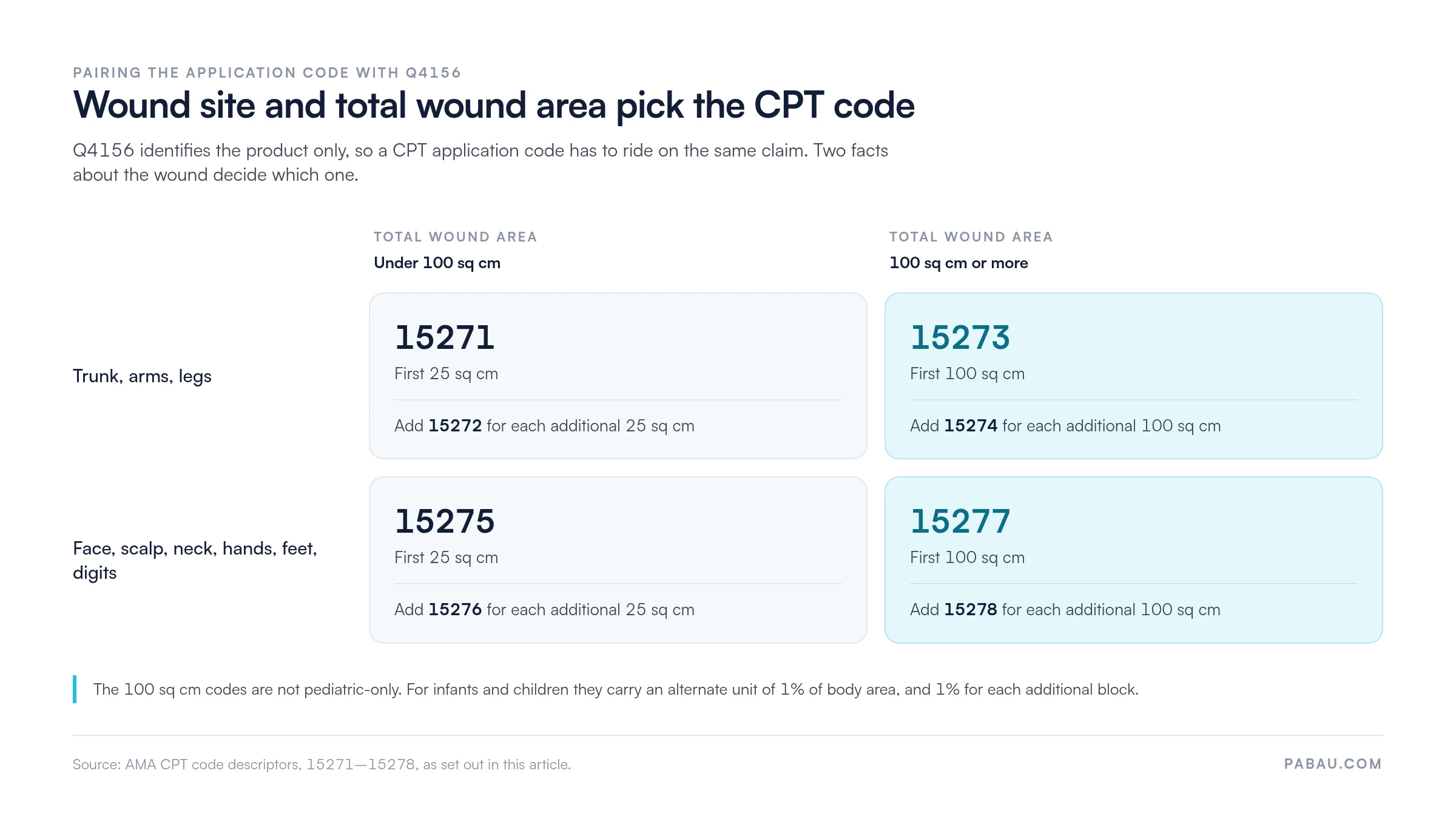
Diabetic foot ulcers typically map to 15275 for the foot, or to 15271 for a leg wound depending on its location. Document wound size in square centimeters in the procedure note. That measurement drives both the CPT selection and the number of add-on codes reported.
Do not read 15273, 15274, 15277, and 15278 as pediatric-only codes. They apply to any patient once total wound surface area reaches 100 sq cm. The percentage-of-body-area unit is only the alternate way to report them for infants and children. Reference the AAPC HCPCS code lookup when you need to verify a descriptor.
Where the skin substitute is applied determines the claim form used, the payment rate applied, and which entity bills Medicare. HOPD and non-facility (physician office) billing follow different rules for Q4156. Mixing them up is one of the most common compliance errors in wound care billing. Check the current-year CMS Physician Fee Schedule for non-facility payment rates.
In an HOPD setting, the hospital bills the facility component on the UB-04. The treating physician may bill the professional component separately under the PFS using CMS-1500. The C5271 through C5278 application codes no longer exist, so hospital outpatient claims use the same 15271 through 15278 series as the office.
In a non-facility setting the charge slip has to capture both the Q-code and the CPT code, so both reach the CMS-1500. Missing either causes denial.
Medicare’s documentation requirements for skin substitute claims are among the most detailed in wound care billing. Missing even one required element is enough for a claim to be denied or flagged during an audit. Compliance here starts with complete documentation before the claim is submitted, rather than after a denial arrives.
Required documentation for Q4156 claims typically includes:
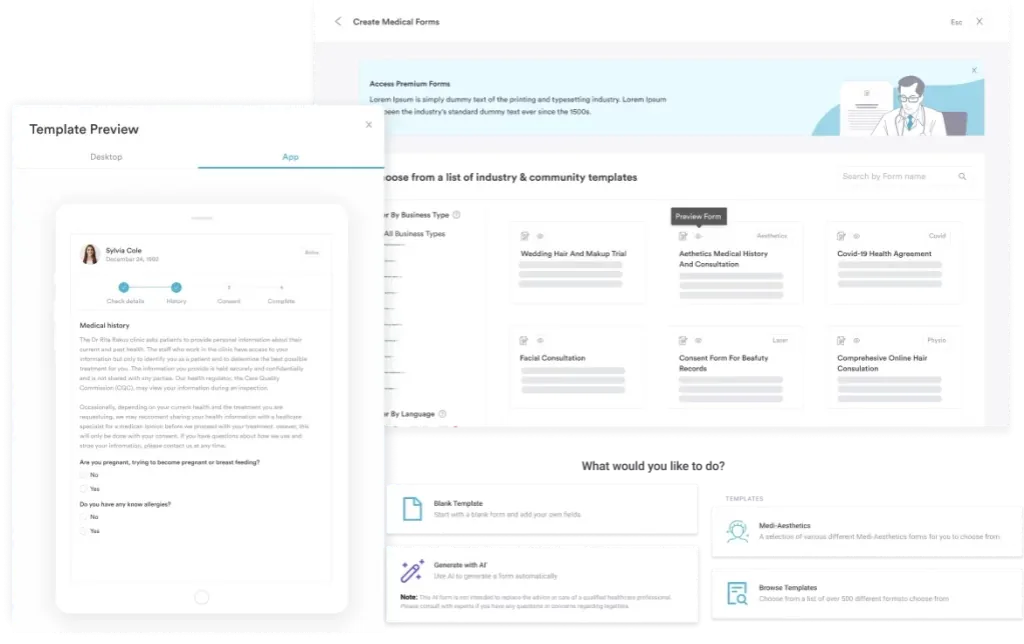
A clean claim submission for Q4156 depends on having each of these elements in the patient record before the claim goes out. Retro-documentation after a denial is flagged as a compliance risk during audits. Standardized digital encounter forms are the simplest way to capture these fields consistently.
Keep record retention HIPAA-compliant for every wound care encounter. Medicare may request records going back several years during a Targeted Probe and Educate (TPE) review. Complete documentation from the original encounter is the primary defense against recoupment.
Most Q4156 denials trace back to a small set of repeat causes. Each one is preventable at charge capture rather than at appeal, which is where the time and the write-offs usually go.
Denials in this category are usually systemic rather than one-off. If the same reason code keeps appearing, fix the charge capture template instead of writing more appeals.
Q4156 belongs to a large family of skin substitute Q-codes updated annually by CMS. Coders who work with wound care practices frequently need to identify the correct Q-code for the specific product applied. The following table shows selected related Q-codes in the bioengineered skin substitute category:
The table above is a selection rather than the full list. Affinity, another human amniotic membrane allograft billed per square centimeter, is coded Q4159.
Always confirm the active status of any skin substitute Q-code before billing. CMS deletes and replaces codes annually, and billing a deleted code results in automatic rejection. The CMS HCPCS overview and quarterly update files are the authoritative source for current code status.
The 2026 rule cycle changed more about skin substitute billing than any single year before it. CMS moved payment off ASP, retired the cost tiers, and deleted a block of application codes. The MACs then withdrew the coverage policies they had spent two years preparing.
CMS gave a blunt reason for the payment change. Medicare spending on skin substitutes rose from $252 million in 2019 to more than $10 billion in 2024. The ASP-based payment method was driving that growth.
The changes that matter for a Q4156 claim are:
Documentation expectations did not move with the payment rules. They remain strict for skin substitute claims, and audit activity in wound care has risen rather than eased. A flat payment rate settles what Medicare pays. It does not settle whether the application was medically necessary.
Charge master teams should replace any January tier-review step with a check on FDA pathway and on the current national rate. That rate is set through the annual PFS and OPPS rulemaking, so it will move again.
Wound care practices billing HCPCS code Q4156 face a documentation-intensive process. Staff measure the wound, capture prior treatment history, record the product lot number, and pair the right CPT code. All of that has to happen before the claim can go out, and manual workflows let required details slip. The result shows up later as denials and delayed reimbursement.
Practice management software like Pabau gives wound care practices one place to manage HCPCS code entry and verify code pairings. Its streamlined claims management also tracks claim status across payers.
When documentation is captured digitally at the point of care, the detail needed to support a Q4156 claim is available at billing time. That covers wound measurements, product details, and diagnosis codes, without chasing paper records.
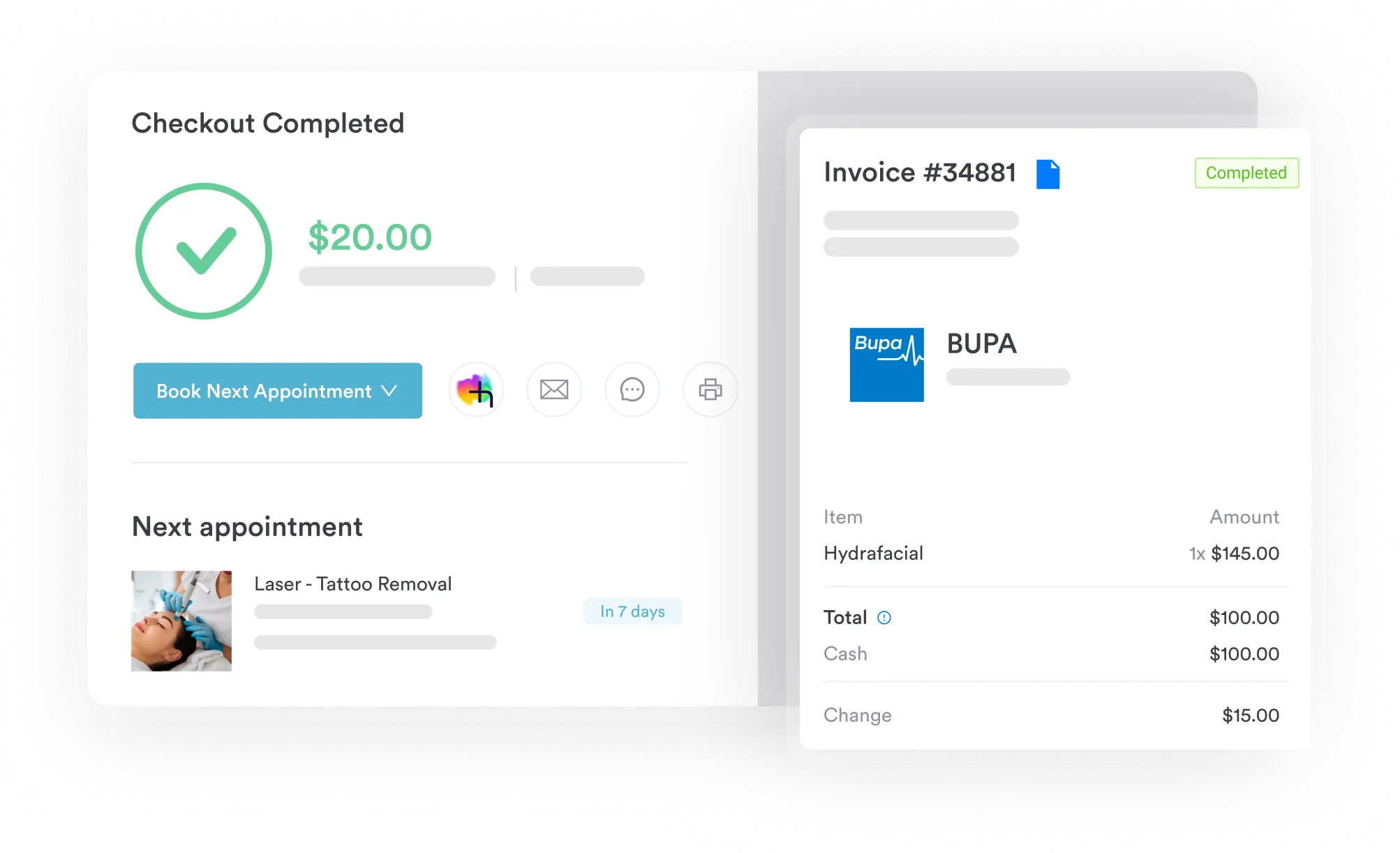
Revenue cycle work in wound care takes more than submitting claims. It means tracking which claims are still pending and catching denials early, so a denied Q4156 claim gets appealed or corrected instead of written off.
Automated billing workflows in Pabau flag incomplete documentation before a claim is submitted. That cuts the denials caused by a missing required field.
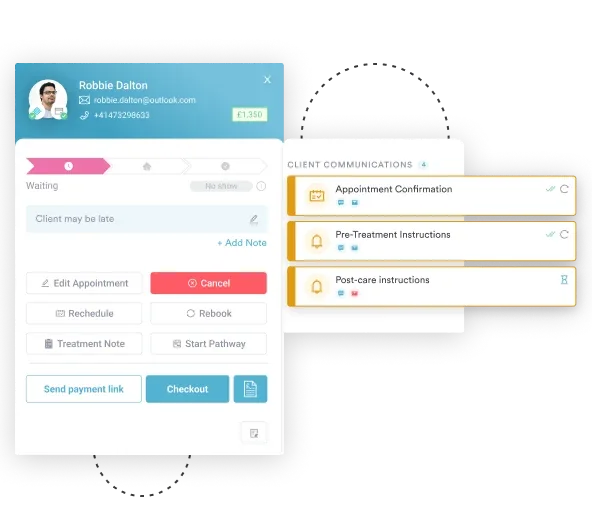

Pabau helps wound care practices capture complete documentation, manage HCPCS code entry, and submit cleaner claims. See how it works for your practice.

HCPCS code Q4156 has to line up with several other pieces on the claim. It needs the right CPT application code, a supporting ICD-10-CM code at the required specificity, and complete documentation before submission.
Payment is simpler than it was, since the 2026 incident-to supply rate replaced the annual cost-tier lookup. Medical necessity documentation still carries the same weight it always did.
Pabau helps wound care practices build consistency into their billing workflow, from structured digital encounter records through to claim submission and denial tracking. To see how it handles skin substitute billing for a practice like yours, book a demo with our team.

Need a structured approach to wound care billing compliance? Medical billing compliance fundamentals covers the documentation and audit readiness practices every wound care biller should know.
Wondering how clearinghouses handle HCPCS claim submissions? Medical claims clearinghouse guide explains how clearinghouses validate, route, and track HCPCS and CPT claims before they reach payers.
Looking to reduce skin substitute claim denials? Denial codes in medical billing breaks down the most common CARC denial reasons and how to resolve them.
HCPCS code Q4156 reports Neox 100 or Clarix 100, a bioengineered skin and soft tissue substitute. It is applied to chronic wounds such as diabetic foot ulcers and venous leg ulcers. Q4156 identifies the product rather than the application procedure. A companion CPT code from the 15271-15278 series must be billed on the same claim to describe the application.
Medicare pays Q4156 as an incident-to supply at a single national rate of $127.14 per square centimeter, before geographic adjustment. That rate took effect on January 1, 2026 and applies in both the physician office and the hospital outpatient department. The high-cost and low-cost classification was retired for products outside the Section 351 biologic pathway. Q4156 is a Section 361 HCT/P, so that older split no longer applies to it.
Q4156 is paired with CPT codes from the 15271-15278 series, which describe the skin substitute application procedure by wound location and size. CPT 15271 covers trunk, arms, and legs for the first 25 sq cm. CPT 15275 covers face, hands, and feet for the first 25 sq cm. Add-on codes (15272, 15276) are reported for each additional 25 sq cm beyond the base unit.
Required documentation includes wound measurements in centimeters, the wound type, and the matching ICD-10-CM diagnosis. You also need the wound duration and a record of the standard wound care that already failed. The product name, its lot number, and the units applied in sq cm all belong in the note too. Some MACs also require a vascular assessment. Missing any of these elements is grounds for claim denial or audit recoupment.
In a hospital outpatient department (HOPD), Q4156 is billed on a UB-04 claim form under OPPS, with revenue code 0636. In a physician office, it is billed on a CMS-1500 form under the PFS. Since January 1, 2026, the product itself is paid at the same national incident-to supply rate in both settings. The place of service code still differs, with POS 22 for HOPD and POS 11 for office.
Coverage for Q4156 is set jurisdiction by jurisdiction by the A/B MACs, including Novitas Solutions, CGS Administrators, Palmetto GBA, and WPS Government Health Administrators. Each MAC specifies covered wound types, documentation requirements, and application frequency limits for skin substitute codes. The dedicated skin substitute LCDs for diabetic foot ulcers and venous leg ulcers were withdrawn on December 24, 2025. Check your MAC’s current coverage articles before billing.
Yes. On December 24, 2025, the A/B MACs withdrew those Local Coverage Determinations before they ever took effect. They had been scheduled to start on January 1, 2026 and would have limited coverage to a short list of products. Coverage now follows each MAC’s remaining policy and general Medicare medical necessity rules. Confirm the current position with your MAC before applying Q4156.



