CCSD code H4430: Examination of rectum under anaesthetic
CCSD code H4430 pays for the examination alone CCSD code H4430 is the UK private...

Last Updated: Oct 20, 2026
Q4143 is the HCPCS Level II code for repriza, per square centimeter (add-on, list separately in addition to primary procedure).
Coverage is decided by the Medicare Administrative Contractor for your jurisdiction, so a claim paid in one state can be denied in another. Unit reporting is the other common failure point. Wound care billing software that keeps the measurement and the claim line in one record makes a mismatch easy to catch before submission.
Let Pabau's smart automation suggest the right codes, reduce claim denials, and keep your practice compliant—effortlessly.
Automate repetitive tasks and focus on what matters most—your patients.
Reduce coding errors and ensure compliance with the latest regulations.
Clean claims, fewer denials, and faster reimbursements.
Powerful insights and reporting to help your practice thrive.
HIPAA compliant SOC 2 certified GDPR-compliant Trusted by 4,000+ clinics worldwide

HCPCS code Q4143 describes Repriza, a human allograft skin substitute reported per square centimeter of wound surface area.
Coverage depends on your MAC. Some jurisdictions publish an LCD for skin substitutes, and others now review medical necessity case by case.
Units must be calculated precisely. The number of square centimeters of wound surface area determines how many units to report.
From January 1, 2026, Medicare pays Q4143 as an incident-to supply at a single national rate of about $127.14 per sq cm. The high-cost and low-cost tiers are gone.
Skin substitute claims use modifier JC when the product is applied as a graft, and JD when it is not.
Pabau’s claims management software helps wound care practices track unit calculations, attach supporting documentation, and submit Q4143 claims accurately.
Repriza is a human allograft skin product from Promethean LifeSciences, used in the management of chronic, non-healing wounds on the lower extremities. It works as a wound covering that supports tissue regeneration by giving cells a scaffold to grow into. That makes it distinct from a simple wound dressing.
CMS recognizes Repriza as a skin substitute product within the Q-code range. It therefore sits inside the same coverage framework MACs apply to bioengineered and allograft skin substitutes on lower extremity wounds. That classification sets which diagnoses are covered. It also puts the product inside the single national payment rate CMS introduced for CY2026.
Coverage for HCPCS code Q4143 is decided jurisdiction by jurisdiction, and no single settled LCD sits behind it. CMS and the MACs withdrew the finalized 2026 skin substitute LCD for diabetic foot ulcers and venous leg ulcers on December 24, 2025. What governs your claim now depends on which Medicare Administrative Contractor (MAC) processes it.
Palmetto GBA, NGS, WPS and Noridian have no published skin substitute LCD at the moment. Claims in those jurisdictions are reviewed case by case on medical necessity. Novitas, First Coast and CGS kept their earlier pre-2026 policies, so their criteria still apply.
So check your MAC’s current position before every application, because this is still in flux. The conditions below are the ones MACs have consistently applied, whether through a published LCD or a medical necessity review. A claim that misses one faces denial, however appropriate the treatment was clinically.
Q4143 is covered only with a diagnosis your MAC accepts for skin substitutes. A claim submitted with a non-covered diagnosis is one of the most common denial triggers. The table below shows the diagnosis categories that have carried coverage under skin substitute policies for lower extremity wounds.
Covered diagnosis lists are jurisdiction-specific and subject to revision. List only codes confirmed in your MAC’s current coverage article or its published billing guidance. Do not infer coverage from adjacent wound care codes that the policy does not name.
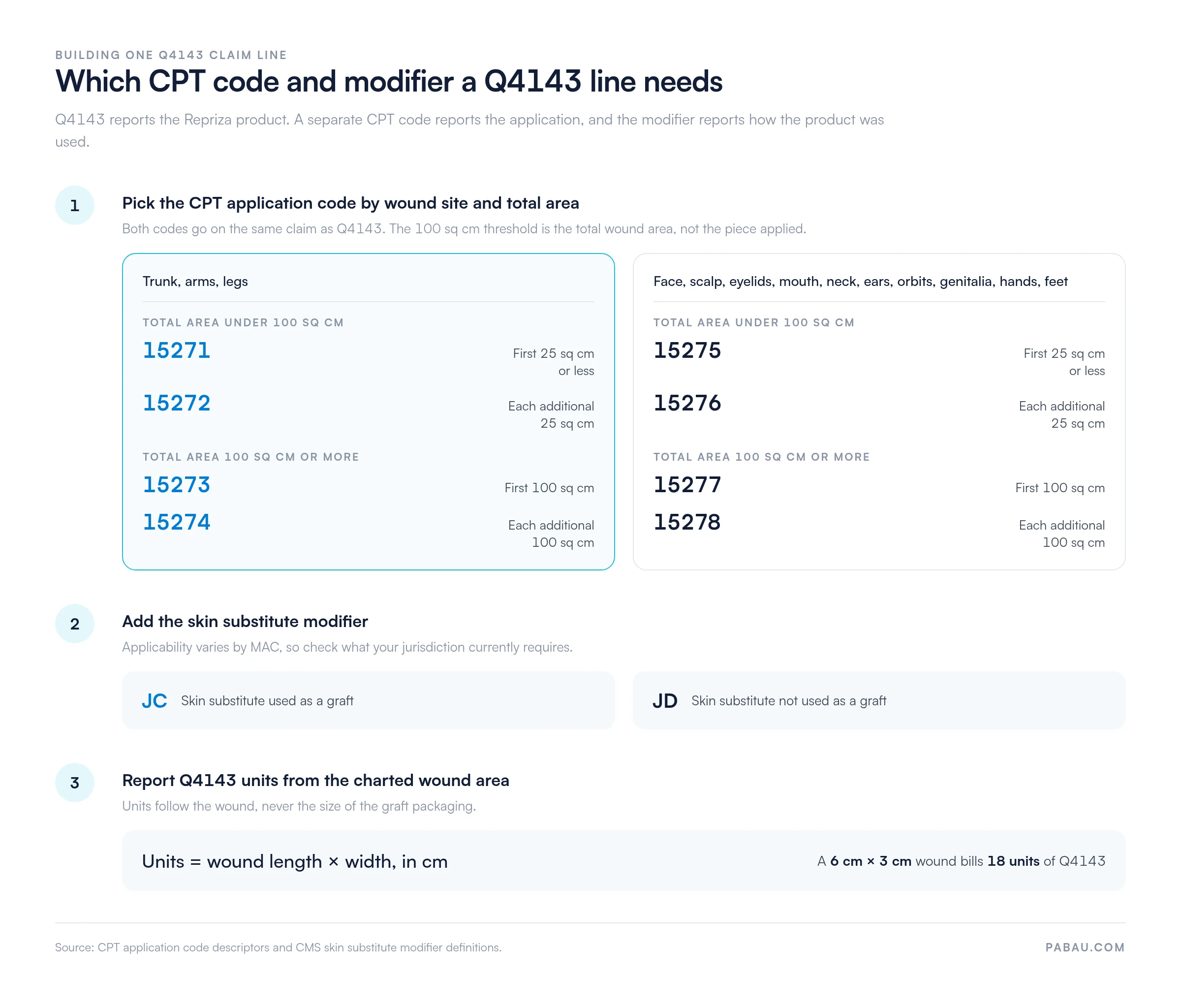
HCPCS code Q4143 reports the product itself, not the application procedure. A wound care practice must bill a separate CPT application code on the same claim to report the work of applying the skin substitute. The CPT code and Q4143 are submitted together.
For a lower extremity wound with a total surface area under 100 sq cm, CPT 15271 is the base code. CPT 15272 is added for each additional 25 sq cm beyond the first 25.
The pair changes once the total wound surface area reaches 100 sq cm. CPT 15273 replaces 15271 for the first 100 sq cm, and CPT 15274 replaces 15272 for each additional 100 sq cm. The face, scalp, hands and feet group follows the same pattern, where 15277 and 15278 take over from 15275 and 15276 at the same threshold.
The low-cost application codes C5271 through C5278 were deleted on December 31, 2025. CPT 15271 through 15278 now cover every skin substitute application, in every setting. Report Q4143 units alongside the CPT code, reflecting the total wound surface area covered by Repriza. The panel below sets out the three decisions a single Q4143 claim line depends on, in both size bands.
Medicare pays about $127.14 per square centimeter for Q4143 in CY2026, and that single national rate applies wherever the product is applied. CMS published the figure as $127.28 in the final rule, then corrected it to $127.14 on November 26, 2025.
The change came from the CY2026 Medicare Physician Fee Schedule final rule (CMS-1832-F, published November 5, 2025) and the companion OPPS final rule. Both reclassified skin substitutes as incident-to supplies, bundled into the covered CPT application procedure. Product-specific ASP pricing and the high-cost versus low-cost tier system were not revised. They were abolished from January 1, 2026.
Setting no longer changes the amount paid for the product, only who receives it. In the physician office, the practice is paid the flat per sq cm amount alongside the application code. In a hospital outpatient department or ASC, that payment sits inside the facility’s payment for the procedure. The practitioner bills no separate product line at all.
The flat rate covers all three FDA pathways CMS grouped together: PMA products, 510(k) and De Novo products, and self-determined 361 HCT/Ps. Only skin substitutes licensed as biologics under Section 351 of the Public Health Service Act stay on ASP-based pricing. Repriza is a 361 HCT/P, so Q4143 is priced at the flat rate rather than product by product.
The same test applies to other skin substitute codes. Q4148 covers the Neox Cord and Clarix Cord allografts, which are also regulated as 361 HCT/Ps. They fall inside the same flat rate, so checking the pathway tells you the pricing basis before you bill.
Use the CMS Physician Fee Schedule lookup tool to confirm the amount loaded for the year you are billing. Any figure from a fee schedule aggregator needs checking against the CMS published schedule or your MAC’s pricing file. Many aggregators still carry pre-2026 tier pricing.
Check the remittance advice once each payment posts. Compare the paid amount against the national per sq cm rate multiplied by the units you reported. Query any difference while the claim is still recent.
Billing HCPCS code Q4143 correctly takes attention at each step of claim preparation. Missing any one step is enough to generate a denial. Follow these steps for every Q4143 claim.
JC and JD are the modifiers specific to skin substitutes, per CMS modifier definitions. Neither one describes wound size. Confirm which of them your MAC expects on a Q4143 line.
Place of service decides whether the claim is covered, and which party is paid for the product. Most skin substitute policies cover application in offices (POS 11), hospital outpatient departments (POS 22), and ambulatory surgical centers (POS 24). Inpatient hospital settings (POS 21) are typically excluded.
Since January 1, 2026 the per sq cm product rate is identical across the covered settings, so only the billing party changes. Confirm the covered POS codes with your MAC before billing.
Check what your billing system holds as the Q4143 rate. Many fee schedule files still carry the pre-2026 tier price, which produces an expected payment that will never match the remittance. Load the CY2026 national per sq cm amount instead. Cite the final rule if a payer applies tier logic to a 2026 date of service.
Inadequate documentation is a frequent reason Q4143 claims are denied. MAC auditors check the record for each element, whether the jurisdiction publishes an LCD or reviews necessity case by case. A standardized wound care record template reduces audit risk, and building those requirements into it from the start avoids retroactive repayments.
A charge sheet that captures each of these elements at the point of care keeps the record complete. Build the wound measurement and product fields into your visit note template, so staff finish them before the patient leaves.
The CY2026 Medicare Physician Fee Schedule final rule rewrote how every Q-range skin substitute is paid, Q4143 included. CMS did not adjust the high-cost and low-cost thresholds. It removed the tier system altogether, effective January 1, 2026.
The AAPC’s HCPCS code lookup database publishes quarterly updates on Q-code status changes, including effective and termination dates. Cross-reference it against your MAC’s published coverage articles before you bill Q4143.
Most Q4143 denials are preventable. These are the errors billing teams encounter most consistently, and each one has a straightforward fix.
Track skin substitute denials by reason code, and the pattern shows which error is driving them. Denial management processes then feed that finding back into the pre-submission checklist, so the same claim does not fail twice.
Audit your last 20 Q4143 claims and categorize each denial reason. A short list of recurring errors usually accounts for most of them. Fix those patterns first, then work through the outliers.
Q4143 belongs to the Q4101-Q4440 skin substitute code family. The table below lists the codes closest to it, all billed per square centimeter. Our HCPCS code library carries the wider reference set for the Q range and the rest of HCPCS Level II.
In most wound care practices the measurement is charted in the clinical note, then the unit count is typed again into the billing system. The two records sit apart, so nobody catches the moment 18 sq cm in the chart becomes 20 units on the claim.
Pabau, our all-in-one practice management system, keeps the treatment note, the wound photos, and the invoice in one patient record. The measurement your clinician charts at the application visit sits beside the line you bill. A coder can check one against the other before the claim leaves the practice.
Supporting records stay attached to the same file, so the prior treatment history and the signed ABN are ready when a MAC asks for them. Reporting then shows which denial reason codes repeat across your skin substitute claims, which tells you where to fix the workflow first.

Pabau’s claims management software lets wound care practices attach wound measurements, product details, and supporting records to each claim. That reduces Q4143 denials caused by missing or mismatched documentation.

Accurate Q4143 billing comes down to three habits. Record the wound in square centimeters and report units that match it. Pull the diagnosis from your MAC’s current covered list. Complete the documentation before the claim goes out. When one of those slips, the denial follows and the rework cost lands on the practice.
The payment side got simpler in 2026, because one national per sq cm rate now applies wherever Repriza is applied. The modifier is still worth a second look on every claim. JC and JD describe how the product was used, never how big the wound was. Get that pairing right and your MAC’s current coverage position is the last variable to check before each application. Book a demo to see how Pabau keeps wound measurements, documentation and Q4143 claim lines in one record.

Need guidance on medical billing compliance requirements? Medical billing compliance covers the documentation and audit standards that apply to wound care and skin substitute claims.
Want to understand how claims move through the payer system? Revenue cycle management explained walks through each stage from coding to payment posting.
Looking for a denial prevention framework? Denial management in healthcare covers root cause analysis and systematic approaches to reducing claim rejections.
HCPCS code Q4143 is a Level II CMS code used to report Repriza, a human allograft skin substitute. It is applied to chronic non-healing lower extremity wounds such as diabetic foot ulcers and venous leg ulcers. Q4143 is billed per square centimeter of wound surface area covered by the product.
Measure the wound length and width in centimeters at the time of application, then multiply to get the total surface area. That number is the unit count for Q4143. A 6 cm x 3 cm wound means 18 units. Units must reflect the wound area covered, not the size of the graft packaging.
Yes. From January 1, 2026, CMS pays skin substitutes as incident-to supplies bundled into the CPT application procedure. A single national rate of about $127.14 per sq cm replaced the high-cost and low-cost tiers. The change came from the CY2026 Physician Fee Schedule final rule and the companion OPPS final rule.
Not in every jurisdiction. CMS and the MACs withdrew the finalized 2026 LCD for skin substitutes on diabetic foot and venous leg ulcers on December 24, 2025. Palmetto GBA, NGS, WPS and Noridian have no published policy and review medical necessity case by case. Novitas, First Coast and CGS kept their pre-2026 LCDs.
Prior authorization requirements vary by MAC jurisdiction and commercial payer. Some payers require pre-authorization for all skin substitute applications. Others require it only above a certain wound size or treatment frequency. Verify with the specific payer before scheduling the application.
The skin substitute modifiers are JC and JD. Use JC when the product is applied as a graft, and JD when it is not. Neither modifier describes wound size. Some MACs also require KX to confirm that coverage criteria have been met. Check what your MAC currently requires on a Q4143 line.
Yes. Q4143 is billable in office (POS 11), hospital outpatient (POS 22), and ambulatory surgical center (POS 24) settings in most jurisdictions. From January 1, 2026 the per sq cm product rate is the same in all three. In a facility the product payment goes to the facility, so the practitioner bills no separate product line. Inpatient settings are generally excluded from coverage.
For CY2026, CMS set a single national rate of about $127.14 per sq cm for skin substitutes paid as incident-to supplies, Q4143 included. Use the CMS Physician Fee Schedule lookup tool at cms.gov to confirm the amount loaded for the year you are billing. Read it alongside the CY2026 final rule, since aggregator sites often still show pre-2026 tier prices.