CCSD code H4430: Examination of rectum under anaesthetic
CCSD code H4430 pays for the examination alone CCSD code H4430 is the UK private...

Last Updated: Oct 20, 2026
Q4106 is the HCPCS Level II code for dermagraft, per square centimeter. CMS terminated it with effect from 31 December 2025, so it is no longer valid for claims after that date.
Let Pabau's smart automation suggest the right codes, reduce claim denials, and keep your practice compliant—effortlessly.
Automate repetitive tasks and focus on what matters most—your patients.
Reduce coding errors and ensure compliance with the latest regulations.
Clean claims, fewer denials, and faster reimbursements.
Powerful insights and reporting to help your practice thrive.
HIPAA compliant SOC 2 certified GDPR-compliant Trusted by 4,000+ clinics worldwide

HCPCS code Q4106 (Dermagraft, per square centimeter) was deleted effective December 31, 2025, and is not billable for 2026 dates of service
The CMS January 2026 HCPCS file still lists Q4106, but the record carries action code D and a termination date of 20251231
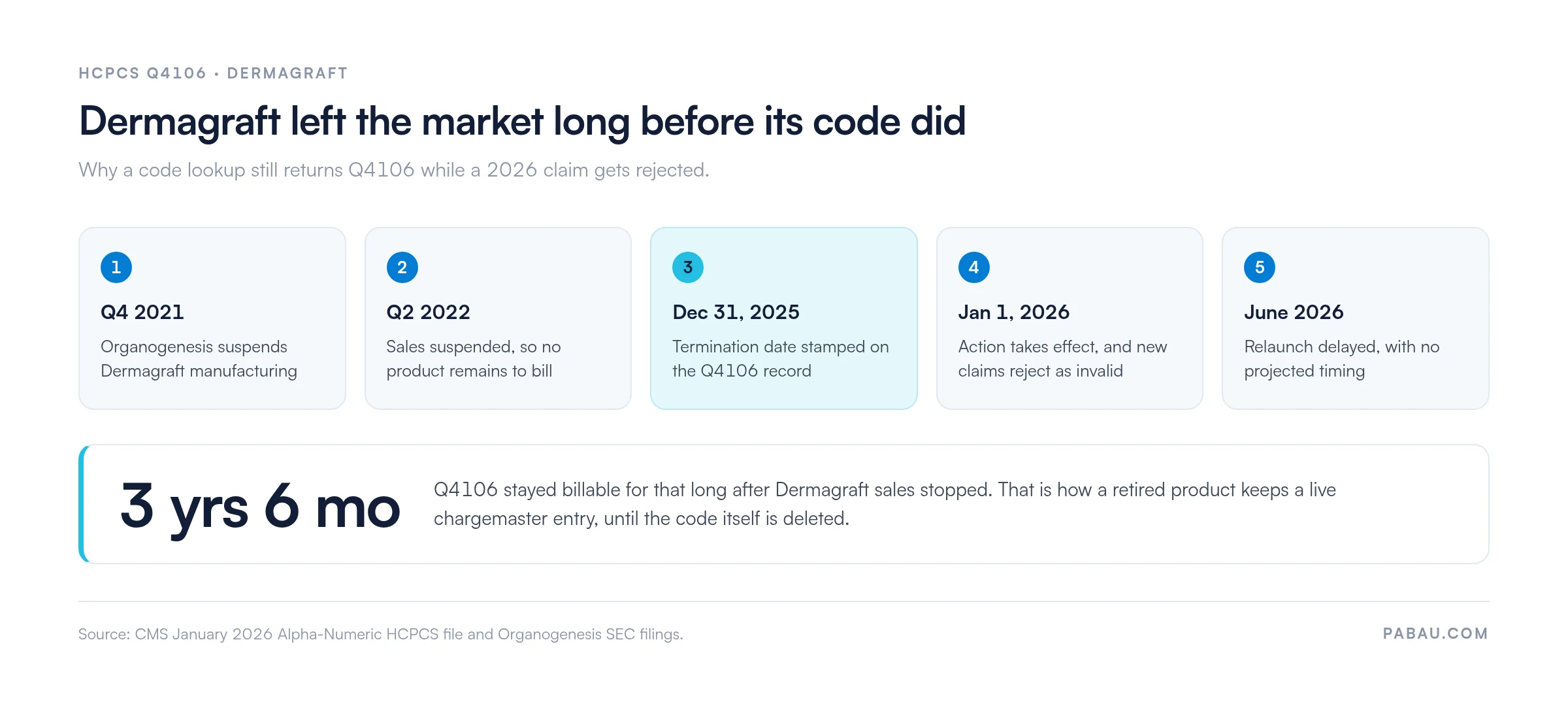
Dermagraft has not been sold since the second quarter of 2022, and Organogenesis has delayed the relaunch with no projected timing
For CY 2026, CMS pays a single national rate of $127.14 per square centimeter for skin substitute products in three new APCs
The high-cost and low-cost skin substitute split is gone, and the low-cost application codes C5271 through C5278 were deleted
Practice management software like Pabau keeps code libraries, wound documentation, and claim submission in one workflow, so retired codes stop reaching payers
No. HCPCS code Q4106 (Dermagraft, per square centimeter) was deleted effective December 31, 2025. It cannot be billed for any date of service on or after January 1, 2026.
The confusion is easy to understand, because the code has not disappeared from the reference files. Q4106 still appears in the CMS January 2026 Alpha-Numeric HCPCS file, which is why plenty of lookup tools still return a result for it. Read the record itself, though, and the answer is unambiguous.
In that file, the Q4106 record carries action code D, which the CMS record layout defines as “discontinue procedure or modifier code”. The termination date field reads 20251231, and the action effective date reads 20260101. The accompanying CMS transaction report lists Q4106 with a single word in the action column: Discontinued.
You can check this yourself in about two minutes. Download the current quarterly file from the CMS HCPCS quarterly update page, open the fixed-width text file, and find the line starting Q4106. Characters 285 to 292 hold the termination date. A third-party code lookup will not always show you that field.
Q4106 was retired because the product behind it is no longer on the market. The wider 2026 skin substitute payment reform did not sweep it away. That distinction matters when you audit the rest of your Q-code list.
Organogenesis has disclosed the Dermagraft timeline in its SEC filings for several years. Manufacturing was suspended in the fourth quarter of 2021. Sales were suspended in the second quarter of 2022. The company planned to restart production at a new biomanufacturing facility in Smithfield, Rhode Island and resume sales by the end of 2027.
That plan has since slipped. Organogenesis said in its quarterly report for the period ended June 30, 2026 that the relaunch is delayed. The filing adds that the company “cannot currently project specific timing”. So there is no billable product, and as of January 1, 2026, no billable code.
Laid out in order, the sequence shows the product leaving the market years before the code did.
The scale of the deletion is worth seeing, because it is smaller than most billing commentary suggests. The January 2026 HCPCS annual update touched 369 codes in the Q4000 series. Only two of them were discontinued.
Counts are taken from the CMS January 2026 HCPCS transaction report. The practical reading is simple. If a Q-code in your chargemaster stopped working in January, a deletion is only likely if the product itself left the market.
Retire the code rather than remap it. There is no successor product code for Dermagraft, so a substitute code would describe a different product than the one your clinician applied. Work through these steps in order.
Whichever product replaced it, bill that product’s own code and unit count. A practice applying Talymed, for example, reports Q4127 per square centimeter alongside the application code.
Practices with a structured denial management process usually catch a retired code within a week. Practices without one tend to discover it during a quarterly reconciliation, several cycles of lost revenue later.
CMS now pays one national rate of $127.14 per square centimeter for skin substitute products, regardless of which product was applied. The rate was set in the CY 2026 OPPS and ASC final rule, published on November 25, 2025.
Two changes landed at once. Products are now paid separately from the procedure that applies them, rather than being packaged into it. And they are grouped by FDA regulatory pathway instead of by average sales price, using three new ambulatory payment classifications.
All three APCs pay the same amount for CY 2026. CMS created a new status indicator, S1, to mark skin substitute products that are paid separately under the OPPS. Every product assigned to APC 6000, 6001 or 6002 carries that indicator.
The framework applies in the physician office (non-facility) setting, the hospital outpatient department, and the ambulatory surgical center. CMS said it will update the category rates annually through rulemaking, using the most recent quarter of average sales price data where that data exists.
Each product still carries its own code and descriptor. A practice that moved to Kerecis Omega3 bills Q4158 per square centimeter, paid at that same national rate. Practices using Biovance, an amniotic membrane allograft, report Q4154 per square centimeter alongside the application code.
Stop quoting per-product reimbursement from a 2025 fee schedule. For CY 2026 every sheet-form skin substitute pays the same $127.14 per square centimeter. Your margin now depends on acquisition cost and documented wound area, rather than on which product you stock.
CMS eliminated the high-cost and low-cost skin substitute categories for CY 2026. If your billing protocol still asks a coder to check a product’s cost tier, drop that step. It is obsolete now, and it only introduces errors.
The low-cost application codes C5271 through C5278 were deleted in the same rule. CPT codes 15271 through 15278 remain, and they now describe skin substitute application for every product rather than only the high-cost group. The add-on codes 15272, 15274, 15276 and 15278 stay packaged in the hospital outpatient setting.
CMS converted the surviving skin substitute product codes into add-on codes so that a product can never be billed without an application procedure. In the January 2026 file, 270 Q4000-series descriptors carry add-on wording that did not appear a quarter earlier.
Q4107 is a good example of the pattern. Its 2025 descriptor read “Graftjacket, per square centimeter”. The 2026 descriptor reads “Graftjacket, per square centimeter (add-on, list separately in addition to primary procedure)”. The code number did not move, so a chargemaster comparison based on code numbers alone will miss the change entirely.
Three unlisted codes were added for products that have FDA authorization but no product-specific code yet. Q4431 covers PMA products, Q4432 covers 510(k) products, and Q4433 covers 361 HCT/P products. Each maps to the matching APC.
Every skin substitute claim must link to an ICD-10-CM diagnosis that establishes medical necessity. The payment reform did not loosen this. The wound type recorded in the chart has to match the diagnosis on the claim.
Always pick the most specific code available. Billing L98.499 for a wound the chart clearly describes as a diabetic foot ulcer is a familiar route to a medical necessity denial. Check the covered diagnosis list in your MAC’s local coverage determination before you submit. If you need the detail behind one of these diagnoses, our ICD-10-CM code reference covers each code on its own page.
Coverage for a skin substitute application is decided by your MAC’s local coverage determination, not by the payment rule. Search the Medicare Coverage Database for the LCD and billing article that apply in your jurisdiction, and read them before the first application. Coverage is not automatic.
Criteria differ by contractor, but most LCDs in this category expect the following:
Prior authorization: Original Medicare does not universally require prior authorization for skin substitute applications, but many Medicare Advantage plans do. Requirements also vary by MAC jurisdiction. Check the individual plan before the appointment, because an application performed without a required authorization is rarely recoverable on appeal.
One more caution for 2026. Several MACs withdrew or revised their skin substitute LCDs around the payment change. A policy your team saved as a PDF last year may no longer be in force. Re-pull the current version rather than working from a local copy.
Incomplete documentation drives more skin substitute denials than coding errors do. A wound care note works as a clinical record and as a billing defense document at the same time. Capturing the required fields at the point of care is far easier than reconstructing them during an audit.
Record the following at every application encounter:
The product identity line matters more in 2026 than it did before. With every product paying the same rate, the code you submit no longer changes the payment. It still has to describe the item on the shelf. Meeting those documentation requirements from the first encounter keeps the record defensible.
Audit your wound documentation template against your MAC’s current LCD before the next application. Make each required element a mandatory field, so an incomplete record cannot be submitted. A single missing wound measurement can void an otherwise compliant claim.
Most avoidable rejections this year come from protocols written for the old rules. The table below covers the errors that surface most often after the January 2026 change.
When a claim is denied, pull the remittance advice remark code and the claim adjustment reason code. Together they name the specific problem and point at the fix. An invalid-code rejection is a chargemaster job, not a resubmission job.
A retired code costs money for as long as it stays in the system. Q4106 is the obvious example. The same pattern repeats every January, when descriptors change and nobody reconciles the chargemaster against the current CMS file.
Practice management software like Pabau keeps the clinical note, the code library, and the claim in one place. When a code is retired, you change it once, and the change reaches every future charge. No spreadsheet has to be circulated for it to take effect. Pabau’s claims management software handles that path end to end.
For wound care teams and dermatology practices billing Q-codes, that means:
The outcome practices notice first is how quickly a CMS change reaches a clean claim. See how it fits your wound care workflow, or book a demo to walk through it with our team.

Pabau connects wound documentation, your code library, and claim submission in one workflow, so a code change reaches every future charge. See how it works for your practice.

Q4106 is a historical code. It described Dermagraft, per square centimeter, and it terminated on December 31, 2025. It should now appear only on closed 2025 claims and in your archive. Any 2026 charge against it will be rejected.
The wider change is the bigger workload. Skin substitute products are paid separately at one national rate of $127.14 per square centimeter. The cost tiers are gone, and product codes now behave as add-on codes. Practices that rewrite their protocol around those three facts will spend far less of 2026 reworking rejections.
If your chargemaster is still carrying codes that CMS retired in January, that is a workflow problem rather than a coding one. Book a demo to see how Pabau keeps documentation, coding, and claims moving together.

Need a complete framework for medical billing workflows? What is medical billing covers the end-to-end billing cycle, from charge capture to payment posting, in plain language for practice teams.
Want to reduce claim denials across your practice? Denial management in healthcare explains how to categorize, track, and systematically reduce denial rates for complex procedure codes.
Still closing out 2025 dates of service? Timely filing limits sets out how long each payer gives you to submit a claim before the revenue is written off.
Need to tighten prior authorization before the visit? The prior authorization process walks through the steps that stop a Medicare Advantage approval from arriving after the appointment.
No. Q4106 (Dermagraft, per square centimeter) was deleted effective December 31, 2025. The CMS January 2026 Alpha-Numeric HCPCS file still lists the code. Its record carries action code D for discontinued, plus a termination date of 20251231. Any claim billing Q4106 for a date of service on or after January 1, 2026 will be rejected as an invalid code.
Nothing replaced it, because the product it described is not on the market. Dermagraft sales were suspended in 2022 and the relaunch has been delayed with no projected timing. Do not remap Q4106 to another Q-code, since every remaining product code describes a specific different product. Bill the code that matches the product your clinician applied.
Yes, within your payer’s timely filing window. The termination date is the last date of service the code covers, not the last date you can submit a claim. Keep the chargemaster entry end-dated rather than deleted, so older claims and any appeals can still be priced and supported.
CMS pays a single national rate of $127.14 per square centimeter for skin substitute products in CY 2026. Products are grouped into three new APCs by FDA regulatory pathway. APC 6000 covers PMA products, APC 6001 covers 510(k) products, and APC 6002 covers 361 HCT/P products. All three pay the same rate, and the product is now paid separately from the application procedure.
No. The CY 2026 OPPS and ASC final rule eliminated the high-cost and low-cost split and deleted the low-cost application codes C5271 through C5278. CPT codes 15271 through 15278 remain and now describe skin substitute application for every product. If your billing protocol still asks a coder to identify a product’s cost tier, that step should be removed.
No. Organogenesis suspended Dermagraft manufacturing in the fourth quarter of 2021 and suspended sales in the second quarter of 2022. The company planned to restart production at a new facility in Smithfield, Rhode Island. Its quarterly report for the period ended June 30, 2026 says the relaunch is delayed, with no specific timing it can currently project.
Record wound measurements in centimeters at every visit. Note the wound type and etiology, and match them to the billed ICD-10-CM code. Confirm the wound has lasted at least four weeks, and show that conservative therapy failed. Add the product name and lot number, plus whether this was a first or subsequent application. Missing any of these gives a payer grounds to deny the claim or recoup after payment.