CCSD code H4430: Examination of rectum under anaesthetic
CCSD code H4430 pays for the examination alone CCSD code H4430 is the UK private...

Last Updated: Oct 20, 2026
L0710 is the HCPCS Level II code for ctlso, anterior-posterior-lateral-control, molded to patient model, with interface material, (minerva type).
Let Pabau's smart automation suggest the right codes, reduce claim denials, and keep your practice compliant—effortlessly.
Automate repetitive tasks and focus on what matters most—your patients.
Reduce coding errors and ensure compliance with the latest regulations.
Clean claims, fewer denials, and faster reimbursements.
Powerful insights and reporting to help your practice thrive.
HIPAA compliant SOC 2 certified GDPR-compliant Trusted by 4,000+ clinics worldwide

HCPCS code L0710 is the custom CTLSO molded to a patient model and built with interface material. CMS calls it a Minerva type.
L0700 is the same custom-molded CTLSO without interface material. L0720 is the prefabricated CTLSO customized to fit at delivery.
Reading L0700 as the prefabricated code is the most expensive mistake in this range. It is custom fabricated, like L0710.
The CTLSO codes sit outside the spinal orthoses LCD that governs TLSO and LSO claims, so the KX routine does not carry over.
Medicare lists L0710 as carrier judgment and carrier priced. Your DME MAC decides both coverage and the allowed amount.
Practice management software like Pabau holds the written order, the fabrication note, the delivery record, and the codes on one claim file.
The full CMS descriptor reads: Cervical-thoracic-lumbar-sacral-orthoses (CTLSO), anterior-posterior-lateral-control, molded to patient model, with interface material (Minerva type). The short descriptor on the claim file is “Ctlso a-p-l control w/ inter”.
Two clauses in that descriptor decide whether L0710 is the right code. “Molded to patient model” makes it custom fabricated. “With interface material” separates it from L0700, which is otherwise the same device.
“Anterior-posterior-lateral control” is not a distinguishing clause here. All three codes in the L0700 to L0720 range carry it. Control planes will never tell you which of the three to bill.
CMS does not define interface material inside the descriptor. In orthotic practice it means a lining or padding layer fabricated into the brace between the rigid shell and the skin. It is built as part of the device, not added afterwards as an accessory.
That distinction has to be visible in your fabrication record. If the record only shows a shell taken from a cast, a reviewer will read the claim as L0700. Photograph or note the interface layer at the time of fabrication.
All three CTLSO codes describe anterior-posterior-lateral control. What separates them is interface material and fabrication method. Read the table below before you assume the low number is the prefabricated one.
The prefabricated code in this range is L0720, not L0700. That single fact reverses the coding logic carried over from the TLSO range, where the lower number is often the off-the-shelf option.
Infant patients sit outside this range. A prefabricated CTLSO immobilizer in an infant size is billed under L1001, not under L0720.
Two questions settle the code, and they run in order. The first asks how the brace was made. The second asks whether an interface layer was built in.
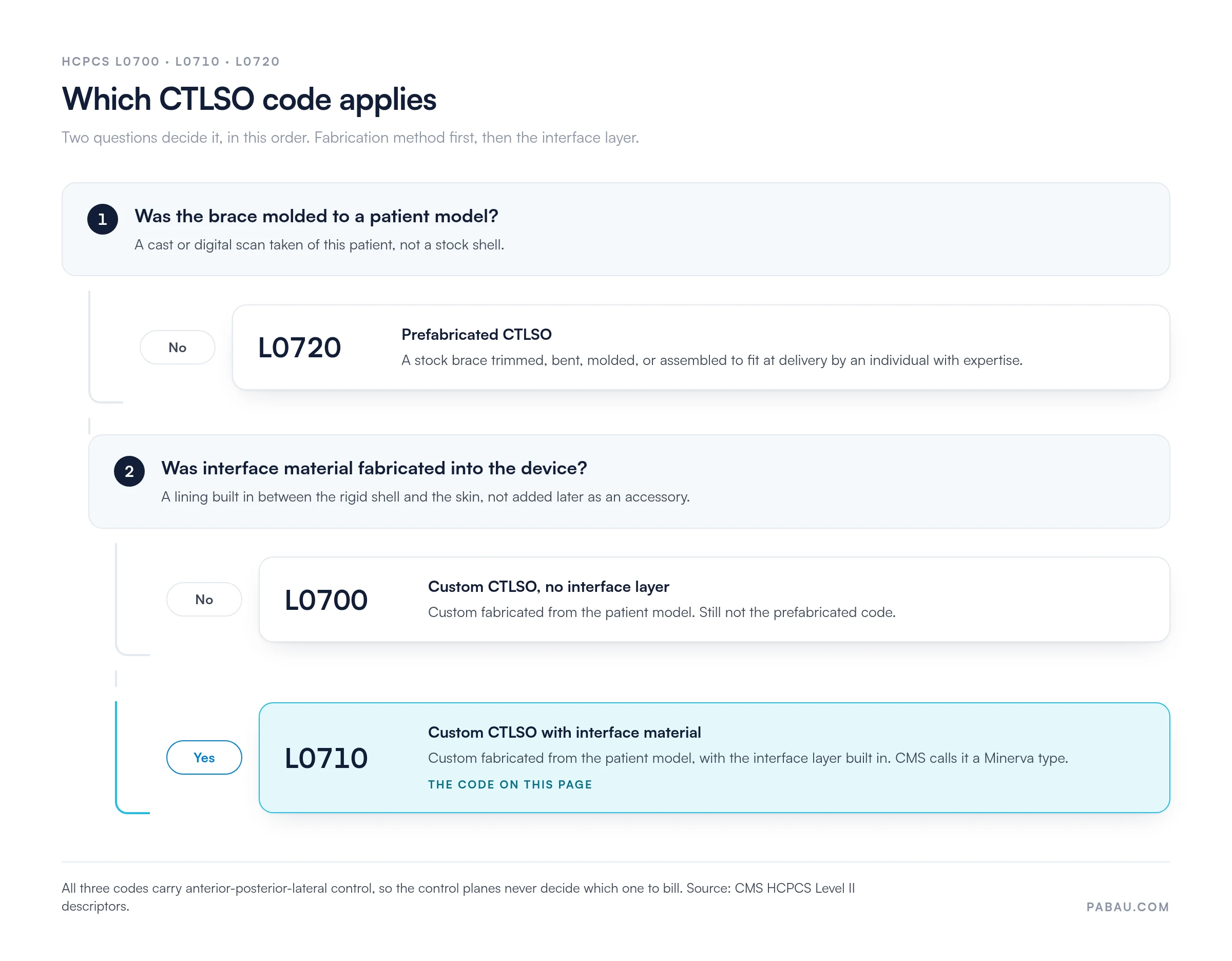
Two errors follow from getting it backwards. Billing a stock CTLSO under L0700 or L0710 is upcoding, and it invites recoupment on audit. Billing a custom Minerva under L0720 underpays the practice for work it already performed.
L0720 also carries its own condition. The customization has to be performed by an individual with expertise, and your record has to name that person. A patient tightening straps at home does not meet the descriptor.
Write the code rationale into the fabrication note while the device is in front of you. One line naming the patient model and the interface layer is what separates L0710 from L0700. Two years later a reviewer will ask, and the orthotist who built it may have moved on.
A CTLSO is a spinal brace that spans the whole axial skeleton, from the cervical spine down to the sacrum. A Minerva-type CTLSO extends up around the head and jaw to restrict cervical motion as well.
The device restricts motion in the sagittal, coronal, and transverse planes at once. That is the level of immobilization a physician orders when a single-segment brace will not hold the spine still enough to heal.
The prescriber establishes medical necessity. A licensed orthotist then takes the cast or digital scan and fabricates the device. Both halves of that work have to appear in the claim file.
CTLSO referrals reach orthotists through spine surgery, neurology, and rehabilitation. The billing entity must hold current DMEPOS accreditation and a Medicare supplier number. A prescriber who is not enrolled as a supplier cannot bill L0710.
Medicare can cover L0710 under the Part B brace benefit, but the decision sits with your DME MAC. The HCPCS record lists the code as carrier judgment, so no national rule sets the criteria in advance.
Payment works the same way. L0710 is carrier priced, which means there is no published national fee schedule amount to quote a patient. The MAC sets the allowance, and it can differ by jurisdiction.
The DME MAC policy that governs most spinal bracing is LCD L33790, Spinal Orthoses: TLSO and LSO. Its covered-code list runs from L0450 to L0651. The CTLSO codes L0700, L0710, and L0720 are not on it.
So the routine that clears a TLSO claim does not transfer. There are no four listed indications to point at, no covered-diagnosis list, and no LCD criteria for a KX modifier to attest to.
The medical record has to do the work the LCD would otherwise do. Document why three-plane control of the full spine, including the cervical segment, was clinically necessary for this patient.
Any site quoting a national fee for L0710 is quoting a number Medicare does not publish. Pull the current allowance from your own MAC, and confirm the code against CMS HCPCS Level II before you quote a patient.
Give the patient a written estimate that says the amount is not final. On a carrier-priced code, the allowed amount arrives with the remittance advice rather than before the claim.
There is no covered-diagnosis list for L0710, because no LCD covers the code. The diagnosis on the claim has to match what the clinical record describes, and no single code makes the claim payable on its own.
The codes below are the ones that commonly appear on CTLSO claims. Confirm each one with the prescribing clinician, and code to the highest level of specificity the record supports.
Pairing the device with a vague diagnosis is a recurring audit finding across DMEPOS. Our library of ICD-10-CM codes covers the spinal and post-surgical codes that pair with an orthotic order.
Assemble the file before the device leaves the building. A carrier-judgment code is reviewed on its record, so the file is the only argument you get to make.
CMS discontinued certificates of medical necessity and DME information forms for dates of service on or after January 1, 2023. Older L0710 billing guides still list a CMN step. Skip it, and put the effort into the clinical record instead.
Run the eligibility check before the cast, not before delivery. A custom Minerva takes days to fabricate and cannot be resold. A coverage problem found at delivery is a device you have already paid to build.
An L0710 claim takes fewer modifiers than a TLSO claim does. Because the code sits outside any LCD, the habits built on TLSO and LSO billing can create the denial they were meant to prevent.
NU, RR, and UE do not belong here. Those modifiers identify payment categories for durable medical equipment, such as capped rental and routinely purchased items. An L-code orthosis is paid as a lump-sum purchase and does not use them.
Most L0710 problems trace back to a coder applying TLSO logic to a CTLSO claim. The two ranges look alike and behave differently.
Denials on a carrier-judgment code are often recoverable within the timely filing window. The problem is usually a missing document rather than a coverage refusal. Our guide to denial management in healthcare covers how to build that recovery workflow.
In most orthotic practices the documents that decide an L0710 claim live in four places. The written order sits with the prescriber and the clinical note in the EMR. The fabrication record is in the workshop and the delivery receipt is in a folder.
Reviewers ask for all four at once. On a carrier-judgment code they ask more often, because no LCD has already settled the question for them.
Practice management software like Pabau stores those documents on the patient record instead. The order, the clinical note, the fabrication note, and the signed delivery record attach to one file. The HCPCS and ICD-10 codes carry through to the claim without retyping.
Pabau’s claims management software then submits and tracks the claim, with US claims going out through its Claim.MD integration. You can see where each submission sits, so a query gets answered from a file that is already assembled.
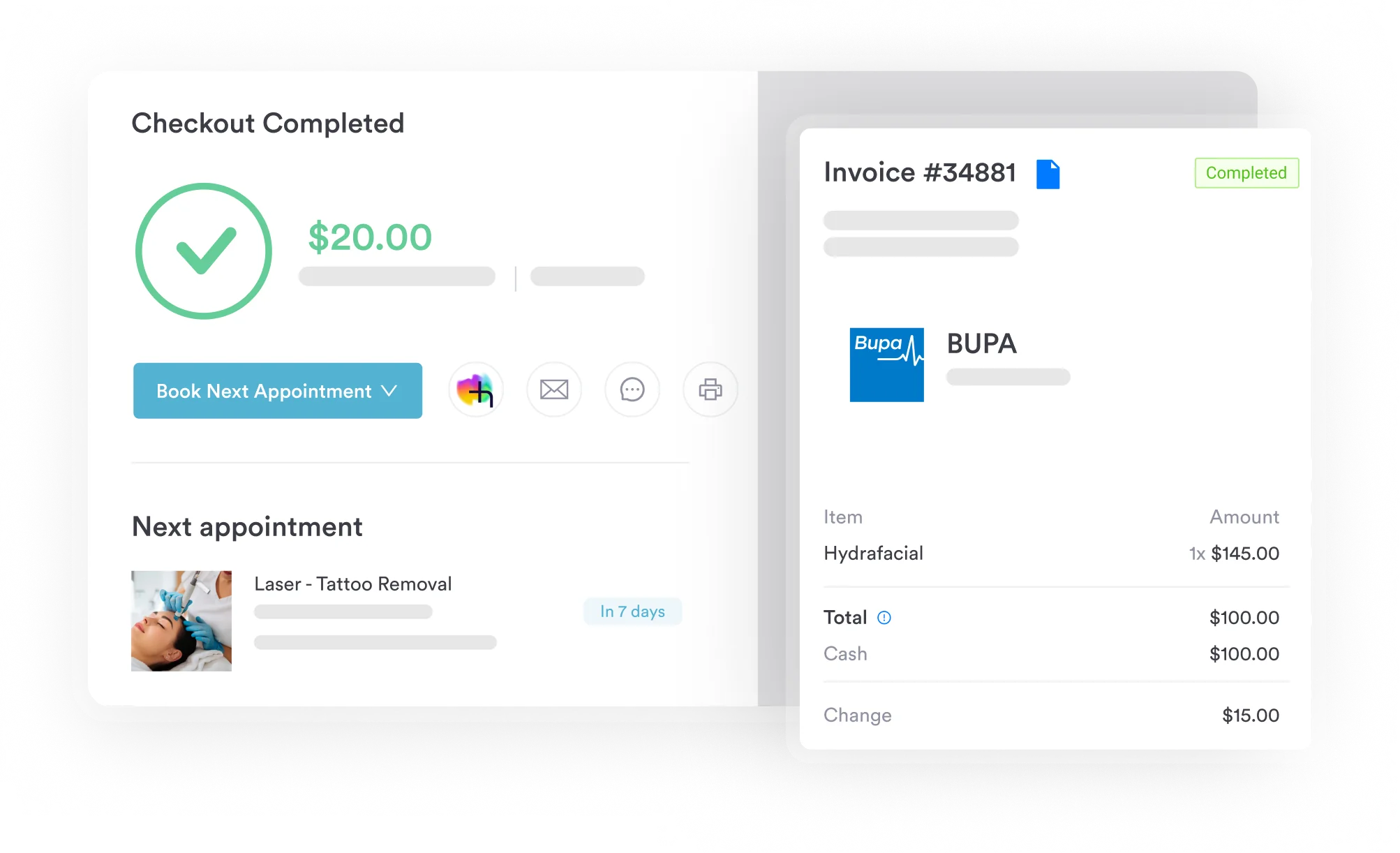

Pabau holds the written order, the fabrication note, and the delivery record on one patient file. Submit the claim and track it through to payment. See how it fits your billing workflow.

L0710 is the custom Minerva-type CTLSO with an interface layer. L0700 is the same brace without that layer, and L0720 is the prefabricated one. Getting that order right is most of the coding decision.
The rest is the file. No LCD sets the criteria for these codes. The written order, the clinical rationale, the fabrication record, and the delivery receipt carry the claim on their own.
If you want to see how Pabau keeps orthotic documentation and claims in one place, book a demo with the team.

Billing the collar rather than a full Minerva? HCPCS code L0180 covers the adjustable multiple-post cervical collar and the documentation it needs.
Need the prefabricated brace one range down? HCPCS code L0464 shows how a modular prefabricated TLSO is described and fitted at delivery.
Working further down the spine? HCPCS code L0650 covers lumbar-sacral orthosis billing, where the spinal orthoses LCD does apply.
Building the billing process from scratch? What is medical billing walks the path from charge capture through to payment posting.
HCPCS code L0710 bills a custom cervical-thoracic-lumbar-sacral orthosis (CTLSO) with anterior-posterior-lateral control, molded to a patient model and fabricated with interface material. CMS calls it a Minerva type. It is billed to Medicare Part B under the brace benefit as a lump-sum purchase.
Both codes describe a custom CTLSO molded to a patient model with anterior-posterior-lateral control. The only difference is interface material, which L0710 includes and L0700 does not. Neither code is the prefabricated option. That is L0720, which covers a stock CTLSO customized to fit by someone with expertise.
L0710 is custom fabricated. The descriptor specifies “molded to patient model”, which requires a cast or digital scan of the individual patient. The prefabricated CTLSO in this range is L0720. Billing a stock brace under L0710 is upcoding and is recoverable on audit.
No. LCD L33790, Spinal Orthoses: TLSO and LSO, lists covered codes from L0450 to L0651. The CTLSO codes L0700, L0710, and L0720 are not on that list. Medicare treats them as carrier judgment, so your DME MAC decides coverage on the record you submit.
Not by default. KX attests that the criteria in an applicable medical policy are met, and no LCD covers the CTLSO codes. Appending it out of TLSO habit adds an attestation that points at nothing. Check your own MAC’s billing instructions before you use it.
You need a standard written order, signed and dated before delivery. You also need clinical records showing why full-spine, three-plane control was necessary. Add a fabrication record naming the patient model and the interface layer, plus a signed proof of delivery. Certificates of medical necessity were discontinued for dates of service from January 1, 2023.
There is no published national amount. L0710 is carrier priced, so the DME MAC sets the allowance and it varies by jurisdiction. Medicare pays 80% of the allowed amount once the annual Part B deductible is met, and the beneficiary is responsible for the remaining 20%.