CCSD code H4430: Examination of rectum under anaesthetic
CCSD code H4430 pays for the examination alone CCSD code H4430 is the UK private...

Last Updated: Oct 20, 2026
L0170 is the HCPCS Level II code for cervical, collar, molded to patient model.
The code sits in the L0100-L0199 spinal orthoses series administered by the Centers for Medicare and Medicaid Services (CMS). The device must be fabricated from a model of the patient, never prefabricated off the shelf. That single detail separates L0170 from every neighboring cervical collar code.
Let Pabau's smart automation suggest the right codes, reduce claim denials, and keep your practice compliant—effortlessly.
Automate repetitive tasks and focus on what matters most—your patients.
Reduce coding errors and ensure compliance with the latest regulations.
Clean claims, fewer denials, and faster reimbursements.
Powerful insights and reporting to help your practice thrive.
HIPAA compliant SOC 2 certified GDPR-compliant Trusted by 4,000+ clinics worldwide

HCPCS code L0170 describes a cervical collar molded to a patient model, classified as a Level II HCPCS DME orthotic code under Medicare Part B.
L0170 does not require PDAC coding verification before billing, unlike L0174, which does require PDAC listing.
Medicare Part B covers L0170 when medical necessity is documented, but reimbursement rates vary by geographic locality under the CMS DME fee schedule.
CMS applies a 5-year minimum reasonable useful lifetime to orthotics, so a replacement L0170 inside that window needs loss, theft, or irreparable damage.
Practice management software like Pabau supports HCPCS claim submission workflows, including documentation tracking and denial management for DME suppliers.
The table below summarizes the key code attributes DME suppliers and billers need before submitting a claim.
The 2026 validity status reflects data from the CMS HCPCS annual update. Confirm it against the current CMS HCPCS release file before submitting claims for the new benefit year.
Medicare reimbursement for L0170 falls under the CMS DME fee schedule, which uses a locality-based pricing model. The allowed amount varies by geographic region. Pull the current rate for your own DMERC jurisdiction before quoting a patient a cost-sharing figure.
Use the CMS Physician Fee Schedule lookup tool and select the DME fee schedule. It returns the precise allowed amount for L0170 by state and locality. Rates are updated annually on January 1.
A few practical points on the fee schedule for cervical orthosis billing:
Accurate superbill generation that carries the correct HCPCS code, diagnosis code, and fee schedule amount reduces back-and-forth with Medicare contractors.
HCPCS code L0170 is covered under Medicare Part B as durable medical equipment when the treating physician or authorized prescriber documents medical necessity. Coverage is not automatic. The supplier must hold a valid Medicare DME supplier number, and the claim must be supported by a physician order and medical necessity documentation.
Confirming active coverage before dispensing protects both the supplier and the beneficiary. Run insurance eligibility verification to confirm Part B enrollment and any secondary payer details before the device is delivered.
Key coverage conditions for L0170:
Medicare and most commercial payers require clinical justification before reimbursing a molded cervical collar. The prescribing provider’s documentation must establish that a custom-molded device is necessary rather than an off-the-shelf prefabricated collar.
Clinical conditions that commonly support medical necessity for L0170 include:
The operative words are “molded to patient model.” The prescriber’s notes should explain why the patient’s anatomy, severity of condition, or treatment goals require a custom-fit device rather than a prefabricated collar. Managing that documentation proactively is a core part of billing compliance for DME suppliers.
Pairing the correct ICD-10-CM diagnosis code with HCPCS code L0170 is what establishes medical necessity on the claim. The table below lists commonly accepted diagnosis codes for cervical orthosis billing.
Always verify diagnosis code pairings against the current HCPCS code reference and the applicable Local Coverage Determinations (LCDs) for your DMERC jurisdiction. LCD requirements vary by MAC region and may name additional covered diagnoses or documentation criteria. Our ICD-10-CM code library carries the full descriptor and billable status for each diagnosis in the table above.
Incomplete documentation is the leading cause of L0170 claim denials during Recovery Audit Contractor (RAC) reviews. CMS requires a specific set of documents to support payment for a custom-molded cervical collar.
Required documentation for HCPCS code L0170 claims:
Retain every L0170 record for a minimum of 7 years, and be ready to produce it promptly when a Medicare contractor requests it.
Audit your L0170 claim files before submission: confirm the DWO is signed and dated before the delivery date, not after. Post-dated physician orders are one of the top three reasons RAC auditors demand repayment on cervical orthosis claims.
No. HCPCS code L0170 does not require PDAC coding verification. That is the single most important compliance distinction for DME suppliers billing cervical orthoses.
The Pricing, Data Analysis and Coding (PDAC) contractor manages a coding verification program for certain off-the-shelf DME items. Before billing those codes, suppliers must confirm that the product they are dispensing appears on the PDAC coding verification list for that code. Missing this step can result in claim denials, even when the device is clinically appropriate.
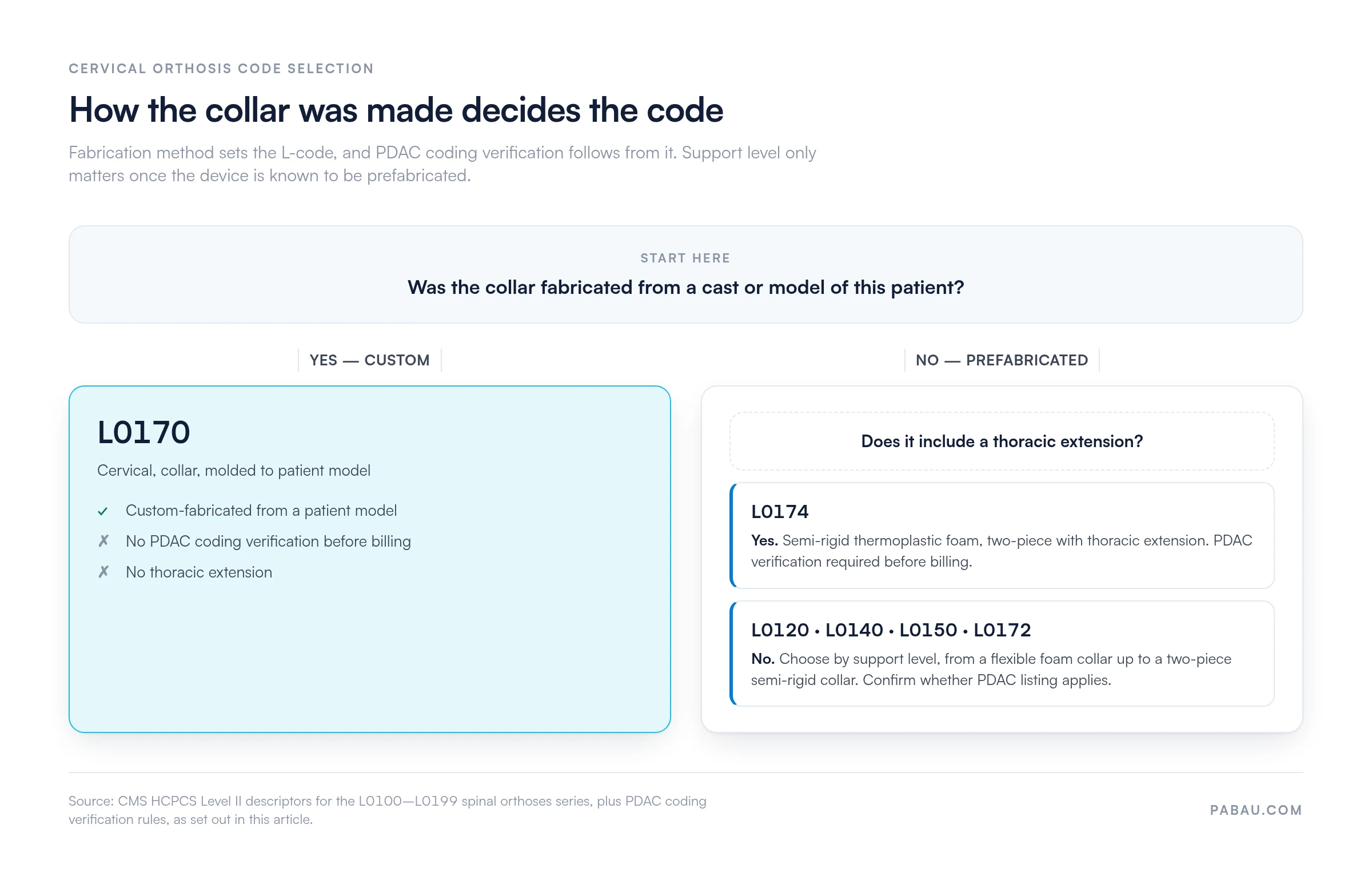
L0170 is exempt because it describes a custom-fabricated device rather than a manufactured product sold from a catalog. The PDAC program applies to prefabricated items, where CMS needs to confirm that a commercially manufactured device meets the code’s criteria. A custom-molded device is a patient-specific fabrication, so there is no product listing to verify.
L0174 (semi-rigid with thoracic extension, prefabricated) does require PDAC verification before billing. Suppliers who apply L0174 billing logic to L0170 claims, or the reverse, create compliance exposure. For CGS Medicare’s guidance on coding verification requirements, review the CGS Medicare coding verification guidance.
L0170 sits within the L0112-L0174 range of cervical spine orthosis codes. Selecting the correct code requires knowing how the device was made and what level of support it provides.
Misassigning L0140 or L0172 when a custom-molded device was actually dispensed results in underpayment. Misassigning L0170 to a prefabricated device is a false claim risk. Document the fabrication method clearly in the patient record.
These two codes are regularly confused because they describe devices that look similar to patients but carry entirely different billing implications.
One practical rule settles most cases. If the orthosis was fabricated from a cast or scan of the patient’s neck, L0170 applies. If it came from a manufacturer’s catalog and was fit from a range of stock sizes, confirm whether PDAC listing applies. The decision tree below runs that rule across the whole cervical range.
Most L0170 denials are avoidable. The errors tend to cluster around incomplete documentation, an incorrect place of service, and missing modifiers rather than clinical coding mistakes.
Use this checklist before submitting any L0170 claim:
Effective revenue cycle management for DME suppliers means tracking the denial rate by code, not only the initial submission. If L0170 denials cluster around documentation requests, that usually points to a breakdown in how the DWO and medical necessity notes get collected before dispensing.
When a claim denies, act quickly. Most Medicare DME MACs allow a redetermination request within 120 days of the remittance date. Review the electronic remittance advice (ERA) for the specific Claim Adjustment Reason Code (CARC) and Remittance Advice Remark Code (RARC) before appealing.
Reading those codes closely lets suppliers build a corrective action plan, so the same error does not repeat across a run of claims. Submitting a clean claim the first time avoids the 60 to 90 day payment delay that redetermination cycles add to cash flow.
Set up a pre-submission checklist specific to L0170. Confirm the DWO is signed before the delivery date, the NU modifier is appended, and the patient’s home address is the POS. Verify the ordering NPI against Medicare enrollment. Running this check before transmitting eliminates the most common denial triggers.
Most DME suppliers keep an L0170 file in three places at once. The written order sits in a fax folder and the delivery ticket sits on a shared drive. The remittance lands in a payer portal nobody opens daily. Assembling that file again for an audit takes hours.
Pabau keeps the order, the model record, the proof of delivery, and the claim on one patient timeline. Our claims management software flags an L0170 file that is missing a signed DWO before the claim is transmitted, rather than after the remittance arrives.
Denials are grouped by reason code as they come back, so a supplier can see whether L0170 rejections trace to documentation, modifiers, or prescriber enrollment. That turns a scattered denial log into one corrective action, and it shortens the path from fitting to payment.

Pabau’s claims management software helps DME suppliers and orthotic providers track documentation, submit clean claims, and manage denials for HCPCS codes including L0170. See how it works for your practice.

L0170 turns on one question: How was the collar made? A collar built from a cast or scan of this patient’s neck earns the code. A collar taken out of a box belongs somewhere else in the L0100 range.
Get that call right and the rest of the claim follows. The DWO explains the custom fit, the model record proves it, and the delivery date sets the date of service. Get it wrong in either direction and you are choosing between underpayment and a false-claims problem.
The trade-off worth remembering is that L0170 pays more than its prefabricated neighbors because it carries more documentation, not less. Book a demo to see how Pabau holds that documentation together for every cervical orthosis claim you bill.

Need to understand how claims move through the system? What is revenue cycle management explains the end-to-end billing pathway from patient intake to payment posting.
Billing for other orthotic or DME codes? Medical billing fundamentals covers payer requirements, claim formats, and common coding pitfalls across DME categories.
Want to reduce your denial rate on HCPCS claims? Submitting a clean claim walks through the elements that prevent first-pass denials on Medicare DME submissions.
HCPCS code L0170 is a Level II HCPCS code with the official descriptor “Cervical, collar, molded to patient model.” DME suppliers and orthotic providers use it to bill Medicare Part B and commercial payers. It covers a cervical collar individually fabricated from a cast or model of the patient’s neck, not a prefabricated off-the-shelf device.
No. HCPCS code L0170 does not require PDAC coding verification before billing. Because L0170 describes a custom-fabricated device made from a patient model, the PDAC verification program does not apply. By contrast, L0174 (prefabricated with thoracic extension) does require PDAC verification, so suppliers should confirm which code applies first.
Yes. L0170 is covered under Medicare Part B as durable medical equipment when the treating physician documents medical necessity. The supplier must also hold a valid Medicare DME supplier number. Medicare typically pays 80% of the allowed amount after the Part B deductible, with the beneficiary responsible for the remaining 20%.
The 2026 Medicare allowed amount for L0170 varies by geographic locality under the CMS DME fee schedule. Suppliers should use the CMS Physician Fee Schedule lookup tool to retrieve the current allowed amount. Select the DME fee schedule and your own MAC jurisdiction. Rates are updated on January 1 each year.
L0170 describes a cervical collar custom-molded to the patient’s specific anatomy and does not require PDAC verification. L0174 describes a prefabricated semi-rigid collar with a thoracic extension. It requires PDAC coding verification before it can be billed to Medicare. The key clinical distinction is fabrication method: custom-made versus manufactured off-the-shelf.
Commonly accepted ICD-10-CM diagnosis codes for L0170 include M47.812 (cervical spondylosis with radiculopathy) and S13.4XXA (cervical sprain, initial encounter). M50.10 (cervical disc degeneration) and S12.000A (cervical fracture) also apply. Always confirm pairings against the applicable Local Coverage Determination for your DMERC jurisdiction, as covered diagnoses vary by MAC region.
CMS applies a statutory reasonable useful lifetime of at least 5 years to DME and orthotics. A beneficiary cannot receive a Medicare-funded replacement L0170 inside that window unless the original device was lost, stolen, or irreparably damaged. Document the reason for any early replacement in the patient record.