CCSD code H4430: Examination of rectum under anaesthetic
CCSD code H4430 pays for the examination alone CCSD code H4430 is the UK private...

Last Updated: Oct 20, 2026
J3465 is the HCPCS Level II code for injection, voriconazole, 10 mg.
Let Pabau's smart automation suggest the right codes, reduce claim denials, and keep your practice compliant—effortlessly.
Automate repetitive tasks and focus on what matters most—your patients.
Reduce coding errors and ensure compliance with the latest regulations.
Clean claims, fewer denials, and faster reimbursements.
Powerful insights and reporting to help your practice thrive.
HIPAA compliant SOC 2 certified GDPR-compliant Trusted by 4,000+ clinics worldwide
HCPCS Code J3465 is the code for injection, voriconazole, 10 mg, billed as one unit for every 10 mg administered. It pays for the drug alone, not the infusion. Medicare Part B reimburses it at the average sales price (ASP) plus 6% in the physician office.
Voriconazole is a triazole antifungal approved by the FDA for serious invasive fungal infections. Pfizer markets the intravenous form as Vfend IV. J3465 sits in the J-series of HCPCS Level II, the CMS code set for drugs given other than orally.
The code was added to the HCPCS file on January 1, 2004, and its most recent action took effect on January 1, 2019. It remains valid and billable for fiscal year 2026. Any claim for IV voriconazole in an outpatient or office setting uses J3465, not the unclassified drug code J3490.

HCPCS Code J3465 covers injection, voriconazole, 10 mg, billed as one unit for every 10 mg administered.
Medicare Part B pays J3465 at ASP plus 6% in the physician office, priced from the quarterly CMS ASP Drug Pricing File.
Every claim carries the 11-digit NDC of the product given, reported after the N4 qualifier on an 837P.
JW reports discarded drug, and JZ attests zero waste on single-dose vial claims from July 1, 2023 onward.
Pabau’s claims management tools capture the administration detail at the chair, so the drug line submits with its supporting fields.
Voriconazole’s FDA-approved indications include invasive aspergillosis, candidemia in non-neutropenic patients, disseminated Candida infections, esophageal candidiasis, and certain rare mold infections (Scedosporium and Fusarium species). Only claims supported by a covered diagnosis will pass medical necessity review. Billing J3465 against an unsupported ICD-10 code is a leading cause of denials for this drug.
Medicare Part B pays for HCPCS Code J3465 under the average sales price (ASP) methodology. CMS updates ASP rates quarterly, so the figures below are benchmarks only. Pull the current quarter’s ASP Drug Pricing File before you submit. Billing against a stale rate leaves the practice absorbing the difference on every vial.
Confirm the current payment amount in the quarterly CMS ASP Drug Pricing File, which sets the Part B payment limits for J-codes. The Physician Fee Schedule does not price J3465, so the MPFS lookup tool will not answer this question. The 6% add-on applies to the drug cost, and the infusion is paid separately under CPT codes 96365 to 96368.
Commercial payer rates vary significantly. Some payers reimburse at ASP + a higher or lower percentage; others use wholesale acquisition cost (WAC)-based pricing. Always verify contracted rates with each commercial payer before billing. Buy-and-bill practices should model their acquisition cost against expected reimbursement to confirm margin viability on a payer-by-payer basis.
Voriconazole is typically dosed in milligrams per kilogram of body weight. That means the units billed on the claim will differ from patient to patient. Getting the quantity right is where many practices make costly errors. A standard adult loading dose of 400 mg, for example, requires billing 40 units of J3465 (40 units x 10 mg each = 400 mg).
A clean J3465 line turns on four fields: quantity, NDC, place of service, and the administration code. Miss one and the line is likely to deny. Integrated claims management software that enforces those fields at charge entry cuts the rework later.
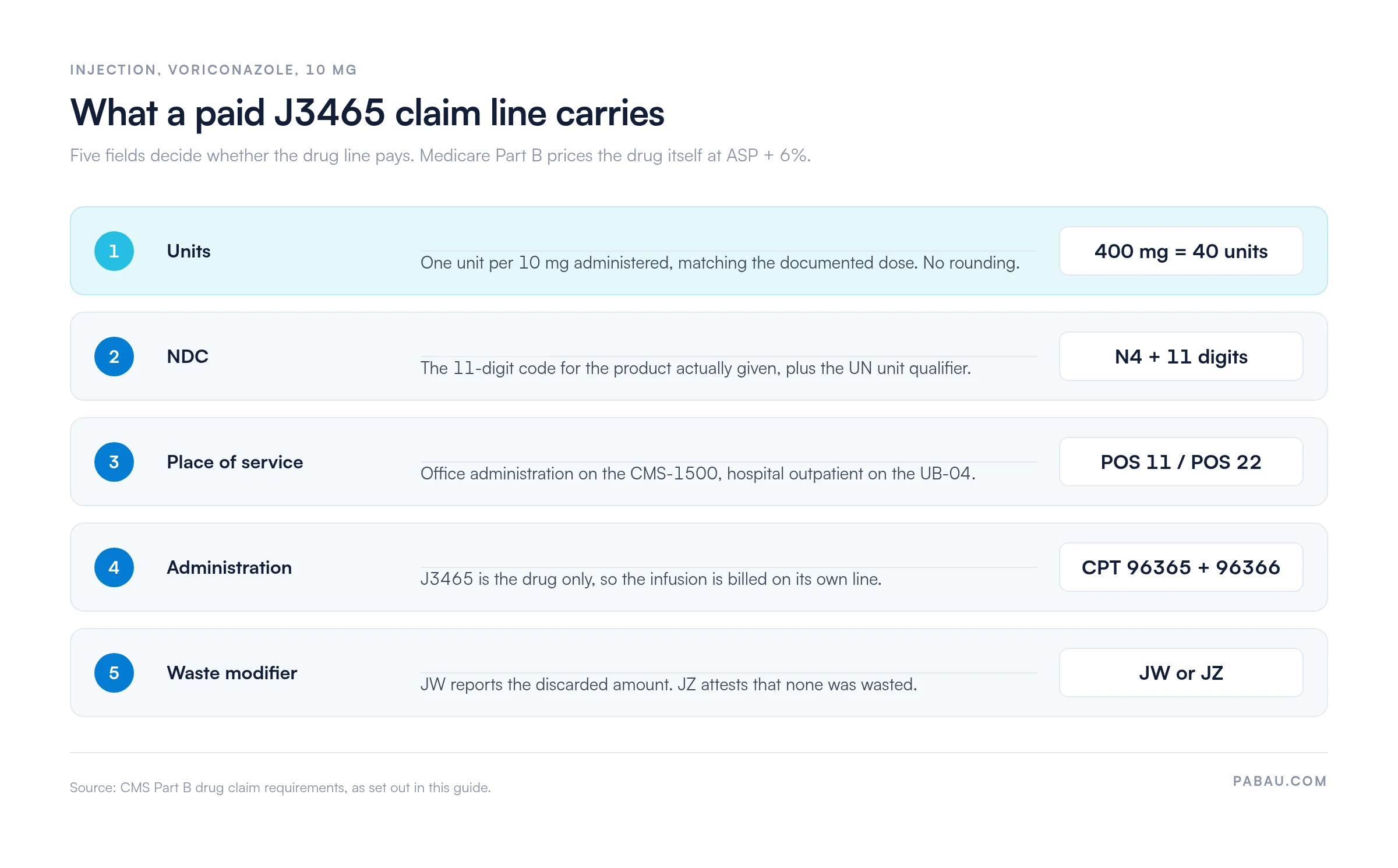
Bill one unit of J3465 per 10 mg of voriconazole administered. Do not round down. If 390 mg is given, bill 39 units. Most payers expect the quantity field to reflect the exact dose administered, not a rounded or average dose. Document the administered dose clearly in the treatment note to support the units billed.
CMS requires the 11-digit National Drug Code (NDC) on every Part B drug claim. For J3465, include the NDC of the voriconazole product used. Add the unit qualifier (UN for units) and the quantity dispensed in NDC units. Failure to include the NDC is a hard-edit denial under CMS Medicare Claims Processing Manual Chapter 17. On an electronic claim (837P), report the qualifier N4 immediately followed by the 11-digit NDC number.
Use POS 11 (physician office) for in-office administration on a CMS-1500. Hospital outpatient claims use POS 22 on the UB-04 form. The POS directly affects which fee schedule applies and how Medicare calculates reimbursement. Mismatched POS codes are a common source of incorrect payment and subsequent recoupment.
J3465 covers the drug only, so the IV infusion is billed separately. Use CPT 96365 for the initial hour of therapeutic infusion, and CPT 96366 for each additional hour. Pair them with J3465 on the same claim date. Without an administration code, the drug line can be questioned as lacking a billable service.
Audit your J3465 claims monthly for missing NDC numbers and mismatched units. Pull a report of every claim where the units billed are round numbers like 10, 20, or 30. That pattern usually means staff are rounding instead of billing the dose given. Rounding underbills the drug and creates audit risk.
CMS has specific modifier rules for J-series drug codes. Applying the wrong modifier (or omitting a required one) leads to denials, recoupment requests, or OIG scrutiny. The two most critical modifiers for J3465 are JW and JZ.
CMS’s JW/JZ policy requires practices to document the waste event in the medical record, including the amount wasted and the reason. Billing JW without that documentation in the chart is an audit trigger. JZ reporting opened as optional on January 1, 2023. CMS then made it mandatory on single-dose vial claims with no waste for dates of service on or after July 1, 2023. Check with your Medicare Administrative Contractor (MAC) for local policy variations.
Every J3465 claim requires a linked ICD-10-CM diagnosis code that establishes medical necessity. CMS and commercial payers review the reported diagnosis against their Local Coverage Determinations (LCDs) and National Coverage Determinations (NCDs) for antifungal agents. The table below lists the most commonly paired ICD-10 codes. Use the most specific code applicable to the patient’s confirmed diagnosis.
Always code to the highest level of specificity. Payers audit J3465 claims against published LCD criteria. If the patient’s diagnosis does not appear on the covered-diagnosis list in your MAC’s LCD for antifungal agents, document the clinical rationale thoroughly before billing. Using a more general code to avoid LCD review is a compliance risk.
Medicare Part B does not currently require prior authorization (PA) for HCPCS Code J3465. Most commercial and managed care payers do require PA before IV voriconazole is administered. Failing to obtain authorization when required leaves the practice holding the cost of a high-priced drug with no reimbursement path. Run the benefit check and the PA before infusion day, not on it.
PA requirements for commercial payers are subject to change. Verify with each payer at the time of service, not at the time of authorization, since formulary tiers can change mid-year.
A covered ICD-10 code gets the claim through the front door. Surviving a post-payment review takes the chart behind it. Recoupments on J3465 usually trace back to one of three thin spots: the evidence that confirmed the infection, the physician order, or the dose calculation.
Recovery Audit Contractors (RACs) target high-cost antifungals, so the documentation standard on injectables is higher than on an office visit. Templates tied to charge capture keep the administered dose and the billed units in step. Administration records also have to stay secure and retrievable inside the CMS response window when a records request lands.
Flag every J3465 claim for a documentation completeness check before submission. The checklist runs to five points. Confirm the diagnosis is supported by lab or imaging, and that the weight and dose calculation sit in the chart. Then confirm the NDC is in the nursing note, the JW or JZ decision is documented, and the administration code is on the claim. Those five catch most denial triggers before the claim leaves your practice.
Billers working voriconazole claims need the companion service codes, plus the rule for when J3465 is the wrong choice. Our HCPCS billing guides cover the neighboring drug codes that follow the same unit and NDC rules.
J3490 should never stand in for J3465. An unclassified code adds documentation work, since payers usually want an invoice or a letter of medical necessity with the claim. It also slows payment. Check the current HCPCS release to confirm a code is still active before you bill it.
In most practices the drug is recorded in one system and billed from another. A nurse notes the dose and the vial in the chart. Days later a biller retypes the units, the NDC, and the waste modifier into the claim. Every retype is a chance to drop a field the payer checks.
Pabau, practice management software for medical and aesthetic practices, keeps that detail on the patient record instead. The administered dose, the product used, and the infusion time are captured where the treatment happens, then carried into charge capture. The biller works from what the clinician documented rather than from a second transcription.
Claims management in Pabau then holds the drug line together before submission, with the unit count tied to the documented dose. Fewer J3465 lines come back for a missing NDC or an unsupported unit count. Your team spends less time reworking claims it already billed once.

Pabau’s integrated claims management tools help you capture drug administration details, enforce NDC documentation, and submit cleaner J-code claims. See how it works in a live demo.

Billing voriconazole is a documentation problem more than a coding problem. The code is unambiguous, the unit is 10 mg, and CMS republishes the payment basis every quarter. What decides the outcome is whether the chart shows the dose given, the product used, and what happened to the rest of the vial.
Capture those three at the point of care and J3465 denials become rare. Leave them to be reconstructed at billing and the practice eventually eats the cost of an expensive drug. Book a demo to see how Pabau keeps drug administration detail attached to the claim that bills it.

Confused about when a denial is appealable? Denial management in healthcare covers the full appeals workflow for claim denials, including documentation strategies for J-code disputes.
Need a cleaner claims process? Pabau’s claims management software integrates documentation and charge capture to reduce drug billing errors from the point of administration.
Want to understand how drug claims move through the revenue cycle? Revenue cycle management explained breaks down each stage from charge capture to payment posting for specialty practices.
HCPCS Code J3465 is used to report the injection of voriconazole at 10 mg per billing unit, administered intravenously in outpatient or physician office settings. Voriconazole (brand name Vfend IV) is a triazole antifungal. It treats invasive aspergillosis, candidemia, invasive candidiasis, and rare mold infections caused by Scedosporium and Fusarium species.
Bill one unit of J3465 for every 10 mg of voriconazole administered. A 400 mg dose requires 40 units; a 350 mg dose requires 35 units. Never round to the nearest 10. Document the dose administered in the nursing record, since that is the source document auditors use to validate the billed units.
Medicare Part B reimburses J3465 at ASP + 6% in the physician office setting. Rates are updated quarterly by CMS. Check the current CMS ASP Drug Pricing File for the applicable quarter before billing. Rates change, and billing against stale data leads to underpayments or adjustments.
Yes. CMS requires the 11-digit National Drug Code (NDC) on every Part B drug claim, including J3465. Submit the NDC with qualifier N4, the unit qualifier (UN), and the quantity dispensed. Missing the NDC is a hard-edit denial under CMS Medicare Claims Processing Manual Chapter 17.
Medicare Part B does not currently require prior authorization for J3465, but most commercial payers do. Requirements vary by payer, plan, and formulary tier. Verify PA requirements before each infusion encounter and submit authorization requests with J3465 (not J3490) to avoid code-mismatch denials at adjudication.