Inpatient billing cheat sheet
An inpatient billing cheat sheet is a quick reference for the codes and claim ru...

Last Updated: Oct 19, 2026
J2562 is the HCPCS Level II code for injection, plerixafor, 1 mg.
Plerixafor is supplied in a 24 mg single-dose vial, and most doses leave part of that vial unused. That makes wastage reporting the part of a J2562 claim most likely to go wrong.
Let Pabau's smart automation suggest the right codes, reduce claim denials, and keep your practice compliant—effortlessly.
Automate repetitive tasks and focus on what matters most—your patients.
Reduce coding errors and ensure compliance with the latest regulations.
Clean claims, fewer denials, and faster reimbursements.
Powerful insights and reporting to help your practice thrive.
HIPAA compliant SOC 2 certified GDPR-compliant Trusted by 4,000+ clinics worldwide

HCPCS code J2562 describes injection of plerixafor, 1 mg, and one billable unit equals 1 mg of the drug.
Bill one unit per milligram administered, after rounding the weight-based dose to the nearest whole milligram.
Modifier JZ has been mandatory on zero-wastage single-dose vial lines since July 1, 2023, with rejections from October 1, 2023.
Modifier JW reports the discarded amount on its own line, so both lines together account for the whole vial.
Practice management software like Pabau tracks units, modifiers, and NDC entries on one claim line before submission.
HCPCS code J2562 is a Level II HCPCS drug code maintained by the Centers for Medicare and Medicaid Services (CMS). Each billable unit represents 1 mg of plerixafor delivered by injection. The code is active for fiscal year 2026 with no termination date currently assigned.
J2562 falls under Medicare Part B as a physician-administered drug. The practice buys the vial, administers it, and bills the payer directly, a model known as buy-and-bill. Acquisition cost, wastage, and reimbursement rate therefore all land inside the same revenue cycle.
Plerixafor is the active pharmaceutical ingredient billed under HCPCS code J2562. It is marketed as Mozobil by Genzyme, a Sanofi company, and was approved by the FDA under NDA 022311 for hematopoietic stem cell mobilization. Coders need that clinical context, because payers ask for medical necessity documentation tied to the approved indication.
Plerixafor blocks the CXCR4 receptor on hematopoietic stem cells. That stops stromal cell-derived factor-1-alpha (SDF-1) from anchoring those cells in bone marrow, and releases them into the bloodstream where apheresis can harvest them. It is always given alongside granulocyte colony-stimulating factor (G-CSF, such as filgrastim) to improve mobilization yield.
The FDA approval covers only NHL and MM patients undergoing autologous stem cell transplantation. Any off-label use needs payer-specific verification before you bill J2562, because coverage outside the label varies widely by plan.
Medicare Part B reimburses plerixafor under the Average Sales Price (ASP) methodology. The payment rate is typically ASP plus 6%, the standard formula CMS applies to most physician-administered drugs. ASP rates are updated quarterly, so no static dollar figure stays accurate across reporting periods.
Verify the current rate in the CMS Physician Fee Schedule lookup tool or the quarterly CMS ASP Drug Pricing file before you submit. Quoting a rate from a prior quarter is a common cause of revenue shortfall when ASP moves after a price negotiation cycle.
Buy-and-bill also creates a cash flow timing risk on high-cost injectables. The practice pays acquisition cost up front, administers the drug, then waits for reimbursement at ASP plus 6%. When acquisition cost climbs above ASP, during a contract renegotiation or a supply disruption, the practice absorbs the margin loss. Compare each quarterly ASP filing against your current acquisition contract, so a shortfall never arrives as a surprise.
Check CMS’s ASP Drug Pricing file every quarter before your billing cycle closes, because plerixafor reimbursement can shift meaningfully between quarters. Set a reminder for the first week of January, April, July, and October. Pull the updated file and compare it to your acquisition contract pricing before you submit pending claims.
Each unit of HCPCS code J2562 equals 1 mg of plerixafor, and dosing is weight-based at 0.24 mg/kg of actual body weight. Multiply the patient’s weight in kilograms by 0.24, round to the nearest whole milligram, then bill that number of units.
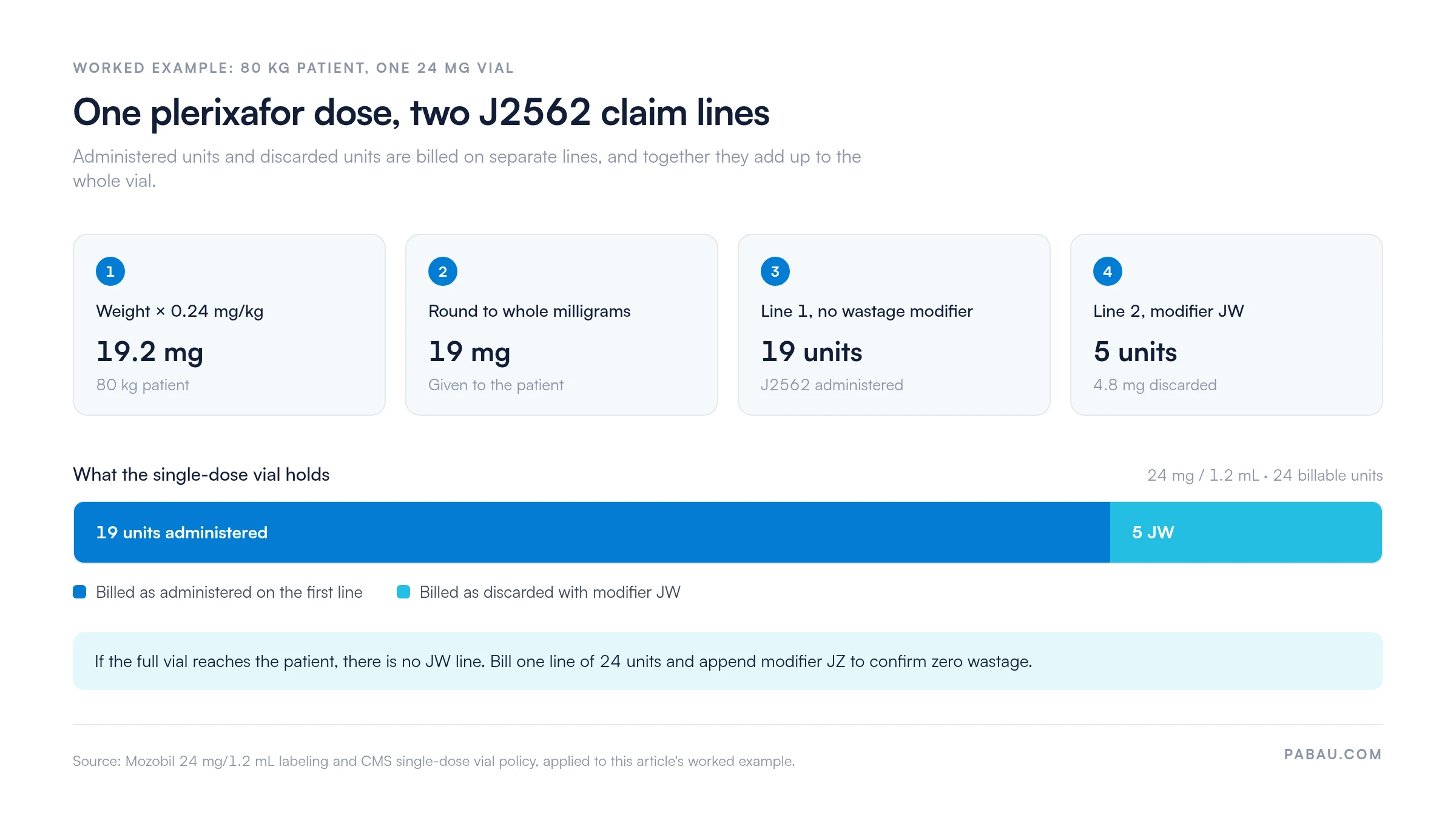
Worked example. A patient weighing 80 kg receives 19.2 mg (80 x 0.24), which rounds to 19 mg. Bill 19 units of J2562 for the administered dose. The 24 mg vial still holds 4.8 mg, and that discarded amount rounds to 5 units reported separately with modifier JW.
The two lines are worth checking against each other before submission. Nineteen administered units plus five wasted units equal 24, the exact contents of the vial. When the two lines do not add up to the vial size, one of the numbers is wrong.
CMS opened voluntary JZ reporting on January 1, 2023. Reporting became mandatory on July 1, 2023, and contractors began rejecting non-compliant claims for dates of service on or after October 1, 2023. Three modifiers govern plerixafor claim lines.
Earlier CMS guidance asked for no modifier at all when a single-dose vial was fully used. That history is why the JZ requirement still catches billing teams out. Under CMS Change Request 13056, issued as Transmittal 12067 on June 2, 2023, every single-dose vial drug line must carry either JW or JZ. A J2562 line with neither modifier draws a technical denial from most Medicare Administrative Contractors.
Most payers require National Drug Code (NDC) reporting for physician-administered drugs billed under J-codes. On a CMS-1500 claim, the NDC goes in the shaded area of Box 24. Enter qualifier N4, then the 11-digit NDC, then the unit of measure. A missing NDC is a leading cause of commercial payer denials for J2562.
Mozobil is manufactured by Genzyme, a Sanofi company, and supplied as a single-dose vial of 24 mg/1.2 mL (20 mg/mL). The NDC details below apply to that commercially marketed formulation. Confirm current NDC numbers against the AAPC HCPCS code reference or your wholesaler’s catalog, since package sizes and labeler codes change during product lifecycle updates.
When your system carries several plerixafor NDC numbers, bill the one matching the vial drawn for that encounter. A mismatched NDC for the same drug still creates a crosswalk failure, which payers flag during processing and answer with a request for additional documentation.
Medicare covers J2562 under Part B when plerixafor is used for its FDA-approved indications. That means NHL and MM patients undergoing autologous stem cell transplantation in combination with G-CSF. Coverage outside those indications is not guaranteed and needs a payer-specific policy review before the drug is given.
Confirm eligibility and active coverage at the time of each administration. A single vial costs thousands of dollars. An invalid coverage date or a lapsed authorization produces a write-off larger than the practice’s whole margin on the encounter.
Prior authorization requirements vary widely by payer. Medicare does not require prior authorization for J2562 under most Medicare Administrative Contractor jurisdictions, but commercial payers almost universally do. Four commercial payer conditions come up repeatedly.
Read your payer’s current coverage policy directly. Commercial policies change at least annually, and sometimes mid-year, for high-cost oncology drugs. Treat Aetna CPB 0779 as one illustrative framework rather than a universal standard.
The setting where plerixafor is administered decides the claim form, and the claim form decides which fee schedule and revenue codes apply. Most J2562 references online stop at the code description and leave that decision to the coder. J2562 may be billed in the following places of service.
The wrong place of service code is one of the most common sources of J2562 denials. Confirm that the POS code matches the physical location where the injection was given, rather than the site where the patient’s care is coordinated.
A service delivered in an outpatient hospital does not belong on a CMS-1500. Billing it that way triggers a rejection or an audit flag. Confirm which claim form applies to your provider enrollment and setting agreements with each payer. The 837P electronic format carries CMS-1500 equivalent submissions, and 837I carries institutional UB-04 submissions.
Most J2562 denials trace back to a small set of recurring errors. Clearing a single denial on a drug this expensive takes hours of documentation and resubmission work. Catching the error before submission is far cheaper.
A pre-billing checklist that flags missing modifiers, NDC completeness, and authorization expiry cuts first-pass denial rates on J-code drugs. It also helps to know which denial codes attach to J2562 most often. CO-4 covers a procedure code inconsistent with its modifier, CO-16 covers an incomplete claim, and CO-97 covers a benefit included in a global payment.
Build a J2562 pre-submission checklist with five items. Check the weight-based unit count against the chart. Check that every line carries a JW or JZ modifier. Check that the NDC matches the vial lot in your drug log. Check that the authorization number is current, and that the POS code matches the administration location. Run the list against every plerixafor claim before batch submission.
Plerixafor is never billed in isolation. A complete stem cell mobilization episode also carries G-CSF drug codes, apheresis procedure codes, and sometimes evaluation and management codes. Knowing which codes travel with J2562 reduces unbundling errors and gives your team an accurate episode charge set.
Administration of the injection itself is coded separately from the drug. Where the payer treats plerixafor as a non-hormonal anti-neoplastic given subcutaneously, CPT 96401 is the administration code to check against your contract. For the wider HCPCS Level II structure, the NLM Clinical Tables HCPCS API exposes the full code set. That helps if you are building an internal code verification workflow.
In most oncology billing teams, a J2562 claim is assembled from three places. The unit count lives in the chart, the vial lot in the drug log, and the authorization number in a spreadsheet. A coder assembles those three sources by hand for every mobilization cycle. One missing piece leaves the clearinghouse before anyone notices.
Pabau is practice management software that keeps those pieces on one record. Its claims software for oncology holds the drug units, the modifiers, the NDC entry, and the authorization status against the same claim line. The billing team reviews a complete line rather than reconstructing one.
Pabau also submits 837P electronic claims through major clearinghouses and pulls electronic remittance advice back for reconciliation. Paid lines and denied lines then land in the same place. Your team sees which is which without opening a payer portal.

Pabau’s claims management tools hold drug units, modifiers, NDC numbers, and authorization status on a single claim line. Your team catches J2562 errors before they reach the clearinghouse.

Two numbers decide whether a J2562 claim pays. One is the unit count derived from the patient’s body weight. The other is the discarded amount reported on its own line with modifier JW. Add them together and they should equal the vial.
That check belongs in the submission workflow rather than the appeals queue. Reading the chart weight, the vial size, and the NDC on the label costs about a minute per claim. Reworking a denied plerixafor line costs considerably more than that, and the money sits unpaid while it happens.
Pabau’s claims management software flags missing modifiers, validates NDC entries, and tracks authorization status before claims reach the clearinghouse. Book a demo to see how Pabau handles high-cost injectable billing for your oncology practice.

Need a framework for reducing claim denials across all drug codes? Denial management in healthcare covers the root-cause analysis process and workflow fixes that cut first-pass denial rates.
Want to understand how the revenue cycle connects drug billing to payment? Revenue cycle management explained walks through the full financial workflow from charge capture to remittance.
Looking for guidance on clean claim submission standards? Clean claim submission requirements outlines what every claim line must include to avoid technical rejections on first pass.
HCPCS code J2562 is a Level II drug code that describes injection of plerixafor, 1 mg per billable unit. It reports Mozobil given subcutaneously as part of a hematopoietic stem cell mobilization protocol before autologous transplantation. It is typically used for patients with non-Hodgkin lymphoma or multiple myeloma.
Bill one unit of J2562 per 1 mg of plerixafor administered. Calculate units by multiplying the patient’s actual body weight in kilograms by 0.24 mg/kg, then rounding to the nearest whole milligram. A 75 kg patient receives 18 mg (75 x 0.24 = 18.0), so you bill 18 units.
Modifier JW applies when drug from a single-dose vial is discarded after the dose is drawn. Modifier JZ confirms that no drug was wasted and the entire vial was administered. Voluntary JZ reporting opened on January 1, 2023, and became mandatory on July 1, 2023. Claims for dates of service on or after October 1, 2023 are rejected when neither modifier is present.
Medicare generally does not require prior authorization for J2562, but most commercial payers do. Commercial requirements often include a confirmed NHL or MM diagnosis, documented failure of G-CSF-only mobilization, and a letter of medical necessity. Verify with each payer before the drug is given, because these requirements change at least annually.
Yes. J2562 is covered under Medicare Part B as a physician-administered drug when plerixafor is used for its FDA-approved indications. Those are hematopoietic stem cell mobilization in NHL or MM patients undergoing autologous transplantation, in combination with G-CSF. Coverage for off-label indications is not guaranteed and needs a payer-specific policy review.
Mozobil is manufactured by Genzyme, a Sanofi company, and packaged as a 24 mg/1.2 mL (20 mg/mL) single-dose vial. Report the NDC for the administered vial in Box 24 of the CMS-1500, using qualifier N4 followed by the 11-digit NDC and unit of measure. Confirm the current NDC with your wholesaler’s catalog, since NDC numbers change between manufacturing lots.
Medicare Part B reimburses J2562 at ASP plus 6%, under the standard Average Sales Price methodology for physician-administered drugs. CMS recalculates and publishes ASP quarterly, so no static rate stays accurate across reporting periods. Check the current CMS ASP Drug Pricing file, or the Physician Fee Schedule lookup tool, for the rate in effect at the time of service.