CCSD code H4430: Examination of rectum under anaesthetic
CCSD code H4430 pays for the examination alone CCSD code H4430 is the UK private...

Last Updated: Oct 20, 2026
J1953 is the HCPCS Level II code for injection, levetiracetam, 10 mg. CMS terminated it with effect from 30 September 2026, so it is no longer valid for claims after that date.
Three mistakes account for most denials on this code: the wrong unit count, a missing modifier, and no ICD-10 linkage.
Let Pabau's smart automation suggest the right codes, reduce claim denials, and keep your practice compliant—effortlessly.
Automate repetitive tasks and focus on what matters most—your patients.
Reduce coding errors and ensure compliance with the latest regulations.
Clean claims, fewer denials, and faster reimbursements.
Powerful insights and reporting to help your practice thrive.
HIPAA compliant SOC 2 certified GDPR-compliant Trusted by 4,000+ clinics worldwide

HCPCS Code J1953 describes an injection of levetiracetam (Keppra IV), billed at 10 mg per unit under HCPCS Level II J-codes.
Bill 1 unit per 10 mg administered, so a 500 mg dose equals 50 units. Undercounting units is the most common claim error for this code.
Medicare reimburses J1953 at Average Sales Price (ASP) plus 6%, updated quarterly by CMS. Check the current quarter’s ASP pricing file before billing.
CMS has required a wastage modifier on single-dose vial drugs since October 1, 2023. Use JW for a discarded amount, or JZ when the full vial is given.
Practice management software like Pabau keeps the treatment note and the invoice on one patient record, so each claim’s documentation stays together.
HCPCS Code J1953 is a Level II J-code maintained by the Centers for Medicare and Medicaid Services (CMS). It covers one unit of levetiracetam injection, equivalent to 10 mg of the drug.
The J-series of HCPCS Level II covers drugs given by injection in physician offices, outpatient facilities, and infusion centers. CMS updates the code set through the annual HCPCS release cycle. Verify the code’s active status each year against the AAPC HCPCS code lookup or the CMS HCPCS release files.
Levetiracetam is an anticonvulsant approved by the FDA for the treatment of partial onset seizures, myoclonic seizures, and primary generalized tonic-clonic seizures. The intravenous formulation, Keppra IV, is indicated when oral administration is temporarily not feasible. Supporting medical necessity for J1953 claims requires linking the claim to a diagnosis that reflects one of these approved indications.
The G40 epilepsy series in ICD-10-CM represents the most commonly paired diagnosis codes. Payers expect an ICD-10 code that demonstrates clinical appropriateness at the time of administration. Off-label use may affect coverage, so document the clinical rationale in the patient record when the indication falls outside the standard G40 grouping.
J1953 is billed at 1 unit per 10 mg administered. Divide the total milligrams administered by 10 to get the unit count.
Practices go wrong by rounding, by failing to convert from mL to mg, or by not counting partial vials. Each of those errors produces a unit count that does not match the drug administered, which triggers claim edits or denials.
Always document the exact milligrams administered before you calculate units for the claim. If a vial holds more than the administered dose and the remainder is discarded, bill only the units administered. Report the discarded units on a separate line with modifier JW. Check each payer’s wastage policy before submitting, since Medicare and commercial rules differ.
Medicare reimburses J1953 under the Average Sales Price (ASP) methodology, as established under Section 1847A of the Social Security Act. The payment rate is set at ASP plus 6%, updated quarterly via CMS drug payment files. Because ASP reflects manufacturer-reported average sales prices and changes every quarter, any rate you reference today may be outdated by the next filing period.
The rates live in the CMS ASP drug pricing files, published each quarter. Use the quarterly ASP pricing file rather than the Physician Fee Schedule lookup, which does not carry drug pricing. Verify the rate applicable to the date of service, not the date of billing.
Commercial payer rates for J1953 are contract-specific and can differ substantially from Medicare’s ASP methodology. Some plans reimburse at a percentage of Medicare, others at a flat negotiated rate.
Medicaid reimbursement is state-administered, so a practice in Texas may receive a different rate than one in New York. Verifying the patient’s benefit before each infusion also shows whether the plan covers the drug under the medical benefit or the pharmacy benefit.
Modifiers signal to payers how a drug was administered, who administered it, or whether special circumstances apply. Using the wrong modifier, or omitting one required by a payer, is one of the fastest ways to generate a denial. Always verify modifier requirements with each payer before submitting, as usage policies vary.
The JA modifier is the most clinically relevant for J1953, since levetiracetam is almost always given intravenously. Many payers require it to distinguish the IV formulation from an oral route billed under a different code.
JW and JZ sit alongside it, and one of the two belongs on every single-dose vial claim. Modifier policies are not universal across Medicare Administrative Contractors (MACs) and commercial plans, so verify each payer’s rules. Getting modifier selection right before submission is the first step in denial management.
Every J1953 claim needs a supporting ICD-10 diagnosis code that establishes medical necessity. The G40 series covers the primary epilepsy and seizure disorder diagnoses that support levetiracetam administration. Payers crosswalk the J-code to the diagnosis code to confirm the drug is appropriate for the condition being treated.
Select the most specific code that reflects the documented diagnosis. Using G40.901 (epilepsy, unspecified) when the record documents a specific epilepsy type can attract payer audit attention.
The clinical notes must support the code selected, and the documentation should state why IV administration was chosen over oral therapy. The full ICD-10-CM code set lists the rest of the G40 subcategories if none of the six above matches the chart.
Where J1953 is administered affects how claims are submitted and, in some cases, what rate Medicare pays. The three most common settings are the physician office, the hospital outpatient department, and the infusion center. Each has a distinct Place of Service (POS) code that must match the setting where the drug was given.
Reimbursement can differ by setting. When the physician practice bills J1953 under Part B, Medicare pays the ASP plus 6% rate. Hospital outpatient settings may be paid under the outpatient prospective payment system instead. Confirm the applicable payment model with your MAC before you set up billing for a new site.
The buy-and-bill model means the practice purchases levetiracetam directly, administers it, and then bills the payer for both the drug and the administration. For J1953, this is the standard pathway in physician office and infusion center settings. The workflow has five steps, each carrying compliance risk if handled incorrectly.
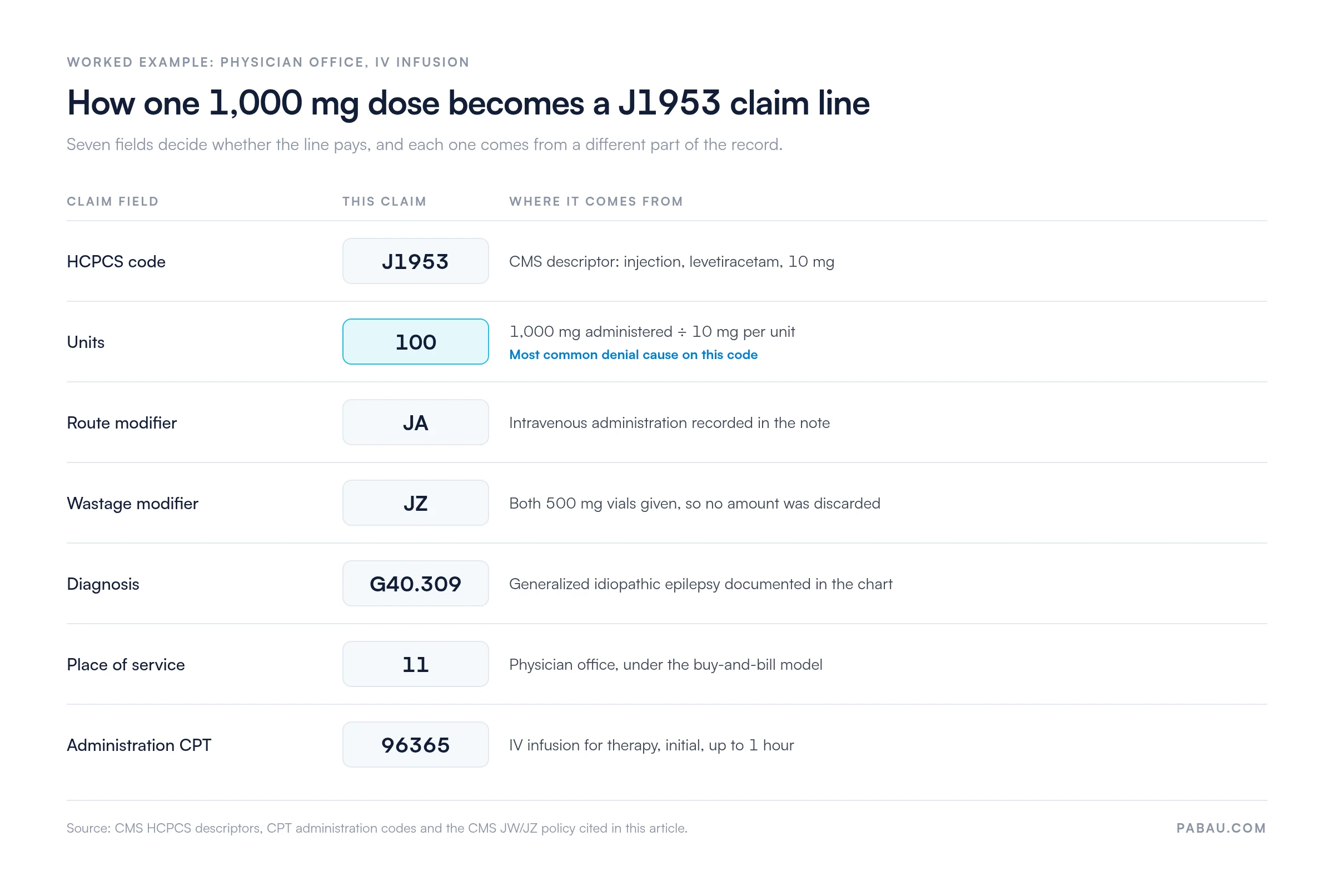
Step four is where the rest of this guide converges. The worked example below turns one 1,000 mg dose into a complete claim line, field by field.
Medicare Part B generally does not require prior authorization for J1953, but commercial payers often do. PA requirements vary by plan, and some payers want documentation of treatment failure with oral antiepileptic drugs before approving the IV form.
When PA is required, submit a medical necessity letter covering the diagnosis, the rationale for IV administration, prescriber information, and the expected treatment duration. Keep a copy of every PA approval, including the authorization number, in the patient’s file.
If a PA is denied, a formal appeal with clinical documentation gives the best chance of reversal. Anti-kickback and fraud-and-abuse rules also apply to drug acquisition and billing under buy-and-bill, so review CMS compliance guidance before you set any markup strategy.
Before the first J1953 infusion for any new patient, run a benefits verification and PA check simultaneously. Most commercial payers require authorization before administration, not after. A denial after the drug has been administered leaves the practice holding the drug cost with limited recourse for recovery.
J1953 does not stand alone on most claims. It is typically submitted alongside an administration CPT code, and it may have crosswalk codes for situations where the drug is billed differently. Knowing the related code set helps practices build complete, accurate claims and avoid unbundling errors.
Using J3490 (unclassified drugs) after J1953 became active is a coding error that can delay or reduce reimbursement. Payers apply manual review to unclassified codes that they do not apply to specific J-codes. Confirm you are using the current active code through the NLM Clinical Table Search HCPCS API or the CMS HCPCS release files.
Four errors account for most J1953 rejections, and each one is visible in the claim before it goes out. The table below pairs each error with the check that prevents it.
A fifth error worth flagging is using J3490 (unclassified drugs) when J1953 is the correct active code. This happens when billing systems are not updated after a new J-code is added to the HCPCS schedule.
Claims submitted under J3490 for levetiracetam may be downpaid or denied as a coding error. Pair your annual code update review with a check of your drug billing templates. The currency check then happens once a year rather than claim by claim.
Run a quarterly audit of your J1953 claims. Pull every submission for the period, then check the unit counts against the doses documented in the chart. Verify that the modifiers match each payer’s current requirements, including JW or JZ. One hour of audit work per quarter catches these errors before they turn into write-offs.
Entering a drug code by hand means working from two places at once. The dose sits in the clinical note, and the unit count belongs on the claim, so the number gets copied between systems.
Pabau, an all-in-one practice management system, keeps the appointment, the treatment note and the invoice on one patient record. Your team records the dose, the route and the infusion times in the note that supports the claim.
From there, Pabau’s claims management software pre-fills a claim from the data already on the record and submits it without a second system. You can check eligibility before the infusion date, follow claim status, and post remittances against the original claim. Your coder still chooses the code, the units and the modifier.
The outcome is less re-keying between a chart and a claim form, and a shorter path from a documented dose to a paid claim.

Pabau keeps each infusion’s dose, treatment note and invoice on one patient record, then pre-fills and submits the claim from the data already there. Your coder still chooses the code and the units, with the documentation behind them one click away.

J1953 rewards a system over a memory. The unit math is trivial. It sits next to a modifier rule, a diagnosis link and a place-of-service code, and each one can sink the claim alone.
So the work worth doing sits upstream of the claim. Record the dose in milligrams at the point of administration, and settle each payer’s modifier rules once. The unit count and the wastage line then stop being a judgment call at submission time.
Pabau keeps the dose, the note and the invoice on one patient record, then pre-fills the claim from what is already there. Book a demo to see how a J-code claim moves from an infusion note to a submitted claim.

Want to understand how claims flow from submission to payment? What is medical billing explains the end-to-end claim lifecycle for outpatient practices.
Need to tighten your denial management process? Denial management in healthcare covers root cause analysis and appeal workflows for injectable drug claims.
Looking to verify eligibility before every infusion appointment? Insurance eligibility verification outlines a pre-service benefits check that catches authorization problems before the infusion date.
HCPCS Code J1953 is used to bill an injection of levetiracetam (brand name Keppra IV) at 10 mg per unit. It is a Level II HCPCS J-code, reported in physician offices, infusion centers and hospital outpatient settings. It covers this anticonvulsant when it is given for epilepsy and seizure disorders.
Bill 1 unit of J1953 per 10 mg administered. Divide the total milligrams given by 10 to get the correct unit count. For example, a 500 mg dose equals 50 units. Always base the unit count on the dose documented in the clinical record, not the vial size.
Medicare reimburses J1953 at Average Sales Price (ASP) plus 6%, updated quarterly by CMS. The exact dollar amount changes each quarter. Check the CMS quarterly ASP pricing file for the date of service before billing.
The most common modifier for J1953 is JA, which confirms intravenous administration. CMS has also required a wastage modifier on single-dose vial drugs since October 1, 2023. Use JW for the discarded amount, or JZ when the full vial is given. GY and GZ apply in non-covered or medical-necessity scenarios. Verify modifier requirements with each payer before submitting, since policies vary.
Yes. J1953 is typically billed under the buy-and-bill model in physician office and infusion center settings. The practice purchases levetiracetam, administers it, and bills the payer for the drug using J1953. The administration CPT code goes on the same claim: 96374 for IV push, or 96365 for IV infusion.