CCSD code L5910: Femorofemoral bypass billing guide
CCSD code L5910: What the code covers CCSD code L5910 is the billing code for a ...

Last Updated: Nov 12, 2026
J1740 is the HCPCS Level II code for injection, ibandronate sodium, 1 mg. It bills the IV bisphosphonate sold as Boniva, given as a 3 mg dose every 3 months for postmenopausal osteoporosis.
One billing unit equals 1 mg, so a standard dose is 3 units. Claims are denied when billers miscalculate units, omit the NDC, or leave off the administration code, CPT 96374.
Let Pabau's smart automation suggest the right codes, reduce claim denials, and keep your practice compliant—effortlessly.
Automate repetitive tasks and focus on what matters most—your patients.
Reduce coding errors and ensure compliance with the latest regulations.
Clean claims, fewer denials, and faster reimbursements.
Powerful insights and reporting to help your practice thrive.
HIPAA compliant SOC 2 certified GDPR-compliant Trusted by 4,000+ clinics worldwide

HCPCS code J1740 bills injection, ibandronate sodium, 1 mg, the IV bisphosphonate sold as Boniva for postmenopausal osteoporosis.
One billing unit equals 1 mg, so the standard 3 mg dose given every 3 months is reported as 3 units.
J1740 pays for the drug only, so the IV push is billed separately with CPT 96374.
The 3 mg prefilled syringe is single-dose, so a full dose with no waste takes the JZ modifier on Medicare claims.
Some MACs cover the IV form only when the patient cannot tolerate oral therapy, and the claim must carry a code that shows it.
HCPCS code J1740 is the Level II code for injection, ibandronate sodium, 1 mg. Wellpoint Federal, formerly National Government Services, lists J1740 for the drug in its billing article for ibandronate sodium. That article also confirms the IV form is approved for use every three months.
Ibandronate is a bisphosphonate sold as Boniva injection, and generic versions bill under the same code. It is given intravenously every 3 months to treat osteoporosis in postmenopausal women.
The drug comes as a 3 mg/3 mL single-dose prefilled syringe, and the labeled dose is 3 mg injected over 15 to 30 seconds. That keeps the arithmetic short: one syringe, 3 mg, 3 units. Most J1740 errors happen around the drug line instead, in the administration code, the modifier and the diagnosis pairing.
J1740 covers ibandronate sodium given by IV injection in a physician office, infusion suite or hospital outpatient department. Oral ibandronate tablets are a pharmacy benefit, usually under Medicare Part D, and never go on a J1740 line.
J1740 units equal the milligrams of ibandronate sodium administered, because one unit is 1 mg. The labeled dose is fixed at 3 mg, so nearly every J1740 line reads 3 units.
Use this three-step method for every injection:
The most frequent unit error is billing one unit per syringe or per visit. J1740 is priced per milligram, so a single unit on a 3 mg dose leaves two-thirds of the drug payment unclaimed.
Medicaid requires the National Drug Code (NDC) on claims for physician-administered drugs, including J1740. Many commercial payers ask for it too. A missing NDC usually triggers a front-end rejection, so the claim never reaches adjudication.
When an NDC is required, format it the same way every time:
J1740 pays for the drug. The injection service is billed with CPT 96374, the code for an intravenous push of a single or initial drug. A 15 to 30 second injection is a push, so the infusion codes 96365 and 96366 do not apply.
In a hospital outpatient department, the facility reports the same pair on the UB-04, with revenue code 0636 on the drug line.
Four drug codes sit close to J1740 in a fee schedule or a formulary search. The two bone-drug neighbors are J3489 for zoledronic acid and J0897 for denosumab. The drug itself decides the code in every case.
Lidocaine never belongs on a J1740 line. Its old IV code, J2001, was deleted on October 1, 2024, and lidocaine now bills under J2002, J2003 or J2004.
Payers want the diagnosis to show why the patient needs IV ibandronate rather than tablets. Wellpoint Federal is the MAC for jurisdictions J6 and JK. It covers the IV form only for patients who need bisphosphonate therapy and cannot tolerate oral treatment.
Its billing article A52421 therefore asks for two codes on an osteoporosis claim. One is an osteoporosis code such as M81.0, and the other shows severe esophagitis or intolerance to oral ibandronate.
Other MACs publish their own lists, so check the article for your jurisdiction. Under A52421, prevention in a postmenopausal woman without osteopenia takes the GY modifier, and Medicare denies it.
Never choose a diagnosis to fit a coverage list. The code has to reflect the findings documented in the record.
Medicare Part B covers J1740 when a practitioner administers the drug and the MAC’s coverage criteria are met. IV ibandronate is not self-administered, so it falls under the Part B drug benefit rather than Part D.
Payment follows the ASP + 6% method. CMS publishes the per-unit payment limit in its quarterly ASP pricing files, so pull the current quarter before setting fees.
A missed dose does not break the schedule. The label says to give it as soon as possible, then every 3 months from that date, so record the new start date.
Two modifiers describe drug waste on J1740, and two more handle coverage doubts. Medicare has required JZ or JW on single-dose drug claims since July 1, 2023.
Ibandronate syringes are single-dose only. The label also forbids mixing the drug with calcium-containing solutions, so any unused portion is discarded and documented.
Before each J1740 dose, check the date of the last injection and the latest serum creatinine. The label calls for a creatinine level before every dose. It also advises against use when creatinine clearance is below 30 mL/min. Both facts belong in the note an auditor will read.
Auditors compare the billed units with the dose in the record. Then they check that the record supports IV rather than oral therapy. Capture these elements before the claim is generated:
A note that says only “Boniva given” is hard to defend at 3 units. Record the dose in milligrams, so the unit count can be traced in one step.
J1740 denials cluster around seven root causes, and six of them sit on the claim itself. Each one comes back with a recognizable reason code, and our guide to denial codes explains how to read them. The checklist below shows where each cause sits on the claim.
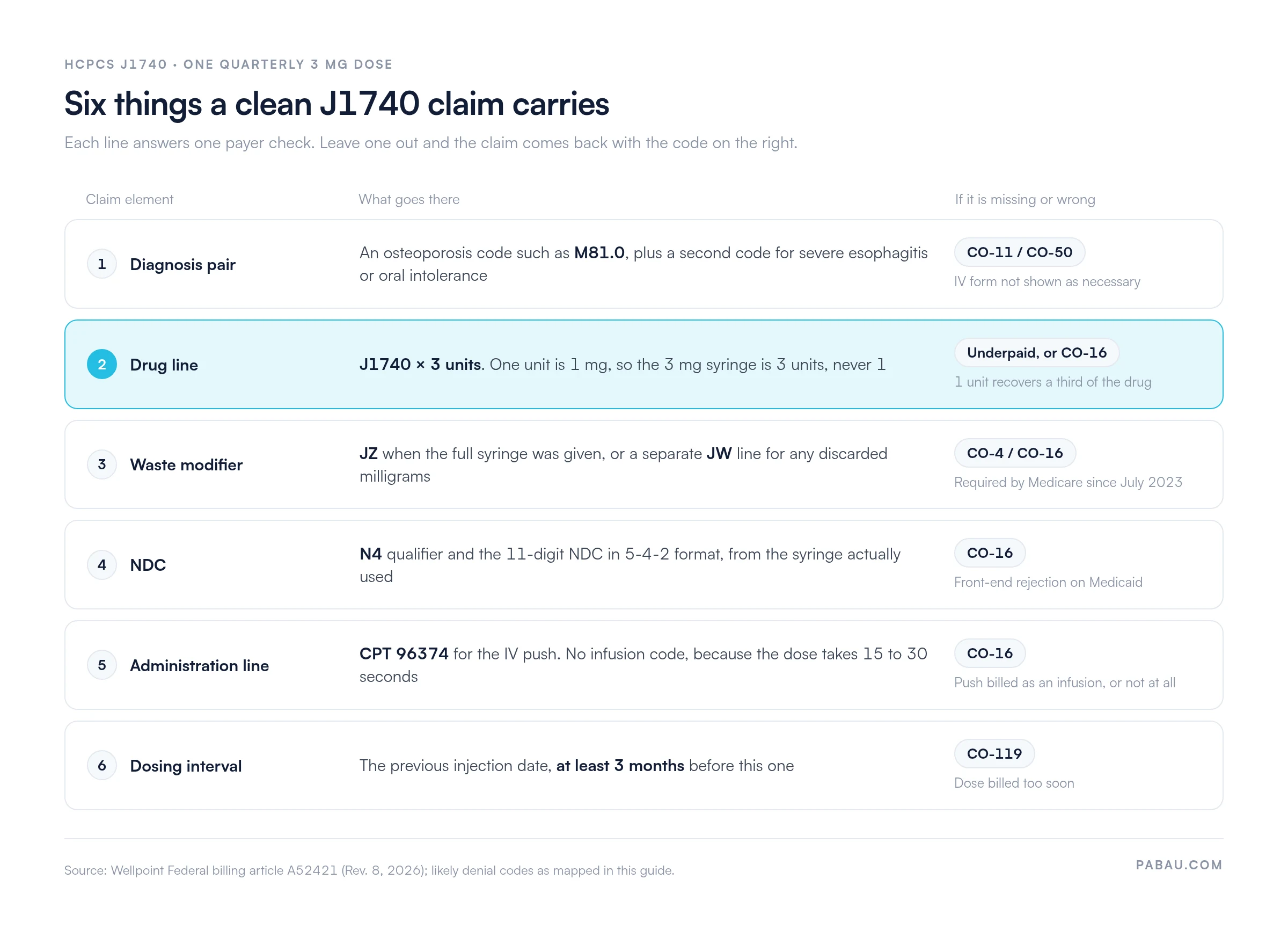
The seventh cause, a missing prior authorization, sits with Medicare Advantage and commercial plans rather than on the claim form. The table maps every cause to its fix.
A pre-claim scrub that checks the second diagnosis, the unit count and the JZ modifier stops most of these at the source. Our guide to medical billing compliance covers what auditors check once the claim is paid.
Ibandronate claims usually fail at a hand-off. The nurse records the injection in one place, and the biller rebuilds the claim somewhere else, retyping the dose, NDC and diagnosis.
Pabau, the practice management and billing platform we build, keeps the injection record and the claim on the same patient. The syringe’s lot number and expiry date are recorded against the patient and the appointment. Prior authorization codes, dates and sessions sit on the case, with a warning when one is missing.
Pabau’s claims management software sends US claims as CMS-1500/837P through the Claim.MD clearinghouse. Eligibility checks and ERA remittances come back to the same record. A 90-day recall workflow can text or email patients when the next dose is due, and it skips anyone already booked.
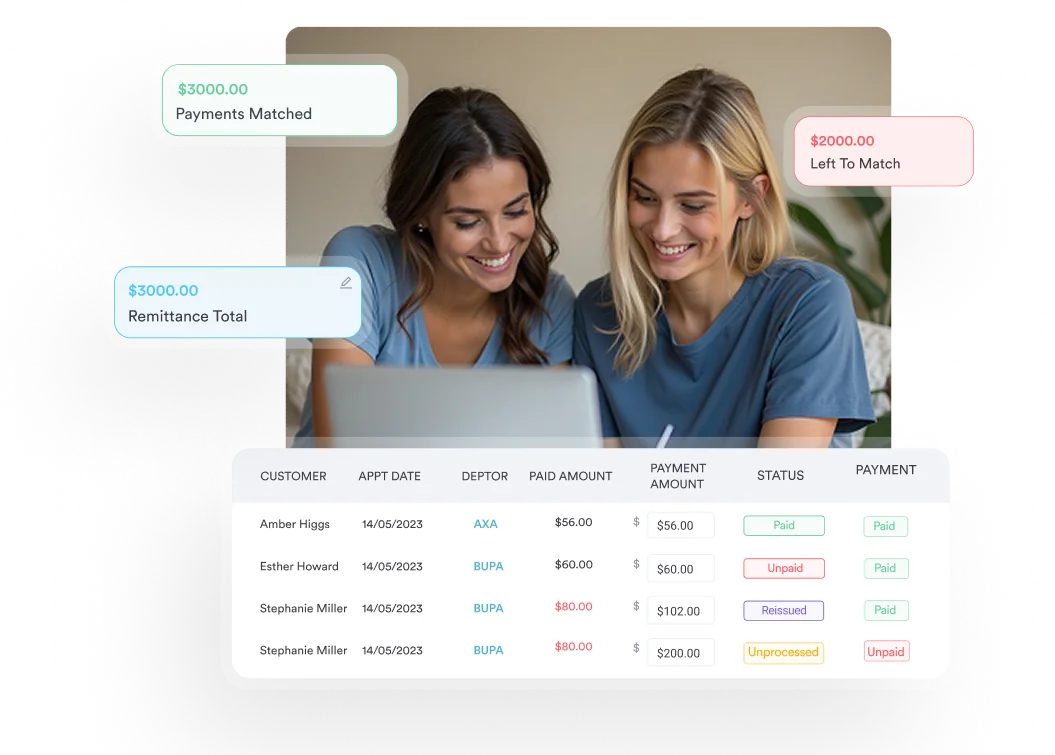

Pabau records the dose, lot and authorization against the patient, then sends the claim through Claim.MD with eligibility checks and ERA remittances. See how it fits your injection workflow.

J1740 looks like the easiest J-code to bill: one syringe, 3 mg, 3 units. Payment depends on the record behind those units. It needs a diagnosis that justifies IV therapy over tablets, CPT 96374 for the push, and a JZ or JW line.
Settle those three at the point of injection, and the quarterly claim becomes routine. Book a demo to see how Pabau carries the injection record straight into a clean ibandronate claim.

Chasing drug-claim denials? Denial management in healthcare shows how to work denials back to their root cause.
Need the bigger billing picture? What is revenue cycle management explains how code accuracy feeds the whole revenue cycle.
HCPCS code J1740 is the Level II code for injection, ibandronate sodium, 1 mg. It bills Boniva injection and its generics, given IV every 3 months for postmenopausal osteoporosis. The code covers the drug only.
Bill 3 units for the standard 3 mg dose. One unit equals 1 mg of ibandronate sodium, so the units match the milligrams given. Billing 1 unit per syringe underpays the drug by two-thirds.
CPT 96374, an IV push of a single or initial drug, is billed for the administration. The label calls for a 15 to 30 second injection, which is a push. The infusion codes 96365 and 96366 do not apply.
Yes, Medicare Part B covers J1740 when a practitioner gives the drug and the MAC’s criteria are met. Some MACs, such as Wellpoint Federal, cover the IV form only for patients who cannot tolerate oral therapy. Payment is ASP plus 6%, updated quarterly.
Use JZ when the full single-dose syringe was given and none was discarded. Use JW on a separate line for any discarded amount. Medicare has required one of the two on single-dose drug claims since July 1, 2023.
Osteoporosis codes such as M81.0 or M80.0- are the core pairing. Under MAC article A52421 they need a second code showing severe esophagitis or intolerance to oral ibandronate. Osteopenia claims pair an M85.8- code with a menopausal state code.
The FDA label sets the dose at 3 mg every 3 months, and doses should not be given more often. A missed dose is given as soon as possible, and the schedule restarts from that date. Document the previous injection date on every claim.
No. J1740 describes ibandronate sodium only. IV lidocaine was billed with J2001 until that code was deleted on October 1, 2024, and it now uses J2002, J2003 or J2004.