HCPCS code Q4154: Biovance billing, Medicare rate and denial guide
HCPCS code Q4154: definition and code details HCPCS code Q4154 is a Level II cod...

Last Updated: Oct 6, 2026
J2001 is the HCPCS Level II code for injection, lidocaine hcl for intravenous infusion, 10 mg. CMS deleted it effective October 1, 2024, so the last valid date of service was September 30, 2024.
There is no grace period. For later dates of service, bill J2003 for lidocaine hydrochloride, J2002 for lidocaine in 5% dextrose, or J2004 for lidocaine with epinephrine. All three count 1 mg per unit, not 10 mg.
Let Pabau's smart automation suggest the right codes, reduce claim denials, and keep your practice compliant—effortlessly.
Automate repetitive tasks and focus on what matters most—your patients.
Reduce coding errors and ensure compliance with the latest regulations.
Clean claims, fewer denials, and faster reimbursements.
Powerful insights and reporting to help your practice thrive.
HIPAA compliant SOC 2 certified GDPR-compliant Trusted by 4,000+ clinics worldwide

J2001 was deleted on October 1, 2024, and the last valid date of service was September 30, 2024.
J2003 is the main replacement for plain lidocaine HCl, with J2002 for lidocaine in 5% dextrose and J2004 for lidocaine with epinephrine.
The replacement codes are billed per 1 mg, so a 200 mg dose is now 200 units rather than 20.
Most payers still expect an NDC and a separate administration CPT code, such as 96365 or 96374, on lidocaine drug claims.
J2001 now belongs only on corrections, appeals, and audits for dates of service on or before September 30, 2024.
HCPCS Code J2001 was the billing code for injection, lidocaine HCl for intravenous infusion, 10 mg. CMS deleted it effective October 1, 2024, so the last valid date of service was September 30, 2024.
There was no grace period. From October 1, 2024, lidocaine is billed with one of three new codes, each counted per 1 mg. J2003 covers lidocaine hydrochloride and replaces most former J2001 use. J2002 covers lidocaine in 5% dextrose, and J2004 covers lidocaine with epinephrine.
Like the codes that replaced it, J2001 was an HCPCS Level II drug code maintained by CMS, not a CPT code from the AMA. It reported the drug supply only. The infusion service was always billed separately with a CPT administration code.
Use this reference when you correct an older claim or update a charge master that still lists J2001.
No. HCPCS Code J2001 has not been valid since October 1, 2024, and CMS has not reinstated it. The October 2024 quarterly HCPCS update deleted it, and Medicare contractors confirmed the change in their bulletins. These include CGS and Noridian’s October 2024 HCPCS update.
AAPC Codify lists J2001 as a deleted code, effective October 1, 2024. Any claim with J2001 on a date of service after September 30, 2024 is rejected as an invalid code. Commercial payers whose edits follow the CMS HCPCS Level II code files reject it as well.
Those rejections usually trace back to stale system data. A charge master, an order set, or an infusion template that still maps lidocaine to J2001 keeps producing denials until someone updates it.
Search your charge master, EHR order sets, and infusion templates for J2001 and update each entry to J2002, J2003, or J2004. Re-check the unit multiplier at the same time, because the new codes count 1 mg per unit instead of 10 mg.
CMS replaced J2001 with three lidocaine codes on October 1, 2024. Each one is defined by the product rather than the route, and each is billed per 1 mg. CMS published no single formal crosswalk, so the product you used decides the code.
The diagram below walks through both decisions, date of service first and then the product.
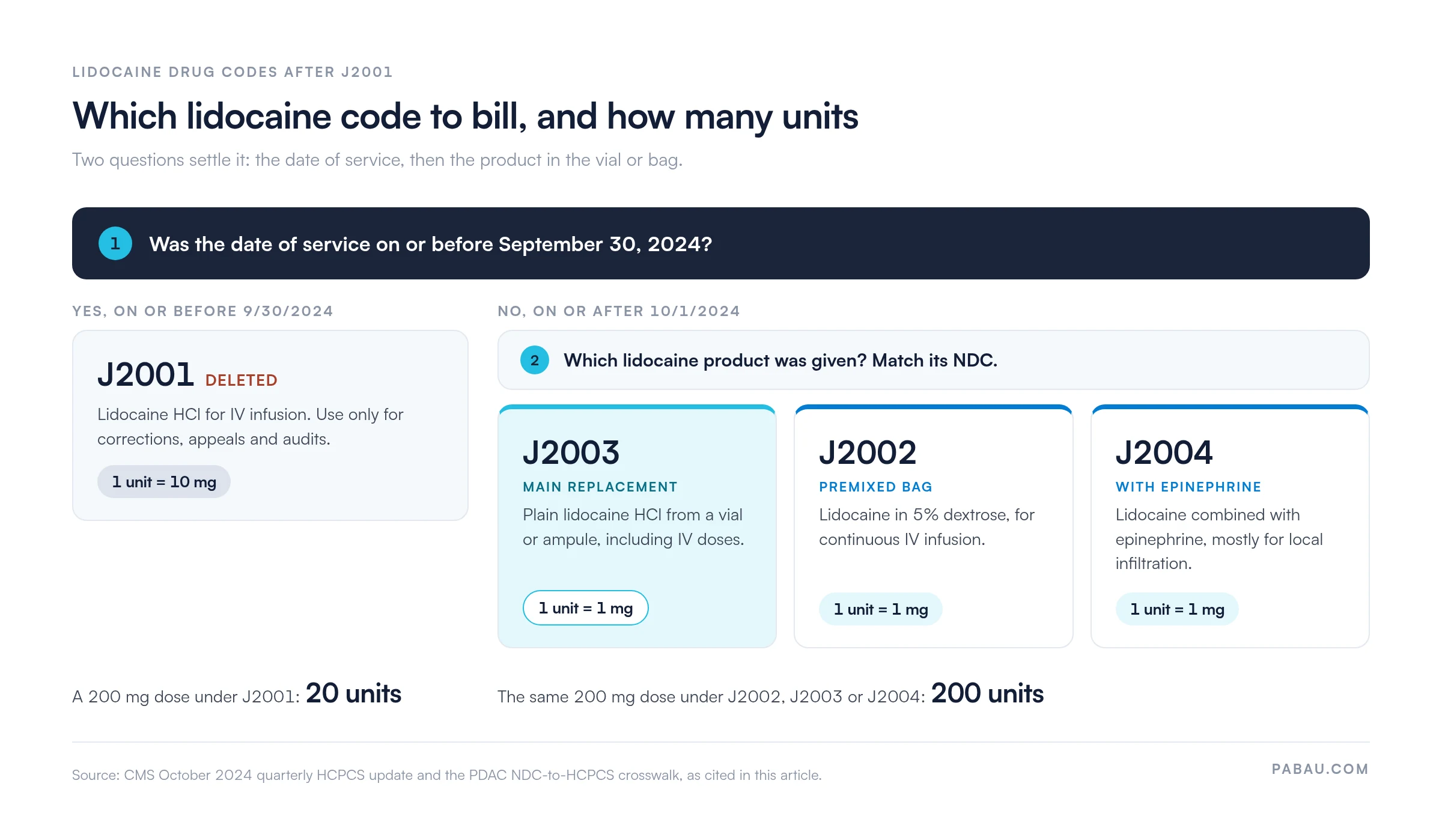
The NDC crosswalk from the Pricing, Data Analysis and Coding (PDAC) contractor, dated October 5, 2024, moved most former J2001 NDCs to J2003. Use it to check each product you stock.
IV lidocaine is given for indications such as ventricular arrhythmia and infusion-based pain management, including post-surgical pain protocols. Coverage for any one indication is set by the payer. For Medicare, that means National or Local Coverage Determinations.
Practices billing IV lidocaine for chronic pain should confirm which LCD applies with their Medicare Administrative Contractor (MAC) before submitting.
Eligible Part B settings include hospital outpatient departments (HOPDs), physician offices, ambulatory surgery centers (ASCs), and infusion centers. HOPD claims are paid under the Hospital Outpatient Prospective Payment System (OPPS). Physician office claims are paid under the Medicare Physician Fee Schedule and the quarterly drug pricing files.
J2002, J2003, and J2004 are billed at 1 unit per 1 mg, so the unit count equals the milligrams given. J2001 counted 10 mg per unit. A J2001 multiplier carried into the new codes under-reports every claim tenfold.
Bill the milligrams given, taken from the infusion record. If the physician orders 200 mg but the infusion stops at 180 mg, report 180 units of J2003. Always check the nursing infusion log against the order before you count units.
Medicare’s JW and JZ modifier policy applies to drugs from single-dose containers. Report any discarded amount on its own line with JW, or add JZ when none was discarded. Multi-dose vials are outside that policy.
Most Medicare MACs and many commercial payers expect a National Drug Code (NDC) alongside the HCPCS drug code. A missing or invalid NDC is a fast route to a rejection. Getting it right is part of clean claim submission, and it matters more now that the NDC decides which replacement code applies.
Report the NDC as an 11-digit number in the 5-4-2 labeler-product-package format. On the CMS-1500 and the 837P, it goes on the drug line after the N4 qualifier. The unit qualifier and the quantity follow it.
CGS (Jurisdiction 15) and Noridian (Jurisdictions E and F) both enforce NDC reporting on Part B drug claims. Record the NDC from the vial or bag used. A transcription error between the label and the claim line is a common audit finding.
The HCPCS lidocaine codes report the drug only. The administration is billed separately with a CPT code from the therapeutic infusion and injection series. A drug line without an administration code, or with the wrong administration type, is a common reason for denial.
CPT treats an infusion of 15 minutes or less as a push, so it is reported with 96374 rather than 96365. Choose the administration code from the documented start and stop times, so the drug line and the service line tell the same story. The same CPT pairing rules applied to J2001 claims.
Medicare Part B covers IV lidocaine when it is medically necessary and the record supports the indication. In the physician office, separately payable Part B drugs are generally paid from the Average Sales Price (ASP) files. The usual rate is ASP plus 6%.
CMS updates those files every quarter, so a dollar figure in a reference guide goes stale quickly. Check the current quarter’s ASP pricing file for J2002, J2003, or J2004. You can also use the CMS Physician Fee Schedule lookup.
Payment in the hospital outpatient setting follows the OPPS, which packages many low-cost drugs into the related service. Confirm with your HOPD billing team whether the lidocaine line is separately paid or packaged for your claim. Pabau’s claims software for billers tracks drug-code payments by payer, so underpayments surface quickly.
J3490 is the unclassified injectable drug code, used only when no specific J-code describes the drug. With J2002, J2003, and J2004 in place, almost every lidocaine product now has a specific code. J3490 is rarely correct for lidocaine.
The main exception is a compounded lidocaine preparation that none of the three descriptors fits. Some payers also give their own instructions for products missing from the PDAC crosswalk. An unclassified claim triggers manual review, so attach the drug invoice, the NDC, and a statement of medical necessity.
Inadequate documentation drives most post-payment takebacks on drug claims. The record must support the drug, the route, the dose, the indication, and the setting. Each element maps to a field on the claim. Good superbill documentation captures them at the point of care.
Build these checkpoints into the clinical workflow itself. Billing staff should not have to reconstruct them after the patient has left.
Attach a lidocaine billing checklist to every IV lidocaine order. It should prompt nursing staff to record the milligrams given, the vial or bag NDC, and the start and stop times before the patient leaves.
Lidocaine denials follow recognizable patterns, and the code change added two new ones. Strong denial management workflows and medical billing compliance processes keep most of them from reaching the payer.
Practices that bill infused drugs carry a quarterly risk. CMS can delete or split a J-code at any HCPCS update. A single missed change can produce weeks of denied claims before anyone spots the pattern.
Pabau holds claims for review before they go out. Billing staff see the HCPCS code, the unit count, and the linked diagnoses on one screen while the claim is still editable. A J2001 line or a 10 mg unit multiplier gets caught there instead of at the payer.
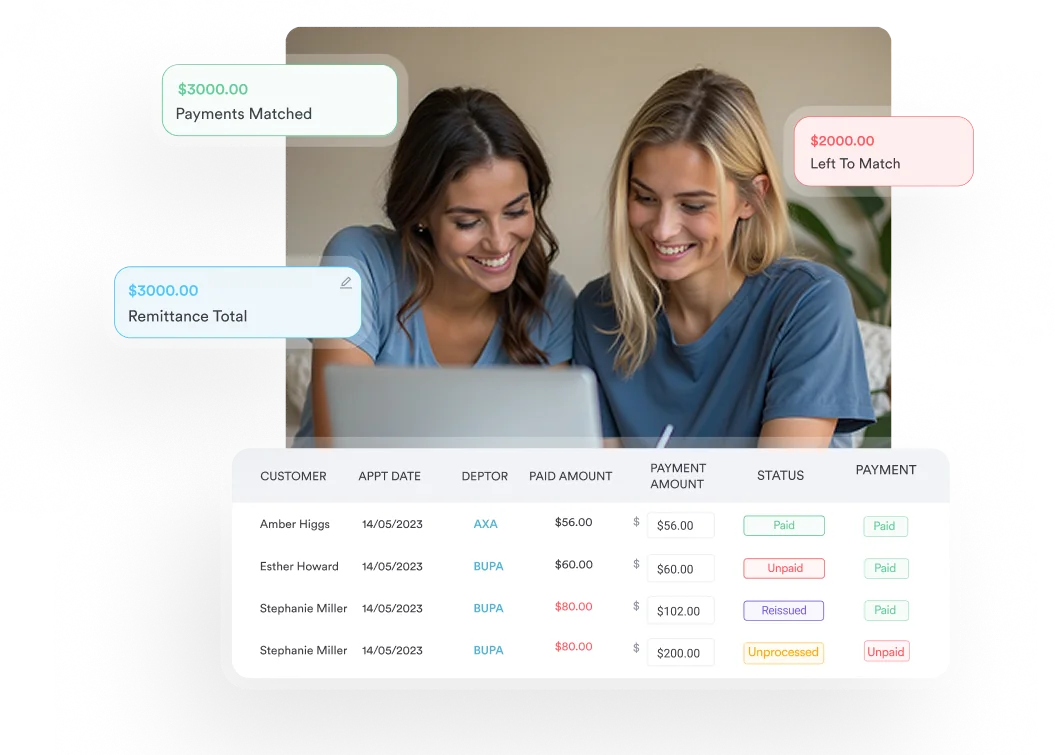
Infusion notes, consent forms, and authorization details sit on the patient’s record. The NDC and the start and stop times are on hand when the claim is built. Denials that do land are grouped by reason code. A wave of invalid-code rejections becomes visible within days instead of at month end.

Pabau holds claims for review with the HCPCS code, units, and linked diagnoses on one screen. Denials are grouped by reason code, so a quarterly code change does not turn into weeks of rework.

J2001 is gone, but stale system data can keep it on claims. Start with any charge master or order set still carrying J2001 or a 10 mg multiplier. Then map each lidocaine NDC you stock to J2002, J2003, or J2004.
The lesson applies well beyond lidocaine. When CMS splits a drug code, both the code and the unit size change, and either one alone can sink a claim. Book a demo to see how Pabau helps you catch drug-code changes before they reach your denial queue.

Want to understand how the 837P electronic claim is structured? 837 file billing guide explains how drug codes, NDC qualifiers, and diagnosis codes fit together in an electronic claim submission.
Billing a short lidocaine push rather than an infusion? CPT code 96374 covers IV push billing, modifiers, and the documentation that separates a push from an infusion.
Yes. CMS deleted HCPCS Code J2001 effective October 1, 2024, so the last valid date of service was September 30, 2024. There was no grace period. A claim carrying J2001 for a later date of service is rejected as an invalid code.
CMS added three lidocaine codes on the same date. J2003 covers lidocaine hydrochloride, 1 mg, and is the main replacement. J2002 covers lidocaine in 5% dextrose, and J2004 covers lidocaine with epinephrine. CMS published no single crosswalk, so match the NDC of the product used to the code.
J2001 reported the drug supply for lidocaine HCl given by intravenous infusion, in units of 10 mg. Practices used it for IV lidocaine in settings such as arrhythmia care and infusion-based pain management. It never covered the administration service, which was billed with a separate CPT code.
J2001 is an HCPCS Level II code, not a CPT code. CMS maintains the Level II J-codes, which describe drugs and biologicals. The AMA maintains CPT codes, which describe services such as the infusion itself.
J2002, J2003, and J2004 are each billed per 1 mg, so the units equal the milligrams given. A 200 mg dose is 200 units. Under J2001 the same dose was 20 units, because one unit was 10 mg.
Most Medicare contractors and many commercial payers expect an NDC with Part B drug codes. Report the 11-digit NDC after the N4 qualifier, followed by the unit qualifier and quantity. The NDC also confirms which of the three replacement codes fits the product used.
Only for dates of service on or before September 30, 2024. Medicare’s 12-month timely filing limit has closed for those dates. J2001 now appears mainly on corrected claims, appeals, and audit responses for that period.