CCSD code H4430: Examination of rectum under anaesthetic
CCSD code H4430 pays for the examination alone CCSD code H4430 is the UK private...

Last Updated: Oct 20, 2026
H0030 is the HCPCS Level II code for behavioral health hotline service.
Let Pabau's smart automation suggest the right codes, reduce claim denials, and keep your practice compliant—effortlessly.
Automate repetitive tasks and focus on what matters most—your patients.
Reduce coding errors and ensure compliance with the latest regulations.
Clean claims, fewer denials, and faster reimbursements.
Powerful insights and reporting to help your practice thrive.
HIPAA compliant SOC 2 certified GDPR-compliant Trusted by 4,000+ clinics worldwide

HCPCS Code H0030 covers behavioral health hotline services: phone-based crisis lines, substance use information lines, and mental health support lines.
Medicare does not cover H0030. Medicaid is the primary payer, and coverage varies by state, so verify before you bill.
Modifier requirements (HE, HF, HH, HK) differ by payer and state program, so confirm which ones apply before you submit.
Wrong place of service and thin call records are the two denial triggers you control on every single claim.
Pabau’s claims management tools help behavioral health practices track HCPCS workflows and catch missing documentation before submission.
HCPCS Code H0030 describes a behavioral health hotline service. That is the Centers for Medicare and Medicaid Services (CMS) designation for phone-based crisis lines, alcohol and drug information lines, and mental health support lines. Trained counselors or other professionals staff them.
Under the CMS Healthcare Common Procedure Coding System, H-codes sit in HCPCS Level II. They cover services delivered mainly through state and local behavioral health agencies.
The code sits in the H0001-H0050 range. CMS designates that range for alcohol and drug abuse treatment, mental health services, and related substance use disorder programs. The service covered is specifically the hotline interaction itself, not the referral outcome, therapy session, or in-person assessment that may follow it.
Adjacent H-codes in the same range are easy to reach for by mistake. H0001 covers alcohol and drug assessment, and H0004 covers behavioral health counseling. H0030 is for the hotline interaction only. Prevention information shared outside a call, such as group presentations or printed materials, falls under H0024 instead.
The table below summarizes the key attributes of HCPCS Code H0030 that billers need before submitting a claim.
Provider eligibility for H0030 is set at the state Medicaid level, so there is no single national answer. Several provider categories do appear consistently across the states that cover behavioral health hotline services. Licensed behavioral health agencies and substance use disorder treatment facilities running crisis lines are the most common.
The Substance Abuse and Mental Health Services Administration (SAMHSA) sets a staffing expectation. Hotline staff are trained in crisis intervention, active listening, and substance use disorder support. This shapes which organizations can credibly bill the code.
Individual practitioners (licensed clinical social workers, counselors, psychologists) typically cannot bill H0030 on their own. The code is billed at the organizational or program level. Verify eligible provider types with your state Medicaid program before billing, since the rules vary sharply from state to state.
Medicare does not typically cover HCPCS Code H0030. Traditional Medicare (Parts A and B) does not recognize behavioral health hotline services as a reimbursable benefit under its current coverage framework.
Some Medicare Advantage (Part C) plans may cover crisis line services as a supplemental benefit, but this is payer-specific and not standardized. Verify with the individual plan before submitting a claim.
Medicaid is the primary payer for H0030, and coverage varies considerably by state. Some states reimburse behavioral health hotline services as part of their mental health and substance use disorder benefit packages. Others have not put H0030 on their Medicaid fee schedule at all.
To verify Medicaid coverage in your state, start with your state Medicaid agency’s provider manual, fee schedule, or provider portal. Medicaid.gov’s state overviews link through to each state agency. State programs update their fee schedules annually, so confirm rates and coverage status at the start of each fiscal year.
Because Medicare does not cover H0030, there is no national Medicare allowable rate to reference. Reimbursement for HCPCS Code H0030 comes exclusively from state Medicaid programs and, in rare cases, commercial payer contracts. Rates vary significantly by state and can change with each annual Medicaid fee schedule update.
State Medicaid behavioral health fee schedules are published by each state’s Medicaid agency, typically through the state’s provider portal or fee schedule publication. The AAPC HCPCS code lookup carries a reference description and code history. Payer-specific rates have to be confirmed with the state Medicaid program or your managed care organization.
State Medicaid rates for hotline services typically reflect the cost of running a staffed crisis line. That cost covers staff time, overhead, and program infrastructure. Some states reimburse per call, while others use daily or monthly program rates. Check your specific state’s provider manual for the reimbursement model before building your billing workflow.
For current H0030 rates, go to the source. That means your state Medicaid agency’s published behavioral health fee schedule, or the contracted rate sheet from your managed care organization. Commercial lookup tools report national benchmarks rather than state-contracted amounts, so they cannot settle a reimbursement question.
Always download your state Medicaid program’s behavioral health fee schedule at the start of each calendar year. State programs often update H-code reimbursement rates with little advance notice, and billing against outdated rates is a common source of underpayment or technical denial.
Before submitting an H0030 claim, confirm three things. Those are the unit definition, the place of service (POS) requirement, and the claim format your state expects. H-code rules vary more than CPT rules do, so the medical billing fundamentals you rely on elsewhere need rechecking here. The guidance below reflects general practice, and your payer has the final word.
H0030 is billed per service, meaning one billing unit corresponds to one hotline interaction or call. Some state Medicaid programs may define a minimum call duration (for example, five or fifteen minutes) before a unit can be claimed.
Check your state program’s billing manual for the operative definition. Billing multiple units per call without a clear payer-approved rationale is a common audit trigger.
Because H0030 describes a telephone-based service, place of service (POS) coding differs from standard in-office or outpatient behavioral health services. Common POS options for H0030 include:
POS requirements are set by the state Medicaid program and can vary by managed care plan. Submitting the wrong POS code is one of the most common technical denial reasons for H0030 claims. Confirm the expected POS with your state Medicaid program or MCO before the first claim submission.
H0030 is typically submitted on a CMS-1500 claim form (or its electronic equivalent, the 837P transaction). Institutional providers operating hospital-based behavioral health programs may submit on a UB-04/837I. Check with your state Medicaid program to confirm which claim form is required for hotline billing specifically.
Modifiers for HCPCS Code H0030 signal additional context about the service setting, population served, or delivery model. The behavioral health HCPCS modifier set (HE, HF, HH, HK) runs across many H-codes. Payers read them to route a claim to the right benefit category.
Incorrect or missing modifiers are a leading cause of H0030 denials. Always verify required modifiers with your specific state Medicaid program or managed care organization before billing.
Not all state Medicaid programs require these modifiers for H0030, and some programs may require modifiers not listed above. Treat this table as a starting reference, not a universal rule set.
Clean H0030 claims start with the medical record. Medicaid auditors reviewing hotline claims look for proof that the service happened and proof of who delivered it. They also want evidence that the provider meets the state’s eligibility criteria.
The following checklist reflects the documentation elements most frequently required by state Medicaid programs for H0030 claims. Requirements vary by state. Treat this as a baseline, and supplement it from your state Medicaid provider manual.
Thorough call records support billing accuracy and patient safety at the same time. Store hotline records as electronic protected health information (ePHI), with the access controls and audit logging you already apply to clinical notes. Hold crisis line notes to the minimum necessary standard, and keep them consistent with your state Medicaid documentation requirements.
Most H0030 denials are preventable, and they cluster around five failure points. Clearing each one before the claim goes out beats working it in a denial queue afterwards. When a claim does come back, the remittance advice names the reason, and our guide to medical billing denial codes explains how to read it.
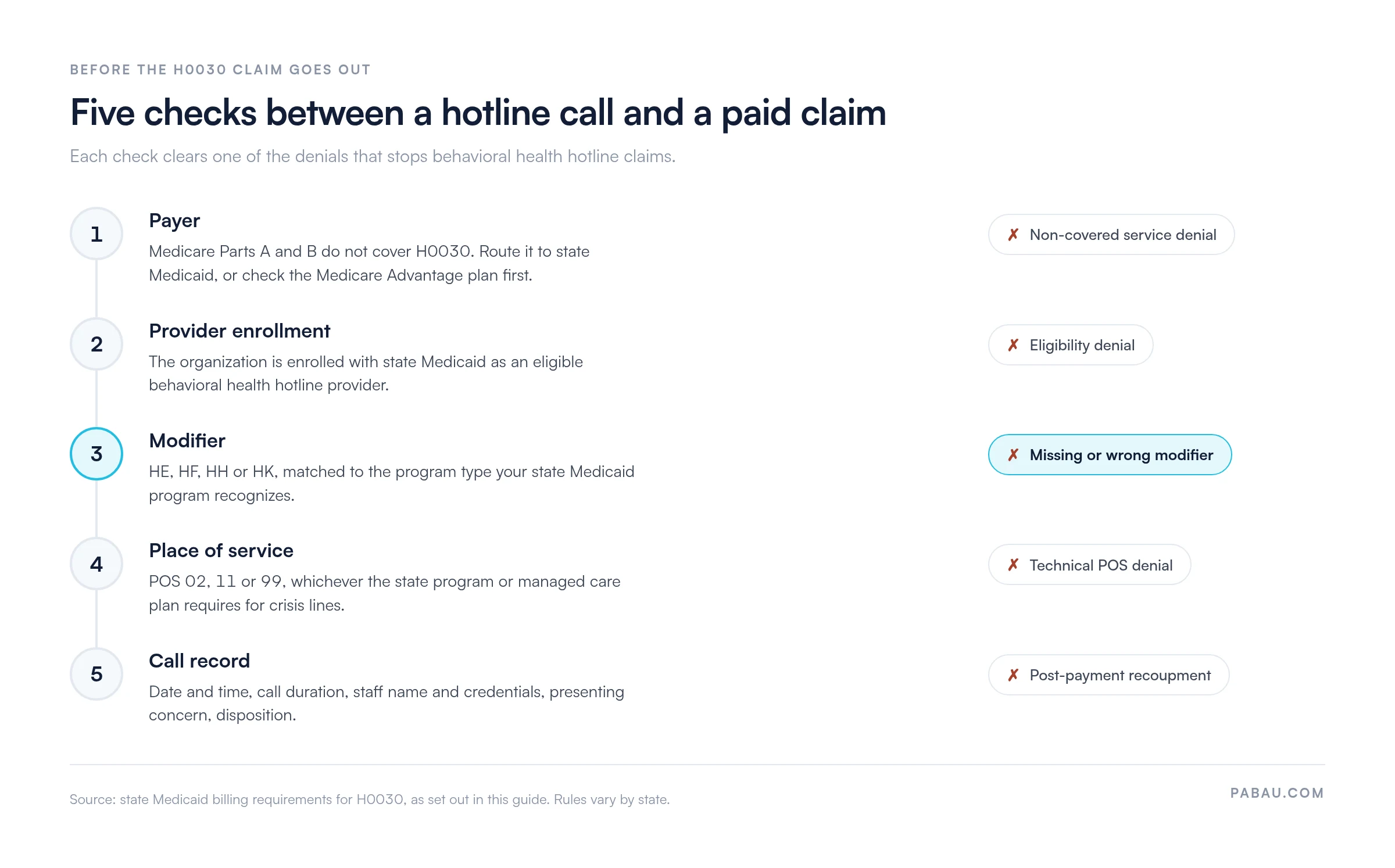
State Medicaid programs that require a behavioral health modifier (HE, HF, HH, HK) will deny or suspend the claim if none is present. Applying the wrong modifier does the same.
Using HF (substance abuse program) for a general mental health crisis line can trigger a medical necessity review or a post-payment audit. Map each hotline program type to its correct modifier before the first submission.
H0030 is a telephone service. Using a standard outpatient POS code (POS 11, office) where the state requires a telehealth POS (POS 02) produces a technical denial. Some state programs have POS requirements specific to crisis line services that differ from standard telehealth billing rules. Confirm POS requirements with your state Medicaid fiscal agent before the first claim cycle.
The provider NPI on the claim has to be enrolled in the state Medicaid program. It also has to be designated as an eligible behavioral health hotline provider. Miss either and the claim comes back as an eligibility denial.
Verify enrollment status and provider type eligibility before billing. This is especially common when crisis lines are added to an existing provider organization’s service array without updating the Medicaid enrollment.
Post-payment audits frequently cite incomplete call records as the basis for recoupment. A record that shows only the date and code, without call duration, staff identification, and disposition, will not survive an audit. Build the documentation requirements into the crisis line’s call-handling workflow. Staff then capture what billing needs during the call, rather than reconstructing it afterwards.
Submitting H0030 to traditional Medicare returns an automatic denial, since the code is not covered. Repeat submissions can flag the provider for a billing pattern review. Flag H0030 in your practice management system as Medicaid-only (or plan-specific) to prevent inadvertent Medicare submissions.
Billers in behavioral health regularly meet adjacent H-codes covering assessments, counseling, and case management. Picking the wrong one from this range is a common audit finding. Pair whichever H-code you select with the ICD-10 diagnosis code that supports it. The table below covers the codes most often confused with H0030.
For the full H-code range, work from the CMS HCPCS Level II file rather than a third-party lookup. That same file lists the G series of Medicare temporary codes, where HCPCS code G0173 was deleted and is now billed as CPT 77372. Always cross-reference with your state Medicaid program’s covered services list, since not every H-code in the national set is reimbursable in every state.
When transitioning a caller from a hotline service (H0030) to a follow-up clinical service, document the transition clearly in the call record. Using H0030 and a clinical service code like H0004 for the same caller on the same day requires distinct, well-documented service events. Duplicate billing of overlapping services is a frequent audit finding in behavioral health.
Behavioral health practices billing HCPCS codes like H0030 need the call record and the claim in one place. Practice management software like Pabau keeps them together, with claims tools built for behavioral health billing teams. Missing documentation gets flagged before the claim leaves the practice, rather than after a denial arrives.
For practices running a high call volume across several hotline programs, matching call records to claims by hand is the bottleneck. Automated workflows do that matching, so your biller reviews exceptions instead of reconciling two lists.
Teams billing H0030 alongside clinical codes like H0004 keep documentation and billing in the same system. Same-day service events are easier to evidence that way, and the risk of duplicate submissions drops.

Pabau helps behavioral health practices track HCPCS claims, manage documentation, and reduce denial rates with built-in claims management tools.

H0030 is a state-level code wearing a national code’s clothes. The description is fixed, but coverage, modifiers, place of service, and documentation are all decided by your state Medicaid program.
So start with your state’s behavioral health provider manual and fee schedule, then build the call-handling workflow from what they say. Get that right up front and the five denial triggers above mostly stop happening.
Leave it until the first remittance advice lands and you are reworking claims that were never going to pay. Book a demo to see how Pabau keeps H0030 call records and claim submissions in one system.

Need a deeper guide on medical billing fundamentals for behavioral health? What is medical billing covers the end-to-end process from patient encounter to payment posting.
Concerned about HCPCS claim denials? Denial management in healthcare billing walks through how to build a systematic appeal and prevention process.
Billing H0030 alongside counseling sessions? HCPCS Code H0004 covers behavioral health counseling and therapy, billed in 15-minute units.
HCPCS Code H0030 is a HCPCS Level II billing code for a behavioral health hotline service. That covers phone-based crisis lines, alcohol and drug information lines, and mental health support lines staffed by trained professionals. It falls within the H0001-H0050 range administered by state and local behavioral health agencies and is billed per service interaction.
No, traditional Medicare (Parts A and B) does not cover HCPCS Code H0030. Some Medicare Advantage plans may include behavioral health hotline services as a supplemental benefit, but this is plan-specific and not standardized across Medicare Advantage products. Verify with the individual plan before submitting a claim.
Four modifiers come up most often with H0030. They are HE (mental health program), HF (substance abuse program), HH (integrated mental health and substance abuse), and HK (specialized programs for high-need populations). Modifier requirements vary by state Medicaid program and managed care organization, so always confirm which modifiers apply with your specific payer before billing.
Place of service for H0030 depends on your state Medicaid program’s requirements. Common options include POS 02 (telehealth provided other than in patient’s home), POS 11 (office), or POS 99 (other). Because H0030 is a telephone-based service, POS requirements differ from standard outpatient behavioral health billing. Using the wrong POS is one of the most frequent technical denial reasons for this code.