CCSD code M2012: Ureter-to-bowel replantation billing guide
CCSD code M2012 covers a ureter joined to the bowel, on one side or both CCSD co...

Last Updated: Nov 9, 2026
98981 is the CPT add-on code for each additional 20 minutes of remote therapeutic monitoring treatment management in a calendar month. It counts physician or other qualified health care professional time, and the month must include at least one interactive communication with the patient or caregiver.
Billers can lose revenue on this code when they confuse it with the base code, miscount billable time, or miss the documentation payers require. Reading 98981 together with its base code, 98980, is the simplest way to avoid those denials.
Let Pabau's smart automation suggest the right codes, reduce claim denials, and keep your practice compliant—effortlessly.
Automate repetitive tasks and focus on what matters most—your patients.
Reduce coding errors and ensure compliance with the latest regulations.
Clean claims, fewer denials, and faster reimbursements.
Powerful insights and reporting to help your practice thrive.
HIPAA compliant SOC 2 certified GDPR-compliant Trusted by 4,000+ clinics worldwide

CPT code 98981 is an add-on code, so it is never billed without CPT 98980 on the same claim.
Each unit of 98981 covers one more full 20-minute block of RTM treatment management after the first 20 minutes in the month.
Physicians, NPs, PAs, physical therapists and occupational therapists can bill 98981 under Medicare, subject to state scope-of-practice rules.
Since January 1, 2026, a month with only 10 to 19 minutes of treatment management can bill the new code 98979 instead.
Pabau, the practice platform we build, turns invoices into electronic CMS-1500 claims, while your team records the RTM time and units.
CPT code 98981 is an add-on code within the remote therapeutic monitoring (RTM) family. It covers each additional 20-minute increment of treatment management beyond the base code, CPT 98980. The American Medical Association (AMA), which maintains the CPT code set, marks 98981 with a “+” prefix. That symbol means it cannot appear on a claim without its parent code.
The official AMA descriptor runs as one long clause. Broken into its four parts, it reads:
The key phrase is “each additional”, which makes 98981 a repeatable add-on rather than a one-time supplement.
CPT 98980 is the parent code. It covers the first 20 minutes of RTM treatment management within a calendar month. CPT code 98981 picks up every additional 20-minute block after that. 98980 is billed once a month, and 98981 is added once for each further full block of documented time.
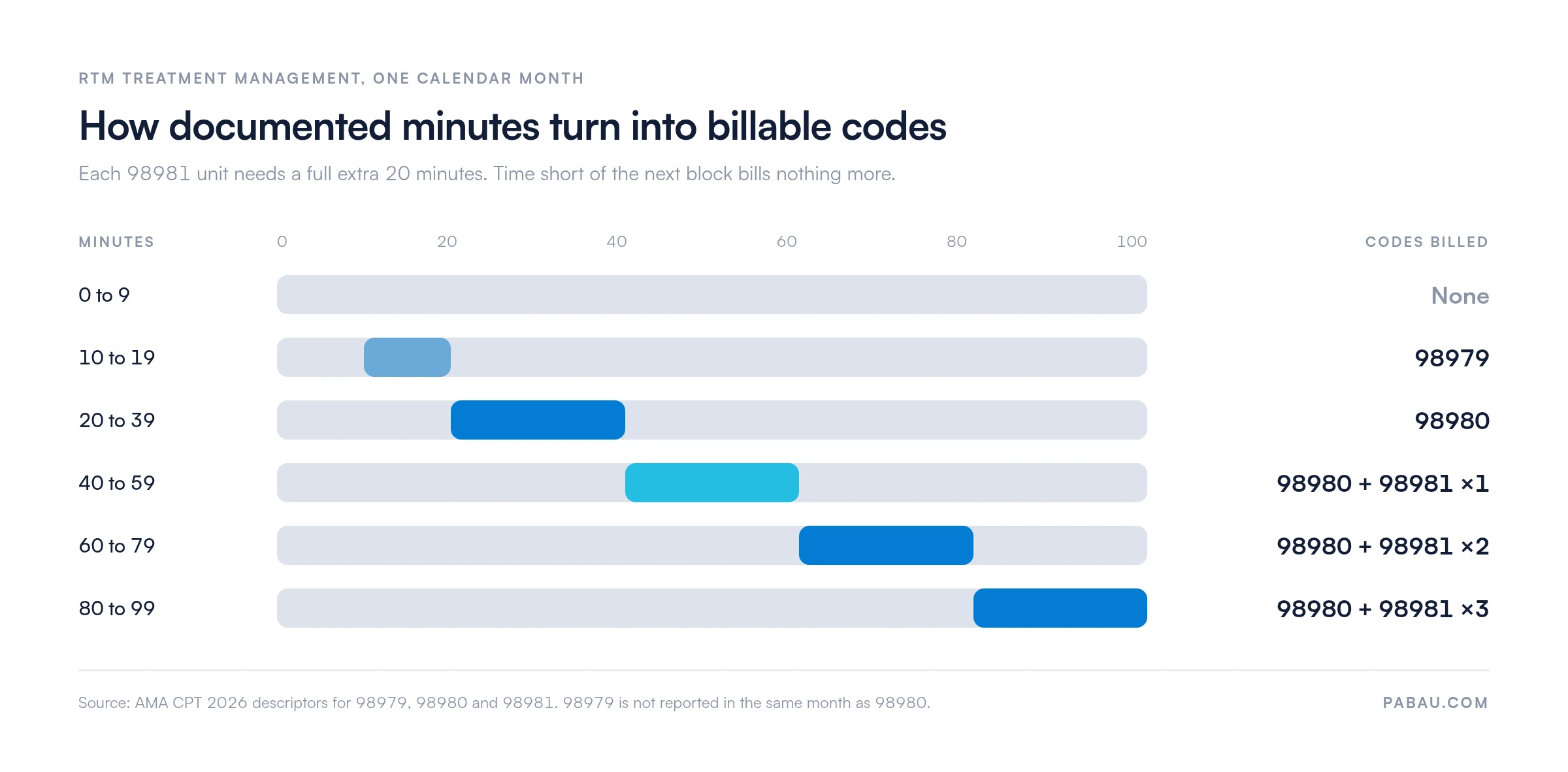
The table below maps total interactive communication time to the correct code combination. Time must be documented in the patient record and attributed to a qualified healthcare professional (QHP), not support staff.
Time below the next 20-minute threshold is not billable as an additional unit. A month totaling 35 minutes bills 98980 once and no units of CPT code 98981, because the remaining 15 minutes do not round up.
Since January 1, 2026, a month with only 10 to 19 minutes of treatment management can bill the new code 98979. It covers the first 10 minutes. The ladder below shows where each threshold falls across the month.
The RTM family covers codes 98975 through 98981, plus 98984 through 98986, which CPT added in 2026. It spans device setup, device data supply, and treatment management. Data supply codes exist for three monitoring categories: respiratory, musculoskeletal, and cognitive behavioral therapy (CBT). CPT code 98981 sits at the treatment management end, alongside 98979 and 98980.
The device supply codes and the treatment management codes are billed in parallel. Both can appear on the same monthly claim when the practice supplies the monitoring device and also delivers management services. The one-time setup and patient education at the start of the program bills under 98975.
Under Centers for Medicare & Medicaid Services (CMS) rules, the following provider types can bill CPT code 98981, subject to state scope-of-practice laws:
CMS RTM guidance for Medicare does not center on speech-language pathologists, clinical psychologists, or clinical social workers. Where one of them delivers monitoring, confirm eligibility in that payer’s RTM policy before billing.
In therapy practices, RTM fits musculoskeletal care well. It covers home exercise adherence, functional activity, and range-of-motion tracking between visits.
Incident-to billing rules can apply when non-physician practitioners furnish RTM services under a physician’s supervision. Medicare’s incident-to requirements differ from commercial payer rules, so confirm the applicable supervision standard before billing under another provider’s NPI.
Billing CPT code 98981 correctly follows a fixed sequence. Missing any step typically results in a denial rather than a correction request.
Underdocumented time is a common denial trigger for RTM claims. Payers audit for every element listed below. A missing item, particularly the interactive communication record, can mean a full denial rather than a partial payment.
Keep a contemporaneous time log. A note written at the end of the month that reconstructs time spent is a red flag in a payer audit. Document each interaction as it occurs, noting the date, duration, and clinical purpose.
Run a monthly pre-billing audit before submitting RTM claims. Pull every patient in your RTM program and check three items. Consent must be recorded, the device type documented, and cumulative time must reach the threshold for each unit billed. Catching missing consent before submission takes seconds. Chasing a denied claim takes days.
CMS sets payment rates for CPT code 98981 annually through the Medicare Physician Fee Schedule (MPFS). Rates vary by geographic location via the Geographic Practice Cost Index (GPCI) and differ between non-facility (office) and facility settings. Non-facility rates are typically higher because the practice bears overhead costs.
Dollar amounts change with each annual MPFS rule. Use the CMS Physician Fee Schedule look-up tool to retrieve current rates for your locality. Enter code 98981, select the applicable year, and filter by your Medicare Administrative Contractor (MAC) locality.
Many commercial payers do not reimburse RTM codes at Medicare rates, and some classify RTM as non-covered altogether. Confirm your contracted rates with each payer before launching an RTM program, since Medicare-based assumptions may not reflect commercial contracts. Solid revenue cycle management habits keep RTM payments tracked, reconciled, and followed up when payers slow-pay or deny.
RTM denials cluster around a handful of consistent errors. The table below maps each denial type to its root cause and the fix that prevents it before the claim goes out. When a remittance does come back denied, the denial code reference explains what each CARC and RARC means.
Effective denial management in healthcare for RTM claims starts at enrollment, long before the remittance arrives. A pre-billing checklist in the monthly RTM workflow catches the common errors before the claim leaves the practice. The clean claim submission standards offer a framework for cutting first-pass denial rates further.
Medicare pays for RTM treatment management codes under the MPFS, subject to MAC LCDs and documentation requirements. Medicare Administrative Contractors (MACs) can add local requirements beyond national CMS guidance, such as diagnosis code lists or documentation thresholds. Check your MAC’s guidance for RTM before billing.
Commercial payer coverage is inconsistent. Many commercial plans still classify RTM as investigational or non-covered. Some payers that cover RTM require prior authorization before the monitoring period begins, and that requirement varies plan by plan, not insurer by insurer. A single insurer may cover RTM on one plan type and exclude it from another.
Payer policies on RTM change from year to year, and coverage can expand or shrink. Re-verify coverage annually at minimum, and again when a patient changes plans.
Remote therapeutic monitoring (RTM) and remote patient monitoring (RPM) are separate code sets. Under the CPT RTM and RPM guidelines, the same monitoring data or service cannot be reported under both RPM and RTM. Confirm how each payer applies that rule before billing both code sets for one patient. Picking the wrong set for the patient’s data type leads to a denial and a resubmission.
The clinical scenario drives the code set. A patient recovering from rotator cuff surgery with a range-of-motion tracking app belongs in RTM. A patient with uncontrolled hypertension sending daily blood pressure readings belongs in RPM, where treatment management bills under 99457 instead.
An RTM program generates paperwork every month. Consent, device data reviews, interactive communications, and time logs all have to reach the record before the claim goes out. Many practices still keep those pieces in spreadsheets and separate inboxes.
Pabau keeps them on the patient record. Digital forms capture consent at enrollment, and clinical notes hold each data review and patient conversation with its date and duration. You record the RTM time and units, and the invoice carries them to the claim.
From there, Pabau turns your invoices into electronic CMS-1500 claims through Claim.MD, which connects to thousands of US payers. It runs real-time eligibility checks before you enroll a patient and tracks claim status and remittances afterward. Your team can spend its time on the denials that need a decision.

Pabau holds RTM consent, notes, and time records on the patient record. It turns invoices into electronic CMS-1500 claims, with real-time eligibility checks and claim status tracking.

CPT code 98981 rewards precise timekeeping. It pays only for full 20-minute blocks on top of 98980, so a contemporaneous log decides how many units a month can support.
Before each billing run, confirm that consent is recorded, 98980 sits on the same claim, and every unit traces to logged time. Re-check payer coverage each year, because commercial RTM policies keep shifting.
Book a demo to see how Pabau keeps RTM consent, notes, and claims together on one patient record.

Tracking time for other care management codes? CCM documentation covers the time and consent records that chronic care management claims need.
Choosing a clearinghouse for RTM claims? How Claim.MD clearinghouse works explains the end-to-end claim submission process from coding through ERA receipt.
Seeing RTM denials you cannot explain? Denial codes in medical billing breaks down CARC reason codes so you can identify the exact rejection cause and correct the claim.
New to billing time-based codes? What is medical billing walks through the claim cycle from charge capture to payment.
CPT code 98981 covers each additional 20 minutes of RTM treatment management in a calendar month. The first 20 minutes bill under CPT 98980. The month must include at least one interactive communication with the patient or caregiver. A physician or other qualified health care professional performs the service.
No. CPT 98981 is an add-on code and cannot appear on a claim without CPT 98980 on the same claim. Submitting 98981 alone is a common RTM denial reason. Payers reject it automatically as an orphaned add-on code.
The AMA descriptor sets no fixed monthly cap. Each unit requires a completed 20-minute block of documented time beyond the initial block. In practice, the documented interactive treatment management time caps the number of billable units. Time short of the next full 20-minute block does not qualify for another unit.
Yes. Medicare pays for CPT code 98981 under the Medicare Physician Fee Schedule (MPFS), subject to MAC policy and documentation requirements. CMS sets payment rates annually and adjusts them by geographic location. Use the CMS Physician Fee Schedule look-up tool for current locality rates, and refresh them after each January 1 update.
Common reasons include billing 98981 without 98980 on the same claim, or documented time that falls short of the claimed 20-minute block. Missing consent, no record of the monitoring data review, and a plan that excludes RTM also trigger denials. Prior authorization errors cause denials with payers that require pre-approval.